

A single mechanical failure in a high-output amplifier during a production cycle isn't just a technical inconvenience; it's a catastrophic breach of professional reliability that can dismantle an entire logistical timeline. You recognize that protecting sensitive signal processors and power amps requires more than a standard container. It demands a precisely engineered environment that accounts for G-force mitigation, thermal dynamics, and structural integrity. For industry veterans, equipment downtime isn't an option when the stakes involve high-value signal chains and rigorous touring schedules.
This guide delivers the technical specifications and engineering standards necessary to select the optimal Amp & Effects Rack Cases for your inventory. You'll master the complexities of ATA 300 Category I construction and the critical importance of EIA-310-E dimensional compliance to ensure seamless interoperability. We will analyze how to mitigate cable strain through proper rack depth selection, optimize airflow for high-output components, and implement standardized logistical truck packs. By the end of this professional guide, you'll have the expertise to maintain zero equipment downtime through superior mechanical isolation and industrial-grade protection.
Key Takeaways
- Learn to evaluate Amp & Effects Rack Cases based on EIA-310-E dimensional standards and ATA 300 Category I engineering specifications for long-term durability.
- Identify when to implement shock-mount architecture versus standard rack builds to protect sensitive signal processors from kinetic impact and vibration.
- Calculate precise rack depth requirements by accounting for chassis dimensions and the necessary clearance for high-performance connectors like XLR and Speakon.
- Implement advanced thermal management strategies, including active cooling and vented paneling, to prevent equipment failure in high-density amplifier racks.
- Optimize logistical efficiency by selecting standardized case dimensions that facilitate uniform truck packs and reduce transit volume.
The Engineering Necessity of Professional Rack Protection
High-stakes production environments leave no margin for equipment failure. When a signal chain collapses during a live event, the financial and reputational fallout is immediate. High-output amplifiers and digital signal processors represent significant capital investments that require more than a simple storage box. They demand a precisely engineered environment. Adherence to the 19-inch rack standard ensures component compatibility, but mechanical protection is where engineering separates professional gear from consumer products.
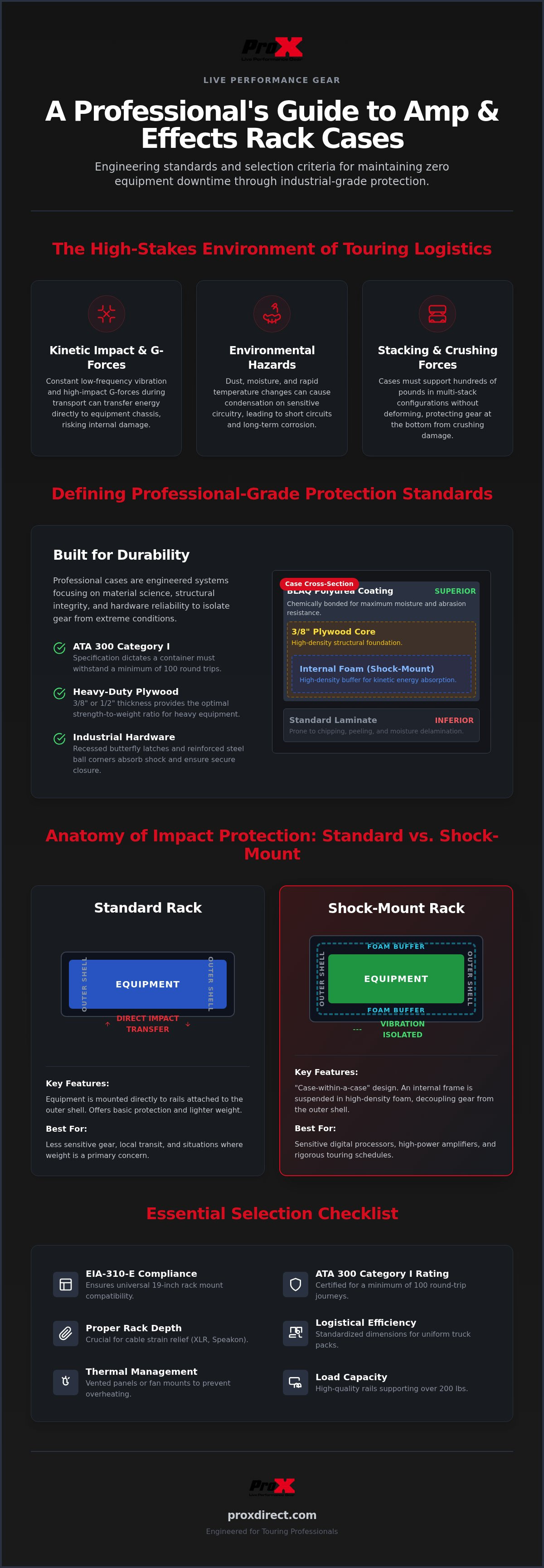
Amp & Effects Rack Cases designed for the touring industry follow the ATA 300 Category I standard. This specification, specifically the A4A Spec 300 Revision 2020.1, dictates that a container must withstand a minimum of 100 round trips. Consumer-grade racks often fail because they prioritize aesthetics over structural rigidity. In contrast, professional builds focus on kinetic energy management and environmental isolation to maintain operational status in extreme conditions.
Analyzing the Risks of Touring Logistics
Truck transport subjects equipment to constant low-frequency vibration and high-impact G-forces. Kinetic energy transfers through the case shell and into the chassis if the internal architecture lacks sufficient dampening. Beyond physical impact, environmental hazards present a constant threat. Dust, moisture, and rapid temperature fluctuations can lead to internal condensation on sensitive circuitry. Professional cases utilize moisture-resistant seals and high-density plywood to maintain a stable internal climate. Structural integrity is also vital during multi-stack configurations. A case must support the weight of several hundred pounds without deforming, protecting the gear at the bottom of the stack from crushing forces.
Defining Professional Grade Protection Standards
Professional protection starts with material science. Using 3/8-inch or 1/2-inch plywood provides the optimal weight-to-strength ratio for heavy-duty use. Advanced coatings, such as BLAQ Polyurea, chemically bond to the wood to provide superior moisture and abrasion resistance compared to traditional laminates. Hardware reliability is another critical factor. Recessed butterfly latches and reinforced steel ball corners are essential for maintaining a secure closure and absorbing shock. Internal rack rails must support distributed loads that often exceed 200 pounds. High-quality Amp & Effects Rack Cases maintain precise rail-to-rail alignment, preventing chassis torque that can lead to internal component failure. For comprehensive inventory management, professionals often source from a diverse range of ProX cases to ensure uniform protection across all gear categories.
Anatomy of Impact Protection: Standard vs. Shock Mount Racks
Professional production environments demand a clear distinction between standard enclosures and shock-isolated systems. Amp & Effects Rack Cases serve as the primary defense against mechanical failure. The internal architecture determines the level of protection provided. A standard rack mounts equipment directly to rails attached to the outer shell. While sufficient for local transit, this configuration doesn't offer the same level of protection against high-frequency vibration as a shock-isolated system. In contrast, shock mount racks utilize a "case-within-a-case" design. This architecture suspends the internal equipment frame within a buffer of high-density foam. It effectively decouples the gear from the outer plywood shell. Precision engineering matters.
Evaluating the efficacy of these systems requires an understanding of mechanical isolation. High-density foam buffers are engineered to absorb kinetic energy before it reaches sensitive internal components. Many professional-grade shock systems are designed with benchmarks similar to MIL-STD-810 testing; these standards assess a container's ability to withstand extreme shock and vibration cycles. For touring professionals managing sensitive digital modelers or high-power amplifiers, the investment in a shock-isolated system is a prerequisite for operational reliability. You can explore a variety of these engineered solutions within the ProX Cases inventory to match your specific protection requirements.
Dual Shock Mount Engineering Explained
Dual shock mount engineering utilizes internal frames that float within high-density foam buffers on all sides. This configuration significantly reduces G-force impact on delicate effects processors and modelers during transit. An ATA 300-compliant shock-mount rack is a specialized enclosure featuring an internal 19-inch steel frame isolated from the outer shell by high-density polyethylene foam to mitigate kinetic energy transfer. This mechanical isolation ensures that the internal chassis remains stable even when the outer shell experiences significant physical trauma. Impact protection is mandatory.
Slam Door vs. Removable Door Configurations
Operational efficiency backstage often dictates the choice between door styles. Slam door designs, also known as hide-away or pocket doors, retract into the sides of the case. This feature is essential in space-constrained environments. Removable doors often create tripping hazards or logistical clutter. Space is a premium. From a structural standpoint, slam doors provide rapid access to rear I/O panels without compromising the case's footprint. However, removable doors often provide a tighter environmental seal. Maintaining these seals is critical for preventing dust and moisture ingress. This prevents component degradation over time.
Selecting the Optimal Rack Depth and Capacity
Precise depth calculation is fundamental to the mechanical integrity of a professional signal chain. Selecting Amp & Effects Rack Cases requires more than matching a specification sheet. You must account for the rear-panel clearance necessary for professional-grade connectors. Standard XLR, Powercon, and Speakon connectors typically require 2.5 to 3 inches of additional space behind the chassis to accommodate a proper bend radius. Forcing cables against the rear door of a shallow case leads to cable strain and intermittent signal failure. It's a common oversight that results in avoidable downtime during production setup.
Adherence to the American National Standard for Shock Testing emphasizes the importance of secure mounting and structural stability. This stability is directly influenced by weight distribution within the rack. When configuring multi-unit amplifier racks, place the heaviest components at the lowest possible rack unit (U) positions. This practice lowers the center of gravity and prevents the rack from becoming top-heavy, which is critical for safety during truck loading and stage positioning. A balanced load reduces the stress on rack rails and ensures the case maintains its geometric alignment over hundreds of transit cycles.
Depth Requirements for Amplifiers vs. Effects
Equipment depth varies significantly across product categories. High-output touring amplifiers often feature deep chassis and heavy transformers, requiring 20-inch or 24-inch rack depths to ensure the rear support brackets can be utilized effectively. Shallow 7-inch or 14-inch cases are better suited for signal processors and wireless receivers. Using an excessively deep case for shallow effects units creates logistical inefficiency and wastes valuable truck space. Balancing rack unit height with logistical portability is essential; a 12U rack might offer more capacity, but two 6U racks often provide better maneuverability and weight management for small crews.
Optimizing Your Inventory with Specialized Solutions
Navigating the variety of available depths allows you to customize your protection strategy based on specific gear requirements. You can browse the full range of ProX Cases Category offerings to find exact matches for your inventory. Whether you need a standard 19-inch depth for general utility or a bespoke 24-inch solution for deep-chassis power amps, selecting the correct depth ensures your connectors remain protected and your signal chain remains uninterrupted. Professional logistical standards rely on this precision to maximize pack efficiency and equipment longevity.
Advanced Thermal Management and Logistical Efficiency
High-power amplifiers convert a significant portion of electrical energy into thermal energy. In high-density Amp & Effects Rack Cases, this heat accumulates rapidly, potentially exceeding the operational temperature limits of internal components. Managing these thermodynamics is critical for long-term reliability. Thermal management involves more than just ventilation; it requires an engineered approach to airflow direction and heat dissipation within an enclosed space. Component failure due to overheating is a preventable risk when the rack architecture prioritizes airflow and thermal stability.
Airflow Optimization in High-Density Racks
Strategic component placement facilitates natural convection. Placing 1U vented panels between high-output amplifiers allows for passive heat exhaust. In deep rack cases, rear-panel heat exhaust is often restricted by cabling and door proximity. Active cooling units, integrated into the rack frame, force air movement across the chassis to maintain stable temperatures. Cable management also plays a role in thermal efficiency. Bundling cables away from exhaust fans prevents air stagnation and reduces the risk of thermal pockets forming behind the equipment. Proper airflow prevents the localized heat buildup that often leads to intermittent digital glitches or power supply failure.
Truck Pack Logistics and Standardization
Logistical efficiency is a primary concern for touring professionals. Standardizing the footprint of your inventory allows for uniform packing within global shipping containers and standard truck widths. Utilizing TruckPaX™ Truck Pack Cases ensures that every unit integrates into a modular grid. This reduces wasted space and prevents equipment movement during transit. A standardized truck pack density allows for predictable loading times and lower logistical costs over the duration of a tour.
Durability is equally important for high-traffic tours. Exclusive BLAQ Polyurea coatings provide a chemical bond to the plywood, offering superior abrasion and moisture resistance compared to traditional laminates. This coating protects the structural integrity of the case against the rigors of frequent loading and unloading. By combining thermal management with standardized logistics, you minimize the risk of equipment failure and maximize operational speed. You can streamline your production workflow by integrating these Amp & Effects Rack Cases into your current inventory.
The ProX Advantage: Engineering for Touring Professionals
Since 1984, the focus has remained on the mechanical integrity of professional production gear. Reliability in high-stakes environments isn't an accident; it's the result of rigorous engineering and a deep understanding of logistical demands. Amp & Effects Rack Cases from ProX reflect this heritage, prioritizing functional excellence over temporary trends. Every component, from the plywood shell to the internal rail systems, undergoes meticulous evaluation to ensure it meets the physical demands of global touring. This long-term expertise provides a steady, dependable foundation for professionals who can't afford equipment failure.
Quality control is a fundamental aspect of the manufacturing process. Impact testing protocols simulate the extreme conditions of air freight and long-haul trucking. These tests verify the effectiveness of shock-mount designs and the durability of polyurea coatings. By adhering to these standards, we ensure that every case provides a consistent level of protection against kinetic energy transfer. This meticulous approach to material science and mechanical assembly reinforces the brand's position as an authoritative guide for industry professionals.
Bespoke Solutions: Santosom and ZCASE
Standardized cases fit many needs, but complex signal chains often require specialized architecture. The partnership with Santosom and ZCASE in Poland provides access to European-made precision for bespoke builds. These solutions cater to high-value consoles and sensitive electronics that require custom-engineered isolation. Santosom Cases represent a commitment to engineering excellence, ensuring that even the most non-standard equipment dimensions receive the same level of protection as industry-standard 19-inch units. This collaboration allows for the creation of workstations and rack systems tailored to specific logistical and technical requirements.
Maintenance and Long-Term Reliability
Ensuring longevity requires a structured approach to equipment care. Routine inspection of recessed latches, handles, and internal rack rails is essential for maintaining the mechanical integrity of the enclosure. When hardware shows signs of wear, utilizing authentic ProX Cases Replacement Parts allows for seamless restoration of protection levels. Maintaining these standards prevents the structural degradation that can lead to equipment failure in high-traffic environments. Serviceability is a key differentiator for gear designed to last through multiple tour cycles.
The global dealer network provides professional support and technical guidance for inventory management. Protecting high-value amplifiers and signal processors is a meticulous engineering challenge that requires a reliable partner. Explore our full range of Amp & Effects Rack Cases to secure your professional inventory with industry-standard reliability and functional excellence.
Securing Your Production Inventory for Long-Term Reliability
Maintaining the integrity of a high-value signal chain requires a commitment to engineering precision. You've learned that selecting the correct Amp & Effects Rack Cases involves more than just matching rack unit heights. It requires precise depth calculations for connector clearance and advanced thermal management to prevent component fatigue. Implementing shock-mount architecture and standardized logistical footprints ensures your equipment remains operational through the most rigorous touring cycles. These technical standards provide the difference between a successful production and a catastrophic system failure.
ProX has been manufacturing engineering performance gear since 1984. Our commitment to ATA 300-style rugged construction provides the structural backbone necessary for modern production professionals. By utilizing our global professional dealer network, you gain access to the technical expertise required to optimize your entire equipment inventory. Industrial-grade protection is a prerequisite for any high-stakes environment where downtime is not an option. Don't leave your signal chain's survival to chance when proven engineering solutions are available.
Browse the Professional Amp & Effects Rack Case Collection and invest in the durability your gear deserves.
Frequently Asked Questions
What is the difference between a standard rack and a shock mount rack case?
A shock mount rack utilizes a case-within-a-case architecture where the internal equipment frame floats within high-density foam buffers. This mechanical isolation decouples the gear from the outer plywood shell; it significantly reduces G-force impact and vibration during transit. In contrast, standard Amp & Effects Rack Cases mount equipment directly to rails attached to the outer structure. While standard racks provide structural protection, shock mount systems are essential for sensitive digital electronics and high-value touring amplifiers.
How much extra depth should I allow for cables in my rack case?
You should allow a minimum of 2.5 to 3 inches of clearance behind the equipment chassis to accommodate professional connectors and cable bend radii. Forcing high-density cables against the rear door of a shallow case leads to cable strain and intermittent signal failure. When selecting Amp & Effects Rack Cases, always calculate the total depth by adding this connector clearance to the physical depth of your deepest component. This practice ensures long-term reliability for XLR and Speakon connections.
Can I stack different sizes of ProX rack cases safely?
Stacking is safe when utilizing cases with standardized footprint dimensions. ProX designs many enclosures, such as TruckPaX™ Truck Pack Cases, to facilitate uniform stacking and efficient truck pack density. You must ensure that the heaviest units are positioned at the bottom to maintain a low center of gravity. Reinforced steel ball corners and precise alignment allow for secure multi-stack configurations; this is critical for safety during loading and global shipping logistics.
Are these rack cases compliant with ATA 300 shipping standards?
ProX engineers cases to meet or exceed ATA 300 Category I construction standards. This specification dictates that a container must withstand a minimum of 100 round trips in high-intensity transit environments. The build process utilizes high-density plywood, recessed hardware, and reinforced corners to ensure equipment longevity. These standards are verified through rigorous impact testing protocols; they provide the structural integrity required by professional production companies and touring professionals worldwide.
What are the benefits of BLAQ Polyurea coating for touring gear?
BLAQ Polyurea is an industrial-grade coating that chemically bonds to the plywood shell of the case. It provides superior resistance to abrasion, moisture, and impact compared to traditional laminates. This coating is ideal for high-traffic touring gear as it prevents the structural degradation often caused by frequent loading and exposure to harsh environments. The result is a more durable enclosure that maintains its professional appearance and mechanical integrity over multiple tour cycles.
How do I determine the correct Rack Unit (U) height for my equipment?
Rack height is measured in standardized Rack Units (U), where 1U equals 1.75 inches or 44.45 mm. To determine the correct height for your Amp & Effects Rack Cases, sum the U-height of all components and include additional space for thermal management. Leaving 1U gaps for passive airflow or active cooling panels is a recommended engineering practice for high-output amplifiers. Always verify the vertical clearance of your signal processors before finalizing your rack capacity requirements.
What is a slam door rack and when should I use one?
A slam door rack features doors that retract into the sides of the case; these are also known as pocket or hide-away door systems. You should use this configuration in space-constrained environments, such as narrow backstage corridors or crowded side-stage areas. This design eliminates the logistical clutter of removable doors and reduces tripping hazards. While slam doors improve operational efficiency, they maintain the same level of structural protection as traditional removable door configurations.
Do ProX rack cases include mounting hardware like screws and washers?
Most ProX rack enclosures include a set of mounting screws and plastic washers to facilitate immediate equipment installation. The specific quantity depends on the Rack Unit (U) capacity of the case. If you require additional hardware for high-density setups or custom configurations, ProX Cases Replacement Parts include a comprehensive range of rack screws and nuts. Using high-quality mounting hardware ensures that your equipment remains securely attached to the internal rails during high-vibration transit.
Disclaimer
Any trademarks, trade names or brand names appearing herein that do not belong to ProX are the property of their respective owners and/or companies, and such appearance doesn't and shall not constitute or imply endorsement, sponsorship or recommendation by ProX.


