

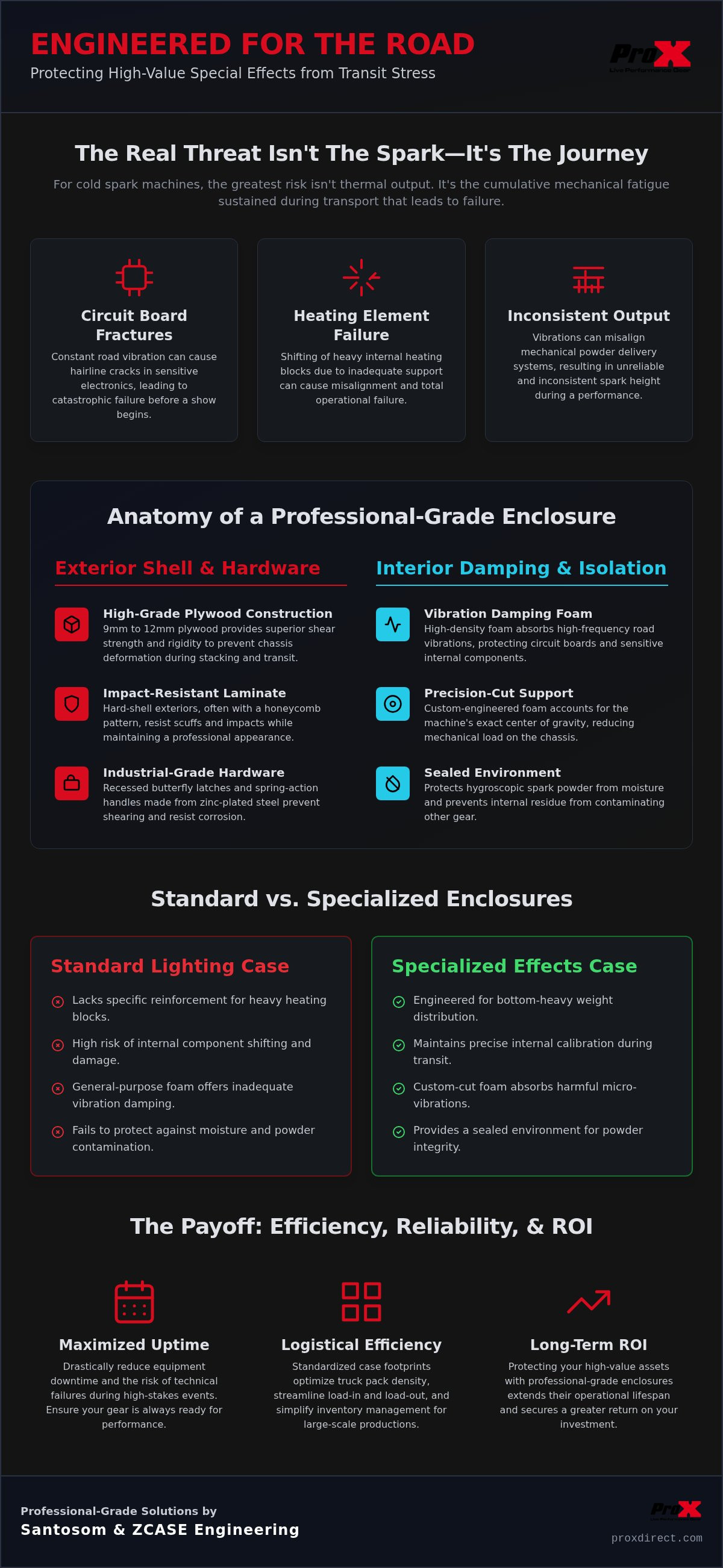
The most significant threat to a cold spark machine isn't the thermal output of the effect, but the cumulative mechanical fatigue sustained during transit. A single hairline fracture in a circuit board caused by road vibration can turn a high-stakes event into a technical failure before the first spark ever fires. In the professional production industry, you recognize that the physical integrity of internal electronics is just as critical as the output of the effect itself. Selecting a precision-engineered cold spark machine flight case is a necessary technical decision to protect sensitive components from the mechanical stresses of long-haul touring.
You understand that equipment downtime is an unacceptable risk when performance schedules are tight. This article demonstrates how to secure your high-value special effects with touring cases designed for maximum durability and logistical efficiency. We'll examine the structural advantages of Santosom and ZCASE manufacturing, focusing on how standardized dimensions improve truck pack density and how ruggedized hardware ensures a long-term ROI. This overview provides the technical data needed to maintain equipment safety and ensure your gear meets the physical demands of high-frequency professional use.
Key Takeaways
- Learn how specialized enclosures protect sensitive heating elements and internal electronics from the mechanical fatigue of road transport.
- Identify the structural requirements for a high-performance cold spark machine flight case, including high-grade plywood thickness and advanced damping foams.
- Understand how standardized case footprints optimize truck pack efficiency and reduce load-in times using multi-unit configurations.
- Discover critical maintenance protocols for moisture control and hardware longevity to ensure consistent performance in high-stakes environments.
- Leverage the precision of Santosom and ZCASE engineering to secure a long-term ROI through professional-grade manufacturing standards.
Engineering Protection for Special Effects Electronics
A cold spark machine flight case is a specialized technical enclosure engineered for the mechanical isolation of pyrotechnic-simulating electronics. Unlike standard lighting fixtures, cold spark machines integrate high-wattage heating elements and mechanical powder delivery systems that require precise internal support. Standard lighting cases often lack the specific architectural reinforcement needed to prevent these heating blocks from shifting during high-G transport. If these internal components lose calibration, the machine may suffer from inconsistent spark height or total heating element failure.
The structural requirements for these machines are distinct because they are typically bottom-heavy, with internal transformers and heating blocks concentrated at the base. This weight distribution places extreme stress on the case floor and mounting hardware. High-performance enclosures utilize ATA 300-style standards to ensure the unit survives the rigors of frequent air and ground transport. When evaluating flight case construction and materials, industry professionals prioritize 9mm to 12mm plywood and recessed hardware to withstand external impacts while maintaining the integrity of the internal cargo.
Why Special Effects Gear Requires Dedicated Enclosures
Micro-vibrations present a constant threat to the internal calibration of special effects equipment. Within a cold spark machine flight case, the internal foam must be dense enough to prevent lateral movement but compliant enough to absorb high-frequency road vibration. These vibrations can loosen agitator assemblies or compromise the seals of the powder hopper. Spark powder is also inherently abrasive and hygroscopic. A dedicated enclosure provides a sealed environment that prevents atmospheric moisture from clumping the powder while keeping internal residue from contaminating other equipment in the truck pack.
Standard vs. Custom Engineering for Production Gear
Selecting between a universal fit and a bespoke Santosom design depends on the specific frequency of deployment and the value of the equipment. While universal ProX Cases provide excellent general-purpose protection, custom-engineered Santosom solutions utilize precision-cut foam that accounts for the machine's exact center of gravity. This precision reduces the mechanical load on the machine's chassis during transit. Engineers must balance the total weight of the enclosure with the necessary structural reinforcement, identifying high-stress points at the casters and corners where the most kinetic energy is absorbed during load-in and load-out procedures.
Structural Specifications: Plywood, Hardware, and Damping Foams
The mechanical integrity of a cold spark machine flight case depends on the interaction between its rigid exterior and its energy-absorbing interior. For equipment in this weight class, 9mm to 12mm high-grade plywood provides the necessary shear strength to prevent chassis deformation during stacking. Unlike budget alternatives that use thin particle boards or plastic shells, professional-grade plywood construction maintains its squareness even when subjected to the torsional forces of a moving truck. This rigidity is reinforced by hard-shell laminate exteriors, often featuring honeycombed patterns that increase impact resistance while providing a professional, scuff-resistant finish.
Industrial-grade hardware is non-negotiable for touring environments. Recessed butterfly latches and spring-action handles are essential for maintaining a low profile, preventing the hardware from shearing off during tight loading sequences. These components must be manufactured from zinc-plated steel to provide maximum corrosion resistance, especially when equipment is exposed to the humidity of outdoor venues. Adhering to PLASA industry safety standards ensures that structural failures do not compromise venue safety or equipment longevity. For those managing complex inventories, investing in ProX Cases built with these specifications ensures that your logistical chain remains unbroken by hardware failure.
Vibration damping is the primary defense for sensitive internal heating elements and circuit boards. A sophisticated cold spark machine flight case utilizes a multi-stage foam architecture. This involves a combination of high-density Polyethylene (PE) foam for structural support at the base and softer Ethylene-vinyl acetate (EVA) foam for lateral shock absorption. This dual-layer approach filters out high-frequency vibrations that can loosen internal electrical connections or damage the precision motors responsible for spark powder agitation.
Material Science in Professional Case Design
Laminated surfaces do more than provide aesthetics; they create a tensioned skin that prevents the underlying plywood from warping in varying temperatures. Cases exceeding 50 lbs require a minimum plywood thickness of 9mm to maintain structural integrity under high-G loading. The use of zinc-plated steel for all rivets and braces prevents the electrochemical corrosion that occurs when dissimilar metals are exposed to moisture, ensuring the case remains a reliable asset for years of service.
Internal Compartmentalization and Accessory Storage
Efficient case design accounts for the entire workflow, not just the machine. Dedicated compartments for power cables and sealed containers of spark powder prevent these items from coming into contact with the machine's cooling fans during transit. Custom-cut foam inserts lock the machine into a neutral position, eliminating internal shifting that causes surface abrasions. Choosing a hinged lid design over a lift-off style is often preferred for fast-paced events, as it keeps the lid off the floor and reduces the footprint in cramped backstage areas.
Optimizing Logistics: Multi-Unit Configurations and Truck Pack Efficiency
Logistical efficiency in professional production is measured by the density of the truck pack and the speed of the load-out. A cold spark machine flight case must do more than isolate sensitive electronics; it must conform to standardized dimensions that allow for seamless integration into a transport grid. Most professional touring trailers and box trucks utilize internal widths of either 90 inches or 96 inches. Cases designed with footprints that are multiples of 22.5 inches or 24 inches allow for "three-abreast" or "four-abreast" packing. This eliminates dead air between cases, preventing the lateral shifting that leads to structural damage during long-haul transit.
Selecting the right multi-unit configuration is a balance between crew efficiency and manageable weight. Comparing 2-in-1, 4-in-1, and 6-in-1 configurations reveals distinct operational advantages. A 4-in-1 cold spark machine flight case is often the industry standard for mid-sized tours because it reduces the total number of individual items to track while keeping the loaded weight within the capacity of a standard ramp or liftgate. These multi-unit enclosures often feature internal dividers that provide secondary structural reinforcement to the case walls, ensuring the enclosure remains square even when stacked three high.
Vertical storage stability is maintained through the use of heavy-duty stacking dishes. these steel recesses are bolted through the lid and aligned precisely with the casters of the case above. This mechanical interlocking system is essential for maintaining a safe environment during transport and within the warehouse. By maximizing vertical space, production companies can significantly lower logistical costs by reducing the total number of vehicles required for a tour.
TruckPaX™ and Logistical Density
Standardizing your special effects inventory around specific dimensions accelerates the load-out process by removing the guesswork from the packing order. Integrating spark machine cases with existing TruckPaX™ Truck Pack Cases ensures that every piece of gear in the inventory shares a common logistical language. This compatibility allows for tighter packs and more predictable floor space calculations when deploying large special effects arrays for stadium-level events.
Caster Selection for Heavy Production Loads
The mobility of a fully loaded multi-unit case depends entirely on caster quality. For the 2026 touring season, 4-inch blue polyurethane wheels remain the industry standard due to their high load-bearing capacity and non-marking properties. These casters must be mounted to 18mm birch caster boards to prevent the bolts from pulling through the case floor under high-G loads. Total-lock brakes are a critical safety requirement for managing heavy special effects gear on inclined loading ramps. Regular maintenance of the caster plates, including checking for rivet tightness and lubricating the swivel bearings, is necessary to prevent structural failure and ensure smooth movement across varied venue flooring.
Environmental and Mechanical Maintenance for Special Effects Cases
Maintaining a cold spark machine flight case is essential for preserving the reliability of the enclosed special effects electronics. While the exterior plywood and laminate provide structural defense, the internal environment must be actively managed to prevent equipment degradation. Spark powder is inherently hygroscopic, meaning it attracts atmospheric moisture. If moisture penetrates the enclosure, it can lead to powder clumping and subsequent mechanical blockages within the machine's delivery system. Regular inspection of the gasket seals and case closure alignment is the first line of defense against environmental contamination.
Mechanical maintenance focuses on the hardware that facilitates transport and security. After outdoor events, latches and hinges often accumulate dust and grit that can cause binding or accelerated wear. Cleaning these components with compressed air followed by a light application of dry industrial lubricant ensures smooth operation. Casters require similar attention; identifying flat spots or bearing noise early prevents catastrophic failure on a loading ramp. Replacing worn components with ProX Cases Replacement Parts allows production teams to maintain their fleet at factory specifications without the cost of total case replacement.
The Maintenance Framework for Touring Gear
Post-show inspection routines are critical for special effects crews managing high-frequency tours. These checks should include a thorough examination of the internal foam architecture to identify degradation from chemical residue or mechanical compression. To clean powder residue from internal foam without damaging the adhesive, use a high-powered vacuum and a dry, soft-bristled brush to lift particles from the pores. Consistent foam integrity is necessary to ensure the vibration-damping properties of the cold spark machine flight case remain effective over multiple years of service.
Preparing for Extreme Weather and Storage
Extreme weather conditions require proactive storage strategies. In high-humidity environments, the use of industrial-grade desiccant packs within the case can mitigate the risk of corrosion on internal circuit boards and heating elements. For long-term storage, cases should be kept in climate-controlled facilities to prevent the plywood from absorbing moisture and warping. For a comprehensive overview of fleet management, refer to The Ultimate Maintenance Checklist for Touring Road Cases to ensure every enclosure in your inventory remains structurally sound.
Ensure your equipment survives the rigors of the road by sourcing professional-grade replacement hardware and accessories to maintain your specialized enclosures.
Professional Grade Solutions: The ProX Advantage in Special Effects Protection
ProX has been engineering performance gear since 1984, establishing a legacy of technical authority in the production industry. This experience is evident in the design of every cold spark machine flight case, where the focus remains on structural integrity rather than cosmetic appeal. By prioritizing functional excellence, the brand provides a reliable backbone for special effects operators who cannot afford equipment failure during a performance. The manufacturing partnerships with Santosom and ZCASE further reinforce this position, offering professional-grade manufacturing standards that meet the rigorous demands of global touring.
The collaboration with Santosom brings precision-cut internal architectures to the forefront, ensuring the cold spark machine flight case provides exact mechanical isolation for sensitive pyrotechnic-simulating electronics. This technical synergy ensures that every enclosure is a result of meticulous engineering and seasoned industry expertise. For production managers, this means access to an exhaustive range of solutions that address the practical realities of professional gear transport, from moisture control to vibration damping.
Bespoke Engineering for High-Value Gear
Tier 1 tours often require more than off-the-shelf protection. ZCASE Custom Build Cases are engineered to provide specialized enclosures for unique special effects configurations. This design-to-build process ensures that every internal component is secured against the specific G-forces encountered during transport. These custom solutions are designed for high-level integration with AV Broadcasting Cases, creating a cohesive logistical system that simplifies warehouse management and truck packing. This level of customization allows for the protection of non-standard machine sizes while maintaining the logistical benefits of a uniform truck pack.
Next Steps: Scaling Your Production Fleet
Scaling an inventory requires access to a reliable supply chain. Through a global dealer network, production companies can rapidly acquire additional inventory to meet the needs of expanding tour schedules. When analyzing the initial flight case price, it's critical to factor in the long-term ROI provided by durable hardware and reduced equipment maintenance costs. Cheap alternatives often lead to higher costs through frequent repairs and potential damage to high-value internal electronics. For production managers in 2026, the final recommendation is to standardize special effects protection around engineering-grade enclosures that provide consistent mechanical isolation and logistical efficiency. Contacting a local dealer allows for a detailed evaluation of your current fleet and the identification of the most efficient path for scaling your special effects capabilities.
Securing the Future of Special Effects Production
Professional production requires more than just functional equipment; it demands a logistical strategy that prioritizes the mechanical integrity of every asset. Implementing a precision-engineered cold spark machine flight case ensures that sensitive internal heating elements and circuit boards remain calibrated through the most demanding touring schedules. By standardizing your inventory with ruggedized ATA 300-style construction, you reduce the risk of technical failure while maximizing truck pack density. This approach transforms equipment protection from a passive necessity into a proactive operational advantage.
ProX has provided engineering precision since 1984, delivering the structural reliability trusted by major global touring brands. Protecting your high-value gear with industrial-grade enclosures is a technical investment in the longevity of your special effects fleet. These cases provide the essential defense against mechanical fatigue and environmental moisture that can compromise performance consistency. While you focus on gear protection, remember that venue safety is paramount; for those managing permanent installations, the option to buy fire sprinkler heads online ensures that your fire suppression systems are always ready for a high-stakes show. Take the next step in optimizing your production workflow with hardware designed for the practical realities of the road.
Browse Professional ProX Cases for Special Effects
Frequently Asked Questions
What is the best case configuration for a mobile DJ with two cold spark machines?
A 2-in-1 configuration with a central accessory compartment is the most efficient choice for mobile DJs. This setup allows for a balanced load that stays under the weight limits of standard lifting procedures while keeping all necessary cables and controllers in one place. It's essential to select a cold spark machine flight case with a compact footprint to ensure it fits easily into smaller transport vehicles without sacrificing the structural protection of the internal electronics.
Can I store spark powder inside the flight case during transport?
Spark powder should only be stored inside the case if it remains in a sealed, moisture-proof container within a dedicated compartment. Loose powder or open bags pose a risk of abrasive dust entering the machine's cooling fans or sensors during transit. Maintaining powder integrity is critical because moisture absorption leads to clumping, which can cause mechanical blockages in the delivery system during a high-stakes performance.
How do I ensure my cases meet ATA 300-style standards for air travel?
To meet ATA 300-style standards, the enclosure must utilize high-grade plywood of at least 9mm thickness and feature recessed, heavy-duty hardware. These specifications ensure the case survives the impact and torsional stresses of air travel. Category 1 compliance specifically requires the case to maintain its structural integrity over 100 round-trip shipments. Always check that the rivets and corner braces are manufactured from zinc-plated steel to prevent corrosion during long-term use.
What is the difference between PE and EVA foam for electronic equipment?
PE foam provides rigid structural support while EVA foam offers superior shock absorption for sensitive electronic components. Polyethylene (PE) is a high-density, closed-cell material that prevents the machine from shifting vertically or horizontally. Ethylene-vinyl acetate (EVA) is more compliant and filters out the high-frequency vibrations that can loosen internal electrical connections. A professional cold spark machine flight case integrates both materials to create a multi-stage damping system for maximum protection.
Are caster wheels necessary for a 2-unit cold spark machine case?
Caster wheels are highly recommended because a loaded 2-unit case typically exceeds the 60-pound threshold for safe individual lifting. While a case without wheels might save vertical space, the lack of mobility increases the risk of chassis damage from being dragged or dropped. Using 4-inch polyurethane casters ensures smooth transit across venue floors and loading ramps, significantly reducing the physical strain on production crews during tight load-in schedules.
How do I prevent my cases from smelling like burnt powder after a show?
Vacuuming the machine’s exterior and allowing the heating element to cool completely before casing is the best way to prevent odors. Residual powder is hygroscopic and can trap scents if enclosed while still warm. Including a desiccant pack or an activated carbon sachet inside the enclosure helps manage atmospheric moisture and neutralize any lingering sulfur-like smells. This maintenance routine also prevents the internal foam from absorbing chemical residues over time.
Can these cases be stacked with standard lighting or audio cases?
Stacking is possible and encouraged if the cases adhere to standardized logistical footprints like those found in the TruckPaX™ line. Compatibility depends on the alignment of the stacking dishes with the casters of the enclosure above. Standardizing your inventory around 22.5-inch or 24-inch widths ensures that special effects gear integrates seamlessly with lighting and audio cases, creating a stable and dense truck pack that prevents lateral movement during transit.
What should I do if a latch becomes difficult to close on tour?
If a latch binds, you should first clear any grit with compressed air and apply a dry industrial lubricant. Latches often become difficult to operate due to mechanical fatigue or small misalignments caused by impact. If the hardware shows signs of structural deformation or the rivets have loosened, you must replace the component with professional-grade replacement parts. Maintaining functional hardware is vital for keeping the enclosure sealed against moisture and securing the equipment inside.
Disclaimer
Any trademarks, trade names or brand names appearing herein that do not belong to ProX are the property of their respective owners and/or companies, and such appearance doesn't and shall not constitute or imply endorsement, sponsorship or recommendation by ProX.


