

What if the standard 19 inch rack configuration is actually the least important factor in your equipment's survival during a cross-country tour? For production professionals, the integrity of Amp & Effects Rack Cases depends less on the fit of the front rails and more on the engineering of the internal environment. High-performance signal processors and power amplifiers generate significant thermal loads. Without precise airflow management, enclosed racks become heat traps that accelerate component failure. You likely understand that a rack is more than a box; it's a critical piece of mechanical infrastructure that must mitigate high-impact vibrations and logistical inconsistencies during transit.
This article will master the technical requirements for professional rackmount protection, from specialized shock-mount engineering to advanced thermal management strategies. We will provide a methodical overview of how to maximize equipment lifespan while ensuring standardized truck pack dimensions for efficient transport. You'll learn to optimize your signal chain by prioritizing rear-panel accessibility and choosing the correct rack depths to eliminate logistical headaches during complex setups. By focusing on engineering precision and material science, you can ensure your gear remains operational in high-stakes environments where failure is not an option.
Key Takeaways
- Understand how precision-engineered structural integrity protects sensitive signal processors and high-wattage power amplifiers from high-impact transit forces.
- Learn to match specific hardware requirements to technical specifications, including the selection of Amp & Effects Rack Cases with depths ranging from 7 to 24 inches.
- Evaluate the operational benefits of Slam Door technology, which streamlines setup efficiency and eliminates the logistical risks associated with traditional removable lids.
- Master the principles of thermal management and airflow optimization to prevent equipment failure while standardizing case dimensions for maximum truck pack efficiency.
The Engineering of Professional Amp & Effects Rack Cases
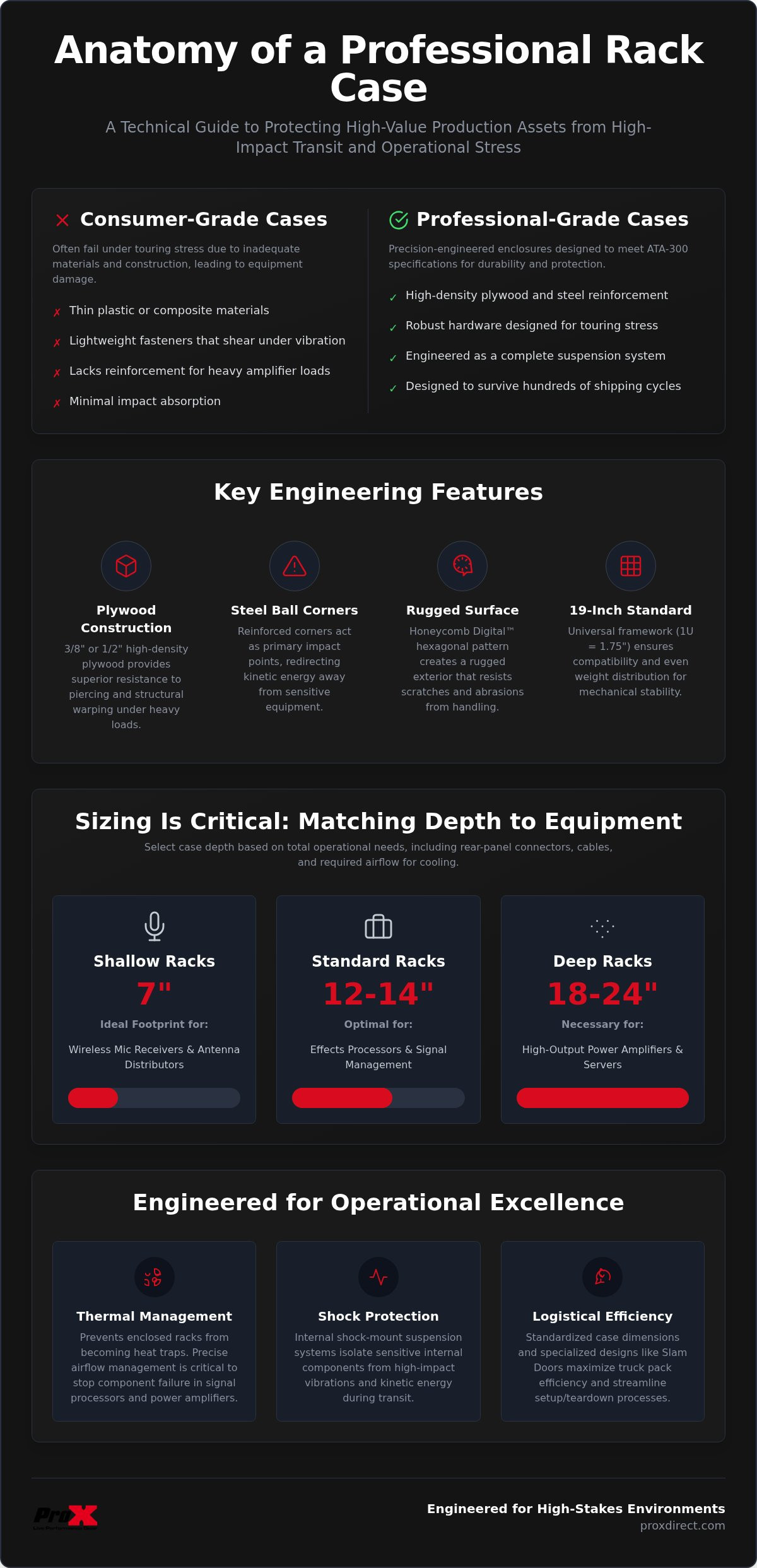
Professional-grade Amp & Effects Rack Cases are precision-engineered enclosures designed to maintain the mechanical and electrical integrity of high-value production assets. While consumer-grade alternatives often rely on thin plastic or composite materials, professional racks utilize high-density plywood and steel reinforcement. These structures must withstand the extreme physical stressors of global touring. The ATA-300 specification serves as the benchmark for this performance, requiring cases to survive hundreds of shipping cycles without compromising the internal contents. For sensitive signal processors and heavy amplifiers, structural rigidity is a functional necessity rather than a luxury. Consumer-grade racks often fail under the stress of professional touring because they lack the structural reinforcement required for heavy amplifier loads. These inferior products typically use lightweight fasteners that shear under vibration, leading to rack rail detachment and equipment damage. Professional engineering treats the case as a complete suspension system, prioritizing functional excellence over reduced weight.
The Role of the 19-Inch Rack Standard
The 19-inch rack standard provides a universal framework for mounting professional audio and video equipment. This system uses the Rack Unit (RU or U), equivalent to 1.75 inches in height, to ensure a consistent vertical footprint. Horizontal alignment is critical for mechanical stability. When gear is secured across multiple points, the rack frame distributes the weight evenly, preventing torque from damaging internal circuit boards or connectors. This standardization ensures that signal processors from different generations and manufacturers remain compatible within a single enclosure. It allows engineers to build modular systems that are easy to service and reconfigure as production needs evolve.
Anatomy of a High-Performance Case
Material selection defines the protective capabilities of a professional rack. Most touring-grade Amp & Effects Rack Cases utilize 3/8 inch or 1/2 inch plywood. This thickness provides the necessary density to resist piercing and structural warping under heavy loads. Surface integrity is further enhanced by Honeycomb Digital™ designs. This hexagonal pattern isn't merely aesthetic; it creates a rugged exterior that resists scratches and abrasions during frequent handling. Impact absorption is managed through reinforced steel ball corners. These components act as the primary contact points during a fall, redirecting kinetic energy away from the case panels and toward the reinforced frame. This engineering approach ensures that high-impact vibrations don't reach the delicate components of an amplifier or processor, preserving the equipment's lifespan and reliability.
Technical Specifications: Depth, Ply, and Shock Mounting
Selecting the correct Amp & Effects Rack Cases involves a rigorous assessment of spatial requirements and material durability. Standardized depths are not arbitrary; they correspond to specific hardware categories. A 7-inch shallow rack provides the ideal footprint for wireless microphone receivers and antenna distributors. Conversely, a 24-inch depth is necessary for high-output power amplifiers with extensive rear-panel cooling assemblies. The engineering priority is to provide a secure environment where mechanical stress is minimized during every phase of transport and operation.
Calculating Required Case Depth
Engineers must distinguish between the equipment's physical chassis depth and its total operational depth. While an effects processor might measure 10 inches, the inclusion of XLR connectors and power cables necessitates a 12 or 14-inch rack depth. Standard effects configurations typically require 12 to 14 inches to allow for cable management without stress on the ports. Touring amplifiers often demand 18 to 24 inches to accommodate heavy-duty power supplies and facilitate adequate ventilation. Shallow racks have become essential for wireless arrays, where minimizing the logistical footprint is a priority for mobile production teams.
The Mechanics of Shock Protection
Shock mounting is a mechanical suspension strategy designed to isolate internal components from external kinetic energy. Traditional foam-lined interiors provide basic dampening, but professional signal processors often require internal rail suspension systems. These systems utilize a floating internal frame secured by high-density rubber shock absorbers. This design allows the entire equipment stack to move independently of the outer shell during impact. G-force attenuation in this context refers to the reduction of peak acceleration forces transmitted to the equipment through the mechanical energy absorption of the suspension system. For high-value processors or delicate tube-based gear, dual shock mount engineering provides a secondary layer of isolation, ensuring that transit vibrations don't compromise internal circuitry.
Material science has evolved beyond traditional plywood laminates. While 3/8 inch or 1/2 inch plywood remains the structural standard, specialized coatings like BLAQ Polyurea offer superior weight-to-strength ratios. This industrial-grade finish provides an airtight, waterproof seal that is significantly more durable than standard PVC laminates. It resists the chemical and physical degradation common in high-humidity environments or rigorous touring schedules. Professional engineers prioritize these materials because they provide maximum protection without adding unnecessary mass to the truck pack. You can evaluate the full range of technical specifications for these high-performance enclosures by browsing the available Amp & Effects Rack Cases to find the exact depth and protection level for your inventory.
Specialized Rack Designs: Standard vs. Slam Door Systems
The selection of an enclosure's access mechanism directly impacts logistical efficiency and stage footprint. While traditional removable lids remain the industry standard for many Amp & Effects Rack Cases, they present significant challenges in cramped environments like narrow Front of House (FOH) positions or crowded stage wings. Detached lids require dedicated floor space and are prone to misplacement during high-pressure load-ins. Integrated door systems address these operational hurdles by maintaining a self-contained footprint throughout the production cycle. This engineering choice prioritizes functional speed and reduces the chaos often found at the technician's workstation during setup.
Slam Door Engineering and Benefits
Slam Door technology utilizes a precision-engineered track system that allows the door to slide into a recessed compartment within the case body. This design eliminates the need for external lid storage, effectively reducing the logistical footprint of the rack on stage. The mechanical integrity of these systems depends on high-tolerance sliding tracks and heavy-duty hinges designed for repeated cycles. By retracting the door into the chassis, engineers gain immediate access to front-panel controls without obstructing walkways or sightlines. This configuration also improves side-access for heat dissipation and maintenance. The internal rails are no longer blocked by a protruding lid frame, allowing for better lateral airflow. Durability testing ensures that the sliding mechanism remains functional despite the accumulation of road dust or the high-impact vibrations inherent in touring.
Wireless and Signal Management Racks
Specialized rack designs often incorporate additional features for complex signal chains, such as antenna distribution and front-facing XLR patch bays. In these configurations, the integration of 2U or 4U drawers provides essential storage for transmitters, cables, and tools directly within the rack environment. This modularity ensures that all components of a specific signal processor or wireless array remain together during transport. For production teams managing complex signal paths, you can Explore AV Broadcasting Cases for specialized signal needs to find enclosures designed for high-density patch management. These specialized designs prioritize organization and accessibility, reducing the time required for troubleshooting and system deployment. By centralizing connectors and storage, these racks minimize the risk of cable failure and lost peripherals in the field.
Thermal Management and Logistical Efficiency
High-wattage power amplifiers convert a significant portion of electrical energy into waste heat. In enclosed Amp & Effects Rack Cases, this thermal load can quickly exceed the safe operating temperature of sensitive signal processors. Engineering a rack requires a balance between physical security and thermodynamic stability. Heat failure is a leading cause of equipment downtime in professional production. Proper management involves more than just leaving the lids off; it requires a calculated approach to airflow and internal component placement. Beyond thermal concerns, the physical dimensions of the enclosure dictate the efficiency of the entire transport operation. Standardizing your rack inventory ensures a predictable logistical footprint, reducing the time and labor required for complex load-ins.
Heat Dissipation in Enclosed Racks
Thermal management begins with the strategic placement of equipment within the rack frame. Power amplifiers, which generate the most heat, should ideally be positioned to allow for the chimney effect. This phenomenon occurs as hot air rises, potentially cooking sensitive effects units mounted directly above the amp. The use of vented rack panels and internal fan units is essential for maintaining a stable internal environment. Vented panels allow for passive intake, while active fan systems force hot air out through the rear of the case. By maintaining a consistent airflow path, you protect delicate circuitry from the cumulative effects of thermal stress. This is especially critical in deep enclosures where air can become stagnant around rear-panel connectors.
Optimizing the Truck Pack
Logistical efficiency depends on the ability to pack cases tightly without wasted space. Standardized dimensions allow different types of enclosures to interlock, which reduces shifting and potential damage during transit. This is the core principle behind the TruckPaX™ Truck Pack Cases standard. These dimensions are calculated to fit perfectly within standard trailer widths, typically 90 to 96 inches. When your Amp & Effects Rack Cases adhere to these standards, you maximize the utility of your cargo space. To maintain the operational integrity of your touring inventory, you should select standardized Amp & Effects Rack Cases that align with these modern logistical requirements.
Mobility is further enhanced by the integration of heavy-duty caster plates. Professional racks utilize 4-inch wheels with high-load bearings to facilitate rapid movement over uneven surfaces. These casters must be secured to a reinforced plywood base to prevent the plate from shearing under the weight of a fully loaded amplifier rack. Inside the enclosure, cable management strategies are vital. Deep racks often include internal lacing bars or D-rings to secure heavy power looms. This prevents cables from putting tension on equipment ports and ensures that airflow remains unobstructed by a tangled mass of wiring. Organized cabling also speeds up troubleshooting during setup, allowing technicians to identify and swap signal paths quickly.
Selecting the Right ProX Solution for Your Production
Selecting Amp & Effects Rack Cases requires an objective assessment of your production's physical environment. For local corporate events where weight is a primary concern, a 3/8 inch plywood construction offers a favorable weight-to-strength ratio. Global touring demands the maximum protection of 1/2 inch plywood and high-density foam inserts to withstand repeated high-impact cycles. Santosom Cases represent the pinnacle of European engineering within the ProX inventory. These enclosures utilize advanced assembly techniques and premium materials to ensure structural longevity in extreme conditions. Choosing the right solution involves balancing the need for mobility with the requirement for absolute hardware security.
Evaluating Long-Term ROI
Production managers must view protective enclosures as a critical capital investment. While the initial cost of professional-grade Amp & Effects Rack Cases exceeds that of entry-level alternatives, the long-term ROI is realized through reduced equipment repair and replacement costs. A single impact during transit can cause catastrophic damage to sensitive signal processors or heavy amplifier transformers. High-quality cases also retain significant resale value. Well-maintained, branded enclosures are highly sought after in the secondary market because their durability is proven. You can browse the full range of ProX Cases to identify the specific technical requirements for your equipment inventory.
Custom Engineering for Specialized Gear
Standard rack depths sometimes fail to accommodate bespoke signal chains or vintage hardware with non-standard dimensions. In these instances, custom engineering becomes a necessity. The process involves precise measurements of the equipment chassis, including clearance for rear-panel I/O and integrated power distribution units (PDUs). Custom builds allow for the integration of specialized patch panels that centralize all signal connections, effectively reducing setup time and minimizing wear on equipment ports. You can discover ZCASE Custom Build Cases to learn about the engineering possibilities for high-value production gear. These bespoke solutions ensure that every component is secured within a frame optimized for its specific physical and thermal requirements.
Hardware reliability depends on a consistent maintenance protocol. Technicians should inspect latches, hinges, and sliding tracks for mechanical wear after every production cycle. Lubricating moving parts with dry silicone spray prevents oxidation and ensures smooth operation during high-pressure load-ins. Casters must be checked for flat spots or bearing failure to maintain mobility over uneven surfaces. Engineering-grade protection is not a one-time purchase; it's a commitment to equipment longevity. By following these maintenance standards, you ensure that your protective infrastructure remains as dependable as the gear it houses.
Engineering Your Production Infrastructure for Longevity
Professional rack management requires a synthesis of mechanical protection and logistical foresight. We've examined how precise depth selection and thermal stabilization prevent equipment failure in high-stakes environments. Advanced features like Slam Door technology and shock-mount suspension provide the structural reliability needed for global transport. High-performance Amp & Effects Rack Cases are the backbone of any reliable touring inventory; they ensure that sensitive processors and heavy amplifiers survive the rigors of the road. Maintaining these standards is essential for maximizing the operational lifespan of your hardware and optimizing your truck pack efficiency.
Since 1984, ProX has specialized in engineering performance gear that meets rigorous ATA-300 style protection standards. Our commitment to functional excellence is backed by a global dealer network that provides comprehensive support for production professionals worldwide. Your production deserves the integrity of a build designed for the practical realities of professional use. Don't leave your signal chain to chance when you can invest in a proven mechanical solution. Secure Your Gear with ProX Amp & Effects Rack Cases and maintain the technical superiority of your audio inventory.
Frequently Asked Questions
What is the difference between an effects rack and an amp rack?
The primary difference between these enclosures is their mechanical depth and weight bearing capacity. Amp & Effects Rack Cases designed for amplifiers typically feature depths of 18 to 24 inches to accommodate large power transformers and rear cooling assemblies. Effects racks are usually shallower, ranging from 12 to 14 inches, because signal processors have a smaller physical footprint and lower thermal output.
How much extra depth should I allow for cables in my rack case?
You should allow a minimum of 2 to 4 inches of additional depth beyond the equipment's physical chassis measurement. This clearance is necessary to accommodate XLR connectors, power cables, and the required bend radius for heavy duty looms. Insufficient space causes mechanical stress on equipment ports and restricts essential airflow at the rear of the rack frame.
Are shock-mount rack cases worth the extra weight for digital gear?
Shock mount enclosures are essential for digital equipment despite the lack of large moving parts. High impact vibrations can loosen internal ribbon cables or damage surface mounted components on delicate circuit boards. The internal suspension system acts as a mechanical filter, absorbing kinetic energy that would otherwise be transmitted directly to the sensitive digital circuitry during transport.
Can I stack different brands of rack cases safely?
Safe stacking depends entirely on the alignment of caster dishes and the overall external case width. While many manufacturers follow the 19 inch internal standard, external dimensions vary significantly between brands. Mixing different manufacturers often results in unstable stacks that can shift during transit. Utilizing standardized dimensions ensures better compatibility and safety across a professional touring inventory.
What is the ATA-300 standard and why does it matter for touring?
The ATA-300 standard is a specification established by the Air Transport Association to certify that a case can withstand at least 100 shipping cycles. It ensures that the materials and construction methods are sufficient for international air travel and rigorous touring environments. This certification serves as a benchmark for professional grade protection and long term hardware reliability in the production industry.
How do I maintain the latches and casters on my rack cases?
Professional maintenance requires regular inspection of all mechanical fasteners and moving parts. Apply dry silicone lubricant to latches and hinges to prevent oxidation and ensure smooth operation during high pressure load ins. Casters must be checked for debris and flat spots, as a single compromised wheel can jeopardize the stability of fully loaded Amp & Effects Rack Cases.
What is the benefit of a Slam Door rack versus a removable lid?
Slam Door systems provide superior space management in cramped production environments like narrow stage wings. Unlike removable lids that require dedicated floor space for storage, Slam Doors retract into the case body. This self contained design eliminates the risk of lost lids and significantly reduces the logistical footprint of the rack during setup and operation.
How do I calculate the total weight of a loaded 12U rack for transport?
To calculate the total weight, add the manufacturer's specified empty case weight to the sum of all mounted equipment. You must also include a 10 to 15 percent margin for the weight of internal cabling, rack screws, and power distribution units. Accurate weight calculations are vital for ensuring that the total load doesn't exceed the caster's rated weight capacity.
Disclaimer
Any trademarks, trade names or brand names appearing herein that do not belong to ProX are the property of their respective owners and/or companies, and such appearance doesn't and shall not constitute or imply endorsement, sponsorship or recommendation by ProX.


