

A custom microphone flight case must survive more than just a drop; it has to withstand at least 100 round trips under the ATA-300 Category 1 standard to be considered professional grade in 2026. You understand that the constant vibration of long-haul transport and the high-stakes environment of global production leave no room for equipment failure. It's a common frustration when disorganized interiors lead to lost wireless components or when non-standard dimensions disrupt a tight truck pack. Protecting high-value microphone arrays requires a level of mechanical engineering that goes beyond simple cushioning.
This article provides a technical overview of the engineering precision required to secure your inventory during complex logistics. You'll learn about the structural specifications and material science that define modern protective solutions for the touring professional. We examine the 2023 revisions to ATA-300 standards, the logistical efficiency of TruckPaX™ dimensions, and the role of precision-cut foam in maintaining gear integrity. We also look at how established lines like Santosom and ZCASE provide the durability and organization needed for efficient load-in and load-out cycles on the global stage.
Key Takeaways
- Learn how a custom microphone flight case mitigates micro-vibrations to protect sensitive condenser capsules during long-haul transport.
- Understand the structural specifications required for ATA-300 Category 1 compliance to ensure a minimum lifespan of 100 round-trip shipments.
- Identify the performance differences between CNC-machined Ester and Ethafoam inserts for superior shock absorption and component organization.
- Optimize logistical efficiency by selecting enclosures with TruckPaX™ dimensions that fit standard 90-inch and 96-inch truck widths.
- Explore the technical process behind bespoke engineering for high-density microphone arrays through specialized ZCASE custom builds.
The Engineering Necessity of Custom Microphone Flight Cases
A custom microphone flight case is a precision-engineered enclosure designed to shield specific transducer sensitivities from the mechanical stresses of global logistics. Unlike standard storage boxes, these units function as a calculated defense system. Professional microphone lockers often contain assets valued at significant sums. Investing in a high-specification enclosure is a logical economic decision relative to the replacement costs of damaged capsules or the logistical nightmare of equipment failure during a 2026 global tour. A specialized ATA case or flight case provides the necessary structural rigidity to ensure that sensitive components arrive in factory-spec condition.
Generic cases often fail because they address only external impact protection while ignoring the cumulative effects of micro-vibrations. High-end condenser capsules are delicate instruments. Continuous low-frequency oscillation during long-distance transport can fatigue internal components and degrade diaphragm tension. Professional engineering ensures that the internal dampening matches the resonant frequency of the microphones. This distinction separates professional-grade protection from consumer-grade storage solutions that prioritize aesthetics over structural integrity. Proper engineering mitigates the risk of "capsule creep" and other mechanical misalignments caused by constant motion.
Anatomy of a Professional Audio Case
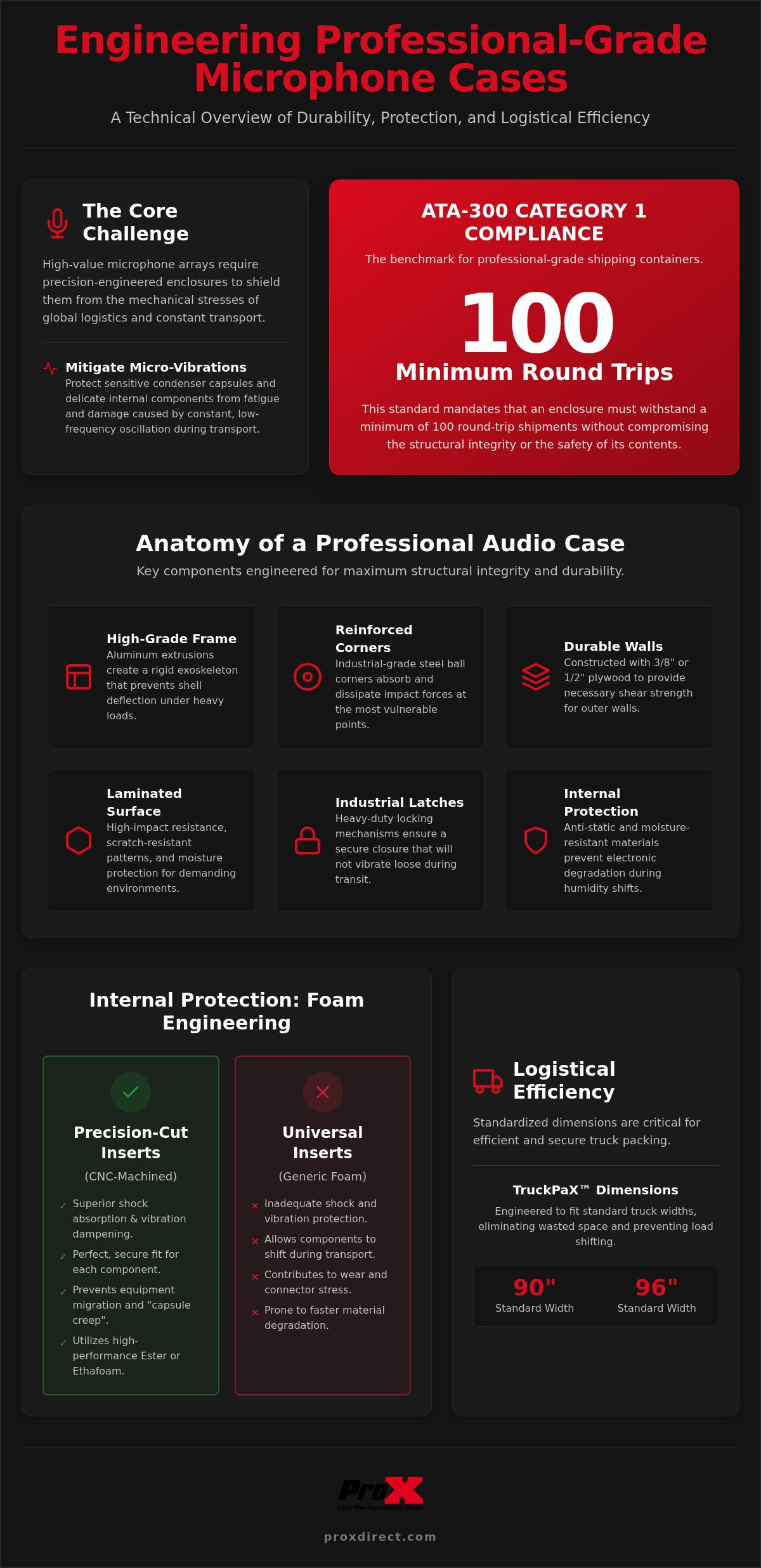
Structural integrity starts with the frame. High-grade aluminum extrusions and reinforced steel ball corners create a rigid exoskeleton that prevents shell deflection under heavy loads. Professional builds utilize specific components to maintain this integrity:
- 3/8" or 1/2" Plywood: Provides the necessary shear strength for the outer walls.
- Laminated Surfaces: Offers high-impact resistance and easy cleaning.
- Industrial Latches: Ensures a secure closure that won't vibrate loose.
Internal environment control is equally critical. Professional builds incorporate moisture-resistant laminates and anti-static materials to prevent electronic degradation during humidity shifts. A custom microphone flight case serves as the primary defense against mechanical failure in professional touring. These specifications ensure that the case maintains its shape even when stacked at the bottom of a heavy truck pack.
Assessing High-Value Microphone Vulnerabilities
Different transducer types require specific engineering responses. Ribbon microphones are notoriously susceptible to sudden air-pressure changes during transport. An airtight seal without a pressure relief valve can cause ribbon sagging or tearing. Large-diaphragm condensers generally require vertical storage to prevent gravity-induced stress on the diaphragm mounting over time. Wireless systems introduce different challenges. Custom layouts must account for antennae clearance and prevent lateral stress on delicate RF connectors. Without these considerations, the physical layout of the case can actually contribute to the wear and tear of the equipment it's meant to protect.
ATA-300 Category 1 Standards: Structural Integrity Specifications
Achieving an ATA-300 Category 1 rating requires more than just a sturdy appearance; it demands adherence to specific mechanical testing protocols established by the Air Transport Association. This standard mandates that a shipping container must withstand at least 100 round trips without compromising the safety of its contents. When engineering a custom microphone flight case, manufacturers must prioritize structural integrity to meet these rigorous demands. This involves a precise combination of high-density materials and specialized hardware that prevents shell deformation under the weight of stacked production gear. These specifications are essential for maintaining equipment calibration over years of heavy use.
Surface durability is enhanced through the use of Honeycomb Digital™ patterns. This hexagonal laminate design provides a superior strength-to-weight ratio while offering significant scratch resistance. The texture also improves grip during manual handling, reducing the likelihood of accidental drops in wet or high-pressure environments. While external protection is vital, the internal safety of the transducers relies on Precision-Cut Foam to absorb kinetic energy and dampen micro-vibrations. For those managing complex inventories, it's often useful to browse ProX Case categories to identify which structural designs best fit their specific logistical needs.
Plywood and Laminate Engineering
The core of a professional enclosure is its plywood substrate. Most Category 1 cases utilize 3/8" or 1/2" plywood, often opting for Baltic Birch due to its high ply count and lack of internal voids. This material provides exceptional torsional rigidity and impact resistance compared to standard construction-grade plywood. High-pressure laminates are then bonded to the wood to prevent moisture ingress and chemical degradation. Modern construction techniques focus on optimizing the weight-to-strength ratio, ensuring the case remains manageable for crew members without sacrificing its protective capabilities. This balance is critical for staying within airline weight limits while ensuring the case doesn't deflect under pressure.
Heavy-Duty Hardware and Assembly
Recessed hardware is a functional requirement for global production logistics. Recessed butterfly latches and spring-loaded handles prevent snagging on conveyor belts or other cases during automated sorting and truck loading. The assembly process relies on specific riveting patterns. High-tensile rivets are placed at calculated intervals along the aluminum extrusions to distribute shear force evenly across the frame. This ensures that the hardware remains securely attached even when the case is subjected to extreme drops or lateral shifts in a moving vehicle. Professionals can find these high-specification builds by exploring the options at proxdirect.com, where hardware standards meet the demands of the 2026 touring circuit.
Precision-Cut Foam vs. Universal Inserts: Maximizing Longevity
While the external shell provides the primary barrier against impact, the internal architecture of a custom microphone flight case determines the long-term survival of the transducer. CNC precision manufacturing allows for the creation of factory-cut foam inserts that outperform "pluck and pull" alternatives in every metric. Universal inserts often lack the structural integrity to support heavy microphone arrays over repeated tours, leading to material compression and gear contact. Professional engineering utilizes computer-controlled routing to create exact negative-space profiles. This ensures that the weight of the microphone is distributed evenly across its chassis, preventing stress on delicate grille assemblies.
Foam density selection is a critical engineering variable. Ester foam, a polyurethane variant, provides superior cushioning for lightweight condenser microphones due to its open-cell structure. In contrast, Ethafoam, a closed-cell polyethylene, is preferred for heavier dynamic microphones and power supplies because it resists permanent deformation under high-load conditions. Adhering to ATA Spec 300 requires these internal materials to maintain their shock-absorbent properties through at least 100 shipments. A well-designed interior also facilitates visual inventory management, allowing technicians to identify missing components instantly during rapid load-out cycles.
Wireless System Management
Wireless microphone arrays require specialized internal layouts to protect critical user interfaces. Custom compartments must account for handheld displays and infrared sync ports, ensuring that no foam contact occurs on these scratch-prone surfaces. Antenna storage is another priority; dedicated slots prevent the bending and connector fatigue that often occurs in disorganized cases. Integrated battery management sections allow for the secure storage of rechargeable cells and chargers alongside the transmitters. For professionals managing large-scale RF deployments, it's beneficial to explore AV Broadcasting Case solutions that integrate these complex storage needs into a single footprint.
Foam Longevity and Maintenance
Long-term reliability depends on the chemical stability of the dampening materials. Professional builds prioritize foams that resist "foam rot," a process where inferior materials oxidize and crumble into a fine dust that can clog microphone diaphragms. High-quality polyethylene and polyurethane variants are selected for their chemical resistance and durability over decades of use. These materials also offer easy-clean surfaces, which is essential in high-use production environments where dust and moisture are prevalent. Maintaining a clean internal environment prevents the transfer of debris to sensitive microphone capsules, extending the service life of the entire kit. Custom compartments for shock mounts and XLR cables further reduce wear by preventing these heavier items from shifting and impacting the microphones during transport.
Logistical Efficiency: Standardizing for Global Production
Standardization is a functional requirement for professional production logistics. A custom microphone flight case must do more than protect internal components; it must integrate seamlessly into the broader transport ecosystem. Efficient load-in and load-out cycles depend on case dimensions that maximize truck floor space and trailer volume. By utilizing standardized footprints, production managers eliminate "dead air" in a trailer, which reduces shipping costs and prevents lateral load shifts. Integrated tour label plates further streamline this process, allowing crew members to identify and route inventory rapidly without the need to open the enclosure. These features reflect a deep understanding of the physical demands placed on professional gear during international tours.
TruckPaX™ engineering represents a methodical approach to these logistical demands. These cases are designed to optimize footprints for standard 90-inch and 96-inch truck widths. This precision ensures that cases fit snugly side-by-side, creating a unified block that resists movement during transit. Secure multi-unit transport is achieved through the use of caster cups. These recessed dishes on the top of the case lid align precisely with the wheels of the unit stacked above it, locking the tier into place. This mechanical interlocking prevents the stack from shifting under the kinetic forces of braking or cornering, ensuring that the integrity of the microphone array remains uncompromised.
Optimizing Truck Pack Density
Standardized case sizes are fundamental to creating stable truck tiers. When cases share a uniform height and footprint, they can be stacked vertically to reach the trailer roof safely. This practice significantly reduces the risk of transport damage caused by uneven weight distribution or toppling. Professionals can learn more about these standards by reviewing TruckPaX™ Truck Pack Cases: Engineering Logistical Efficiency. High-density packing isn't just about space; it's about the structural safety of the entire inventory. Uniformity allows for a predictable loading pattern that saves time and reduces labor costs over the course of a 2026 touring schedule.
Casters and Mobility Engineering
Mobility hardware must withstand the high-impact environment of loading docks, gravel lots, and stage wings. Professional builds utilize 4-inch heavy-duty casters with high load ratings to manage the weight of high-density microphone lockers. These wheels are typically manufactured from non-marring materials like polyurethane to protect delicate venue flooring. Locking mechanisms on at least two casters are mandatory to ensure stability on sloped ramps or within stage wings. Regular maintenance of these components is essential for multi-year tours to prevent hardware failure. For those looking to upgrade their fleet, you can view our full range of standardized microphone cases to ensure your next tour is logistically sound.
Custom Engineering Projects: The ProX and ZCASE Advantage
Standard inventory often fits into the catalog of TruckPaX™ enclosures, but complex microphone arrays or vintage collections require a more specialized approach. A custom microphone flight case engineered through a bespoke process addresses the unique physical geometry of high-value transducers that off-the-shelf solutions cannot accommodate. This level of precision is achieved through our ZCASE and Santosom lines. ZCASE Custom Builds are manufactured in Poland, utilizing advanced fabrication techniques for unique production gear. Santosom Cases represent European engineering standards, providing a reliable backbone for high-stakes touring professionals who require uncompromising durability. This ensures your equipment remains calibrated and secure across international borders.
Collaborating with our engineering team allows you to specify every structural detail, from internal dampening ratios to external hardware placement. Since 1984, we've provided performance gear that prioritizes functional excellence over aesthetics. This collaborative engineering ensures that the final build isn't just a container, but a precision-tuned environment for your specific mic locker. By integrating the technical requirements discussed in previous sections, such as ATA-300 compliance and Honeycomb Digital™ surfaces, we create a solution tailored to your exact logistical needs.
The Bespoke Design Process
The engineering cycle begins with precise equipment dimensions, which are then translated into detailed 3D CAD models. This digital environment allows us to visualize the interaction between the microphone chassis and the internal foam architecture before fabrication starts. Prototyping and stress-testing follow, ensuring the enclosure meets specific touring requirements for impact resistance and vibration dampening. You can learn more about this workflow by reading ZCASE Custom Build Cases: Engineering Bespoke Protection. This methodical approach eliminates the guesswork often found in DIY modifications, providing a professional-grade result that withstands the rigors of the 2026 global tour circuit.
Long-Term Reliability and Support
A professional enclosure is a long-term investment that requires ongoing maintenance to maintain its Category 1 status. We ensure the longevity of your build through the availability of ProX Cases Replacement Parts. Whether you need to replace a damaged caster after a grueling season or refresh an internal latch, our global dealer network provides immediate access to professional gear and support. This infrastructure ensures that your custom solution remains operational for decades, rather than just a few seasons. Our commitment to durability means that your investment is protected by a reliable supply chain. If your production requirements demand a unique solution, contact ProX for a custom case quote to begin the engineering process.
Securing Your Audio Inventory for the 2026 Touring Season
Protecting high-value microphone arrays requires a transition from generic storage to engineered solutions. Adhering to ATA-300 Category 1 standards ensures that your equipment maintains its calibration through at least 100 round-trip shipments. A custom microphone flight case provides more than physical shielding; it integrates precision-cut foam and TruckPaX™ logistical dimensions to optimize every aspect of your production cycle. This technical approach prevents the micro-vibrations and organizational failures that compromise professional gear during international transport.
Since 1984, we've focused on manufacturing performance gear that meets the functional demands of the global stage. Our global dealer network provides the long-term support and replacement parts necessary to extend the service life of your investment. By prioritizing mechanical integrity and logistical compatibility, you eliminate the risk of equipment failure during high-stakes events. It's time to standardize your inventory with enclosures designed for the practical realities of professional use. We look forward to supporting your next global production with the engineering precision your gear deserves.
Design Your Custom Microphone Protection with ProX
Frequently Asked Questions
What is the difference between ATA-300 and standard flight cases?
ATA-300 Category 1 is a verified industry standard that mandates a case must withstand a minimum of 100 round-trip shipments. Standard cases often lack the structural testing and material specifications required to meet this certification. A certified build uses specific plywood grades, high-tensile rivets, and recessed hardware to ensure the enclosure doesn't deflect under pressure. This distinction is critical for international air freight where handling is often automated and aggressive.
Why is custom CNC-cut foam better than pick-and-pluck foam for microphones?
CNC-cut foam provides superior longevity because it's machined from solid blocks of Ester or Ethafoam rather than pre-scored sections. Pick-and-pluck foam relies on thin bridges of material that fatigue and tear after repeated use, eventually allowing gear to shift. A custom microphone flight case with CNC-machined inserts maintains its structural profile for decades. This precision ensures that the weight of the microphone is distributed evenly, protecting delicate internal diaphragms.
Can I fit wireless receivers and handheld microphones in the same custom case?
Integrated cases allow for the simultaneous storage of receivers, handheld transmitters, and RF accessories within a single footprint. Professional engineering accounts for antenna clearance and display protection to prevent lateral stress on connectors during transport. These layouts often include dedicated compartments for power supplies and rechargeable batteries. Combining these components into one enclosure improves logistical efficiency and ensures that all necessary RF infrastructure is present at every tour stop.
How do TruckPaX dimensions help with production logistics?
TruckPaX™ engineering optimizes the external footprint of the case to fit standard 90-inch and 96-inch truck widths. This standardization eliminates empty space in the trailer, which prevents the load from shifting during transit. By sharing uniform dimensions, these cases stack securely using integrated caster cups. This methodical approach to packing density reduces shipping costs and minimizes the risk of transport damage caused by uneven weight distribution in the truck tiers.
What plywood thickness is recommended for a professional touring microphone case?
Professional touring cases typically utilize 3/8-inch or 1/2-inch plywood to achieve the necessary shear strength. Baltic Birch is the preferred substrate due to its high ply count and absence of internal voids, which provides superior torsional rigidity. While 1/4-inch plywood is lighter, it lacks the impact resistance required for ATA-300 Category 1 compliance. Thicker panels ensure the enclosure maintains its shape even when placed at the bottom of a heavy stack.
Do I need a custom case for a single high-value studio microphone?
A single high-value studio microphone requires a custom enclosure if it's being moved between professional locations. Standard manufacturer boxes are often made of cardboard or thin plastic that won't survive the mechanical stresses of professional transport. A dedicated custom microphone flight case protects sensitive ribbon or condenser capsules from micro-vibrations and air pressure shifts. This investment is an essential insurance policy for maintaining the factory-spec calibration of expensive recording assets, a standard maintained by Remote Podcast Recording and Production when deploying high-end gear for on-location sessions.
How do I maintain the hardware on my flight case to ensure longevity?
Maintaining case hardware involves regular cleaning and the application of dry lubricants to latches and hinges. Inspecting rivets for signs of shear fatigue is also a standard practice for multi-year tours. When hardware is damaged, utilizing our global dealer network for replacement parts allows you to extend the service life of the enclosure. Keeping casters free of debris ensures smooth mobility on stage wings and prevents damage to venue flooring during load-in cycles.
What is the advantage of ZCASE custom builds for touring orchestras?
ZCASE custom builds offer the high-density organization required for the complex microphone arrays used in touring orchestras. These Polish-engineered solutions provide bespoke compartments for hundreds of small-diaphragm condensers and specialized instrument clips. The precision of ZCASE manufacturing ensures that each piece of equipment has a fixed, protective location. This organization speeds up the inventory check process and prevents the loss of expensive components during rapid transitions between international concert halls.
Disclaimer
Any trademarks, trade names or brand names appearing herein that do not belong to ProX are the property of their respective owners and/or companies, and such appearance doesn't and shall not constitute or imply endorsement, sponsorship or recommendation by ProX.


