

ATA 300 Category I standards require a transport case to withstand a minimum of 100 round-trip shipments, yet many professionals find their hardware failing long before reaching that milestone due to neglected mechanical maintenance. You understand that in high-stakes production environments, equipment failure is not an option. You rely on your transport solutions to be the backbone of your logistics, but the physical demands of the road eventually take a toll on aluminum extrusions and mechanical latches. Left unaddressed, these small points of wear lead to catastrophic failure during transit.
This flight case maintenance guide provides the industrial protocols necessary to preserve structural integrity and logistical reliability for the long term. You'll learn how to extend the lifecycle of your professional gear protection while maintaining a clean, client-facing aesthetic. We'll examine technical procedures for mitigating aluminum corrosion, preventing foam degradation that damages equipment finishes, and ensuring your hardware meets the rigorous engineering standards required for 2026. This methodical approach ensures your cases remain a reliable asset rather than a liability.
Key Takeaways
- Understand maintenance as a critical risk-mitigation strategy for preserving high-value electronic assets in high-stakes production environments.
- Learn technical protocols for evaluating the mechanical tension of recessed butterfly latches and the pin integrity of heavy-duty hinges.
- Identify the chemical breakdown signs of interior polyurethane and polyethylene foam to prevent off-gassing damage to sensitive equipment.
- Discover industrial-grade cleaning methods for removing tour labels and adhesive residue without degrading structural case adhesives.
- Utilize this flight case maintenance guide to establish a professional "Repair vs. Replace" matrix for sourcing engineering-grade replacement hardware.
The Engineering Necessity of Professional Case Maintenance
In the high-stakes environment of professional production, equipment failure represents more than a technical inconvenience; it is a significant logistical risk. High-value electronic assets, from mixer consoles to LED video panels, require a protective shell that functions at peak performance. This flight case maintenance guide establishes the necessary engineering protocols to ensure your transport solutions meet industry benchmarks. Adhering to these standards is not merely about aesthetics. It's a systematic risk-mitigation strategy designed to prevent catastrophic failures during transit. When you prioritize structural integrity, you protect both your equipment and your professional reputation. If you apply this same standard to heavy equipment, you can check out GSM Internacional for expert distribution of essential components.
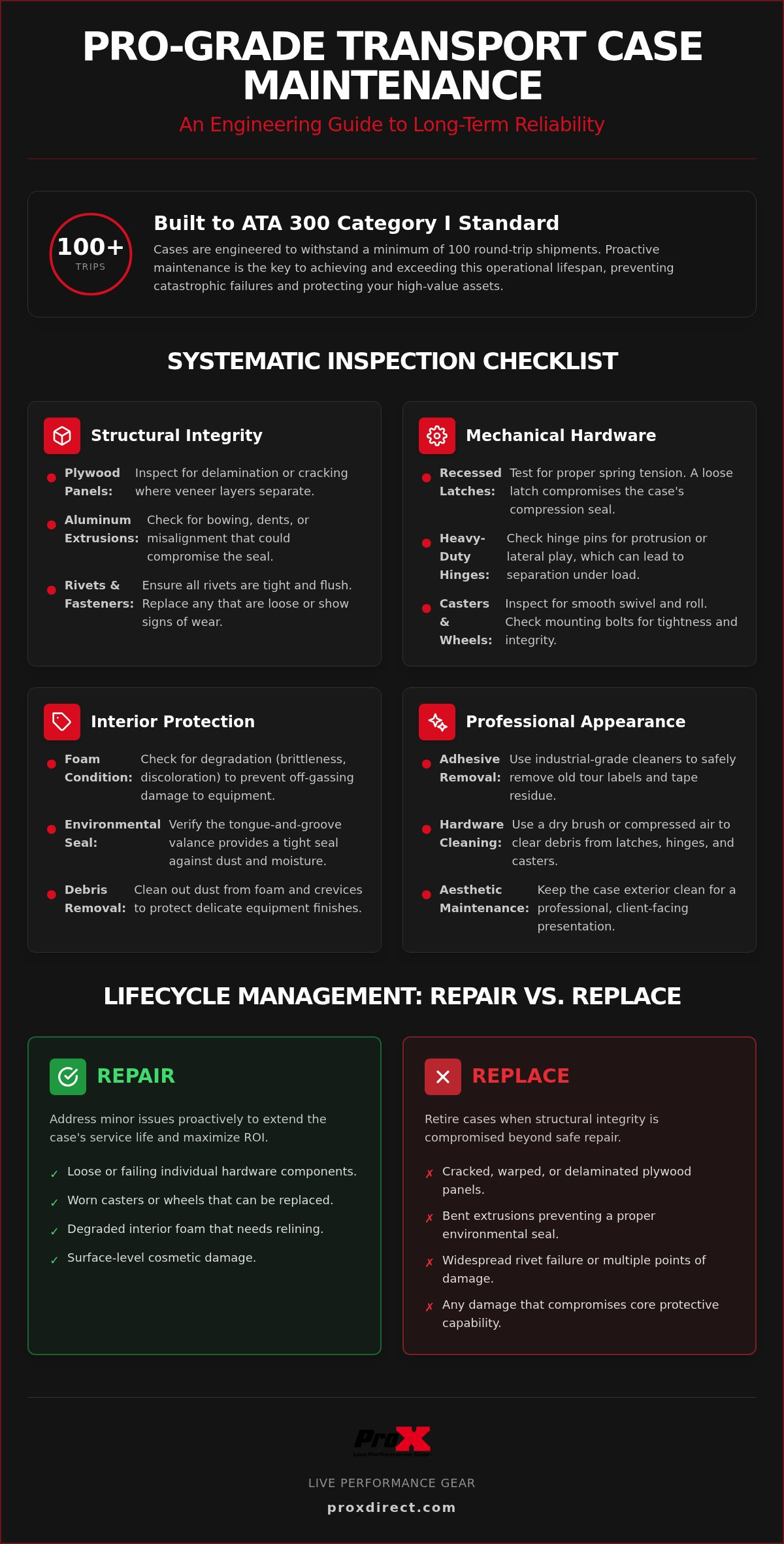
Professional maintenance benchmarks are often defined by the Air Transport Association (ATA) Specification 300. Category I containers are engineered to withstand a minimum of 100 round-trip shipments. However, achieving this operational lifespan requires active oversight of the Flight Case Construction components. Structural neglect compromises the mechanical integrity of the case, leading to a breakdown in the protective barrier that keeps your gear secure. Regular inspections ensure that your fleet remains reliable throughout its service life.
Identifying Structural Fatigue in Plywood and Extrusions
Structural fatigue in the context of transport cases is defined as the cumulative degradation of material strength and mechanical bonds resulting from cyclical loading, vibration, and environmental stress during the logistical lifecycle. You must inspect plywood panels for signs of delamination, where the adhesive bonds between veneer layers begin to fail. This is especially critical given the rising costs of specialized plywood in 2026. Aluminum extrusions require similar scrutiny. Monitor the metal profiles for bowing or misalignment. Even slight deviations can prevent the tongue-and-groove valance from sealing correctly. A compromised seal allows moisture and dust to bypass the outer shell, threatening internal components. Consistent alignment is mandatory for maintaining the case's structural capabilities.
The Impact of Neglect on Equipment Safety
Neglecting minor structural issues leads to a cascade of mechanical failures. Loose hardware, such as vibrating rivets or stripped screws, compromises the entire protective shell. When a case loses its rigidity, its ability to provide internal vibration damping diminishes. This increases the mechanical shock transferred to sensitive electronics during transit. For a deeper look at high-performance protection, you can explore professional transport case solutions designed for these rigorous demands. Ensuring every component remains tight and aligned is the only way to maintain the protection your gear requires. Routine checks prevent small vibrations from turning into expensive damage.
Structural Hardware and Mechanical Inspection Protocols
Mechanical hardware represents the primary interface between the user and the protective shell. In this flight case maintenance guide, we prioritize the inspection of moving parts because their failure often occurs suddenly during high-stress loading scenarios. Recessed butterfly latches must maintain specific mechanical tension to ensure the lid and base remain compressed against the valance. If a latch feels loose or fails to draw the two sections together, the internal spring tension has likely degraded. This compromise allows for lateral movement, which can shear rivets over time and lead to a breach of the internal compartment.
Maintaining Latching Mechanisms and Hinges
Inspect heavy-duty hinges for lateral play and pin integrity. A hinge pin should remain centered and secure; any protrusion indicates a potential for complete separation under load. Debris such as gaff tape residue or stage dust often accumulates in mechanical pivot points, leading to increased friction and premature wear. Clean these areas with a dry brush or compressed air to ensure smooth operation. Ensuring a flush closure is essential for maintaining the environmental seals that meet MIL-STD-810G Testing Standards. A gap of even a few millimeters can admit moisture or particulates during outdoor transitions, risking damage to sensitive internal circuitry.
Caster Maintenance and Load Bearing Integrity
Casters bear the entire weight of the payload and the case itself. Inspect the swivel mechanism for smoothness. If the rotation is notched or resistant, the bearings are likely contaminated or damaged. Remove hair, carpet fibers, and grit from the wheel axles to prevent flat-spotting. A flat spot on a wheel creates excessive vibration, which is then transferred directly to the internal electronics during transport. Verify the tightness of the bolts on the caster plate. Structural cracking around the bolt holes is a sign of extreme stress or improper loading. For those looking to upgrade their inventory, our Professional DJ Equipment Case Purchase Guide provides further insights into selecting the correct hardware for touring environments.
Ball corners and bracing provide the necessary reinforcement at impact points. Check that all rivets are flush and that the corners haven't been pushed inward by heavy impact. If you identify hardware that is beyond repair, sourcing original manufacturer replacement parts is the only way to restore the case to its original engineering specifications. Maintaining these mechanical components ensures the case continues to function as a reliable logistical asset.
Interior Foam Management and Environmental Protection
While the exterior shell provides the primary defense against impact, the interior environment of a transport case determines the long-term survival of sensitive electronics. This flight case maintenance guide emphasizes that interior foam is a consumable engineering component with a finite functional lifespan. Over time, polyurethane and polyethylene foams undergo chemical breakdown. This degradation is often accelerated by exposure to UV light, temperature fluctuations, and residual cleaning chemicals. When foam begins to crumble or feel "sticky" to the touch, it has reached a state of advanced failure and must be replaced immediately to protect your equipment.
A significant risk associated with aging foam is the phenomenon of off-gassing. As the molecular bonds in the foam degrade, they release volatile organic compounds (VOCs) into the sealed environment of the case. These chemicals can settle on sensitive optical lenses, clouding them permanently, or react with the copper traces on printed circuit boards (PCBs) to cause micro-corrosion. Maintaining a clean interior is not just about organization; it's about managing the chemical stability of the storage environment to prevent internal asset damage.
Foam Integrity and Equipment Cushioning
You must regularly test for compression set, which occurs when the foam loses its ability to return to its original shape after a load is removed. Perform a "rebound test" by applying firm pressure to the foam inserts for ten seconds. If the material does not return to its original profile within three seconds, its shock-absorption capacity is compromised. In many professional applications, you don't need a full interior overhaul. Localized sections of high-density foam can be replaced using industrial adhesives. Ensure that any hook-and-loop fasteners used for securing cables or accessories are free of debris. If the grip strength of these fasteners has diminished, replace them to prevent equipment from shifting during high-vibration transport cycles.
Corrosion Prevention and Oxidation Control
Internal moisture is the primary catalyst for hardware failure. Even within a closed case, humidity can lead to the oxidation of aluminum extrusions and steel latches. Electrochemical oxidation occurs when aluminum surfaces react with atmospheric oxygen and moisture, creating a layer of aluminum oxide that can eventually lead to pitting and structural weakening of hardware components. To mitigate this risk, utilize high-capacity desiccant packs within your cases, especially during long-term storage or sea-freight logistics. For those managing large inventories, sourcing specialized case accessories like specialized humidity indicators can provide an early warning system before corrosion begins. Consistent environmental monitoring is a hallmark of professional gear management.
Professional Cleaning and Restoration Protocols
Maintaining the professional aesthetic of your transport fleet is a functional requirement for client-facing events. This flight case maintenance guide prioritizes the use of industrial-grade cleaning agents that effectively remove contaminants without compromising the chemical integrity of structural adhesives. Selecting the wrong solvent can lead to the degradation of the bonds between the plywood core and the exterior laminate. You must avoid petroleum-based cleaners that can seep into the wood fibers and cause permanent swelling or delamination. Instead, utilize pH-neutral detergents for routine maintenance and specialized citrus-based solvents for targeted residue removal.
Adhesive residue from tour labels and gaff tape is the most common contaminant on professional cases. Left unaddressed, these sticky deposits attract grit and dust, which can eventually migrate into the mechanical components of latches and hinges. When removing residue, apply the solvent to a microfiber cloth rather than spraying the case directly. This prevents liquid from pooling in the rivets or the tongue-and-groove valance. For heavy accumulation, a plastic scraper can be used with caution, but metal blades must be avoided to prevent gouging the protective laminate surface.
Exterior Panel and Aluminum Extrusion Cleaning
Honeycomb-style laminates require a non-abrasive approach to preserve their textured finish. A soft-bristled brush is effective for removing dust from the recessed areas of the pattern. For aluminum extrusions, use a dedicated metal cleaner to remove surface oxidation. You must work in the direction of the grain to avoid visible scratching. Rubber gaskets and seals should be wiped down with a damp cloth to remove particulates that could compromise the environmental seal. Regular cleaning of these gaskets prevents the rubber from becoming brittle, ensuring the case remains weather-resistant during outdoor transitions.
Hardware Lubrication and Rust Removal
Mechanical pivot points in recessed butterfly latches and heavy-duty hinges require specific lubrication protocols. Avoid wet oils or greases, as these attract stage dust and create a grinding paste that accelerates mechanical wear. Instead, apply a dry-film lubricant, such as a PTFE-based spray. This provides the necessary reduction in friction while keeping the hardware clean. If you identify minor surface rust on steel components, treat it immediately with a rust converter or fine steel wool followed by a protective clear coat. For hardware that has suffered deep pitting or mechanical failure, you can source engineering-grade ProX Cases Replacement Parts to restore the unit to its original specifications. If your hardware is beyond restoration, browse our professional replacement components to ensure your gear stays protected.
Component Replacement and Long-Term Lifecycle Management
Every professional inventory eventually reaches a point where routine cleaning is insufficient to maintain structural integrity. This flight case maintenance guide establishes a "Repair vs. Replace" decision matrix to help logistics managers determine the most cost-effective path forward. When evaluating a unit, prioritize the condition of the plywood core. If the panels show extensive water damage, deep delamination, or structural rot, the case is typically beyond a reliable repair. However, mechanical hardware is designed for modular replacement. Swapping a damaged latch or a compromised caster is a standard engineering procedure that restores the case to its original protective capacity without the expense of a full replacement.
Establishing a spare parts inventory is a mandatory requirement for touring professionals. In the high-stakes environment of live production, waiting for a shipment is not an option. You should maintain a stock of common failure points, including recessed butterfly latches, heavy-duty casters, and various sizes of aluminum rivets. Standardizing your fleet around specific hardware specifications simplifies this process. When every case in your inventory utilizes compatible components, you reduce the complexity of your maintenance logs and ensure that repairs can be executed quickly during tight load-in windows.
Integrating ProX Replacement Components
Successful hardware replacement depends on precise mechanical integration. When you source parts, you must match the hole patterns and depth specifications of the original build to maintain the structural load path. Utilizing professional-grade steel rivets is essential; aluminum rivets may lack the shear strength required for high-impact corners. For those looking to enhance their existing inventory, you can find specialized ProX Case Accessories designed for professional upgrades. Proper installation ensures that the replacement part functions as a cohesive element of the protective shell, maintaining the ATA 300-style protection levels your gear requires.
The Logistical Benefits of Standardized Maintenance
Well-maintained cases provide significant logistical advantages beyond simple gear protection. A case with properly aligned extrusions and functional casters improves truck pack efficiency. When hardware is bent or misaligned, cases don't stack flush, which wastes valuable cubic volume and creates instability during transit. Furthermore, documented maintenance logs directly impact the long-term value of your assets. A fleet with a verifiable history of hardware inspections and component replacements commands a higher resale value in the professional market. This disciplined approach to lifecycle management ensures your equipment remains a reliable backbone for your operations. If you've identified hardware that requires immediate attention, explore our full range of professional replacement parts to secure your inventory for the 2026 season.
Securing Long-Term Reliability for Your Transport Fleet
ProX has been engineering performance gear since 1984. We understand the physical demands of the road. Our global dealer network provides direct access to the specialized components required to restore your cases to their original specifications. Whether you are addressing aluminum oxidation or replacing a recessed butterfly latch, using manufacturer-grade parts is the only way to maintain logistical reliability.
Take the next step in professionalizing your inventory management. Browse Professional Replacement Parts and Hardware at ProX to ensure your gear remains a dependable asset for every production. Your commitment to meticulous maintenance today prevents catastrophic equipment failure tomorrow.
Frequently Asked Questions
How often should a professional transport case be inspected?
Professional transport cases should undergo a visual and mechanical inspection after every major deployment or tour cycle. This flight case maintenance guide recommends a comprehensive quarterly audit for all inventory held in storage. Frequent checks allow you to identify vibrating rivets or minor hardware misalignments before they lead to structural failure during high-stress loading.
Can I replace just the latches on my case if they become loose?
You can replace individual recessed butterfly latches if the internal spring tension has failed or the mechanical hook is bent. These components are modular and designed for field replacement using standard engineering tools. Use high-strength steel rivets rather than aluminum variants to ensure the new hardware maintains the original shear strength of the case assembly.
What is the best way to remove old tour label adhesive without damaging the laminate?
Utilize a pH-neutral, citrus-based solvent applied to a microfiber cloth to dissolve tour label adhesive safely. You should avoid spraying the liquid directly onto the case to prevent it from seeping into the plywood core or under the aluminum extrusions. A plastic scraper is acceptable for stubborn residue; however, metal blades will gouge the honeycomb laminate and compromise the aesthetic finish.
Why is my case foam turning into a sticky residue, and is it dangerous for my gear?
Sticky foam is a result of advanced chemical degradation and off-gassing of the molecular bonds within polyurethane materials. This residue is dangerous for professional gear as it can permanently cloud optical lenses and cause micro-corrosion on electronic circuit boards. If you detect a sticky texture or a sweet, chemical odor, you must strip the interior and re-foam the case immediately.
Should I lubricate the wheels on my casters, and what lubricant should I use?
Caster bearings require regular lubrication to prevent friction-induced heat and flat-spotting, but you must avoid wet oils or greases. Apply a dry-film PTFE-based lubricant that doesn't attract stage dust or grit. This maintenance ensures the swivel mechanism and wheels move smoothly without creating the grinding paste that leads to premature mechanical failure.
How do I stop aluminum oxidation from spreading on my case extrusions?
Aluminum oxidation is halted by removing the existing oxide layer with a non-abrasive metal cleaner and maintaining a low-humidity environment. Once the extrusions are clean, applying a thin layer of clear protective wax can provide a barrier against atmospheric oxygen. Consistent use of desiccant packs inside the case is a critical step in this flight case maintenance guide for preventing electrochemical reactions.
Is it better to repair a damaged plywood panel or replace the entire case?
If the plywood core shows signs of rot, deep delamination, or significant water absorption, you should replace the entire case. The structural integrity of the shell is the primary defense for your gear; once the wood fibers fail, mechanical hardware cannot be securely anchored. If the damage is limited to hardware or extrusions, a professional repair is a viable and cost-effective solution.
How should I store my cases when they are not on tour to prevent damage?
Store your cases in a climate-controlled environment that is free from extreme temperature fluctuations and high humidity. Keep them on a level surface, preferably off the ground on pallets, to prevent moisture wicking into the base panels. It's essential to keep the latches closed but not overly compressed to maintain the integrity of the rubber gaskets over long periods.
Disclaimer
Any trademarks, trade names or brand names appearing herein that do not belong to ProX are the property of their respective owners and/or companies, and such appearance doesn't and shall not constitute or imply endorsement, sponsorship or recommendation by ProX.


