

A shipping container is not a passive box; it's a technical extension of the equipment it houses. In high-stakes production environments, the difference between a successful load-in and a catastrophic failure often comes down to the structural integrity of your transport solution. You likely understand that even minor micro-vibrations can lead to digital circuitry damage or lighting rig misalignment during transit. Generic foam and standardized shells often fail to address these specific mechanical stresses, leading to equipment degradation and costly downtime.
Our custom flight case design service bridges the gap between basic logistics and precision engineering. By utilizing advanced Polish manufacturing and ATA 300 standards, ZCASE provides bespoke protection that secures your high-value assets against the rigors of the road. This guide details how our engineering process optimizes truck pack efficiency and utilizes advanced material science to ensure zero-failure transport. You'll discover how standardized footprints and CNC-milled interiors lead to faster load-out times and a more reliable professional workflow for your technical teams.
Key Takeaways
- Learn why migrating from generic enclosures to equipment-specific fitment is essential for the long-term integrity of high-value digital and lighting infrastructure.
- Understand the technical advantages of Polish manufacturing, including the use of precision CNC machining and premium birch plywood for superior structural stability.
- Identify how a specialized custom flight case design service integrates CAD modeling to mitigate micro-vibrations that threaten sensitive console circuitry.
- Explore logistical strategies for global touring, such as standardizing external dimensions to optimize truck pack density and reduce cargo space waste.
- Master the custom build lifecycle, from initial equipment specification and collaborative CAD design to final deployment in professional environments.
Engineering Bespoke Protection: Defining ZCASE Custom Build Cases
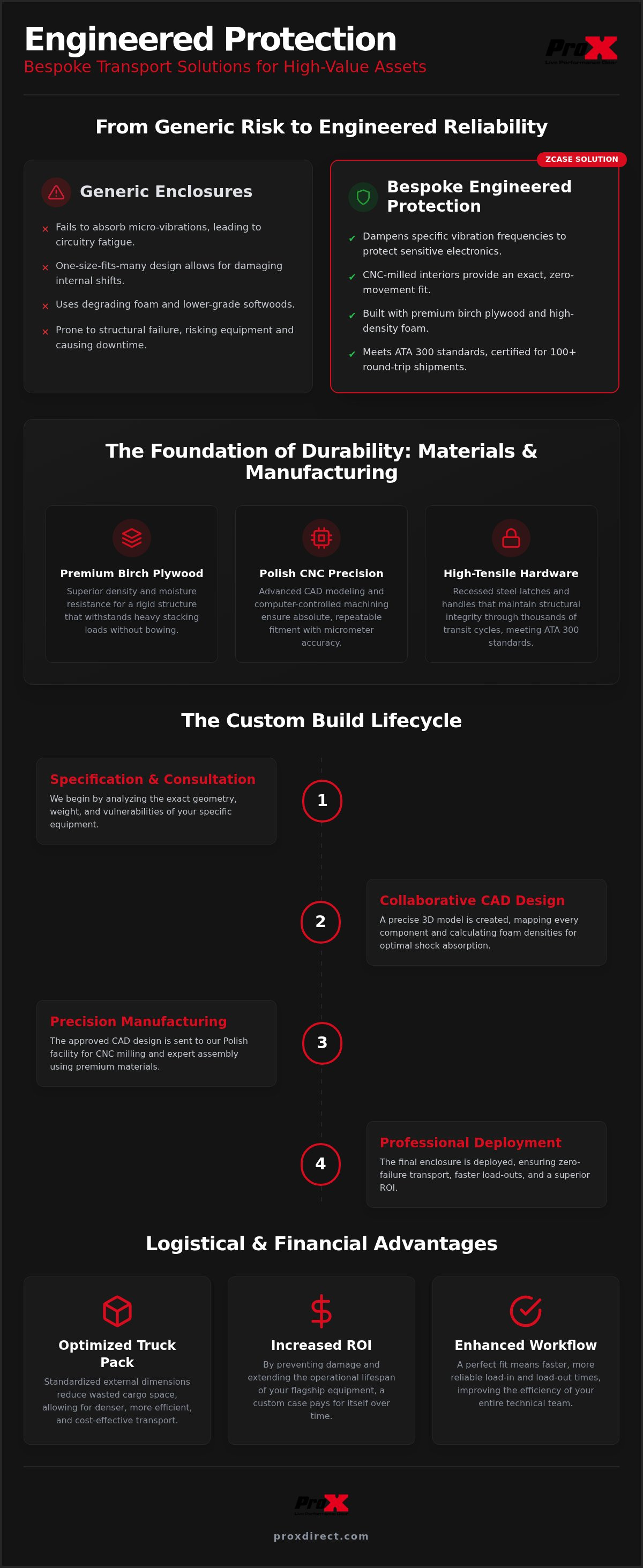
ZCASE Custom Build Cases represent the intersection of mechanical engineering and logistical necessity. These are not merely boxes; they are technical enclosures developed to match the exact geometry of high-value professional electronics. Within the ProX ecosystem, ZCASE functions as the premium tier for users requiring a specialized custom flight case design service. By moving away from one-size-fits-many solutions, these builds provide a structural interface that absorbs kinetic energy before it reaches sensitive internal components. Every ZCASE unit is manufactured in Poland using precision CNC machining and CAD modeling to ensure that the internal fitment is absolute and repeatable.
The Vulnerability of High-Value Digital Infrastructure
Modern digital consoles are essentially high-performance computers housed in chassis designed for ergonomics, not impact resistance. Mechanical stress during transit directly affects PCB integrity and connector stability. Micro-vibrations are the primary threat in professional touring. In standard containers, these high-frequency oscillations cause solder joints to fatigue and ribbon cables to unseat over time. A failed console on-site results in immediate operational paralysis. The financial impact of a cancelled show or emergency equipment rental far exceeds the initial investment in a bespoke enclosure. Precision engineering focuses on dampening these specific frequencies through high-density foam densities calculated for the weight of the specific gear.
Bespoke Engineering vs. Universal Transport Solutions
A shipping container specifically designed to protect must maintain strict internal fitment tolerances. While universal solutions rely on generic foam or pluck-and-pull alternatives that degrade, ZCASE utilizes CNC-milled interiors tailored to specific equipment footprints. Millimeters matter in shock absorption. If a heavy mixer shifts even slightly within its housing, the force of impact during a drop is magnified exponentially. Bespoke engineering ensures that pressure is distributed across the strongest points of the gear's frame rather than sensitive encoders or faders.
This meticulous approach to construction satisfies ATA 300 Category 1 requirements. This industry standard dictates that a case must withstand a minimum of 100 round-trip shipments without structural failure. Engaging a custom flight case design service provides a superior long-term ROI by extending the operational lifespan of flagship gear. By utilizing premium birch plywood and high-tensile hardware, ZCASE builds remain rigid under the weight of stacked cargo. This prevents the bowing and shifting common in lower-grade materials, ensuring that your equipment remains secure throughout the entire logistics cycle.
Precision Manufacturing: The Polish Engineering and Material Advantage
Polish manufacturing has become a hallmark of quality in the professional production industry. ZCASE leverages this regional expertise to produce technical enclosures that exceed standard market offerings. The process begins with material science, prioritizing structural components that can withstand the extreme mechanical stresses of global touring. By integrating a specialized custom flight case design service, ZCASE transforms raw materials into high-precision protective systems. This methodical approach ensures that every build is a repeatable, industrial-grade solution rather than a one-off assembly.
Material Integrity and Structural Durability
The foundation of every build is premium birch plywood. This material is chosen for its superior density and moisture resistance compared to standard softwoods. Cross-laminated construction provides a high strength-to-weight ratio, ensuring the case remains rigid under heavy stacking loads. External surfaces are treated with high-pressure laminates to resist abrasion and impact during frequent loading cycles. Hardware selection is equally critical. We utilize high-tensile, recessed steel latches and handles that maintain their integrity even after hundreds of transit cycles. These components are essential for meeting ATA Spec 300 Category 1 standards, which require the enclosure to survive at least 100 round-trip shipments.
The Role of CAD and CNC in Technical Design
Precision is achieved through the marriage of CAD (Computer-Aided Design) and CNC (Computer Numerical Control) machining. Digital blueprints allow engineers to map out integrated cooling channels and cable management paths before any material is cut. This level of detail ensures that equipment doesn't just fit; it functions while protected. Our custom flight case design service includes virtual stress testing to identify potential weak points in the design. CNC routing then executes these blueprints with sub-millimeter accuracy. This precision extends to the internal foam, where multi-density layers are cut to provide targeted shock protection for sensitive faders and touchscreens.
This methodical approach to manufacturing ensures that every unit provides zero-failure reliability. For those managing complex inventories, exploring the full range of technical cases reveals how these manufacturing standards are applied across diverse equipment categories. Quality control protocols are strictly enforced at every stage. This ensures that the final build matches the initial engineering specifications without compromise, providing a dependable backbone for professional production gear.
Technical Applications for Digital and Lighting Infrastructure
Professional production gear encompasses a diverse range of mechanical and electronic architectures. A specialized custom flight case design service provides the necessary technical granularity to protect these varied assets. Whether managing the high-density circuitry of a digital console or the delicate optics of a laser projector, the engineering must match the specific vulnerability of the hardware. ZCASE builds address these requirements through targeted internal fitment and structural reinforcement, ensuring that each asset class is secured according to its unique physical properties.
Optimizing the Digital Command Center
Mixer Console Cases serve as the operational hub for live events. Engineering these enclosures requires a deep understanding of cable management and connector protection. ZCASE designs often feature integrated doghouses. These rear compartments provide a secure space for cable looms and power distribution, shielding sensitive I/O ports from physical impact and lateral strain. This design allows for a clean workspace while maintaining the integrity of the signal path. Beyond protection, ergonomics are a priority. Custom builds allow engineers to operate the console at the correct height and angle, reducing fatigue during long shifts. For specialized production environments, these standards extend into our AV Broadcasting Cases, where rack space and monitor integration are essential.
Specialized Engineering for Lighting and Projectors
Standardization is a core component of this engineering strategy. Even when the internal fitment is bespoke, the external dimensions are often standardized to match industry-standard footprints. This ensures that different gear categories, from lighting to utility trunks with custom dividers, can be stacked uniformly. Using standardized heights simplifies the loading process and maximizes truck pack density, a critical factor for global touring operations. This methodical approach to technical applications guarantees that every piece of equipment, regardless of its function, arrives in optimal operational condition.
Logistical Strategy: Standardizing Custom Dimensions for Global Touring
Logistics is the final test of any protective solution. While internal engineering secures the equipment, external dimensions dictate the financial efficiency of a tour. A specialized custom flight case design service must account for the physical constraints of transport vehicles. ZCASE achieves this by utilizing standardized external footprints that align with 90-inch or 96-inch truck widths. This allows for uniform stacking and eliminates the gaps that lead to equipment shifting during transit. When cases fit perfectly into these dimensions, the risk of lateral impact is significantly reduced because the load remains tight and secure.
Calculating Truck Pack Density for Production Crews
Optimizing truck pack density is a mathematical necessity for large-scale productions. Uniform external dimensions eliminate dead air within the trailer, allowing crews to maximize every cubic inch of cargo space. Standardized case heights are equally important. They enable multi-tier stacking where the top of one case provides a stable, level surface for the next. This philosophy is deeply integrated into the TruckPaX™ Truck Pack Cases framework. By utilizing interlocking features and recessed hardware, ZCASE prevents lateral movement. The result is a cohesive load that resists the chaotic forces of the road. This precision reduces the time required for load-in and load-out, which directly impacts labor costs and schedule adherence.
Durability in High-Frequency Multi-Modal Transit
Global touring requires equipment to move seamlessly between air, sea, and road transport. Each mode presents unique mechanical and environmental challenges. Air transit involves rapid pressure changes and rigorous handling, while sea freight exposes enclosures to prolonged humidity and salt air. ZCASE builds address these multi-modal demands through the use of high-pressure laminates and moisture-resistant birch plywood. These materials prevent the structural warping that occurs with lower-grade alternatives. It's this attention to material science that ensures the enclosure remains square and the latches stay aligned over years of use.
Maintaining a fleet in peak condition requires a proactive strategy. Regular inspection of casters, latches, and internal foam ensures that the protective barrier remains intact. Because ZCASE uses standardized hardware, replacement parts are easily sourced through the ProX dealer network. This logistical foresight reduces downtime and extends the service life of the enclosure. For teams managing complex inventories, it's essential to evaluate standardized case dimensions to ensure maximum logistical efficiency across all equipment categories. Professional logistics is about more than just moving gear; it's about maintaining the integrity of the asset through every mile of the journey.
The Custom Build Lifecycle: From CAD Design to Professional Deployment
The transition from equipment acquisition to field deployment requires a methodical workflow. A custom flight case design service is most effective when it follows a structured engineering lifecycle. This process ensures that the final technical enclosure isn't just a physical barrier but a functional component of the production environment. By following a five-step lifecycle, ZCASE and ProX ensure that bespoke requirements are translated into industrial-grade reality without compromising structural integrity or logistical efficiency.
- Step 1: Identifying Equipment Specifications. This initial phase involves documenting the physical dimensions, weight, and center of gravity of the gear.
- Step 2: Collaborative CAD Design. Engineering teams create a digital twin of the enclosure, allowing for virtual stress testing and fitment verification.
- Step 3: Precision Manufacturing. The design is executed in the Polish facility using CNC technology and high-density materials.
- Step 4: Global Distribution. Finished builds are routed through the ProX dealer network for international procurement.
- Step 5: Deployment. The equipment is integrated into the case, verified for operational stability, and deployed into the professional workflow.
Collaborating with ProX Engineering Teams
Accurate data is the foundation of a successful build. When dealing with non-standard or modified gear, providing precise CAD files or physical measurements is mandatory. This phase also allows for the integration of custom branding through specialized laminate selection. For 2026 projects, lead times are influenced by the complexity of the internal fitment and current global production schedules. Early engagement with engineering teams is recommended to ensure alignment with tour start dates and to verify current plywood thickness standards for upcoming 2026 builds.
Procurement Through the Authorized Dealer Network
Procurement is handled exclusively through an authorized dealer network. This structure ensures that professionals receive local support and technical guidance throughout the design phase. Dealers also serve as the primary source for long-term maintenance and ProX Cases Replacement Parts, such as casters or latches. This local presence is vital for maintaining fleet reliability. It ensures that any field repairs are handled with components that match the original manufacturing specifications, preserving the integrity of the bespoke protection system throughout its service life.
Securing Technical Infrastructure for Global Operations
Professional production gear requires a protective strategy that functions as a technical extension of the equipment itself. By prioritizing bespoke fitment and material integrity, you mitigate the risks of micro-vibration damage and structural fatigue during transit. ZCASE builds leverage precision Polish manufacturing and ATA 300 compliant engineering to provide a zero-failure transport solution for high-value digital and lighting assets. This methodical approach is why these builds are trusted by global touring professionals who cannot afford equipment downtime at the venue.
Utilizing a specialized custom flight case design service ensures that your logistics remain optimized through standardized footprints. This precision directly reduces cargo space waste and improves the efficiency of your technical teams during load-in and load-out cycles. By coordinating with the ProX dealer network, you gain access to a comprehensive lifecycle of support, from initial CAD design to long-term maintenance with authentic replacement parts. Protecting your inventory with engineered precision is a necessary investment in the long-term reliability of your professional workflow and the safety of your high-value assets.
Start Your ZCASE Custom Build Project with a ProX Dealer Today
Frequently Asked Questions
Why is Polish engineering preferred for custom technical enclosures?
Polish engineering is recognized for its integration of high-precision CNC machining and meticulous mechanical assembly. This regional expertise ensures that every technical enclosure meets strict tolerances for equipment-specific fitment. ZCASE utilizes this established manufacturing infrastructure to produce builds that exceed the structural performance of generic alternatives. This industrial authority provides a reliable backbone for production crews who require zero-failure performance during rigorous transit cycles.
Can ZCASE builds accommodate modified equipment with extra components?
Yes, our custom flight case design service is specifically engineered to accommodate modified hardware or non-standard equipment configurations. Because every build starts with a collaborative CAD design phase, we can integrate additional clearance for external connectors, specific cooling requirements, or integrated rack units. This bespoke approach ensures that modified equipment remains secure and functional within its protective housing without the need for field modifications.
What is the typical lead time for a ZCASE custom build in 2026?
Lead times for 2026 ZCASE projects vary based on the complexity of the internal fitment and current manufacturing queue in the Polish facility. Most bespoke projects require a methodical progression through the CAD design, CNC routing, and assembly phases. Professionals should consult with their authorized dealer to verify current production schedules and shipping timelines for specific regions. Planning ahead is essential to align the build lifecycle with upcoming tour dates or equipment deployments.
Are ZCASE custom cases compliant with ATA 300 transit standards?
ZCASE custom builds are engineered to meet and exceed ATA 300 Category 1 standards. This specification requires the enclosure to withstand a minimum of 100 round-trip shipments without structural failure. By utilizing premium birch plywood and high-tensile hardware, these cases provide the necessary rigidity for multi-modal transport. This compliance ensures that high-value digital and lighting assets remain protected against the extreme mechanical stresses encountered during air, sea, and road transit.
How do standardized case footprints improve truck pack efficiency?
Standardized footprints eliminate dead air within a trailer by aligning case dimensions with industry-standard truck widths, such as 90-inch or 96-inch configurations. This logistical strategy allows for uniform stacking and prevents lateral shifting during transit. By optimizing truck pack density, production crews can maximize cargo space and reduce the overall volume of the load. This efficiency directly impacts transportation costs and streamlines the load-in and load-out process at the venue.
Can I get custom foam inserts for existing ProX cases?
While ZCASE specializes in the engineering of complete bespoke enclosures, technical foam solutions are integrated into the initial build process to match specific equipment geometries. For existing ProX cases, users should evaluate the range of available replacement parts and accessory foam through the dealer network. The custom flight case design service is most effective when the internal fitment and external shell are engineered simultaneously to provide a cohesive protective system.
What materials are used to ensure the durability of ZCASE exteriors?
ZCASE exteriors utilize cross-laminated birch plywood treated with high-pressure laminates for superior abrasion and moisture resistance. This material selection provides a high strength-to-weight ratio, ensuring the enclosure remains rigid under heavy stacking loads. Structural integrity is further reinforced by high-tensile steel hardware, including recessed handles and latches. These components are selected for their ability to maintain alignment and functionality through years of professional use in high-vibration environments.
How do I start the CAD design process for a bespoke console case?
The CAD design process begins by providing accurate physical dimensions or digital blueprints of your equipment to an authorized dealer. This data allows engineering teams to create a digital twin of the enclosure, mapping out internal fitment and cable management paths. Once the initial design is reviewed and verified, it moves to the precision manufacturing phase in Poland. This collaborative approach ensures that the final build meets all technical and logistical requirements for professional deployment.
Disclaimer
Any trademarks, trade names or brand names appearing herein that do not belong to ProX are the property of their respective owners and/or companies, and such appearance doesn't and shall not constitute or imply endorsement, sponsorship or recommendation by ProX.


