

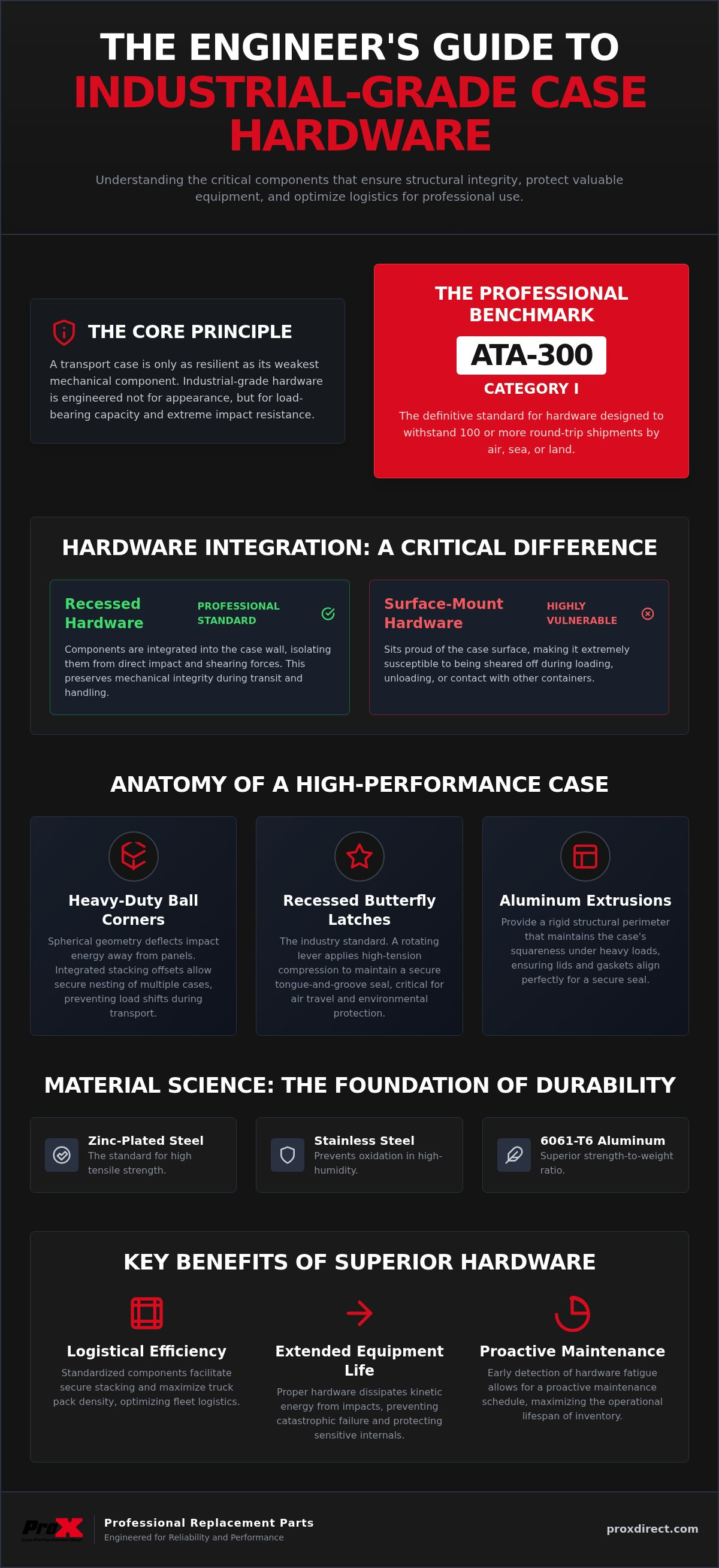
A flight case is only as resilient as its weakest mechanical component. While the structural shell provides the foundation, the actual longevity of your gear depends on the engineering precision of your flight case accessories. Professionals recognize that hardware failure during transit is a calculated risk that must be mitigated through superior engineering. Incompatible components and excessive weight from poorly selected hardware often result in cases that don't stack or pack efficiently, compromising the logistics of a production fleet.
This guide provides the technical specifications needed to identify durable, industrial-grade hardware that ensures your cases meet ATA-300 Category I standards. You'll learn how to select replacement parts that extend equipment life and optimize your logistics for better mobility and structural integrity. We'll examine the mechanical capabilities of high-load casters, recessed latches, and specialized extrusions to help you maintain a high-performance inventory that withstands the rigors of global transport. By mastering these specifications, you can ensure your equipment remains protected and your operations remain efficient.
Key Takeaways
- Understand the engineering requirements of ATA-300 Category I standards to ensure your hardware withstands the physical demands of international transit.
- Identify high-performance flight case accessories, such as recessed butterfly latches and spring-loaded handles, based on their mechanical weight ratings and material composition.
- Learn to detect hardware fatigue early to implement a proactive maintenance schedule that maximizes the operational lifespan of your production inventory.
- Improve logistical efficiency by selecting standardized components that facilitate secure stacking and maximize truck pack density for touring fleets.
- Discover how specialized hardware from the Santosom and ZCASE lines provides superior structural reliability for complex custom-build applications.
The Role of High-Performance Hardware in Equipment Protection
Professional-grade flight case accessories are specialized engineering components designed to preserve the structural integrity of a container under extreme mechanical stress. While consumer-grade hardware often prioritizes visual appeal, industrial components are rated specifically for load-bearing capacity and impact resistance. The primary function of high-performance hardware is the management and dissipation of kinetic energy. During a drop or a high-velocity collision, the hardware must distribute the resulting force across the entire case shell. This prevents energy from concentrating on a single point of failure, which could lead to a catastrophic breach of the protective environment.
Surface-mount hardware is generally insufficient for professional touring environments. Because these components sit proud of the case surface, they're highly vulnerable to shearing forces during loading and unloading. Recessed hardware is integrated directly into the case wall, which isolates mechanical parts from direct impact. This design philosophy is central to the construction of a professional-grade flight case, ensuring that latches, hinges, and handles remain fully operational after repeated heavy-duty use in high-stakes production environments.
Mechanical Integrity and Load Distribution
Recessed dishes and corner braces serve as critical reinforcement points that mechanically lock the case panels together. These components act as an external skeleton that prevents plywood panels from delaminating under stress. Aluminum extrusions provide a rigid perimeter that maintains case squareness under heavy loads, ensuring gaskets remain aligned. Compliance with ATA-300 style protection serves as the definitive benchmark for professional touring equipment intended for 100 or more round-trip shipments.
Material Science: Zinc, Steel, and Aluminum
The selection of raw materials dictates hardware resistance to mechanical fatigue. Zinc-plated steel is the standard for most flight case accessories due to its high tensile strength. For high-humidity environments, stainless steel is used to prevent oxidation. Structural extrusions utilize 6061-T6 aluminum, which offers a superior strength-to-weight ratio. This ensures the case remains lightweight for logistical efficiency while maintaining industrial-grade rigidity.
Essential Case Components: Anatomy of Industrial-Grade Hardware
Selecting the correct flight case accessories requires a deep understanding of mechanical stress and load distribution. Each component serves a specific structural purpose, transforming a plywood shell into a resilient transport container. While standard hardware might suffice for stationary storage, industrial-grade components are engineered to withstand the vibrational frequencies and physical impacts common in global logistics. High-performance hardware ensures that the case remains a cohesive unit, protecting internal electronics from external environmental factors and mechanical shock.
Heavy-duty ball corners are a foundational element of this protective system. Unlike flat corners, the spherical geometry of a ball corner is designed to deflect impact energy away from the case panels. These components also feature integrated stacking offsets, which allow multiple cases to be securely nested during transport. This prevents lateral movement in a truck pack, reducing the risk of load shifts that could damage equipment or compromise vehicle safety.
Latches and Secure Closures
The butterfly latch is the professional standard for secure closure. Unlike a simple drawbolt, the butterfly mechanism uses a rotating lever to apply high-tension compression. This tension is critical for maintaining the integrity of the tongue-and-groove seal, especially when cases are subjected to the vacuum effects of air travel. The depth of the recessed dish is a vital specification. It must be deep enough to ensure the latch wings sit below the case surface, preventing them from shearing off during contact with other containers. For those maintaining a fleet, sourcing verified ProX Cases Replacement Parts ensures that these mission-critical closures meet precise engineering tolerances.
Mobility Solutions: Casters and Skid Feet
Mobility is more than just ease of movement; it's about stability and load management. Selecting the right caster depends on the total weight of the loaded case.
- 4-Inch Casters: These are the industry standard for heavy workstations and speaker cases, providing superior clearance for cable ramps and floor transitions.
- 3-Inch Casters: Ideal for smaller utility cases where a lower center of gravity is required to prevent tipping.
- Total-Lock Brakes: These mechanisms lock both the wheel rotation and the swivel race, ensuring the case remains stationary on raked stages or uneven surfaces.
For cases that do not require wheels, the choice between rubber feet and plastic skids is dictated by the intended use. Rubber feet provide high-friction stability for desktop mixers or rack units. In contrast, plastic skids are preferred for utility cases that need to be slid across truck floors. Spring-loaded handles further enhance this mobility by providing an ergonomic grip that retracts when not in use. These handles are rated for specific weight capacities, and exceeding these limits can lead to hardware fatigue or shell failure. If you're planning a new build or an upgrade, you can browse professional hardware options to find components that match your specific weight requirements.
Upgrading and Maintaining Touring Cases for Reliability
Proactive maintenance is a critical risk-mitigation strategy for any professional production fleet. Even containers built to ATA-300 Category I standards can fail prematurely if components are neglected. Identifying hardware fatigue early prevents catastrophic gear failure during transit. Common indicators of fatigue include sheared rivets, bent latch tongues, or caster bearings that exhibit excessive lateral play. When these signs appear, technicians must decide between a localized repair or a full hardware replacement to maintain the structural integrity of the shell. Investing in high-quality flight case accessories for these repairs ensures that the case continues to meet industrial performance benchmarks.
Replacing damaged hardware requires specific industrial tools to ensure a secure bond. A heavy-duty pneumatic or manual rivet gun is essential for installing large-flange 3/16-inch rivets, which provide the necessary shear strength for load-bearing components. Technicians should use cobalt drill bits to remove old steel rivets without damaging the underlying plywood or aluminum extrusions. Compatibility is rarely an issue when using standardized ProX Cases Replacement Parts, as these components are engineered to align with the hole patterns of most industrial-grade touring cases manufactured since 1984.
The Professional Maintenance Schedule
Consistent inspections are the backbone of equipment longevity. Caster wheels should be checked monthly for flat spots or debris entanglement in the swivel race. Moving parts, such as the internal springs of butterfly latches and handles, require periodic lubrication with a dry-film silicone spray to prevent binding in dusty or high-humidity environments. For a comprehensive breakdown of service intervals, technicians should refer to the Ultimate Maintenance Checklist for Touring Road Cases to ensure no critical component is overlooked during the off-season.
Retrofitting for Modern Needs
Upgrading legacy inventory with modern flight case accessories can significantly improve logistical efficiency. Adding recessed label dishes allows for standardized tour labeling, while RFID tracking mounts facilitate rapid inventory scans. Many professionals are also retrofitting older, bulkier cases with low-profile hardware. This modification reduces the external footprint of the case, allowing for tighter truck pack density without sacrificing internal volume. Replacing degraded foam with custom CNC-cut inserts further enhances protection by ensuring a precision fit for modern, high-value electronics that may be smaller than the gear the case was originally designed to house.
Selecting Accessories for Logistical Efficiency and Truck Packing
Logistical efficiency in professional touring is a function of mathematical precision. Every cubic inch within a trailer represents a fixed operational cost, making the external dimensions of flight case accessories a primary concern for fleet managers. When hardware components are standardized, cases can be arranged in interlocking configurations that eliminate wasted space. This approach relies on the integration of hardware that respects industry-standard footprints, ensuring the total width of a row matches the internal dimensions of a standard 96-inch or 102-inch wide trailer. Truck space isn't cheap, and poorly chosen hardware can lead to significant cumulative losses in transport capacity.
Stacking dishes are mission-critical for maintaining load stability during transit. These recessed components allow the casters of an upper case to nest securely into the lid of the case below it. This mechanical interlocking prevents lateral shifting when the vehicle encounters vibration or sudden changes in momentum. They don't just facilitate stacking; they lock the load into a singular unit. By utilizing these flight case accessories, crews can build taller, more stable stacks. This maximizes vertical trailer volume and accelerates the load-in process by allowing multiple units to be moved as a single, cohesive block.
Optimizing the Truck Pack
Achieving a high-density truck pack requires hardware that adheres to 22.5-inch or 45-inch footprint standards. These dimensions allow for efficient three-across or two-across loading patterns. Recessed caster dishes are an essential engineering choice here. By partially submerging the wheel assembly into the case body, technicians can save up to four inches of vertical height per case. This seemingly small adjustment often allows for an additional layer of cases to be stacked in a high-cube trailer. For a detailed analysis of these logistical standards, consult the TruckPaX™ Truck Pack Cases Guide.
Specialized AV and Broadcast Accessories
Mobile workstations and broadcast rigs require internal hardware that supports high-density electronic integration. Zinc-plated steel rack rails provide the necessary tensile strength for heavy server units. Integrated thermal management fans prevent heat soak in enclosed environments. Efficient cable management is equally vital. Specialized hooks and internal dividers allow for the organized storage of 12-gauge speaker wire and SMPTE fiber, reducing setup times and preventing cable fatigue. You can explore the full range of these professional-grade solutions in the AV Broadcasting Cases Category. To ensure your fleet meets these rigorous logistical benchmarks, source your standardized logistical hardware from verified industrial suppliers.
ProX Engineering: Professional Replacement Parts and Specialized Accessories
ProX has been engineering performance gear since 1984. This legacy provides a baseline of reliability for the global production industry. When sourcing flight case accessories, professionals require parts that adhere to exact mechanical tolerances. ProX components are designed as part of a modular ecosystem, ensuring that replacement latches, handles, and extrusions integrate seamlessly with existing inventory. This precision reduces the labor hours required for fleet maintenance and ensures that repaired cases retain their original structural rating. Each component undergoes rigorous testing to verify its performance under the load-bearing stresses of international logistics.
A professional case is more than a shell; it is a precision-engineered system. Utilizing standardized components allows for predictable maintenance cycles and consistent performance across a fleet. By prioritizing functional excellence over generic alternatives, technicians can maintain the integrity of their builds for hundreds of shipments. This engineering-first approach is what separates industrial-grade hardware from consumer-level alternatives, providing the reliability required for high-stakes production environments where equipment failure is not an option.
Santosom and ZCASE Hardware Excellence
The partnership with Santosom and ZCASE represents a commitment to high-level engineering standards. Santosom cases utilize European hardware configurations that prioritize high-density plywood and specialized aluminum profiles. These cases are engineered for the specific demands of heavy-duty touring where weight distribution is critical. ZCASE, manufactured in Poland, offers bespoke hardware solutions for complex electronic integrations. The ZCASE Custom Build Cases Pillar details how these specialized components protect high-value production gear through unique mechanical assemblies and precision-fit hardware.
Sourcing the Right Parts
Efficient fleet management requires rapid access to technical data and inventory. The ProX catalog provides detailed SKUs and technical drawings for every component, from hybrid extrusions to internal rack rail systems. This transparency allows engineers to verify compatibility before placing orders. For large-scale operations, the dealer portal facilitates bulk procurement of flight case accessories and raw extrusions. Leveraging this global dealer network ensures that mission-critical parts are available for rapid delivery, minimizing downtime for touring rigs. Maintaining a standardized hardware inventory through these professional channels is the most effective way to ensure long-term logistical reliability and equipment safety. Professionals can Browse the Full ProX Case Accessory Catalog to source industrial-grade components for their next build or maintenance cycle.
Optimizing Fleet Longevity Through Engineering Precision
Maintaining a professional production inventory requires a commitment to technical standards that go beyond simple repairs. By prioritizing industrial-grade flight case accessories, you ensure that every container in your fleet functions as a cohesive, energy-dissipating system. Standardizing your hardware around ATA-300 benchmarks and logistical footprints doesn't just protect your high-value gear; it optimizes your entire touring operation. These engineering choices reduce mechanical fatigue and maximize truck pack density, directly impacting your long-term operational ROI.
ProX has been engineering performance-gear since 1984, providing a foundation of rugged reliability for the most demanding environments. Our global dealer network ensures you have rapid access to the technical support and precision-fit parts needed to keep your equipment in peak condition. Whether you're retrofitting legacy cases or building bespoke solutions with Santosom or ZCASE components, the focus remains on functional excellence. It's time to upgrade your gear with ProX Engineering-Grade Accessories and secure the future of your production inventory. Your equipment deserves the highest standard of protection available.
Frequently Asked Questions
What is the difference between recessed and surface-mount hardware?
Recessed hardware is integrated into the case panel through a specific cutout, while surface-mount hardware is riveted directly onto the exterior surface. Recessed components are the industrial standard for touring because they sit below the surface of the shell, protecting them from shearing forces during loading. Surface-mount parts are more vulnerable to impact and are generally reserved for lighter applications where cases won't be tightly packed in a truck.
How do I know if a replacement latch will fit my existing flight case?
Identify the correct fit by measuring the dimensions of the recessed dish and the specific rivet hole pattern. Most professional flight case accessories utilize standardized offset patterns, but you should always verify the dish depth to ensure it doesn't interfere with internal gear. Comparing your measurements against the technical drawings in the ProX replacement parts catalog is the most reliable way to ensure a precision fit.
What are the benefits of using 4-inch casters over 3-inch casters?
Four-inch casters provide a higher load-bearing capacity and superior clearance when rolling over cable ramps or uneven thresholds. The larger diameter reduces rolling resistance, making it easier for crews to move heavy workstations or speaker cabinets. Three-inch casters are typically used for smaller utility cases where maintaining a low center of gravity is more important than navigating significant floor obstacles.
Can I replace the foam inside my case without damaging the shell?
You can safely replace internal foam by using a heat gun to soften the adhesive bond before prying the material away from the plywood. It's vital to clean the interior surface with a non-corrosive solvent to remove residual glue before installing new CNC-cut inserts. This maintenance step allows you to upgrade your protection for new equipment without the cost of a completely new shell.
What tools are necessary for DIY flight case hardware repair?
Professional hardware repair requires a heavy-duty manual or pneumatic rivet gun and a drill equipped with cobalt bits to remove old steel rivets. You'll also need a caliper for precise measurement of extrusions and a vacuum to clear metal shavings from the case interior. Using the correct bit size is critical to ensure the new flight case accessories sit flush and maintain a secure mechanical bond.
Are there specific accessories for organizing cables within a utility case?
Specialized internal hooks, dividers, and cable management dishes are engineered specifically to organize high-density looms and speaker wire. These accessories prevent cable fatigue by stopping tangles and reducing the physical stress on connectors during transit. Integrating these components into your build significantly improves load-in efficiency and extends the life of your cabling inventory.
How does black hardware compare to chrome in terms of durability?
Chrome and black hardware are typically manufactured from the same zinc-plated steel, providing identical tensile strength and structural reliability. Chrome finishes are generally better at masking surface abrasions and scratches during long tours. Black powder-coated hardware provides a professional aesthetic, though high-velocity impacts can chip the coating and reveal the silver steel underneath.
What are ATA-300 style standards and why do they matter for accessories?
ATA-300 Category I is an airline industry benchmark that requires a container to survive a minimum of 100 round-trip shipments. This standard dictates the durability of latches, handles, and corners, ensuring they can withstand repeated drops and extreme vibrational stress. Selecting accessories that meet these specifications is essential for any gear intended for international transit or rigorous professional touring.
Disclaimer
Any trademarks, trade names or brand names appearing herein that do not belong to ProX are the property of their respective owners and/or companies, and such appearance doesn't and shall not constitute or imply endorsement, sponsorship or recommendation by ProX.


