

Static compression loads as low as 30 lbs are often enough to shear a potentiometer or fracture an internal PCB through the flexible walls of a textile bag. While soft-sided protection serves a purpose for light, hand-carried transport, it lacks the structural integrity required for the high-stakes environment of professional logistics. If you have reached the point where your equipment is regularly stacked in trailers or handled by third-party logistics teams, upgrading from padded bags to hard cases is no longer an optional luxury; it's a technical necessity for asset preservation.
You likely appreciate the initial portability of soft cases, yet you're tired of the recurring costs associated with damaged encoders and frequent bag replacements. This article provides a professional engineering framework for transitioning to rigid, laminated plywood enclosures to ensure long-term equipment survival and professionalize your touring rig. We will analyze the mechanical advantages of impact-deflecting surfaces, the logistical benefits of standardized footprints for improved truck pack density, and the specific material standards that define professional-grade transit protection.
Key Takeaways
- Identify the mechanical thresholds where soft-sided protection fails and learn why upgrading from padded bags to hard cases is essential for preventing structural damage to internal PCBs.
- Analyze the engineering standards of professional enclosures, focusing on 3/8-inch to 1/2-inch plywood construction and high-density EVA foam cushioning.
- Improve logistical efficiency by utilizing standardized dimensions and TruckPaX™ designs that transform equipment into stackable, load-bearing units.
- Calculate the long-term ROI of rigid protection through reduced downtime and the preservation of equipment resale market value.
- Distinguish between global touring standards like Santosom and specialized environmental protection like UltronX™ watertight cases.
The Performance Limits of Padded Bags and Soft Cases
Padded bags are engineered for abrasion resistance and light dust protection, but they lack the structural integrity required for industrial logistics. These soft-sided solutions rely on impact absorption through thin layers of open-cell foam. This design has a low mechanical threshold. Once external pressure exceeds the foam's compression limit, the kinetic energy transfers directly to the equipment. This is why upgrading from padded bags to hard cases becomes a technical requirement as soon as gear enters a shared cargo environment.
The primary engineering distinction lies in how energy is managed. While a textile bag attempts to soak up an impact, road case structural engineering focuses on impact deflection. A rigid shell redirects force around the equipment through a reinforced perimeter. Without this deflection, sensitive components like optical encoders, fader stems, and rotary knobs are vulnerable to lateral shear. Environmental factors also play a role; fabric is porous and offers minimal resistance to moisture ingress or fine dust, which can degrade internal PCBs over time.
When Padded Bags Are No Longer Sufficient
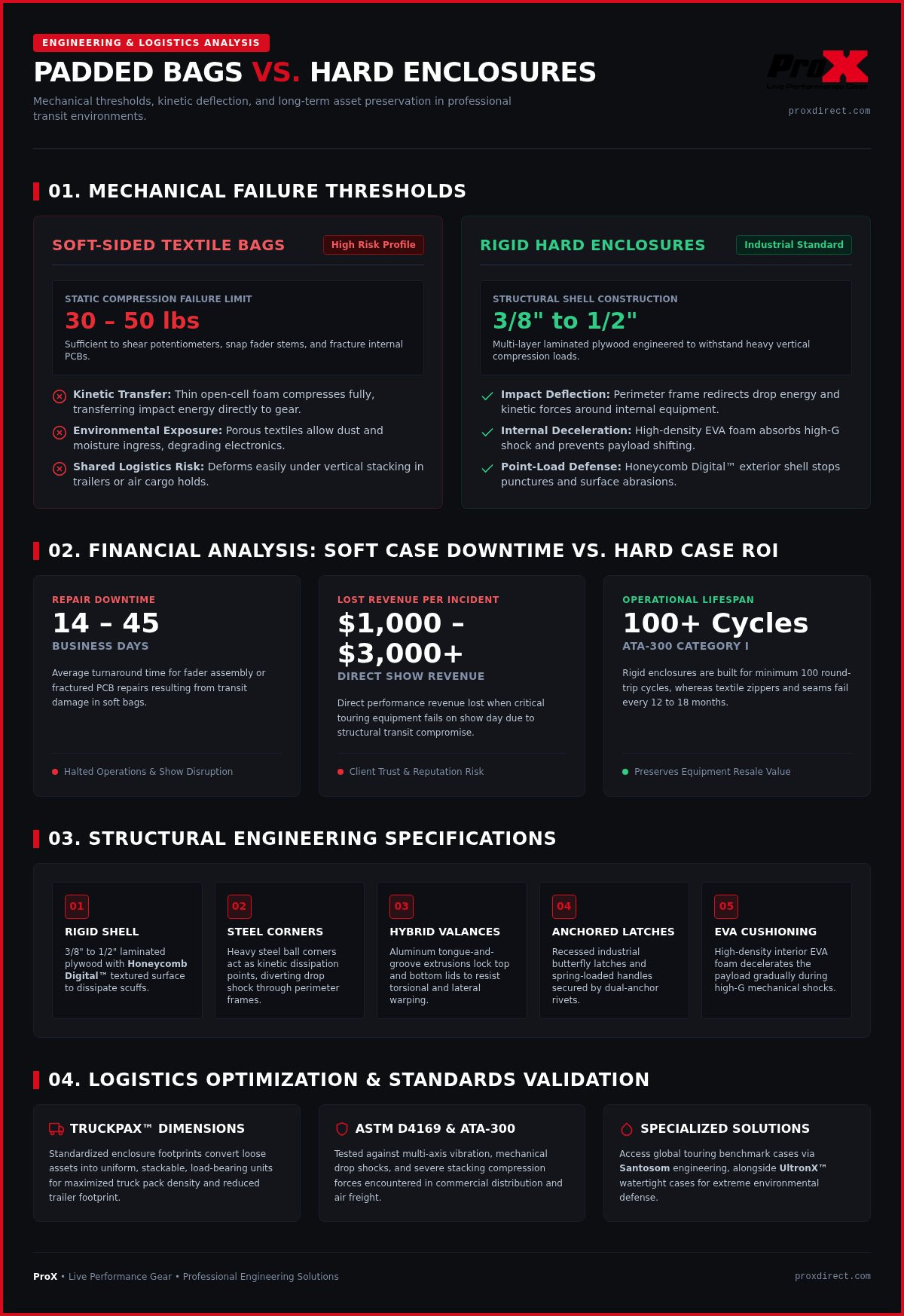
The transition from personal transport to third-party logistics is the most common failure point for soft cases. In a van or personal vehicle, you can control exactly where a bag sits. In a professional truck pack or air cargo hold, your gear is subject to the "crush damage" of heavier equipment. Research indicates that soft-sided bags can deform under static compression loads as low as 30 to 50 lbs. This is insufficient for multi-city touring cycles where equipment is stacked vertically to maximize space. If your workflow involves LTL shipping or commercial air travel, ProX Cases provide the necessary 3/8-inch or 1/2-inch plywood shells to withstand these compressive forces.
The Hidden Costs of Soft Case Failure
The true cost of a soft case isn't found in the purchase price; it's found in the equipment downtime. When a fader assembly or internal PCB fractures during transit, the average repair turnaround ranges between 14 and 45 business days. For a working professional, this downtime can result in lost performance revenue exceeding $1,000 to $3,000 per incident. Beyond the financial impact, equipment failure at showtime damages your professional reputation. Fabric and zippers also have a short lifespan in industrial use, often requiring replacement every 12 to 18 months, whereas an engineered hard case is built for a minimum of 100 round-trip transit cycles.
Structural Engineering: The Anatomy of Professional Hard Cases
When upgrading from padded bags to hard cases, the shift in material science is the most significant factor in long-term reliability. Professional enclosures utilize multi-layer laminated plywood, typically in 3/8-inch or 1/2-inch thicknesses, to provide a rigid shell that is resistant to warping and impact penetration. This shell is often finished with a Honeycomb Digital textured surface, which is designed to dissipate surface scuffs and offer enhanced grip during loading. Unlike the flexible walls of a bag, this rigid exterior forms the first line of defense against point-load puncture stresses.
The structural integrity is reinforced by aluminum tongue-and-groove hybrid valances. These extrusions lock the top and bottom sections together, creating a torsional-resistant frame that maintains its shape even under heavy vertical loads. Hardware precision is equally critical; recessed industrial butterfly latches and spring-loaded carry handles are mounted with dual-anchor rivets to prevent mechanical failure. Heavy steel ball corners serve as kinetic dissipation points, transferring the energy of a drop through the perimeter frame rather than through the delicate electronics inside.
ATA-300 Style Construction Explained
The ATA-300 standard defines the operational lifespan of transit containers in high-frequency environments. Category I containers are engineered to withstand a minimum of 100 round-trip transit cycles without a loss of structural integrity. These engineered cases are validated through ASTM D4169 transit performance standards, which simulate the multi-axis vibration, mechanical shock, and stacking compression gear faces during global distribution. Interior protection relies on high-density EVA foam, which decelerates the payload gradually and prevents the gear from shifting during high-G impact events.
Material Comparison: Plywood vs. Plastic vs. Fabric
Plywood-based cases offer superior shear strength and repairability compared to molded plastic or textile alternatives. While fabric provides basic abrasion resistance, it fails entirely under the compressive vertical loads found in professional cargo bays. ATA-300 style protection requires a container to withstand multiple 30-inch free-fall drops while maintaining the absolute integrity of the internal equipment. Professionals requiring this level of structural precision often utilize ProX Cases to secure their high-value inventory. This engineering balance between tare weight and maximum protection ensures that your rig remains within commercial weight limits without sacrificing durability.
Logistical Efficiency: Why Hard Cases Outperform Bags in Transport
Professional logistics demand predictability. While soft bags are often praised for their flexibility in small vehicles, this variability becomes a liability in high-density truck packs. Upgrading from padded bags to hard cases transforms your gear from loose inventory into standardized, stackable cargo units. This transition enables the "Tetris" effect, where every cubic inch of a trailer or cargo bay is utilized effectively. Cases equipped with nesting ball corners and caster dish indentations ensure that stacks remain secure during multi-axis vehicle vibration, a feat impossible to achieve with irregular soft-sided luggage.
Logistical mobility is another critical factor for high-weight equipment. Padded bags require manual lifting for every movement, increasing the risk of drops and personnel fatigue. In contrast, professional enclosures feature industrial-grade caster wheels that allow a single technician to move hundreds of pounds of equipment across a venue floor. This mechanical advantage speeds up the deployment process and professionalizes the entire touring operation.
Standardizing Your Production Footprint
Uniformity is the backbone of efficient touring. By utilizing TruckPaX™ Truck Pack Cases, production teams can calculate floor space requirements with mathematical precision. Standardized dimensions eliminate the "dead space" created by the rounded corners and protruding pockets of soft bags. This streamlining significantly reduces labor costs during load-ins and load-outs, as stagehands can move larger volumes of equipment on casters rather than carrying individual pieces. When dealing with commercial carriers, understanding DOT regulations on baggage transit liability is essential; carrier liability caps often fall short of the replacement value for professional electronics, making the self-protection of a rigid shell an economic imperative.
Protection Beyond Impact: Stacking and Compression
The mechanical advantage of a hard case extends to its vertical load-bearing capacity. A 3/8-inch or 1/2-inch plywood shell allows for stacking multiple units high, effectively turning the equipment itself into a structural component of the truck pack. Padded bags offer zero vertical compression resistance. Placing even light items on top of a soft case can lead to sheared knobs or fractured displays. For miscellaneous hardware and accessories, Utility/Storage Cases provide a rigid environment that prevents shifting loads from crushing delicate internal components. This structural reliability is a primary driver for professionals upgrading from padded bags to hard cases, ensuring that the gear arrives in the same operational state in which it was packed.
Financial Analysis: Calculating the ROI of Enhanced Protection
Professional asset management requires a shift from viewing protection as a secondary expense to an essential capital investment. Upgrading from padded bags to hard cases is justified through a Total Cost of Ownership (TCO) analysis. While a textile bag has a lower initial acquisition cost, its inability to prevent mechanical shock leads to recurring repair expenses. Industry data indicates that professional DJ consoles and digital mixers cost between $2,000 and $5,000 to replace. A single transit incident resulting in fractured internal PCBs or sheared encoders can incur repair costs and downtime revenue losses exceeding $3,000.
The "One Event" rule serves as the primary financial benchmark for production companies. An engineered hard case typically represents a small fraction of the total asset value, often roughly 6% to 15% of the replacement cost. Consequently, the investment yields a positive ROI upon mitigating just one significant transit drop or cargo shift event. Beyond immediate repair savings, standardized protection preserves the resale value of equipment by preventing the "road rash" and structural fatigue common in gear transported in soft-sided bags.
Gear Longevity and Professional Appearance
Maintaining the cosmetic integrity of equipment is vital for rental inventory and high-end client presentations. Scratched chassis, bent rack ears, and cracked screens signal a lack of professional oversight. Beyond aesthetics, the rigid shell of Santosom Cases: Engineering Excellence for Touring Pros preserves the structural alignment of sensitive optical components and internal solder joints. These internal elements are susceptible to vibration fatigue during long-haul transit, a factor textile bags cannot mitigate.
Analyzing the Upgrade Timeline
The transition should be prioritized based on equipment value and mechanical sensitivity. High-value AV assets like digital consoles, LED processors, and media players should be the first candidates for custom-engineered enclosures. Hard cases function as a high-yield insurance policy for high-value AV assets, ensuring that the gear remains operational and retains maximum market value when it's time to cycle the inventory. If you're moving from local, hand-carried gigs to regional or national logistics, the upgrade timeline is immediate.
To begin standardizing your inventory for long-term financial stability, explore the full range of ProX professional cases.
Selecting Your Upgrade Path: ProX Engineering Solutions
Selecting the correct enclosure depends on your specific logistical environment and the mechanical sensitivity of your equipment. It's a multi-tiered process. Upgrading from padded bags to hard cases requires matching the line's engineering specifications to the physical demands of your touring schedule. For global touring where equipment faces extreme handling and automated sorting, Santosom Cases represent the pinnacle of engineering precision. These cases are designed with a focus on structural endurance, utilizing high-grade multi-layer plywood shells that meet rigorous transit standards.
For environments where environmental ingress is the primary concern, UltronX™ Watertight Cases provide a specialized solution. These IP-rated enclosures protect sensitive optics and electronics from moisture, dust, and pressure changes. If your production workflow requires integrated setup efficiency, Flip Ready Cases Made by ZCASE in Poland offer a mechanical advantage. These systems allow consoles to remain in the case during operation, which reduces the risk of damage during the transition from transport to performance. For complex setups, professional workstations provide a centralized hub for all necessary peripherals in a single, rigid enclosure.
Choosing Between Santosom and Standard ProX Cases
Touring frequency dictates the required level of engineering. Standard ProX builds are excellent for regional transport and frequent local use where you're handling the gear yourself. However, Santosom is the preferred choice for international logistics where gear is subject to third-party handling and high-G impacts. When selecting protection for AV Broadcasting Cases, consider the interior fit. While universal pick-and-pluck foam is versatile for small items, custom-engineered foam inserts provide superior kinetic dissipation for high-value components with non-standard dimensions.
Next Steps for Your Production Rig
Standardizing your entire inventory to a unified system is the final step in professionalizing your rig. This creates a predictable logistical footprint that simplifies truck packing and inventory management. The process of upgrading from padded bags to hard cases should prioritize your most vulnerable and expensive assets first. If your gear has unique dimensions that aren't covered by standard models, ZCASE Custom Build Cases provide bespoke solutions tailored to your exact specifications. Consulting with engineering experts ensures that every component of your rig receives the appropriate level of structural defense. To begin your transition and secure your high-value assets, Browse the ProX Case Catalog for a comprehensive range of professional solutions.
Standardizing Your Professional Logistics
Transitioning your production rig to rigid enclosures is a strategic move that extends far beyond simple equipment protection. By upgrading from padded bags to hard cases, you replace the unpredictable failure points of soft-sided padding with the mechanical certainty of impact deflection and structural rigidity. This shift maximizes logistical density through standardized TruckPaX™ dimensions, allowing for secure vertical stacking and optimized trailer floor space that textile bags cannot support.
Utilizing 100% professional-grade materials and the expertise of the Santosom Engineering Partnership ensures your high-value assets survive the rigors of global touring. These engineered solutions provide a measurable ROI by eliminating equipment downtime and preserving the cosmetic integrity of your inventory. Your gear is a significant capital investment; it deserves the structural defense required to perform reliably at every event. Standardizing your rig ensures you're prepared for the physical demands of any professional environment.
Take the next step in professionalizing your touring rig and securing your technical assets. Upgrade Your Protection with ProX Engineering today.
Frequently Asked Questions
Do hard cases always weigh more than padded bags?
Hard cases possess a higher tare weight than textile alternatives due to the structural density of multi-layer plywood and steel hardware. However, manufacturers utilize CNC-machined birch and aircraft-grade aluminum to optimize the weight-to-protection ratio. While a bag is lighter, it offers zero vertical compression resistance. When upgrading from padded bags to hard cases, the primary goal is achieving the structural integrity needed for industrial logistics rather than minimizing individual unit weight.
Can I use a hard case for air travel without paying extra fees?
Avoiding extra fees requires staying under the 50 lb weight limit and 62 linear inch threshold established by major commercial carriers. While the rigid shell adds weight, it prevents the damage that often occurs in cargo holds. High-value equipment exceeding 70 lbs will incur significant overweight surcharges. Professionals often use lightweight composite materials or 3/8-inch plywood configurations to balance the need for ATA-300 style protection with strict airline baggage policies.
What is the difference between a standard case and an ATA-300 rated case?
The ATA-300 Category I standard requires a container to survive a minimum of 100 round-trip transit cycles. This involves rigorous testing for free-fall drops, mechanical shock, and moisture resistance. A standard case provides basic impact protection but may not meet the specific structural engineering requirements for global air transport. ATA-300 rated enclosures utilize reinforced valances and high-density interior cushioning to ensure the payload remains operational after repeated high-G impact events.
How do I choose the right foam density for my internal protection?
Selecting foam density depends on the mass and fragility of the equipment. High-density EVA foam is necessary for heavy payloads to prevent the gear from bottoming out against the plywood shell during a drop. For sensitive electronics with lower mass, a softer foam layer may be combined with a rigid base to decelerate the item gradually. The objective is to dissipate kinetic energy through the foam rather than transferring it to internal solder joints.
Are watertight cases necessary for indoor touring gear?
Watertight enclosures like the UltronX™ series are beneficial even for indoor gear due to their protection against humidity and fine dust. Indoor environments often involve high-moisture loading docks or storage in non-climate-controlled warehouses. An airtight seal prevents atmospheric corrosion on internal PCBs and sensitive optical sensors. For high-value digital mixers and media players, this environmental isolation is a critical component of long-term asset preservation and operational reliability.
How do I maintain the hardware on my hard cases to ensure longevity?
Maintaining hardware longevity requires periodic cleaning and mechanical inspection. You should apply dry silicone-based lubricants to recessed butterfly latches and spring-loaded handles to ensure smooth operation. Check dual-anchor rivets for any signs of loosening and verify that aluminum tongue-and-groove valances are free of grit or debris. Proper maintenance ensures that the case maintains its torsional rigidity and continues to provide a secure, dust-resistant seal during transit.
Can I retrofit a universal hard case for my specific equipment?
Retrofitting is a common practice when transitioning a rig to professional standards. You can utilize universal utility cases and install custom-cut high-density foam or adjustable dividers to secure non-standard gear. This approach is an effective first step when upgrading from padded bags to hard cases, allowing you to standardize your truck pack while maintaining a precise interior fit for miscellaneous hardware, cables, or legacy equipment that lacks a dedicated case model.
Is it possible to stack different brands of hard cases safely?
Stacking different brands is generally discouraged because nesting ball corners and caster dishes often lack dimensional compatibility. Standardizing on a unified system, such as TruckPaX™ cases, ensures that each unit locks into the one below it. This creates a stable, load-bearing stack that resists shifting during vehicle vibration. Mismatched stacks are prone to sliding, which increases the risk of equipment damage and personnel injury during loading and unloading operations.
Disclaimer
Any trademarks, trade names or brand names appearing herein that do not belong to ProX are the property of their respective owners and/or companies, and such appearance doesn't and shall not constitute or imply endorsement, sponsorship or recommendation by ProX.


