

Routine mechanical maintenance transforms heavy-duty transport cases from expendable logistics packaging into multi-decade protective assets. Logistical tracking shows over 50% of technical shipments record acute shock or vibration events during transit, meaning dock plate jarring and trailer vibrations steadily stress structural rivets long before plywood panels show wear. Implementing practical road case maintenance tips protects your internal payload by keeping every structural joint, tongue-and-groove valance, and recessed latch working to strict factory tolerances.
You already know the operational drag caused by sticky butterfly latches that bind during load-out, seized caster raceways that track off-balance, and brittle foam shedding particulate residue into delicate electronics. You don't have to accept premature hardware failure as an inevitable touring expense. This field guide details how to service mechanical assemblies, safely clean laminated exterior panels without breaking down adhesives, and preserve internal foam cushioning across your fleet. We'll examine structured pre-tour inspection protocols, dry lubrication standards, and methodical hardware care that maintain case integrity across thousands of miles.
Key Takeaways
- Applying proven road case maintenance tips preserves structural tongue-and-groove extrusion alignment and prevents mechanical shock transfer to delicate electronics.
- Safe exterior cleaning protocols eliminate stubborn tape residue and road grime without degrading panel laminates or core adhesives.
- Servicing butterfly twist latches and caster bearings with dry PTFE or specialized lubricants stops mechanical binding and prevents abrasive dust accumulation.
- Distinguishing closed-cell polyethylene from deteriorating open-cell foam protects sensitive circuit boards from crumb particulate and chemical off-gassing.
- A structured pre-tour audit establishes clear benchmarks for routine field adjustments versus timely installation of OEM replacement parts.
Why Preventative Road Case Maintenance Protects High-Value Production Gear
High-performance flight enclosures function as essential production infrastructure, engineered to safeguard sensitive electronics across decades of active touring. Multi-city logistics, however, subject these containers to continuous mechanical shock, environmental moisture, and low-frequency trailer harmonics. Without disciplined execution of proven road case maintenance tips, physical wear accumulates unnoticed. Unchecked latch slippage or degraded interior foam allows transit vibration to bypass outer defenses, transferring severe shock loads directly to internal circuit boards, delicate lenses, and digital console interfaces.
Systematic upkeep directly reduces touring overhead by preventing equipment failures before load-in. Well-maintained enclosures preserve their exact structural geometry, which guarantees uniform truck pack integration, stabilizes multi-tier stacks, and accelerates dock turnaround times.
The Hidden Operational Costs of Equipment Transport Neglect
Overlooked hardware fatigue often triggers catastrophic operational downtime during critical production schedules. A failing butterfly latch or bent aluminum valance breaks the environmental perimeter, allowing rain, abrasive venue dirt, and pyrotechnic particulates to penetrate sealed racks. Inside, particulate build-up corrodes delicate audio faders and shorts internal power supplies. Furthermore, mechanical neglect creates severe personnel safety risks on stage. Seized caster raceways and fatigued, loose-riveted handles cause heavy enclosures to veer unexpectedly on truck ramps, risking crew injuries and dropped payloads during tight load-in windows.
Anatomy of a Professional Flight Case Under Tour Stress
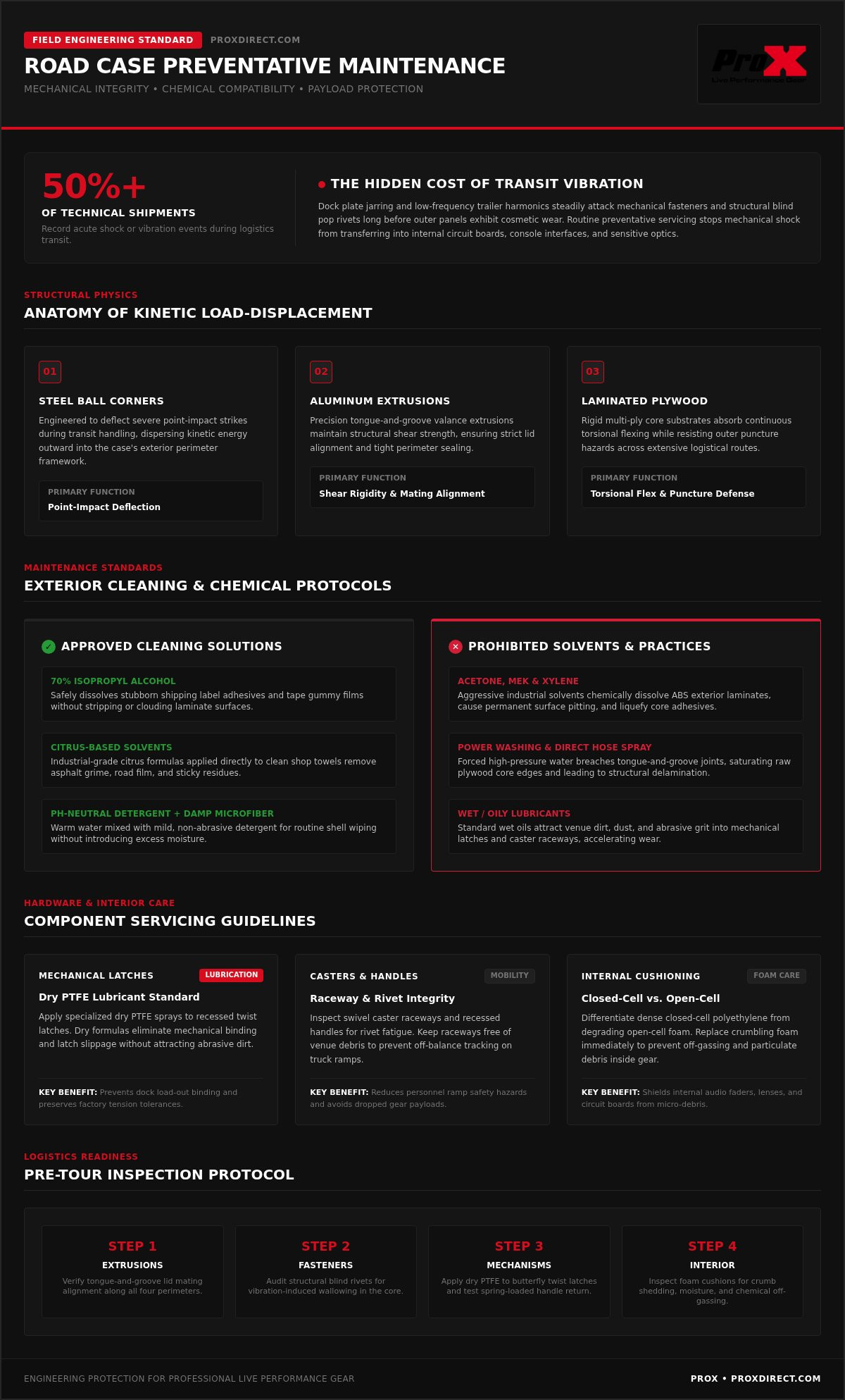
An ATA-style flight case functions as an integrated kinetic load-displacement system. Impact forces typically travel through standard structural paths:
- Steel Ball Corners: Deflect point-impact strikes and distribute shock loads outward into the perimeter framing.
- Aluminum Extrusions: High-tolerance tongue-and-groove extrusions maintain perimeter shear strength and lock mating lid sections securely.
- Laminated Plywood Panels: Rigid multi-ply birch substrates absorb torsional flex while resisting surface punctures.
Continuous transit vibration steadily attacks these mechanical joints. Low-frequency resonance stresses structural blind pop rivets, gradually wallowing out pre-drilled holes in the plywood core and loosening latch dishes. By mastering the core build engineering documented in the ultimate guide to flight cases, technicians can apply preventative road case maintenance tips that reinforce mechanical fasteners before structural shear occurs.
Essential Road Case Cleaning Procedures for Exterior Shells and Hardware
Accumulated road film, residual gaffer tape adhesive, and de-icing road salts steadily corrode exterior hardware while attacking protective panel finishes. While standard flight case catalogs display heavy-duty materials, they rarely outline chemical compatibility guidelines for field cleaning. Executing disciplined road case maintenance tips begins with removing these corrosive field elements after every tour leg before microscopic contaminants degrade panel adhesives or mechanical fittings.
Begin exterior washing by wiping down external panels with a damp microfiber cloth dampened with warm water and a mild pH-neutral, non-abrasive detergent. Avoid power washing or direct hose spray, as forced water penetrates perimeter tongue-and-groove joints and saturates internal raw wood edges.
Decontaminating Exterior Laminates Without Stripping Finishes
Adhesive removal requires strict chemical selectivity to protect outer finishes:
- Approved Cleaners: Use 70% isopropyl alcohol or specialized citrus-based industrial solvent cleaners applied directly to clean shop towels to dissolve shipping label glue and duct tape gummy films.
- Contraindicated Solvents: Avoid acetone, methyl ethyl ketone (MEK), and xylene entirely. These aggressive compounds dissolve ABS exterior sheets, cause permanent surface pitting, and soften the structural contact adhesives that fuse outer veneers to the plywood core.
- Moisture Management: Thoroughly towel-dry panels immediately after cleaning. Lingering liquids pool along bottom aluminum extrusions, eventually causing inner ply swelling and rot over repeated seasons.
Cleaning Aluminum Extrusions and Steel Ball Corners
Tongue-and-groove aluminum valances trap sand, crushed stage chalk, and gravel during truck loading. Clear this abrasive grit out of mating channels using stiff-bristled nylon detailing brushes; never use steel wire brushes, which score mating aluminum lips and ruin the perimeter alignment. If galvanized steel ball corners show signs of white zinc oxidation from winter slush or coastal fog, scrub them with fine non-metallic scouring pads, wipe clean, and mist with a micro-thin anti-corrosion water-displacement film before long-term storage.
Keeping a comprehensive fleet in fully operational condition requires reliable structural components. If heavily battered enclosures exhibit persistent valance distortion or damaged corner braces that cleaning cannot fix, upgrading to field-proven heavy-duty cases from ProX Cases restores structural reliability across challenging touring itineraries.
Mechanical Hardware Maintenance: Servicing Latches, Handles, and Casters
Mechanical hardware endures the highest physical cycle counts of any flight case component. Continuous kinetic shock, road vibration, and lateral load shifts steadily degrade moving assemblies over time. Applying actionable road case maintenance tips targeting mechanical pivot points prevents sudden hardware failure during truck pack operations and staging.
Spring-loaded recessed handles demand regular tension checks. Internal springs must snap the handle bail flush inside the recessed dish when released. A handle that sags outward creates a strike hazard, snagging on adjacent cases, door thresholds, or truck straps during rapid logistical moves. If an internal torsion spring fails, replace the handle assembly rather than securing it with tape.
Lubricating and Aligning Recessed Butterfly Latches
Butterfly latches lose clamping force when dirt and dried grime pack into the internal cam mechanism. Service latches by flushing the assembly with residue-free contact cleaner to clear particulates. Once dry, coat the internal cam tracks with dry PTFE spray or micro-fine graphite powder. Never apply standard wet lubricating oils or penetrating sprays; wet residues attract airborne sand, accelerate abrasive wear, and strip factory finishes. Inspect latch draw-down alignment to confirm the wing pulls the valances together with positive clamping tension without binding.
Caster Wheel Care, Debris Extraction, and Plate Fastener Torque
Caster assemblies carry the entire weight of loaded enclosures over rough dock plates and concrete thresholds. Inspect swivel casters regularly during active tours, executing three vital maintenance steps:
- Debris Extraction: Slice away carpet fibers, stage tape strings, and cable jacket shavings wound around wheel axle hubs using a utility knife. Left unchecked, wound fibers seize rolling bearings and tear outer dust seals.
- Bearing Lubrication: Re-grease open swivel raceways and wheel zerk fittings quarterly using an NLGI Grade 2 lithium complex grease. Scheduled lubrication prevents raceway brinelling, extending caster service life up to seven years under heavy touring conditions.
- Fastener Torque: Verify torque on all caster plate mounting bolts and nylon-insert lock nuts. Snug fasteners are vital on high-capacity TruckPaX™ truck pack cases, where dynamic transit shock can quickly shear loose mounting hardware.
Interior Preservation: Foam Maintenance, Odor Removal, and Moisture Control
Shock-absorbing foam represents the final barrier isolating sensitive electronics from kinetic shock, yet interior cushioning is frequently neglected until material breakdown occurs. Implementing rigorous interior road case maintenance tips prevents degrading foam from contaminating expensive electronics. Technicians must first categorize the foam polymer. High-density closed-cell polyethylene (PE) and cross-linked polyethylene (XLPE) offer five to ten years of structural memory, resisting fluids and repeated impacts. In contrast, open-cell polyurethane foam lasts roughly 12 to 24 months under active touring conditions before structural fatigue sets in.
Preventing Foam Degradation, Off-Gassing, and Chemical Breakdown
Polyurethane hydrolysis presents a serious hazard for production equipment. As open-cell foam absorbs ambient humidity, it undergoes chemical breakdown, turning tacky, crumbling into fine grit, and releasing acidic vapors that pit metal chassis and corrode circuit traces. It's vital to replace inserts immediately if foam exhibits crumbling or if permanent compression exceeds 15% to 20% of pocket depth. When re-securing lifting foam blocks, apply solvent-based industrial contact cement rather than water-based glues, which soften in humid truck bays. For modular interior partitions, use heavy-duty hook-and-loop fasteners to maintain stable load positions without tearing foam backings.
Deep Cleaning and Disinfecting Production Case Interiors
Abrasive venue grit settles deep into custom cutouts over time. Clear out sand, metal burrs, and stage dust by vacuuming interior compartments using a HEPA-filtered vacuum with a soft brush attachment. To clean closed-cell PE foam surfaces, wipe them down using a microfiber towel dampened with warm water and mild soap, but don't saturate the material. For trapped odors caused by damp weather or spilled fog fluid, apply an active enzyme treatment, then leave case lids fully open in a dry, ventilated shop environment until interior moisture drops to baseline.
Deploy rechargeable silica gel packs inside case cavities to absorb ambient humidity during warehouse storage cycles. For mobile video switchers, master monitors, and broadcast controllers that demand precision cushioning, explore heavy-duty AV broadcasting cases engineered with precision-milled protective interiors.
Routine Field Inspection Checklist: When to Repair vs. Replace Hardware
A disciplined touring schedule requires clear operational criteria to separate routine bench repairs from full chassis retirements. Establishing standard road case maintenance tips ensures shop technicians audit structural integrity methodically rather than relying on guesswork during rapid load-ins. Before dispatching production gear, run a ten-point structural audit across the enclosure. Close the case empty, latch every catch, and sight down all four perimeter edges to confirm the tongue-and-groove aluminum valances mate flush with zero light gaps. Simultaneously inspect the laminated birch panels for core delamination, soft spots from standing water, or structural impact punctures.
Pre-Tour Inspection Checklist for Production Crews
Audit each mechanical fastener under dynamic tension before staging cases on the truck dock. Verify these critical checkpoints:
- Rivet Retention: Examine all structural blind pop rivets anchoring edge extrusions and corner braces. If a rivet head spins freely or pulls away from the wood core, it requires immediate replacement.
- Latch Draw: Verify that butterfly latches pull the lid down securely without binding against misaligned extrusions.
- Handle and Brake Operation: Confirm spring-loaded handles retract fully flush into their recessed dishes, and engage caster pedal locks on a loading ramp decline to verify they hold static load weight securely.
Repair or Replace: Establishing Critical Safety Thresholds
Differentiating field-repairable wear from permanent chassis failure protects both gear and personnel. Isolated hardware failures don't warrant discarding an entire enclosure. Technicians can easily drill out loose rivets, install new heavy-duty caster wheels, or swap out stripped butterfly latches in the shop by sourcing OEM parts through dedicated ProX Cases inventory channels.
Conversely, retire cases that exhibit severe structural compromise. If a severe impact shears the inner plies of a plywood sidewall, crushes a structural corner joint beyond 90 degrees, or twists the aluminum extrusion perimeter so the lid cannot seat cleanly, retire the shell immediately. Bent valances expose internal gear to environmental hazards and fail to distribute kinetic shock evenly. When rebuilding your fleet or servicing modular racks, source heavy-duty components and specialized assemblies from ProX Direct to guarantee mechanical compatibility and tour-grade resilience.
Maximize Enclosure Lifespan with Proactive Fleet Care
Integrating consistent road case maintenance tips into regular shop workflows transforms transport enclosures into multi-decade protective assets. Methodical dry lubrication keeps butterfly latches clamping tightly, while routine foam inspections prevent particulate contamination caused by chemical breakdown. Rigorous caster wheel servicing and bolt torque checks eliminate transit shock before it reaches delicate production electronics.
ProX has engineered tour-grade flight enclosures and precision hardware since 1984, supporting crews through an extensive global distribution network. Direct access to a complete catalog of OEM replacement parts, heavy-duty casters, latches, and structural extrusions makes maintaining case geometry straightforward and cost-effective. Servicing worn mechanical hardware extends operational longevity, protecting your capital investments without the expense of premature case retirement.
Explore ProX Cases and Heavy-Duty Replacement Hardware to keep your production inventory secure, fully operational, and protected across every upcoming tour date.
Frequently Asked Questions
How often should touring road cases undergo a full maintenance inspection?
High-frequency touring enclosures should undergo a comprehensive bench inspection before every multi-week tour leg and quarterly during active runs. Key road case maintenance tips recommend auditing structural rivets, inspecting valance tongue-and-groove alignment, checking handle spring retention, and torqueing caster baseplate bolts before every deployment. Catching hairline fractures, worn casters, and loose fasteners in the warehouse prevents catastrophic breakdowns on truck loading ramps or stage wings.
What is the best lubricant for recessed butterfly twist latches and hinges?
Use dry PTFE spray or micro-fine powdered graphite to service recessed butterfly twist latches and hinges. These dry lubricants coat the internal cam tracks without attracting abrasive road grit, sand, or sawdust. Never apply wet penetrating oils, silicone gels, or petroleum spray solvents. Wet residues collect particulate matter backstage, accelerating mechanical friction and grinding away internal spring tension and zinc protective coatings.
Can you replace broken flight case hardware without damaging the wood panels?
Yes, technicians can replace broken handles, latches, and ball corners cleanly by drilling out the original blind pop rivets. Use a drill bit matched precisely to the rivet diameter to core out the factory rivet head without expanding the hole in the laminated birch panel. Push the remaining shank through, align the new OEM hardware, and set fresh structural blind rivets backed with interior steel or aluminum support washers.
How do you remove stubborn stage tape residue without ruining case laminates?
Apply 70% isopropyl alcohol or a mild citrus-based adhesive remover directly to a microfiber towel to lift gaffer tape residue. Gently buff the exterior laminate until the tacky adhesive dissolves, then wipe the area dry with a clean cloth. Never use aggressive industrial solvents like acetone, xylene, or MEK. These volatile chemicals dissolve protective ABS plastic coatings, cause surface discoloration, and weaken contact adhesives binding the plywood plies.
Why is the foam inside older road cases becoming sticky or crumbly?
Crumbly or sticky interior foam indicates advanced polyurethane hydrolysis, a chemical breakdown triggered by ambient moisture and heat. Inexpensive open-cell polyurethane foam typically degrades within 12 to 24 months under heavy touring use. Once it begins off-gassing acidic vapors and shedding fine dust, it can short out circuit boards and etch equipment finishes. Replace deteriorating foam immediately with closed-cell polyethylene or cross-linked EVA foam inserts.
What should you do if an aluminum tongue-and-groove lid becomes misaligned?
First, check the mating channels for trapped grit or crushed tape fragments that prevent complete closure. If an extrusion is slightly warped from an impact, tap it back into alignment using a non-marring dead-blow rubber mallet and a protective wood block. For warped panels, following systematic road case maintenance tips helps pinpoint whether the bend originates in the aluminum valance or a racked wooden chassis requiring structural rebuild.
How do you protect road cases from corrosion during outdoor festival tours?
Wipe down damp exterior hardware immediately following rainy load-outs, paying close attention to zinc-plated steel ball corners and recessed latch pans. Clear away mud and grass clippings using a stiff nylon detailing brush. Apply a micro-thin water-displacing corrosion inhibitor to exposed metal hardware, and place rechargeable silica gel desiccant packs inside the case cavity before latching the lid shut for storage in humid environments.
Disclaimer
Any trademarks, trade names or brand names appearing herein that do not belong to ProX are the property of their respective owners and/or companies, and such appearance doesn't and shall not constitute or imply endorsement, sponsorship or recommendation by ProX.


