

A 2025 survey of event production companies revealed that implementing a standardized cable management system reduces troubleshooting time by at least 50%. Yet, under tight venue schedules, haphazard packing continues to compromise timelines and crush internal conductors beneath shifting multi-pair snakes. Implementing an engineered method for organizing cables in a utility trunk isn't merely an aesthetic preference; it directly dictates whether your signal lines survive the physical trauma of intense transit.
Every touring technician knows the frustration of unearthing a tangled bird's nest of feeder lines while the clock ticks toward doors. Shifting payload weight during haul-in often causes invisible copper fatigue, severed optical strands, and missing patch runs right when you need them most. You can eliminate these points of failure. Mastering professional cable packing methods will protect your high-cost copper and optical assemblies, eliminate tangles, and accelerate stage turnovers under strict deadlines. In this guide, we detail structural partitioning strategies, cable isolation techniques, and crew-wide loading protocols designed to keep your production moving smoothly.
Key Takeaways
- Standardize over-under coiling protocols across the production crew to eliminate torsional mechanical stress and internal conductor fatigue.
- Implement structured compartmentalization when organizing cables in a utility trunk to isolate delicate optical lines from heavy feeder runs.
- Execute a strict bottom-to-top density progression during load-in to keep heavy multi-pair assemblies from crushing sensitive patch cables.
- Apply durable color-coding rings and clear heat shrink identification to enable instant line length recognition during rapid stage turnovers.
- Select modular utility enclosures engineered with heavy-duty caster assemblies and truck-pack dimensions to optimize trailer space and transit stability.
Cable Preparation Protocols: Coiling Techniques and Initial Classification
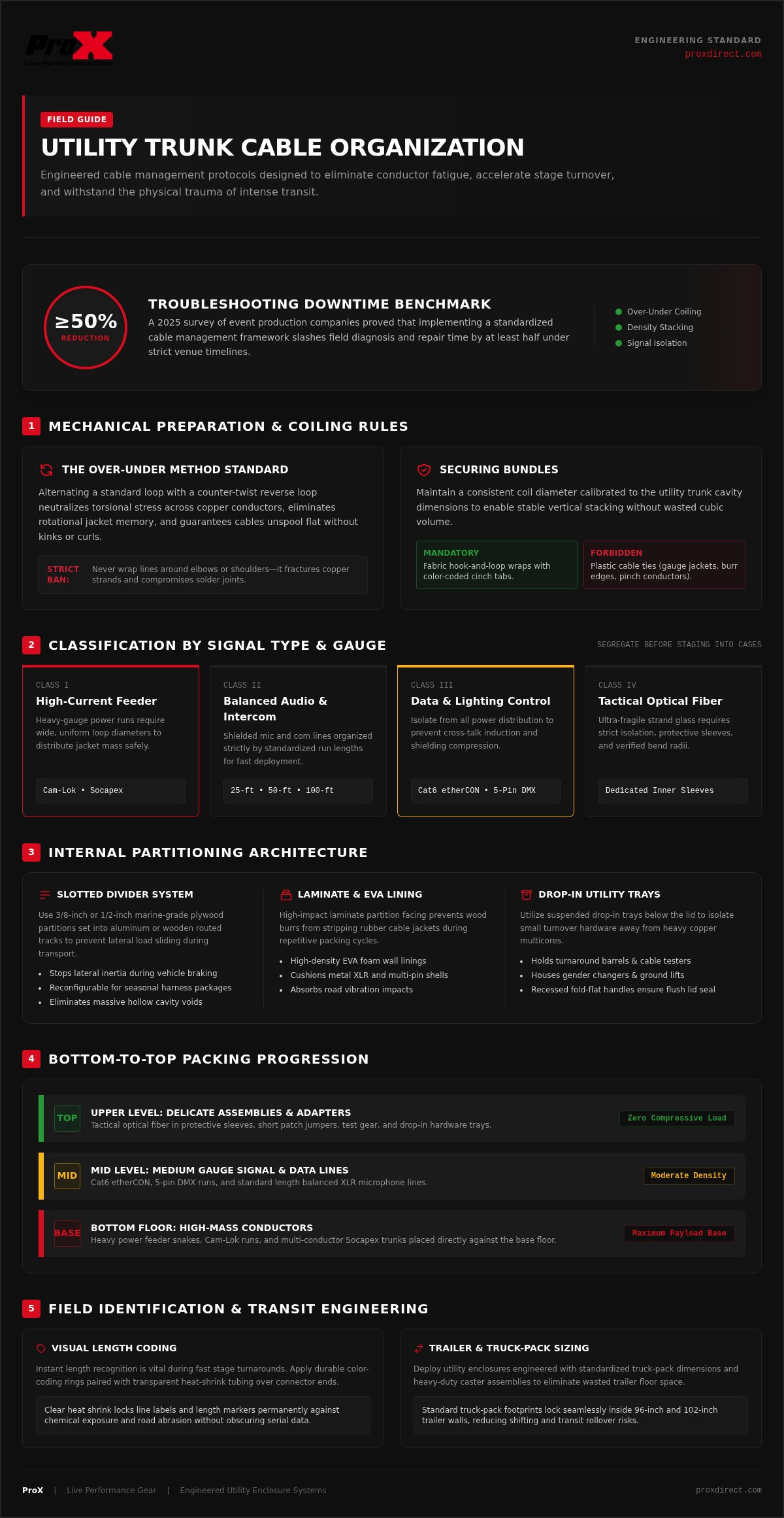
Organizing cables in a utility trunk begins well before lines ever reach the foam-lined lid. When high-amperage lines, multicores, and signal patch cables are dumped into an enclosure without mechanical prep, road vibrations turn loose loops into structural failure points. Road crews that skip systematic prep protocols invariably face core breakage, braid separation, and erratic grounding loops. Proper coiling neutralizes torsional stress across copper conductors and preserves shield geometry under demanding freight conditions. Securing these bundles requires durable fabric hook-and-loop straps; avoid plastic cable ties, which gouge jackets, create sharp burrs, and pinch internal conductors.
The Over-Under Coiling Standard for Production Reliability
The over-under technique remains mandatory across touring crews. Alternating a standard loop with a counter-twist reverse loop eliminates rotational memory in the cable jacket. When staged, an over-under wrapped run unspools flat across a floor without curling or creating kinks. Never wrap cables around elbows or shoulders. This shortcut bends wires beyond their rated bend radius, fractures copper strands, and strains fragile connector solder cups. Maintain a consistent coil diameter matching the trunk's inner cavity dimensions, allowing vertical stacking without wasted volume.
Categorizing Cables by Signal Type and Gauge
Signal isolation must happen during coiling rather than during load-in. Heavy power lines crush sensitive conductors if packed indiscriminately, causing erratic drops during live performances. Separate lines systematically before loading into a protective road case container:
- High-Current Power Feeder: Coil heavy Cam-Lok and multi-conductor Socapex into wide, uniform loops to manage heavy jacket mass.
- Balanced Audio and Intercom: Group shielded microphone lines by standard run lengths (25-foot, 50-foot, 100-foot) using color-coded cinch wraps to accelerate field deployment.
- Data and Lighting Control: Coil Cat6 etherCON and 5-pin DMX assemblies separately from power runs to avoid cross-talk induction and crushed shielding.
- Tactical Fiber Optic Lines: Always route delicate optical assemblies through dedicated protective sleeves or inner cases, strictly adhering to manufacturer bend-radius limits.
Standardizing these physical preparation steps guarantees that anyone organizing cables in a utility trunk can drop every coil into assigned partitions cleanly, drastically cutting venue changeover times.
Trunk Compartmentalization: Dividers, Trays, and Partition Systems
Throwing coiled lines into a hollow, open trunk creates a chaotic void during transit. Heavy copper coils shift under road vibration, working their loops together until simple unpacks turn into frustrating mechanical extraction jobs. While knowing the proper way to wind lines keeps individual conductors intact, disciplined containment preserves that effort. Effective methods for organizing cables in a utility trunk rely entirely on modular interior architecture rather than deep, cavernous bins.
Fixed vs Adjustable Marine Plywood Dividers
Open floor spans inside trunks invite heavy loads to slide. Inserting slotted 3/8-inch or 1/2-inch marine-grade plywood partitions creates dedicated boundary channels that stop lateral inertia during sudden braking. Adjustable dividers slide along routed aluminum or wooden tracks, giving production teams the flexibility to resize bays around seasonal harness packages without compromising wall stiffness. High-impact laminate faces on every divider face prevent burrs from abrading rubber jackets, while thin, high-density EVA foam wall linings cushion metal XLR barrels and multi-pin connector shells against rigid boundaries.
Removable Utility Trays for Adapters and Short Jumpers
Small jumper lines, breakout tails, and turnaround barrels vanish when dropped into the lower regions of deep trunks. Suspended drop-in utility trays eliminate this issue by utilizing the empty top volume directly below the lid:
- Hardware Isolation: Integrated tray bins keep gender changers, ground lifts, and cable testers isolated away from heavy multicores.
- Flush Clearance: Industrial recessed fold-flat tray handles guarantee smooth removal while preventing contact with the lid foam when latched.
- Rapid Deployment: Stage techs can pull an entire top tray out at front-of-house or dimmers, leaving the trunk base accessible for primary loom extraction.
When outfitting touring inventory, integrating modular partition systems with industrial ProX Cases utility enclosures establishes a clean, repeatable loadout that prevents transit damage across full tour cycles.
How to Pack a Utility Trunk: Stacking and Weight Distribution
Loading an enclosure without a calculated density progression invites equipment failure. In professional live touring, seasoned road veterans emphasize must-have cable management skills because improper stacking crushes delicate inner lines long before cases reach the stage. Heavy copper coils placed atop fragile runs cause internal conductor displacement, shield pinching, and jacket cracking under typical trailer vibration. Mastering the physics of organizing cables in a utility trunk requires a strict bottom-to-top weight hierarchy paired with vertical array placement.
Bottom Layer: Heavy Feeder, Socapex, and Multicores
Position the heaviest payload directly over the wheel plates. Stacking 4/0 feeder sets, multi-conductor lighting runs, and heavy multi-pair drive snakes at the floor anchors the center of gravity low. This base stabilization prevents top-heavy tip-overs during truck ramp transitions and dock navigation. Coil heavy lines flat and tight across the floor pan to eliminate hollow pockets beneath. Keep heavy multi-pin connectors away from case boundary walls; shifting metal shells against exterior panels can crack housings or shear panel rivets during sharp highway turns.
Mid to Top Layer: Microphone Lines, DMX, and Video Cables
Never lay standard balanced runs, network cables, or video lines flat on top of one another. Flat stacks bury necessary inventory, forcing stage hands to pull out entire layers to retrieve a single line. Instead, pack coiled runs vertically on edge like books across your partition bays:
- Direct Visual Auditing: Technicians can immediately inspect inventory levels and read length markings without disturbing adjacent runs.
- Rapid Deployment: Crews can pull designated 25-foot or 50-foot runs directly from the vertical stack without snagging neighboring coils.
- Shield Protection: Vertical arrangement disperses downward force along coil edges, preventing crushed inner insulation on delicate SDI, network, and audio lines.
Load Restraint and Impact Damping
Internal void volume allows contents to drift when haulers brake hard. Empty gaps between coils let bundles unravel into chaotic nests through highway friction. Fill residual top gaps with canvas utility drapes, stage sandbags, or dense closed-cell foam blocks to lock the payload firmly in place. Choosing heavy-duty ProX Cases built with recessed industrial butterfly latches provides the positive clamping force needed to compress the internal load, securing delicate runs when organizing cables in a utility trunk across long haul routes.
Labeling and Color-Coding Systems for Rapid Stage Turnover
Adhesive paper tape fails quickly under touring conditions. Road heat turns low-grade adhesives into gummy residues that foul hands and attract dirt, while printed labels peel away during high-friction pulls. Rapid stage turnover demands physical identification that remains readable in low-light wings from several feet away. A comprehensive visual standard accelerates changeovers and prevents lost inventory during midnight strikes. Organizing cables in a utility trunk reaches maximum efficiency only when every line displays an unmistakable visual signature before it leaves a technician's hands.
Industry Standard Color Conventions for Cable Lengths
Production departments rely on uniform color rings positioned at both termination boots to convey line length instantly. Instead of uncoiling a run across the stage deck to verify its reach, technicians simply read the colored collars. While internal shop standards can vary, the most widely adopted production convention designates length by specific base colors:
- Blue: 10-foot patch runs and short interconnects.
- Yellow: 25-foot standard stage drops and vocal lines.
- Green: 50-foot primary stage runs and instrument lines.
- Red: 100-foot main trunk lines and long returns.
- Dual-Color Striping: Identifies phase-reverse adapters, ground lifts, or dedicated cross-over data feeds.
To lock this coding in permanently, slip clear, dual-wall adhesive heat shrink tubing directly over printed barcode and length tags. Heating the polyolefin sleeve activates an internal sealant that seals out moisture, grease, and mechanical friction, preserving critical scannable data for the entire life of the line.
Interior Case Lid Cue Sheets and Tracking Systems
Accountability at the strike phase requires instant visual auditing. Mounting an acrylic sleeve or laminated cue sheet directly inside the case lid establishes a clear compartment map for local stagehands. The sheet lists the exact inventory count assigned to each partition channel. When a bay is short by three 50-foot runs, the loading crew spots the void immediately before the lid latches.
Exterior labeling matters just as much out on the dock. Standard tour label dishes riveted to the exterior plywood allow road staff to mark truck destinations, case weights, and production zones without leaving residue. If you manage extensive inventories across multiple regional semi-trailers, coordinate your deployment by reviewing our heavy-duty TruckPaX™ Truck Pack Cases to optimize logistical fleet integration and simplify dock-side scanning.
Selecting the Right Utility Trunk: Engineering Features That Matter
Build quality determines how well your internal cable architecture holds up against the road. A meticulously packed trunk cannot protect delicate core wiring if the container flexes under torque or fails during transit. In high-demand live production environments, organizing cables in a utility trunk requires an enclosure engineered to endure severe mechanical stress, multi-ton stacking forces, and continuous road vibration. Investing in robust hardware ensures your carefully compartmentalized signal and power runs stay fully protected between tour stops.
Structural Integrity: Plywood Thickness and Hardware Joinery
Touring enclosures demand rigid exterior paneling that resists severe impact and lateral compression. Professional builds utilize precision 3/8-inch or 1/2-inch multi-layer plywood laminated with a scratch-resistant honeycomb pattern to deflect scuffs, moisture, and road grime. Heavy-duty steel ball corners absorb sudden drops on dock plates, while integrated caster dishes on the lid facilitate secure vertical stacking in the warehouse. Dual-anchor industrial rivets bind aluminum tongue-and-groove extrusions tightly to the frame. Recessed industrial butterfly latches draw the lid and base together with positive clamping pressure, keeping dust out and maintaining structural rigidity under load.
Logistical Standardization: The Truck-Pack Footprint
Standardized exterior case dimensions are critical for touring efficiency. Enclosures engineered with modular truck-pack footprints align flush within standard 96-inch box trucks and 102-inch semi-trailers. Sizing cases to fit two-wide or three-wide eliminates loose trailer voids and stops dangerous load shifting during highway transit. Industrial 4-inch caster assemblies with heavy-duty top plates roll easily across door thresholds and steep ramps, while dual-locking wheels keep trunks anchored during staging.
Recessed spring-action handles sit flush to avoid shear damage during tight truck packs. To evaluate materials and construction methods, consult The Ultimate Guide to Flight Cases. Deploying standard Utility/Storage Cases throughout your fleet establishes a reliable, repeatable loading strategy, protecting hardware and maximizing efficiency when organizing cables in a utility trunk for regional or national tours.
Standardize Your Cable Logistics for Flawless Production Runs
Systematic cable management transforms hectic load-ins into predictable, efficient deployments. By enforcing the over-under coiling protocol, maintaining vertical slot arrays, and applying high-visibility color coding, you protect delicate conductors while accelerating stage turnovers. Mastering the logistics behind organizing cables in a utility trunk ensures that every copper snake, breakout loom, and optical drop arrives in working order night after night.
Your workflow is only as dependable as the hardware safeguarding it. Since 1984, ProX has engineered performance-grade protection built around precision-engineered plywood construction designed for heavy touring. Featuring heavy-duty steel ball corners with integrated stacking dishes, these enclosures endure punishing load transfers and severe highway vibrations without buckling. Equip your production crew with rugged Utility/Storage Cases from ProX to streamline trailer packs, safeguard valuable lines, and execute seamless venue strikes on every leg of your tour.
Frequently Asked Questions
Why is the over-under coiling technique preferred for production utility trunks?
The over-under technique neutralizes internal torsional twist by pairing standard loops with counter-twist reverse loops. Wrapping cables in this manner prevents the internal copper conductors from binding, curling, or kinking under transit pressure. It also preserves cable memory, allowing technicians to throw smooth, flat runs across the stage deck instantly without creating knots or snagging neighboring lines.
How do you prevent cables from shifting and tangling during truck transport?
Prevent shifting by eliminating interior void space and using vertical boundary partitions. When organizing cables in a utility trunk, pack coiled runs upright on edge within dedicated divider bays to stop bundles from sliding laterally. Top off any remaining void spaces beneath the lid with canvas utility drapes or dense foam blocks, then clamp the industrial butterfly latches tight to immobilize the entire payload.
What is the best way to divide a utility trunk for multiple cable types?
The most effective strategy utilizes adjustable, slotted 3/8-inch or 1/2-inch marine plywood dividers combined with a suspended top utility tray. Rigid vertical dividers isolate different signal classes and line lengths into individual bays across the main floor. The drop-in top tray captures short jumpers, breakout barrels, and turnaround adapters, keeping small components separated from deep multi-pair lines.
Should heavy power feeder cables be stored in the same trunk as audio cables?
You can store them in the same enclosure only if they are physically isolated by rigid structural partitions and packed with a strict bottom-to-top density progression. Heavy Cam-Lok feeder lines must sit flat on the floor pan to keep the center of gravity low. Placing heavy power runs directly on top of delicate shielded audio lines will crush foil shielding, deform copper conductors, and cause premature line failure.
How can crew members quickly identify cable lengths in low-light stage wings?
Apply standardized, high-visibility colored bands to the strain-relief boots on both connector ends. Utilizing standard color designations, such as yellow for 25-foot runs and green for 50-foot runs, allows crew members to identify line reach from 10 feet away. Encasing these color bands and barcode asset labels beneath clear, dual-wall adhesive heat shrink tubing protects the identification from peeling, scuffing, and road grime.
What caster size is recommended for heavy cable utility trunks?
Heavy-duty 4-inch industrial casters with reinforced mounting plates are the standard recommendation for trunk enclosures. Cables represent one of the densest payloads in live event production, and larger 4-inch wheels effortlessly clear dock thresholds, truck ramps, and warehouse expansion joints without binding. Ensure at least two wheels feature positive-locking brakes to secure the trunk on inclined ramps and working stages during loading.
Disclaimer
Any trademarks, trade names or brand names appearing herein that do not belong to ProX are the property of their respective owners and/or companies, and such appearance doesn't and shall not constitute or imply endorsement, sponsorship or recommendation by ProX.


