

Professional truck packing isn't improvised puzzle solving; it's an applied science of fractional geometry and load securement. Production managers know that finding the best way to stack cases in a truck means ditching guesswork in favor of modular footprint planning. When cases don't lock together cleanly on the deck, road vibration quickly turns minor gaps into catastrophic equipment shifts.
You already understand the high stakes of interstate transit. Gear rolling between axle groups damages delicate internal components, cracked caster dishes create unstable tiers, and wasted cubic volume triggers costly secondary freight dispatches. Worse yet, an unevenly loaded deck can put your vehicle in violation of federal gross axle weight ratings. By mastering standardized modular dimensions, caster dish stacking techniques, and axle weight distribution, you can build zero-clearance, interlocking walls that eliminate transit failures. This logistics guide details the engineering principles and deck-loading math required to keep your production gear protected, road legal, and fast to strike.
Key Takeaways
- Standardizing your footprint around 90-inch or 96-inch modular dimensions provides the best way to stack cases in a truck without leaving empty voids.
- Distributing heavy cable vaults and amp racks forward of trailer tandems maintains axle weight compliance and protects vehicle suspension systems.
- Staging equipment on the dock by footprint width and mass ensures clean, interlocking walls from the front bulkhead to the tail.
- Seating wheels securely into lid-mounted steel caster dishes and aligning swivels parallel to trailer walls prevents tier shifts under braking forces.
- Integrating rigid truss lengths and utility enclosures around sensitive console housings stabilizes irregular cargo during interstate transport.
Understanding Truck Pack Dimensions and Modular Case Geometry
Truck pack geometry aligns external case dimensions directly with freight trailer widths. In professional event logistics, finding the best way to stack cases in a truck starts with treating the deck as an engineered grid. Improvised loading creates air gaps. Under dynamic road transport, those gaps allow equipment to drift, crush exterior extrusions, and damage internal components. Aligning equipment footprints with standard carrier interiors transforms separate road trunks into a unified cargo block that adheres to fundamental load securing principles.
Standard Trailer Widths in Live Event Production
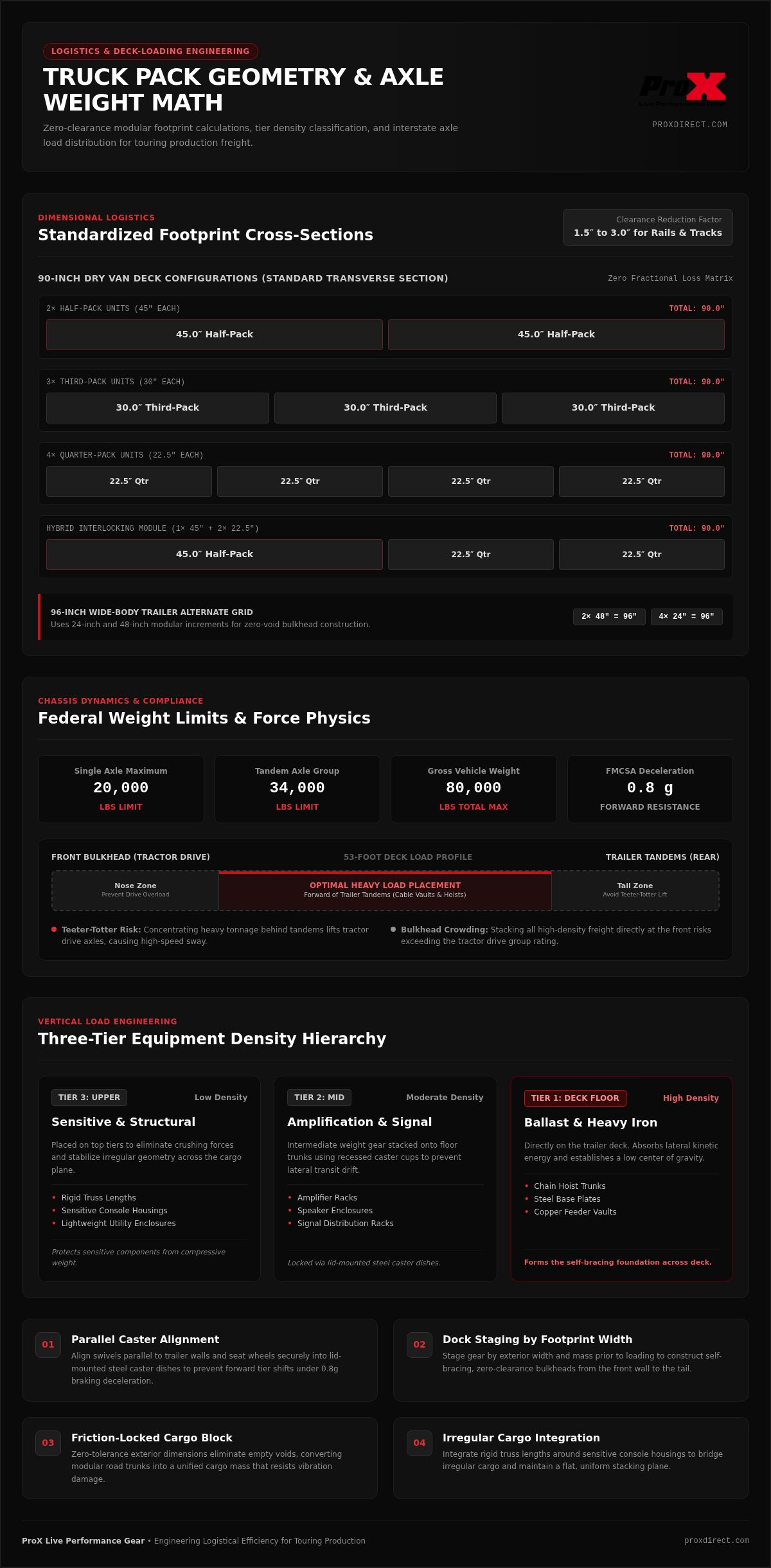
Commercial freight logistics relies primarily on two interior trailer widths: 90-inch dry vans and 96-inch wide-body trailers. Standardizing cargo footprints requires planning for physical obstructions inside the box. Vertical logistics tracks, rub rails, and roll-up door jambs reduce interior clearance by 1.5 to 3 inches. When calculating usable floor space across a 53-foot deck, external case measurements must accommodate these mechanical boundaries to prevent binds against side skins. Touring professionals rely on ProX Cases built to these exterior specifications to guarantee zero fractional loss along the walls.
The Fractional Math of Touring Enclosures
Zero-tolerance loading uses a fractional grid based on integer divisors of standard wall widths. Within a 90-inch system, touring cases are constructed in three primary dimensions:
- Half-pack: 45-inch exterior width
- Third-pack: 30-inch exterior width
- Quarter-pack: 22.5-inch exterior width
Combining two 45-inch cases, three 30-inch cases, or four 22.5-inch cases creates an identical 90-inch transverse cross-section. Crews can also mix modules, such as one 45-inch half-pack paired with two 22.5-inch quarter-packs. For 96-inch trailers, an alternate grid relies on 24-inch and 48-inch increments. Modular systems like TruckPaX™ Truck Pack Cases leverage this dimensional math. Interlocking standard footprints side-by-side forms self-bracing bulkheads across the box. This math establishes the best way to stack cases in a truck by turning open floor space into a stable, friction-locked load that stays pinned during emergency stops.
Weight Distribution Physics: Protecting Axles and Equipment
Managing axle mass is just as critical as locking in case footprints. Finding the best way to stack cases in a truck requires calculating how gross vehicle weight transfers across the chassis during transit. An improperly distributed deck risks mechanical strain, uneven tire wear, and failed Department of Transportation roadside scale checks. Under federal interstate standards, commercial vehicles must not exceed 20,000 pounds on a single axle, 34,000 pounds on a tandem axle group, and an 80,000-pound gross vehicle weight. Compliance demands balance before the trailer doors shut.
Balancing the Center of Gravity and Axle Ratings
Maintaining a low, centered load profile preserves steering control and braking efficiency. Positioning dense cargo too far behind the trailer tandems creates a teeter-totter effect, lifting weight off the drive axles and inducing high-speed trailer sway. Conversely, crowding excessive tonnage against the front bulkhead overloads the tractor drive group. Federal enforcement under FMCSA cargo securement rules requires cargo systems to withstand 0.8 g forward deceleration forces. Heavy equipment must be positioned forward of the trailer axles without exceeding individual axle ratings.
Classifying Equipment by Weight and Density
Systematic tiering prevents structural failure and keeps the center of gravity near the floorboards. Classify inventory into three distinct density tiers before loading:
- Floor Tier (High Density): Position chain hoist trunks, steel base plates, power distribution racks, and heavy copper feeder vaults directly on the trailer deck. These dense units absorb lateral energy and stabilize lower walls.
- Mid Tier (Moderate Density): Stack amplifier racks, speaker enclosures, and delicate signal hardware above floor trunks. Structural hardware like recessed caster cups on ProX Cases prevents these mid-tier layers from drifting under transit vibration.
- Top Tier (Low Density): Reserve upper tiers for lightweight utility trunks, empty road trunks, and wardrobe cases. Never deck-load heavy hardware on top of delicate electronics housings.
This tiered strategy represents the best way to stack cases in a truck while safeguarding internal components against excessive vertical shock. Heavy base tiers resist dynamic g-forces, while lighter upper tiers prevent crushing bottom caster assemblies and lid extrusions during hard stops.
Step-by-Step Execution: Building a Solid Wall from Front to Back
Executing an efficient pack requires operational discipline long before the first road trunk rolls up the ramp. Debris, loose screws, or broken pallet nails on the trailer bed can puncture plywood panels or jam swivel bearings during transit. Sweeping the deck clean prevents irregular floor friction that disrupts case alignment. Mastering the best way to stack cases in a truck depends on establishing rigid vertical cross-sections directly against the front nose wall, ensuring each completed tier locks tight before advancing toward the tail doors.
Staging and Grouping on the Loading Dock
Efficient loading starts outside the box. Stage cases on the dock in pre-planned blocks based on exterior footprint dimensions and relative mass. Keep heavy power distribution units and motor trunks together, while grouping sensitive items like AV Broadcasting Cases apart from raw rigging components. Pre-align all caster sets perpendicular to the load face. This mechanical adjustment accelerates pushing and allows hands to roll enclosures straight into their assigned truck slots without dock-side turning delays.
Locking the Base Layer and Building Vertical Tiers
Forming a secure load demands following proven steps to properly load a trailer from the floor upward. Build each wall completely before starting the next:
- Pin the base tier: Push the heaviest utility enclosures flush against the front bulkhead nose. This eliminates forward momentum space and forms a rigid barrier.
- Engage caster locks: Set wheel brakes on all exterior cases, or flip heavy units directly onto bottom skid runners to create positive floor traction.
- Nest upper tiers: Hoist upper enclosures into position, nesting their casters into the recessed stacking dishes of the lower lids.
- Align structural corners: Align steel ball corners precisely over the lower case frame to transfer downward loads through vertical aluminum extrusions rather than center lid panels.
Eliminating Air Gaps to Prevent Momentum Buildup
Even a 2-inch horizontal void creates severe transit hazards. When a trailer stops, unrestrained equipment accelerates across those open gaps, transforming static weight into destructive impact force against adjacent hardware. To preserve wall integrity, pack empty spaces tightly. Slide sandbags, ballast weights, or heavy soft-goods trunks directly into lateral voids between case sides and trailer ribbing. Maintaining a completely flat, plumb face across every row represents the best way to stack cases in a truck, ensuring the entire wall acts as a single, rigid unit that absorbs highway vibration without buckling.
Securing the Load: Caster Alignment, Stacking Dishes, and Shoring
Locking rolling road cases into an unyielding cargo wall requires deliberate mechanical restraint. Finding the best way to stack cases in a truck means controlling rolling hardware and reinforcing vertical stacks with physical barriers. Wheel brakes alone won't hold under dynamic highway transit. To resist forward and rearward inertia, swivel casters on the floor tier must be aligned parallel to the trailer walls rather than facing the nose. This parallel orientation forces the casters to slide sideways across the wood planking rather than roll freely if an unexpected gap opens during transit.
Mechanical Locking: Caster Dishes and Ball Corners
Vertical tiering relies entirely on positive mechanical engagement between stacked units. High-grade touring enclosures incorporate deep-recessed steel caster dishes stamped directly into the lid panels. When hoister crews place an upper case on top of a lower unit, every blue caster wheel must seat flush inside its corresponding dish. This physical pocket prevents upper cases from drifting sideways under lateral cornering loads. In addition, interlocking ball corners reinforce exterior aluminum tongue-and-groove extrusions by transferring vertical shock directly through the perimeter plywood panels. Inspect the structural stacking hardware across ProX Cases to ensure your inventory features matched caster dishes and certified corner reinforcements.
Shoring Bars and Logistics E-Track Systems
Even perfectly interlocked tiers require horizontal load bars to handle severe braking deceleration. Commercial trailers feature horizontal logistics E-track rails welded along the sidewall posts. Deploy heavy-duty, rated ratchet straps and adjustable aluminum shoring beams across every third completed equipment tier:
- Lock shoring beams at two-thirds height: Snap rigid aluminum shoring bars into the horizontal track at roughly two-thirds of the total stack height. This counteracts the rotational tipping axis of tall two-high or three-high stacks.
- Apply uniform strap tension: Ratchet logistics straps across the face of the case wall. Snug them firmly without applying excessive mechanical pressure that could bow exterior plywood panels inward.
- Section your cargo: Building independent, shored compartments every three tiers ensures that if an isolated case shifts, the entire trailer doesn't cascade backward into the tail.
Combining positive wheel-pocket seating with mechanical shoring beams represents the best way to stack cases in a truck while preventing cargo avalanches at the loading dock. To upgrade your fleet's transit security hardware, explore professional touring enclosures and hardware accessories at proxdirect.com before your next major run.
Specialized Stacking Strategies for Mixed and Irregular Production Cargo
Live production freight rarely consists purely of uniform rectangular road trunks. Touring manifests frequently require integrating irregular shapes like aluminum truss chords, circular base plates, and ultra-fragile digital mixing consoles. Finding the best way to stack cases in a truck containing mixed cargo requires integrating rigid structural components alongside standard modular footprints without creating voids or uneven pressure points.
Integrating Staging Truss, Base Plates, and Pipe
Heavy half-inch steel base plates carry immense mass; lay them dead flat across the wood floorboards beneath rolling utility trunks or pin them vertically using dedicated perimeter staging bins. Stack 12-inch or 16-inch aluminum box truss sections using dense dunnage spacers or specialized wheeled dollies to prevent aluminum tube gouging against case panels. For purpose-built hardware transport solutions, review engineered Stage Truss and Base Plate Cases that convert irregular metalwork into standard modular footprints.
Protecting Shock-Mounted Mixers and Sensitive Video Panels
Large audio console housings and delicate flat-panel LED displays demand isolated positioning. Place large digital consoles resting on heavy-duty dampening skids along the centerline of the trailer, directly over the floor stringers where vertical frame deflection is minimized. Flank LED video panel trunks tightly between rigid utility enclosures to eliminate lateral flex. Always verify the physical condition of internal elastomer shock mounts inside rack frames before rolling them into place. Highway vibration can loosen internal PCB assemblies if cases are allowed to teeter against unyielding steel hardware.
Building the Tail Pack: Final Containment at the Doors
The rear bay is the most volatile zone on the trailer deck. The best way to stack cases in a truck culminates in an immovable tail-pack barrier constructed directly inside the roll-up door:
- Fill tail voids: Pack the final row with ramp storage, folding worktables, and heavy rubber cable crossovers placed firmly on edge.
- Form a solid vertical face: Ensure all cases facing the tail match in height to present a flat plane for strapping.
- Rig crisscross retention straps: Install heavy-duty ratchet straps in an interlocking "X" configuration anchored to the final vertical E-track slots.
This barrier prevents freight from resting against the roll-up door during transit, preventing cargo avalanches when hands release the latch at the loading dock.
Engineer Precision into Your Fleet Logistics
Achieving zero transit damage requires replacing loading dock guesswork with applied mechanical discipline. Standardizing enclosure footprints around modular 90-inch or 96-inch grids, balancing mass forward of trailer tandems, and mechanically locking wheels into lid pockets represents the best way to stack cases in a truck. These deliberate techniques eliminate wasted cubic volume, protect sensitive audio-visual electronics from dynamic vibration, and keep your fleet fully compliant with federal axle ratings.
ProX has engineered road-tested protection since 1984. Every enclosure is built with heavy-gauge steel ball corners, deep-recessed caster dishes, and modular dimensions designed specifically for standard truck packing grids to maximize cargo density. When every minute of load-in counts, reliable hardware keeps your crew moving fast and your gear operating flawlessly. Take control of your trailer deck and explore ProX heavy-duty cases for professional touring logistics today.
Frequently Asked Questions
Can you stack flight cases with caster wheels still attached?
Yes, you can safely stack flight cases with casters attached if the lower lid features integrated steel caster dishes. These recessed cups seat the wheels securely, preventing lateral drift while transferring downforce through the case perimeter. Never place caster wheels directly on flat plywood lids lacking dishes. The concentrated point load can crush the wood panel and compromise structural extrusions beneath.
What is the 90-inch rule in commercial truck packing?
The 90-inch rule refers to dimensioning cases into fractional modules that cleanly divide standard 90-inch trailer interior widths. Cases sized in 45-inch (half), 30-inch (third), or 22.5-inch (quarter) increments fill the transverse deck without leaving lateral voids. Applying this dimensional discipline is the best way to stack cases in a truck because it forms self-bracing bulkheads that eliminate shifting against trailer sidewalls.
How do you prevent top cases from sliding off lower tiers?
Top cases are prevented from sliding by fully engaging lower-tier caster dishes and maintaining plumb vertical alignments. Upper wheel assemblies must drop cleanly into the recessed steel cups of the case below. For added stability on dynamic road routes, install horizontal aluminum shoring beams locked into trailer E-track rails at two-thirds overall stack height, backed by cross-straps that compress the tiers together.
Where should the heaviest equipment cases be placed in a truck?
Place high-density equipment-such as chain hoist trunks, copper feeder vaults, and steel base plates-directly on the trailer floor ahead of the rear axle group. Distributing heavy mass across the floorboards forward of trailer tandems provides the best way to stack cases in a truck without exceeding federal gross axle weight ratings or lifting tongue weight off tractor drive axles.
How do you pack odd-sized gear that does not match standard footprints?
Pack non-standard cargo by isolating irregular items against exterior walls or within purpose-built dunnage cradles. Truss lengths should ride in wheeled dollies or stacked on dense wood runners along wall ribs. Fill remaining lateral voids with cable trunks, worktables, or ballast bags. Maintain flat vertical faces across adjoining modular cases so irregular items cannot oscillate into adjacent electronic housings during transit.
What type of straps should be used to secure road cases inside a trailer?
Use two-inch or three-inch heavy-duty commercial ratchet straps fitted with rated spring E-fittings designed for logistics tracks. Ensure all tiedowns carry clear working load limit (WLL) markings, maintaining aggregate strength equal to at least 50% of the restrained cargo mass. Avoid light cam straps or non-rated utility webbing, which stretch under dynamic deceleration forces and permit destructive tier movement.
Disclaimer
Any trademarks, trade names or brand names appearing herein that do not belong to ProX are the property of their respective owners and/or companies, and such appearance doesn't and shall not constitute or imply endorsement, sponsorship or recommendation by ProX.


