

With the global live music market reaching an estimated 19.70 billion dollars in the U.S. alone for 2026, the physical demands on production hardware have never been more rigorous. For a touring professional, the margin for error is nonexistent. A single mechanical failure in a mixer or rack system can derail an entire production schedule and compromise your professional reputation. Selecting custom flight cases for audio equipment is no longer just about purchasing a container; it is a critical engineering decision that directly impacts your operational bottom line.
You already know that standard, off-the-shelf solutions often fail to address specific thermal buildup or the precise vibration damping required for sensitive digital components. This guide provides the technical framework to master the engineering requirements for bespoke protection, ensuring zero-failure touring and maximum logistical efficiency. We will analyze the ATA Spec 300 Revision 2020.1 standards for Category I durability, explore the precision of CNC-cut foam integration, and detail how to optimize truck pack density for streamlined global transit. By the end of this procurement guide, you will have the data needed to extend equipment lifespan through superior structural integrity and meticulous mechanical assembly.
Key Takeaways
- Master the structural differences between simple physical containment and true mechanical isolation when procuring custom flight cases for audio equipment.
- Decode the rigorous testing protocols of ATA Spec 300 Category I to ensure your enclosures are verified for a minimum of 100 round trips.
- Analyze the total cost of ownership advantages of custom dimensions that maximize truck pack density and reduce recurring freight expenditure.
- Acquire a systematic approach to measuring audio consoles, accounting for essential rear-panel connectivity and cable clearance requirements.
- Explore the technical capabilities of Santosom and ZCASE custom builds engineered specifically for high-stakes professional touring environments.
The Engineering of Audio Protection: Why Bespoke Design is Mandatory
Professional audio protection is an engineering discipline that prioritizes internal mechanical integrity over mere external durability. When deploying high-value digital consoles or sensitive rack-mounted processing, bespoke engineering is mandatory to protect complex internal circuitry from the rigors of global logistics. Standard enclosures often fail because they treat equipment as a static mass rather than a collection of delicate electronic components vulnerable to kinetic energy transfer. Understanding Flight case construction and history reveals that the primary objective has always been the mitigation of transit-related stress through specialized material science.
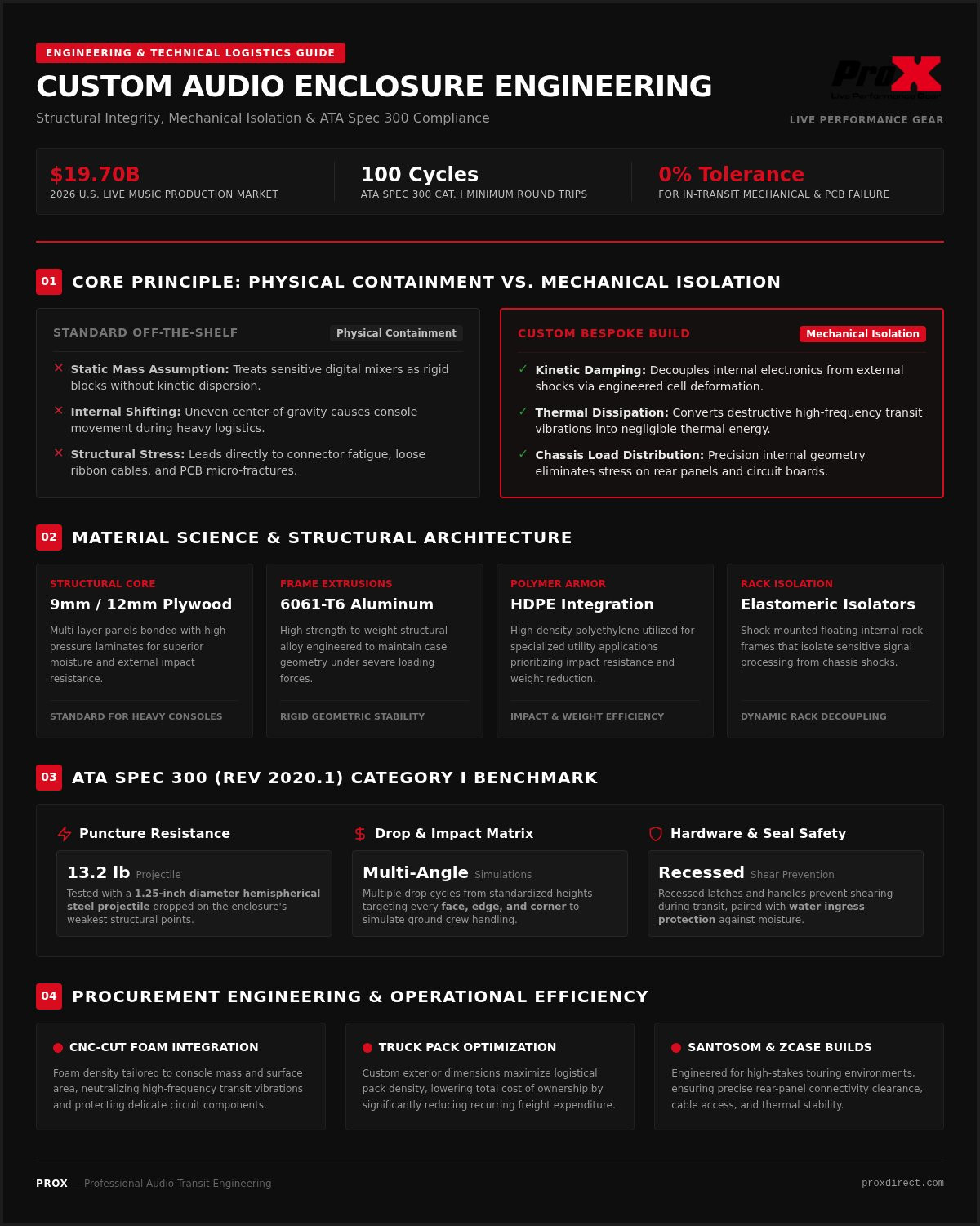
Effective protection requires a clear distinction between physical containment and mechanical isolation. Physical containment simply prevents the equipment from falling out of the case. Mechanical isolation, however, uses engineered internal structures to decouple the gear from external shocks. Professional integrators often source ProX Cases to meet these exact structural requirements. Custom designs address the specific center-of-gravity issues inherent in large-format mixers. Universal cases frequently allow heavy consoles to shift, placing undue stress on the frame and leading to connector fatigue or PCB micro-fractures. Precision-fit internals ensure the load is distributed evenly across the chassis, maintaining long-term electronic reliability.
Vibration Isolation and Damping Standards
High-frequency vibrations during truck or air transit can be as damaging as a single drop. These vibrations often lead to loosened ribbon cables and component creep on circuit boards. Custom foam densities are selected based on the specific mass and surface area of the audio gear to absorb these frequencies. Vibration isolation for audio gear utilizes mechanical damping principles to decouple the equipment from the case shell, effectively converting kinetic energy into negligible thermal energy through specialized foam cell deformation. For rack-mounted gear, custom shock-mounted systems provide an additional layer of protection by floating the internal rack frame on elastomeric isolators.
Material Science in Professional Case Construction
The structural integrity of a custom build depends on the precise selection of raw materials. Professional cases utilize 9mm or 12mm multi-layer plywood bonded with high-pressure laminates to resist moisture and impact. Structural rigidity is maintained through the use of 6061-T6 aluminum extrusions, which provide a high strength-to-weight ratio and ensure the case maintains its geometry under heavy loads. While plywood remains the standard for large consoles, high-density polyethylene (HDPE) is utilized in specific utility applications where extreme impact resistance and weight reduction are prioritized. These material choices, combined with CNC-guided assembly, define the performance limits of custom flight cases for audio equipment.
Decoding ATA 300 Standards for Professional Audio Logistics
The A4A ATA Spec 300, Revision 2020.1, serves as the definitive benchmark for professional transit enclosures. For engineers procuring custom flight cases for audio equipment, understanding Category I requirements is essential. This classification mandates that an enclosure must withstand a minimum of 100 round trips. Construction must utilize high-grade materials like multi-layer plywood and steel corners to ensure the internal electronics remain operational after repeated logistical cycles. ProX engineers these solutions to meet and often exceed these baseline aviation standards, focusing on the mechanical stresses unique to touring environments.
Testing protocols for ATA 300 compliance are rigorous and data-driven. Drop tests involve multiple falls from specific heights onto every face, edge, and corner to simulate rough handling by ground crews. Puncture resistance is verified by dropping a 13.2-pound steel projectile with a 1.25-inch diameter hemispherical end onto the case's weakest points. Additionally, water ingress testing ensures that gear remains protected against environmental moisture during outdoor load-ins. Recessed hardware is a mandatory feature for logistical safety, as it prevents external protrusions from shearing off during transit and allows for high-density stacking in truck packs.
Structural Integrity and Plywood Standards
The choice between 3/8-inch and 1/2-inch plywood depends on the total mass of the audio gear. While 3/8-inch panels are sufficient for most standard rack units, 1/2-inch plywood is necessary for large-format mixing consoles to prevent panel deflection. Professional builds often incorporate honey-comb laminates, which provide a hexagonal grid surface that increases structural rigidity and offers superior scratch resistance compared to standard flat laminates. You can explore these material specifications further in The Ultimate Guide to Flight Cases to better understand how these choices impact long-term durability.
Hardware Specifications: Recessed Handles and Latches
Hardware selection is a critical component of mechanical assembly. Spring-loaded recessed handles are engineered to remain flush with the case surface, preventing damage during tight truck packs while providing ergonomic grip points for heavy lifting. Zinc-plated steel hardware is the industry standard for corrosion resistance, ensuring that latches remain functional even after exposure to humid environments. Industrial-grade casters, often featuring reinforced mounting plates, are essential for maintaining case integrity under significant static and dynamic loads. If you're ready to specify your next build, you can browse professional-grade ProX Cases to see these hardware standards in application.
Custom vs. Universal Cases: A Performance and ROI Analysis
Evaluating the total cost of ownership (TCO) reveals that universal enclosures often introduce hidden operational costs. While an off-the-shelf case has a lower initial acquisition cost, its generic internal dimensions require generic foam inserts that degrade rapidly under touring conditions. This degradation leads to increased equipment repair frequency due to inadequate shock absorption. In contrast, investing in engineered custom flight cases for audio equipment ensures that the internal mechanical assembly is matched precisely to the hardware's mass. This precision significantly mitigates the risk of component failure during transit, protecting the initial capital investment over multiple touring cycles.
Financial recovery at the end of an asset's lifecycle is another critical variable. Audio consoles protected by custom-engineered enclosures consistently command higher resale values on the secondary market. Prospective buyers recognize that a console housed in a dedicated, custom-fit enclosure has been shielded from the structural stresses and micro-fractures that common universal cases fail to prevent. By treating the protective enclosure as a logistical asset rather than a simple container, production companies can minimize maintenance overhead and maximize equipment amortization.
Logistical Efficiency and TruckPaX™ Standards
Universal cases frequently feature non-standard external dimensions that create dead space within production trailers. Custom engineering solves this by utilizing standardized footprints designed to match standard truck bed widths. You can review how these dimensions optimize space in the TruckPaX™ Truck Pack Cases analysis, which details how modular case sizing eliminates spatial inefficiencies. For global touring crews, this mathematical predictability means that truck pack density is maximized, reducing the total number of vehicles required and lowering recurring freight expenditures in highly volatile transport markets.
Equipment Lifespan and Resale Value
Bespoke internal design provides critical protection for the control surfaces of high-value electronics. Universal foam inserts often press directly against sensitive components, whereas custom CNC-cut foam is relieved around vulnerable areas to prevent cosmetic damage and knob shear on complex mixers. Protecting high-value assets like Pioneer DJ or Roland consoles requires this exact level of engineering precision to maintain operational readiness. Custom-engineered internal padding isolates the chassis from external impacts, preserving the mechanical integrity of motorized faders and rotary encoders during rigorous multi-city transit schedules.
Specifying Your Custom Build: Essential Measurements and Features
Procuring custom flight cases for audio equipment requires a high degree of technical precision during the specification phase. Measuring a console or rack system is not merely about documenting the maximum physical dimensions of width, depth, and height. You must also account for the dynamic requirements of the hardware in a touring environment. A common engineering oversight is failing to provide adequate clearance for rear-panel connectivity. Most professional mixers require an additional 4 to 6 inches of depth to accommodate XLR connectors, power cables, and network snakes without placing mechanical stress on the ports. Accurate measurements ensure that the internal mechanical assembly provides the necessary clearance for operation while maintaining structural support.
Selecting the appropriate internal support material is a function of the equipment's mass and fragility. High-density Polyethylene (PE) foam is the industry standard for load-bearing surfaces because its closed-cell structure resists compression over long-term use. For lid lining and non-structural areas, softer Polyurethane (PU) foam provides a non-abrasive grip that secures control surfaces without applying excessive pressure to faders or encoders. Integrating centralized power distribution units (PDUs) within the build further enhances logistical efficiency by reducing the number of external connections required during setup.
Precision Foam Lining and Waterjet Cutting
Standard manual foam cutting cannot match the micron-level accuracy required for modern audio interfaces. CNC waterjet cutting is the preferred method for creating complex internal geometries that match the specific contours of your gear. This precision allows for the integration of 'doghouse' compartments; these are specialized wooden enclosures built into the rear of the case. They provide a secure environment for cable management and protect delicate connectors from external debris and mechanical strain. This level of detail ensures the equipment remains isolated from the kinetic energy of transit while remaining fully accessible for rapid deployment.
Thermal Management for Enclosed Audio Gear
Thermal buildup is a primary cause of electronic component failure in high-density rack systems. When specifying high-wattage amplifier racks, calculating airflow requirements is essential to prevent thermal throttling. Active cooling systems, featuring whisper-quiet fans, are mandatory for studio-grade mobile workstations where ambient noise must be minimized. These systems ensure that heat is efficiently dissipated from the enclosure, maintaining optimal operating temperatures for sensitive circuitry. You can examine technical examples of these integrated cooling solutions in our specialized AV-Broadcasting Cases. If you're ready to secure your production assets, start your custom build specification with our engineering team.
ProX Solutions: Santosom and ZCASE Engineered Bespoke Protection
Finalizing the procurement of custom flight cases for audio equipment requires a partner capable of translating complex technical specifications into physical reality. ProX coordinates directly with an authorized dealer network to deliver precision-engineered solutions that meet the high-stakes demands of professional production. By leveraging specialized manufacturing partnerships, we provide access to two of the most respected engineering lines in the global touring industry. This collaborative approach ensures that the logistical data gathered during the initial specification phase, such as rack unit counts and thermal requirements, is executed with absolute mechanical accuracy.
The procurement process for professional production companies is methodical and data-driven. It begins with the identification of specific equipment dimensions and logistical needs, followed by the selection of the appropriate engineering tier. Whether the application requires the standardized excellence of Santosom or the extreme customization of ZCASE, the goal remains zero-failure touring. Professional integrators rely on these engineered solutions to act as a reliable backbone for their operations, prioritizing structural integrity and material science over the aesthetics of the sale.
Santosom Cases: Precision Touring Standards
The Santosom engineering partnership represents a commitment to touring-grade standards for the global market. These cases are characterized by meticulous mechanical assembly and a deep understanding of the physical demands placed on high-end audio consoles. You can explore the technical details of this collaboration in our guide on Santosom Cases: Engineering Excellence. This line is specifically designed for professionals who require a blend of industrial authority and proven reliability for their most valuable signal processing assets, ensuring that every enclosure meets rigorous European durability standards.
ZCASE Custom Builds: The Pinnacle of Bespoke Engineering
ZCASE custom builds, manufactured in Poland, offer the highest level of bespoke engineering available for modern production environments. A primary innovation of this line is the Flip Ready Cases Made by ZCASE in Poland, which facilitate rapid deployment in professional audio setups. This specialized design allows consoles to remain connected while transitioning from transit to operational states, significantly reducing setup times. Beyond audio, ZCASE provides bespoke options for lighting, video walls, and integrated workstations. You can view the full range of these professional solutions in the ProX-Cases category. These builds are engineered for crews who view their protective enclosures as high-performance logistical assets rather than simple containers.
Optimizing Your Touring Infrastructure
Securing professional production assets requires an engineering-first approach that prioritizes mechanical isolation and logistical data. Off-the-shelf solutions cannot address the specific thermal demands or center-of-gravity requirements of high-value digital consoles. By implementing custom flight cases for audio equipment, you ensure your gear maintains its operational integrity across rigorous global transit schedules. Precision CNC-cut internals and compliance with ATA Spec 300 Revision 2020.1 standards provide the structural reliability necessary for zero-failure touring.
ProX has been engineering performance gear since 1984. Our partnerships with Santosom and ZCASE provide access to the industry's most advanced technical specifications, from rapid deployment workstations to shock-mounted rack systems. A global dealer network is available to support your procurement needs with professional-grade expertise. It's time to transition from simple equipment containment to a comprehensive logistical strategy that extends asset lifespan and maximizes truck pack density.
Request a Quote for Your Custom Engineered Audio Case to secure your production assets today. We're here to help you achieve functional excellence.
Frequently Asked Questions
What is the difference between ATA 300 Category 1 and Category 2 cases?
ATA 300 Category 1 specifications require an enclosure to survive a minimum of 100 round trips, utilizing multi-layer plywood and recessed hardware. Category 2 cases are engineered for limited transit, typically rated for 10 round trips. Category 1 is the industry standard for global touring where equipment faces repeated high-impact handling. ProX focuses on Category 1 standards to ensure long-term durability for sensitive audio circuitry and high-value production assets.
How do I measure my audio console for a custom case build?
Accurate measurement requires documenting the maximum width, depth, and height, including all protruding knobs, faders, and side handles. Crucially, you must add 4 to 6 inches of rear-depth clearance for XLR connectors and power cables to prevent mechanical stress on ports. Documenting these dimensions ensures the internal mechanical assembly provides a precision fit. This data allows engineers to design custom flight cases for audio equipment that isolate the chassis from kinetic energy.
What foam density is best for protecting sensitive audio electronics?
High-density Polyethylene (PE) foam is the superior choice for load-bearing surfaces due to its closed-cell structure and resistance to compression. For non-structural areas or lid lining, softer Polyurethane (PU) foam provides a non-abrasive grip that secures control surfaces without damaging faders. Selecting the correct density depends on the equipment's total mass. Precision waterjet cutting ensures the foam is relieved around sensitive encoders to prevent knob shear during transit.
Can custom cases be designed with integrated cooling systems for rack gear?
Active cooling systems can be integrated into rack builds to prevent thermal buildup in high-wattage amplifier racks. These systems typically utilize whisper-quiet fan arrays that maintain optimal operating temperatures for sensitive electronics. Thermal management is essential for enclosed workstations where airflow is restricted. ProX engineers these solutions into bespoke rack cases to ensure electronic reliability, especially during long-duration events where heat accumulation can lead to component throttling or total system failure.
How does a custom case improve truck pack efficiency for touring?
Custom engineering allows for standardized external footprints that match standard truck bed widths, eliminating wasted space in production trailers. Unlike universal cases with irregular dimensions, modular sizing ensures every cubic inch of a truck pack is utilized. This mathematical predictability increases pack density and reduces the total number of vehicles required for a tour. By optimizing these dimensions, production companies significantly lower recurring freight expenditures and improve overall logistical efficiency for global crews.
What are the typical lead times for a ZCASE bespoke engineering project?
Lead times for ZCASE bespoke engineering projects vary based on the complexity of the mechanical assembly and current manufacturing capacity in Poland. These projects involve high-level customization, including waterjet foam cutting and integrated power distribution. Because every build is tailored to specific equipment dimensions, you should consult with an authorized dealer for a current timeline. This ensures your production schedule aligns with the meticulous engineering process required for premium protection.
Why should I choose a custom case over a universal fit for my mixer?
A custom enclosure provides precise mechanical isolation that universal cases cannot replicate. Universal fits often allow heavy mixers to shift, leading to connector fatigue and chassis stress. Custom flight cases for audio equipment utilize CNC-cut foam to distribute the load evenly, mitigating the risk of PCB micro-fractures. While the initial acquisition cost is higher, the ROI is realized through reduced equipment repair frequency and significantly higher resale values for well-protected consoles.
Are custom flight cases for audio equipment waterproof or just water-resistant?
Standard professional flight cases are engineered for water resistance, protecting gear from environmental moisture and light rain during load-ins. They are not fully submersible. For environments requiring total immersion protection, the UltronX series offers watertight capabilities with specialized gaskets and pressure valves. Most touring applications rely on the moisture-resistant properties of high-pressure laminates and zinc-plated hardware to maintain equipment integrity in humid or outdoor event settings.
Disclaimer
Any trademarks, trade names or brand names appearing herein that do not belong to ProX are the property of their respective owners and/or companies, and such appearance doesn't and shall not constitute or imply endorsement, sponsorship or recommendation by ProX.


