

A hard outer shell is often the least important factor in preventing terminal electronic failure during global logistics. Protecting sensitive electronics during transport requires a sophisticated approach to mechanical impedance and environmental isolation rather than just heavy-duty plywood. You understand that the most significant risks to your inventory aren't always visible impacts. Instead, it's the low-frequency vibrations that cause solder joint fractures and the thermal buildup in dense rack environments that compromise long-term reliability. Even the simple act of unboxing can introduce electrostatic discharge that bricks a console before it's even powered on.
This article delivers the engineering-grade standards you need to achieve zero equipment failure on arrival. You'll master the technical requirements for internal dampening, electrostatic discharge mitigation, and the material science behind professional-grade enclosures. We'll analyze how to implement Santosom engineering and UltronX™ technology to maintain equipment integrity through every stage of the supply chain. Finally, we'll explore how standardized TruckPaX™ dimensions optimize logistics while ensuring your professional AV and broadcast gear survives the most rigorous touring schedules.
Key Takeaways
- Identify how mechanical impedance and low-frequency vibrations impact internal hardware to develop a data-driven strategy for protecting sensitive electronics during transport.
- Evaluate the structural advantages of multi-layer plywood and Honeycomb Digital™ laminates in mitigating high-velocity impacts and long-term structural stress.
- Master the technical application of Polyethylene and Polyurethane foams to optimize deceleration distance and provide targeted vibration isolation based on equipment mass.
- Implement standardized TruckPaX™ dimensions and thermal management designs to ensure logistical efficiency and prevent component overheating during operation.
- Leverage Santosom engineering and UltronX™ watertight standards to safeguard mission-critical AV and broadcast equipment in the most demanding touring environments.
Analyzing the Physical Dynamics of Transport Stress on Electronics
Effective strategies for protecting sensitive electronics during transport begin with a technical understanding of the forces at play. Transport stress isn't a single event; it's the cumulative effect of mechanical shock, vibration, and environmental fluctuation. For the professional logistics manager, distinguishing between these forces is critical for selecting the correct protective enclosures. While a single drop might be the most visible threat, the invisible, sustained stresses often cause the most damage over time.
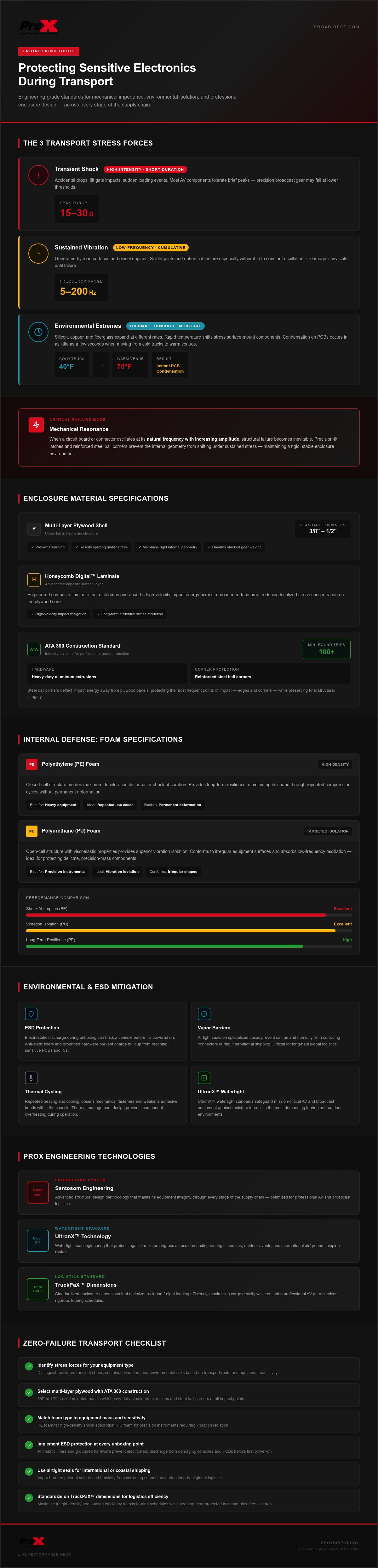
Transient shocks represent high-intensity, short-duration events. An accidental drop from a lift gate or a sudden impact during loading can subject gear to 15 to 30 Gs of force. Most professional AV components are engineered to withstand these brief peaks, but precision broadcast gear may fail at much lower thresholds. Sustained vibrations are different. These are low-frequency stressors, typically ranging from 5 to 200 Hz, generated by road surfaces and diesel engines. These vibrations are particularly destructive to solder joints and internal ribbon cables, which aren't designed for constant oscillation.
Mechanical Fatigue in Professional Logistics
Repetitive micro-vibrations lead to component displacement over long touring cycles. It's a process of gradual degradation. Mechanical resonance is the physical phenomenon where a circuit board or connector oscillates at its natural frequency with increasing amplitude, often leading to structural failure. To mitigate this, high-grade hardware must be used to maintain enclosure integrity. Precision-fit latches and reinforced steel ball corners ensure the case remains a rigid, stable environment, preventing the internal geometry from shifting under stress.
Environmental Extremes: Humidity and Temperature
Electronics face significant risks from thermal expansion and contraction. High-density assemblies contain various materials, such as silicon, copper, and fiberglass, which expand at different rates. Rapid temperature shifts during long-haul transport can stress surface-mount components to the point of failure.
- Condensation: Moving gear from a 40°F truck into a warm, 75°F venue with high humidity creates immediate moisture on internal PCBs.
- Vapor Barriers: For international shipping, utilizing specialized cases with airtight seals is necessary to prevent salt air and humidity from corroding sensitive connectors.
- Thermal Cycling: Repeated heating and cooling cycles can loosen mechanical fasteners and weaken adhesive bonds within the chassis.
Understanding these physical dynamics allows engineers to move beyond basic storage and toward true logistical protection. By accounting for resonance and thermal shifts, you ensure that your equipment arrives in the same operational state it left the warehouse.
Material Specifications for High-Impact Protective Enclosures
Plywood selection is the foundation of high-performance enclosure design. While solid wood might seem robust, it lacks the structural uniformity required for high-stakes logistics. Engineering-grade enclosures utilize multi-layer plywood, typically 3/8" or 1/2" thick, because the cross-laminated grain structure prevents warping and splitting under extreme mechanical stress. This material choice is fundamental when protecting sensitive electronics during transport, as it maintains a rigid internal geometry even when subjected to the weight of stacked gear and repetitive loading cycles.
ATA 300-style construction serves as the industry baseline for professional-grade protection. This standard ensures that an enclosure can withstand rigorous handling, including at least 100 round trips through air and ground transit. To meet these requirements, manufacturers integrate heavy-duty aluminum extrusions and steel ball corners. These components reinforce the edges and corners, which are the most frequent points of impact. The steel ball corners are specifically designed to deflect impact energy away from the plywood panels, preserving the structural integrity of the entire unit.
Structural Reinforcement and Hardware
Hardware failure often leads to catastrophic equipment damage. Professional enclosures prioritize recessed latches and handles to ensure a flush exterior profile. This design prevents hardware from snagging on other cases or truck walls during tight packing. Reliability is further enhanced through the use of dual-anchor rivets. These fasteners provide twice the shear strength of standard rivets, ensuring that handles and latches remain secured to the plywood walls under heavy loads. Professionals seeking these specifications should explore the full range of ProX Cases to find the appropriate build for their inventory.
Laminate Technology and Surface Protection
The exterior surface of an enclosure does more than provide a professional finish. Modern Honeycomb Digital™ laminates utilize a hexagonal surface pattern that serves a dual purpose. The pattern creates a ruggedized texture that significantly increases scratch and scuff resistance compared to smooth finishes. Additionally, the geometry of the honeycomb design helps dissipate impact energy across the panel surface, reducing the force transferred to the interior. This technology is a key component of high-performance protective gear. For a deeper analysis of these construction techniques, refer to The Ultimate Guide to Flight Cases.
Choosing the right materials ensures long-term durability and equipment safety. By prioritizing engineering precision over basic storage solutions, you protect your investment from the physical realities of the road. High-quality hardware and advanced laminates work together to create a reliable backbone for any professional production environment.
Internal Defense: Foam Density and Vibration Isolation Techniques
Protecting sensitive electronics during transport relies heavily on the internal management of mechanical energy. While the outer shell deflects direct impacts, the interior foam must manage the energy transfer that occurs during sudden stops or drops. Deceleration distance refers to the specific amount of space allowed for an electronic device to slow down within the foam cushioning before reaching a full stop. If this distance is too short, the resulting G-force spike can fracture internal solder joints or dislodge delicate components. Proper engineering ensures the foam absorbs this energy progressively rather than abruptly.
Material selection is categorized by the mass and fragility of the equipment. Polyethylene (PE) is a high-density, closed-cell foam that offers superior load-bearing capacity for heavy items such as power amplifiers or large-format consoles. Its rigid structure prevents heavy gear from shifting or compressing the foam permanently. In contrast, Polyurethane (PU) is an open-cell, flexible foam used for lighter components or as a protective top layer for delicate interfaces. CNC-cut inserts are vital for securing irregular surfaces. These precision-milled cavities cradle faders, encoders, and touchscreens, ensuring that no lateral movement occurs during high-vibration truck transits.
Calculating Load-Bearing Foam Requirements
Engineering a protective environment requires matching foam density to the specific mass of the gear. Static loading is the amount of pressure an object exerts on a cushioning material while at rest. If the gear is too heavy for the selected foam density, the material compresses completely, a failure known as "bottoming out." When this happens, the foam loses its ability to absorb shock, transferring the full force of an impact directly to the equipment chassis. Technicians must calculate the surface area of the device to ensure the load is distributed evenly across the foam inserts, maintaining the necessary deceleration distance.
ESD Protection and Static Mitigation
Static electricity poses a severe risk in dry, climate-controlled cargo environments. Friction between non-conductive surfaces during transport generates triboelectric charges that can compromise CMOS sensors or integrated circuits. Utilizing anti-static foam and liners is a necessary technical requirement for professional gear. These materials are treated with antistatic agents to dissipate charges before they reach critical components. Using hook-and-loop fasteners instead of adhesive tapes is a standard engineering choice to prevent chemical residue and reduce static buildup during the unboxing process. These measures ensure the internal environment remains electrically neutral, preserving the integrity of the micro-architecture within professional digital consoles and broadcast gear.
Integrating these internal defense mechanisms is as vital as the external shell when protecting sensitive electronics during transport across global logistics networks. Precise foam selection and ESD mitigation strategies form a comprehensive barrier against the invisible threats of the road.
Logistical Optimization: Securing Racks and Mobile Workstations
Logistical efficiency is directly tied to equipment longevity. When protecting sensitive electronics during transport, the physical arrangement of gear within a vehicle determines the level of kinetic stress each unit endures. Standardizing case dimensions isn't merely a convenience for the loading crew; it's a technical requirement for stabilizing the load. By utilizing TruckPaX™ Truck Pack Cases, professionals ensure that every cubic inch of a trailer is utilized, preventing the lateral shifting that leads to impact damage.
Mobile workstations and racks represent a unique challenge because they often house interconnected systems that must remain operational upon arrival. Securing these internal components requires more than just foam cushioning. It requires a rigid mounting architecture that prevents internal component shift. This is especially true for high-density servers and broadcast switchers where even a millimeter of movement can disconnect a critical bridge or seating. A secure rack prevents the internal chassis from absorbing the vibration of the road surface.
Thermal Management in Enclosed Environments
Thermal failure often occurs before a show even begins. High-performance electronics generate significant heat. When packed into dense amp or effects racks, this heat can become trapped. Engineering effective ventilation paths is critical for active cooling. Racks must be designed with sufficient spacing and integrated heat sinks to facilitate airflow even when the enclosure is closed for transit. This prevents the "oven effect" where residual heat from a performance or extreme ambient temperatures in a shipping container causes capacitors to swell or solder joints to weaken. For mission-critical deployments, professionals should specify AV-Broadcasting Cases that incorporate these thermal management standards.
Truck Pack Density and Physical Security
The elimination of "dead space" is a primary goal in professional touring. Non-standard case footprints create gaps that allow the load to "settle" during transit, often resulting in crushed corners or compromised latches. Standardizing on the TruckPaX™ footprint allows for an interlocking grid that resists movement in all three axes. Physical security also extends to the mobility of the case itself. Utilizing heavy-duty casters with integrated braking systems ensures that workstations remain stationary during loading on inclined ramps and within the truck bed. These casters must be rated for the static load of the fully populated rack to prevent flat-spotting, which introduces unwanted vibration during the next transport cycle.
Optimizing your logistics workflow reduces the mechanical and thermal stresses placed on your inventory. To upgrade your fleet with standardized, high-performance enclosures, browse our full selection of professional-grade cases.
Specialized Engineering: ProX Solutions for Professional Production Gear
High-performance touring requires more than off-the-shelf storage solutions. Santosom engineering represents a peak in the integration of material science and professional workflow. These enclosures are specifically designed for the rigors of global logistics, where protecting sensitive electronics during transport is a non-negotiable requirement. By utilizing ZCASE custom builds, production houses can secure bespoke electronic arrays that standard cases cannot accommodate. This level of specialization ensures that mission-critical gear remains within operational tolerances regardless of the transit method.
Bespoke Engineering for High-Value Assets
The design process for high-value assets involves a meticulous CNC milling protocol. Every knob, fader, and touchscreen on a large-format mixing console requires specific relief in the foam to prevent mechanical pressure during transit. Santosom engineering focuses on these micro-details, ensuring the enclosure provides a precision fit that eliminates internal movement. This level of detail is necessary for safeguarding large-format consoles during global tours, where equipment is subjected to multiple loading cycles across different continents. This precision engineering also applies to supporting specialized assets, such as LED Video Panel Wall Support, where structural rigidity is essential to prevent module alignment issues and diode damage.
Extreme Environment Protection
Technical specifications for environmental isolation are defined by the IP67 rating found in UltronX™ cases. This standard ensures the enclosure is completely dustproof and capable of withstanding water immersion. For professionals utilizing air transport, the integrated pressure equalization valve is a critical component. This valve automatically balances internal and external pressure during altitude changes, preventing the case from warping or becoming impossible to open due to vacuum sealing. These features are vital for protecting sensitive electronics during transport through varying atmospheric conditions.
Professional maintenance protocols are essential for ensuring long-term case reliability. Technicians should regularly inspect the integrity of the watertight gaskets and ensure that hook-and-loop fasteners used for internal cable management are free of debris. Periodic cleaning of the aluminum extrusions and lubrication of the recessed latches prevents oxidation and mechanical binding. These steps ensure that the specialized engineering of the enclosure continues to provide maximum protection throughout the lifecycle of the production gear.
Advancing Your Logistical Engineering Standards
Securing professional AV and broadcast equipment requires a shift from basic storage to rigorous mechanical engineering. You've seen that protecting sensitive electronics during transport is a multi-dimensional challenge involving vibration isolation, material science, and thermal management. By prioritizing Santosom engineering and UltronX™ environmental standards, you eliminate the variables that lead to terminal equipment failure. Standardizing your inventory with TruckPaX™ dimensions ensures that logistical efficiency never comes at the expense of structural integrity. Precision ensures reliability.
Since 1984, we've focused on the technical requirements of the touring professional. Our partnership with industry leaders like Pioneer DJ reflects a commitment to functional excellence and long-term durability. Whether you require standardized rack enclosures or bespoke ZCASE engineering for complex electronic arrays, the objective remains zero failure on arrival. We provide the backbone for your production. Explore ProX Professional Engineering Solutions and ensure your gear is prepared for the physical demands of the road.
Frequently Asked Questions
What is the difference between ATA 300 and standard shipping containers?
ATA 300 is a technical specification for reusable transit packaging designed to withstand a minimum of 100 round trips in rigorous logistical environments. Unlike standard shipping containers, cases built to this standard utilize reinforced aluminum extrusions, steel ball corners, and high-density plywood. This construction ensures the enclosure remains structurally sound under the repetitive mechanical stress common in global touring and professional production cycles.
How do I calculate the foam density needed for my specific electronic gear?
Calculating the required foam density involves matching the material's load-bearing capacity to the static loading of your device. You must divide the total weight of the gear by the surface area in contact with the foam. Polyethylene is preferred for heavy items like power amplifiers, while Polyurethane is suitable for lighter components. Ensuring the correct density prevents the equipment from bottoming out during high-impact events.
Is it necessary to use anti-static foam for all electronic transport?
Yes, utilizing anti-static foam is a critical requirement when protecting sensitive electronics during transport. Friction between non-conductive materials generates triboelectric charges that can easily bridge the microscopic gaps in modern integrated circuits. ProX integrates anti-static liners and specialized foam in its custom ZCASE builds to dissipate these charges safely, preventing terminal damage to CMOS sensors and digital processing boards.
How does vibration affect solder joints during long-distance truck transport?
Sustained low-frequency vibrations, typically between 5 and 200 Hz, induce mechanical resonance within circuit boards. This constant oscillation places stress on solder joints, leading to microscopic fractures that eventually cause component failure. When protecting sensitive electronics during transport, professional enclosures utilize Santosom engineering and precision-cut foam to dampen these frequencies, isolating the internal hardware from the resonant energy generated by truck engines and road surfaces.
What are the benefits of Honeycomb Digital™ laminates over standard plywood?
Honeycomb Digital™ laminates offer a superior strength-to-weight ratio compared to traditional smooth plywood surfaces. The hexagonal surface pattern serves as a structural reinforcement that dissipates impact energy across the entire panel rather than allowing it to penetrate the core. Additionally, this technology provides increased scratch resistance and durability, ensuring the enclosure maintains its professional appearance and structural integrity through years of heavy logistical use.
Can I use hardshell cases for air travel without exceeding weight limits?
You can utilize professional hardshell cases for air travel without necessarily exceeding weight limits by selecting units engineered with modern material science. Honeycomb Digital™ laminates and specialized plywood thicknesses allow for high-impact resistance at a lower mass. Many touring professionals utilize these lightweight, ATA 300-style enclosures to maintain equipment safety while staying within the strict weight tolerances mandated by commercial and cargo airlines.
How do I manage heat buildup in a closed amplifier rack case?
Managing thermal buildup in enclosed racks requires a design that facilitates active airflow and ventilation. High-density amplifier racks should include rack spacing for heat dissipation and integrated heat sinks where possible. ProX AV-Broadcasting cases often incorporate ventilation paths that allow for cooling during operation and transit. This prevents thermal expansion issues and capacitor swelling caused by the trapped heat generated by high-performance electronic components.
What maintenance is required for professional-grade transport cases?
Professional-grade transport cases require periodic inspections to ensure long-term reliability. Technicians should lubricate recessed latches and hinges to prevent mechanical binding and oxidation. For UltronX™ watertight cases, it's vital to check the integrity of the rubber gaskets and pressure equalization valves. Additionally, ensuring that hook-and-loop fasteners are free of debris maintains the security of internal cable management systems and accessory pouches.
Disclaimer
Any trademarks, trade names or brand names appearing herein that do not belong to ProX are the property of their respective owners and/or companies, and such appearance doesn't and shall not constitute or imply endorsement, sponsorship or recommendation by ProX.


