

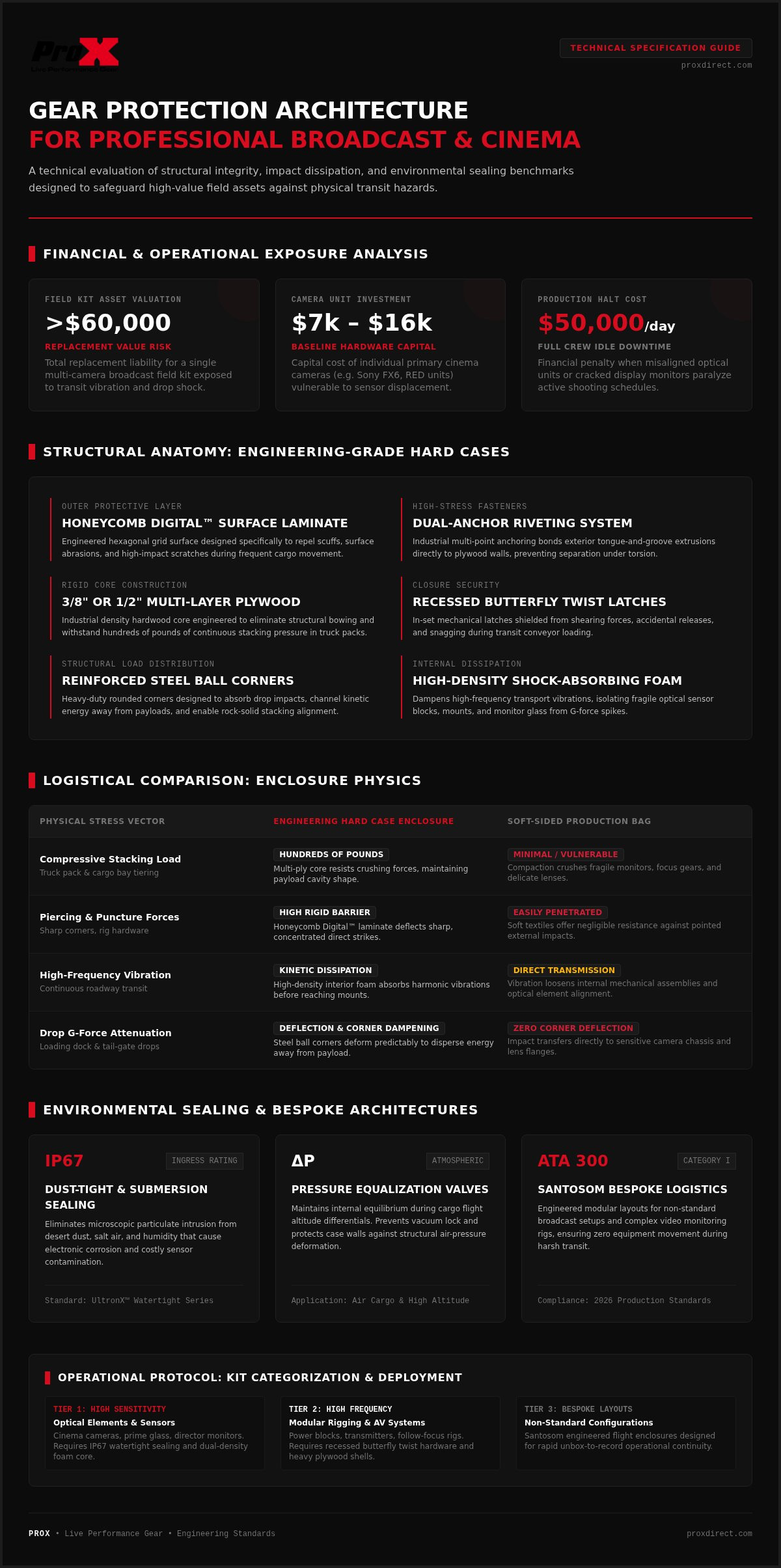
When a single professional multi-camera field kit carries a replacement value exceeding $60,000, a minor transit vibration isn't just an inconvenience; it's a catastrophic financial risk. You recognize that in high-stakes cinema and broadcast environments, the structural integrity of your equipment is the only thing standing between a successful wrap and a total production failure. Equipment downtime caused by impact or moisture ingress isn't an option when schedules are tight and budgets are fixed. This guide details the technical requirements for gear protection for professional videographers, focusing on engineering-grade solutions that safeguard high-value assets against the physical demands of global transport.
You'll learn how to implement industrial-standard protection using multi-layer plywood cores, Honeycomb Digital™ laminates, and IP67-rated sealing to prevent environmental damage. We provide a methodical overview of ATA 300 Category I compliance and modular logistics, ensuring your kits remain organized and secure from the cargo hold to the outdoor set. By prioritizing functional excellence and mechanical precision, you can eliminate disorganized workflows and ensure your gear is protected for the most rigorous 2026 production requirements.
Key Takeaways
- Analyze the logistical costs of equipment failure and how mechanical impact protection prevents catastrophic project delays.
- Compare material properties of high-density plywood and Honeycomb Digital™ laminates to select the most durable transit enclosures.
- Identify the specific engineering benchmarks required for gear protection for professional videographers to meet ATA 300 Category I standards.
- Implement a systematic inventory assessment to group cinema and broadcast gear by sensitivity and frequency of deployment.
- Explore specialized solutions like UltronX™ watertight cases and Santosom designs for protecting non-standard or bespoke production configurations.
The High Stakes of Gear Protection for Professional Videographers
High-value cinema cameras like the Sony FX6 or RED units represent a baseline hardware investment of $7,000 to $16,000, but the real cost of equipment failure is measured in production downtime. If a primary monitor cracks or a cine lens loses alignment during transit, the entire crew sits idle while costs mount. Effective gear protection for professional videographers is a logistical requirement that ensures operational continuity. Implementing robust gear protection for professional videographers minimizes the risk of electronic failure during high-pace schedules. Transit involves more than moving from point A to point B; it subjects delicate optical systems to high-frequency vibration and mechanical impact. Unlike consumer-grade storage, ATA 300 flight cases are engineered to dissipate these forces away from the payload. A single broken component can halt a $50,000-a-day production, making the choice of transport enclosure a critical business decision.
Vibration and Impact: The Physical Realities of Transport
Constant road vibration can loosen internal mechanical assemblies and sensitive sensor mounts over time. Professional heavy-duty cases utilize high-density foam inserts to absorb G-force during accidental drops or rough handling. In a standard truck pack, stacking pressure can exceed hundreds of pounds. Enclosures must feature reinforced steel ball corners and multi-ply plywood to maintain structural integrity under load. Consumer bags lack the rigidity to withstand these compressive forces, often leading to crushed components when kits are stacked in a production van. Ruggedized transport enclosures are the only way to guarantee that a camera arrives in calibration and is immediately functional for the first shot of the day.
Environmental Integrity on Location
Outdoor sets expose gear to salt air, desert dust, and tropical humidity. These elements are silent killers of cinema electronics, causing internal corrosion and sensor contamination. Air transport introduces another variable: pressure differentials. Cases equipped with pressure equalization valves prevent vacuum lock and structural deformation during altitude changes. Environmental integrity for videographers is defined by the ability to maintain a sealed, climate-controlled internal atmosphere, a standard exemplified by the UltronX™ watertight series. By utilizing specialized AV broadcasting cases, production teams ensure that dust-tight integrity remains intact even in hostile field conditions. This level of protection prevents the ingress of microscopic particles that can ruin a sensor and necessitate expensive professional cleaning.
Material Science: Comparing Hard Cases and Specialized Bags
Choosing between structural rigidity and portability is a fundamental decision in logistics. While soft-sided bags provide weight advantages for handheld transport, they offer minimal protection against the crushing forces of a professional truck pack. Gear protection for professional videographers requires a shell capable of withstanding hundreds of pounds of stacking pressure. Engineering-grade hard cases prioritize prevention over recovery, ensuring that high-value optics and electronics remain functional despite mechanical impact. For touring and broadcast environments, a rigid enclosure is the only viable method for maintaining equipment calibration and preventing costly production delays.
The Anatomy of Professional Hard Cases
A professional transit case is defined by its material composition and assembly standards. Most high-performance units utilize 3/8-inch or 1/2-inch multi-layer plywood cores for maximum structural integrity. These cores are bonded with Honeycomb Digital™ surface protection, a specialized hexagon grid laminate designed to repel scuffs and scratches. This construction resists piercing forces that would easily penetrate a soft bag. Structural fittings include dual-anchor rivets and reinforced steel ball corners, which allow for stable stacking and dissipate kinetic energy during a drop. Recessed butterfly twist latches and spring-loaded handles are essential for preventing hardware failure in high-pace logistics. You can browse ProX Cases to see these engineering specifications in detail.
Watertight and Dustproof Enclosures
Field videography often necessitates protection against liquid submersion and airborne particulates. UltronX™ watertight cases utilize high-impact polypropylene to achieve IP67-rated seal integrity. These enclosures protect sensitive camera sensors from desert dust and tropical humidity. When transporting power solutions, it's critical to adhere to FAA lithium battery transport regulations, which dictate how high-capacity cells must be secured. Inside these cases, custom-cut high-density foam inserts are non-negotiable. Unlike generic "pick-and-pluck" solutions, custom inserts provide exact support for lens arrays and monitors, preventing any internal movement. This combination of a rugged outer shell and a precision-engineered interior ensures total gear protection for professional videographers working in extreme conditions. For those managing complex kits, specialized AV broadcasting cases offer the necessary organizational depth for rapid setup times without compromising safety.
Evaluating Engineering Standards: ATA 300-Style and Beyond
Engineering standards serve as the baseline for evaluating gear protection for professional videographers. While "consumer rugged" products might offer basic scuff resistance, industrial-grade manufacturing focuses on structural shock dissipation and mechanical longevity. The primary benchmark for this level of protection is the ATA 300 specification, which categorizes transit enclosures based on their ability to withstand repeated handling cycles without compromising the internal payload. Implementing high-level gear protection for professional videographers requires a transition from discretionary storage to standardized engineering benchmarks that prioritize prevention over recovery.
Understanding the ATA 300 Category
The Air Transport Association (ATA) Spec 300 Revision 20 defines the requirements for Category I reusable transport containers. To satisfy this standard, a case must withstand a minimum of 100 round trips. This involves rigorous drop and shock testing designed to simulate the realities of global logistics. ProX engineering adheres to these specifications by utilizing reinforced aluminum extrusions, recessed hardware, and high-density plywood cores. This approach ensures that the enclosure remains structurally sound even after years of intensive touring use. For a deeper analysis of these technical benchmarks, you can read more about Understanding ATA 300-Style Protection.
Specialized Protection for Visual Displays
Large-format monitors and LED panels present unique logistical challenges due to their fragile glass substrates and sensitive pixel diodes. Standard utility trunks often lack the necessary anti-vibration mounts required to isolate these displays from high-frequency road vibrations. Professional display cases incorporate floating internal frames and specialized foam densities to mitigate kinetic energy. This is particularly critical when deploying LED Video Panel Wall Support Solutions, where individual modules must remain perfectly aligned to avoid visible seams during assembly. Proper display housing prevents the micro-fractures that typically occur during rough transit in unrated containers.
Environmental sealing is another critical engineering factor. Many field-grade enclosures are tested according to IEC Ingress Protection (IP) ratings, which measure the effectiveness of seals against dust and water ingress. An IP67 rating, for instance, confirms that the enclosure is dust-tight and capable of withstanding temporary submersion. This level of precision ensures that sensitive sensors and display electronics are shielded from the microscopic particulates and humidity that can cause internal short circuits. By prioritizing these industrial standards, videographers ensure their kits remain operational in any environment, regardless of the transit method or location conditions.
Building a Scalable Protection Strategy for Production Kits
A scalable strategy for gear protection for professional videographers transitions from individual case selection to a comprehensive logistical framework. This process begins with a methodical inventory audit that categorizes equipment by mechanical sensitivity and deployment frequency. High-value optical components and cinema camera bodies require primary isolation in specialized enclosures, while secondary support gear can be consolidated into utility storage. This hierarchical approach ensures that protection levels match the financial and operational risk of each asset. Implementing a structured system involves four critical steps:
- Perform an inventory audit to group gear by sensitivity and deployment frequency.
- Select cases with standardized dimensions to maximize truck pack density.
- Install precision-cut high-density foam for cinema camera bodies and optics.
- Deploy TruckPaX™ enclosures to facilitate rapid load-ins and load-outs.
Optimizing for Logistical Efficiency
Standardizing case dimensions is the most effective method for increasing truck pack density. Random case sizes create dead space in transport vehicles, leading to shifting loads and potential mechanical impact. Utilizing TruckPaX™ Truck Pack Cases: Engineering Logistical Efficiency allows production teams to calculate load-outs based on exact 90-inch truck widths. These cases are engineered to interlock, providing superior stability during transit and reducing the risk of gear shifting. For field production, integrating mobile workstations further streamlines the workflow by combining transport and operation into a single unit. This organization reduces setup times and prevents the misplacement of critical accessories in high-pace environments. Effective gear protection for professional videographers doesn't just safeguard hardware; it optimizes the entire production timeline.
Custom Engineering for Non-Standard Rigs
Off-the-shelf enclosures often fail to accommodate bespoke cinema rigs or specialized broadcast configurations. When equipment dimensions exceed standard specifications, custom engineering becomes a necessity. The process involves precise CAD modeling to ensure that internal support structures align with the gear's center of gravity. You can explore ZCASE Custom Build Cases for High-Value Gear to understand how bespoke protection is engineered for global distribution. These custom solutions utilize high-density foam and reinforced chassis to protect non-standard arrays, such as multi-camera VR rigs or specialized wireless transmission hubs. By focusing on the structural integrity of the build, these cases provide the reliability needed for high-stakes professional use.
To ensure your technical infrastructure remains secure throughout the 2026 production season, invest in standardized transit cases that meet industrial engineering benchmarks.
ProX Engineering: Professional Solutions for Broadcast and Cinema
ProX engineering represents the industry standard for gear protection for professional videographers, offering a catalog that spans from specialized AV broadcasting cases to high-capacity utility storage. Since 1984, the focus has remained on functional excellence and mechanical precision. Professional production companies require more than just shipping containers; they need integrated logistical solutions that withstand the rigors of global transit. By prioritizing industrial-grade materials and structural integrity, ProX ensures that high-value cinema and broadcast equipment remains operational regardless of the environment. This commitment to reliability allows production teams to focus on the technical execution of a shoot rather than the safety of their hardware.
Specialized AV and Broadcasting Solutions
The modern broadcast environment requires a mobile command center that can be deployed rapidly without compromising safety. You can Explore AV Broadcasting Cases to see how specialized engineering protects rack-mounted electronics, switchers, and field monitors. These cases often serve a dual purpose as field workstations, integrating rack rails and cable management directly into the protective chassis. This design philosophy prevents the mechanical stress associated with frequent assembly and disassembly of sensitive broadcast rigs. By maintaining a fixed internal configuration within a ruggedized enclosure, videographers reduce the risk of cable failure and connector wear during high-pace load-ins. These workstations provide the necessary structural backbone for complex DIT setups and live video village operations.
The ProX Commitment to Manufacturing Excellence
Decades of experience engineering for touring professionals and major broadcast brands have informed every aspect of the ProX manufacturing process. This expertise is evident in the use of dual-anchor rivets, reinforced steel ball corners, and Honeycomb Digital™ laminates across the entire product line. For production companies operating on a global scale, the advantage of a widespread dealer network ensures that replacement parts and additional enclosures are accessible in major markets. This reliability is why industrial-grade gear protection for professional videographers is synonymous with the ProX name. The brand acts as a dependable partner for those who understand that equipment failure is not an option in professional production.
Integrating these solutions into a production workflow involves more than selecting a single case; it requires a commitment to a standardized logistical system. Whether deploying a custom cinema rig or a large-scale LED wall, the engineering must match the stakes of the production. To secure your technical assets for the upcoming season, Explore the ProX Catalog for Professional Videography Protection. This comprehensive range of Santosom, UltronX™, and TruckPaX™ solutions provides the structural integrity necessary for modern professional production.
Securing Technical Assets for the Future of Production
The evolution of cinema and broadcast technology necessitates a corresponding advancement in physical transit standards. Relying on unrated storage solutions introduces unacceptable risks to high-value sensors and optical arrays. By implementing gear protection for professional videographers that adheres to ATA 300 Category I benchmarks, you ensure your equipment remains operational despite the mechanical stresses of global logistics. This guide has detailed the critical role of material science, from multi-ply plywood cores to IP67-rated polypropylene shells, in preventing catastrophic equipment failure.
ProX has been engineering performance gear since 1984, providing the structural backbone for global touring professionals who don't compromise on durability. Whether you require standardized TruckPaX™ dimensions for logistical efficiency or custom design-and-build capabilities for bespoke cinema rigs, the focus remains on technical superiority and build integrity. Adopting an engineering-grade protection strategy allows you to maintain professional standards in any field environment.
Secure your production kit with engineering-grade ProX Cases
Investing in robust transit enclosures is a commitment to the longevity and reliability of your production business. Your equipment is protected for the rigors of the 2026 season when it's backed by industrial-grade engineering.
Frequently Asked Questions
What is the difference between a standard hard case and an ATA 300-style case?
ATA 300-style cases are engineered to meet Category I specifications, which require a container to withstand a minimum of 100 round trips. A standard hard case may provide basic impact resistance but lacks the structural reinforcements needed for repeated global logistics. These industrial-grade enclosures utilize multi-ply plywood, reinforced steel ball corners, and recessed hardware. This level of gear protection for professional videographers ensures that sensitive electronic payloads remain secure through rigorous handling cycles.
Can professional cases be customized for specific cinema camera rigs?
Professional cases can be fully customized for bespoke cinema rigs through specialized engineering services. ZCASE custom build cases utilize CAD modeling to create protective structures tailored to specific equipment dimensions. This process ensures that non-standard rigs, such as multi-camera arrays or integrated wireless hubs, receive precise internal support. Custom engineering accounts for the center of gravity and mechanical sensitivity of the gear, providing a level of safety that off-the-shelf enclosures cannot match.
Why should videographers choose hard cases over soft-sided bags for transport?
Hard cases provide superior structural rigidity and resistance to crushing forces compared to soft-sided bags. In professional truck packs, equipment is often subjected to hundreds of pounds of stacking pressure that would compromise soft materials. Hard shells protect against piercing and dissipate kinetic energy away from fragile optics. For videographers managing high-value assets, a rigid enclosure is a logistical necessity to prevent catastrophic mechanical failure during transit and high-pace production load-ins.
What features should I look for in a watertight case for outdoor shoots?
A watertight case for outdoor deployment should feature an IP67 rating and a pressure equalization valve. IP67 certification confirms that the enclosure is dust-tight and protected against water immersion up to one meter for 30 minutes. UltronX™ watertight cases utilize high-impact polypropylene and specialized O-ring seals to maintain environmental integrity. The equalization valve is critical for air transport, as it allows internal pressure to adjust during altitude changes without compromising the seal or deforming the chassis.
How do standardized case dimensions help with production logistics?
Standardized case dimensions optimize truck pack density by eliminating wasted space in transport vehicles. TruckPaX™ cases are engineered to interlock and fit the 90-inch width of standard production trucks, creating a stable load that resists shifting. This level of gear protection for professional videographers prevents mechanical damage caused by loose kits. Efficient logistics also reduce the time required for loading and unloading, allowing production teams to focus on technical execution rather than organizational delays.
Are there specialized cases for transporting large LED video panels?
Specialized cases are engineered specifically for large-format displays and LED modules. Flat Panel LED TV Cases incorporate anti-vibration mounts and floating internal frames to isolate fragile glass substrates from road shock. When transporting LED video panel wall support modules, these cases ensure that individual diodes and alignment hardware remain protected. Proper housing prevents micro-fractures and pixel damage that commonly occur when using unrated containers for sensitive visual display technology.
How does high-density foam protect sensitive camera sensors from vibration?
High-density foam protects sensitive camera sensors by absorbing kinetic energy and G-force during transit. This specialized material isolates the internal components of a cinema camera from high-frequency vibrations that can loosen mechanical assemblies. Unlike generic foam, precision-cut high-density inserts provide exact support for the equipment's center of gravity. This isolation is essential for maintaining sensor calibration and preventing the mechanical drift that often results from rough handling in non-industrial storage.
What maintenance is required to keep professional cases in touring-grade condition?
Maintaining professional cases involves regular inspection of mechanical fittings and structural seals. You should periodically check recessed butterfly latches, spring-loaded handles, and dual-anchor rivets for signs of wear or loosening. For watertight enclosures, ensure the O-ring seals are free of debris and maintain their elasticity. Utilizing ProX replacement parts for hardware repairs ensures the case continues to meet its original engineering benchmarks. Consistent maintenance preserves the enclosure's ability to withstand the demands of global touring.
Disclaimer
Any trademarks, trade names or brand names appearing herein that do not belong to ProX are the property of their respective owners and/or companies, and such appearance doesn't and shall not constitute or imply endorsement, sponsorship or recommendation by ProX.


