

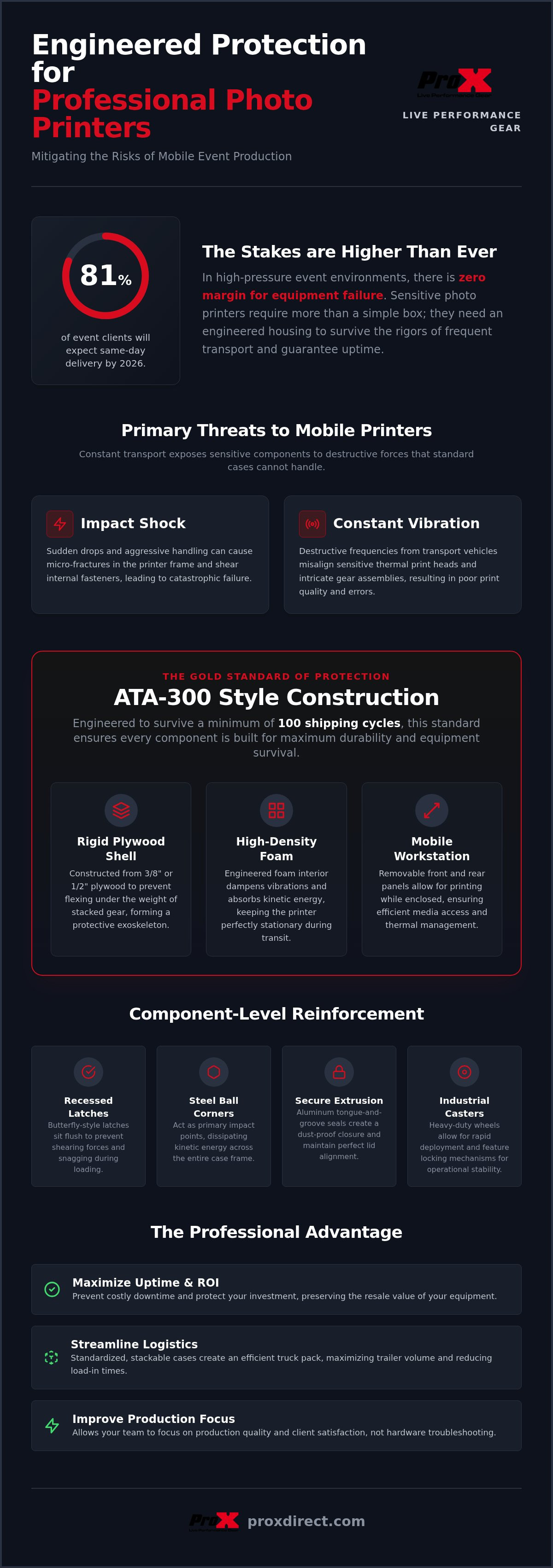
With 81% of event photography clients expecting same-day delivery in 2026, the margin for equipment failure has effectively disappeared. You understand that your high-value photo printers are sensitive instruments, not just peripherals. When these units face the rigors of frequent transport, mechanical misalignment from constant vibration becomes a constant threat. High-performance Printer Cases are no longer optional accessories; they're essential components of a reliable mobile production workflow. Protecting your investment requires more than a standard box. It demands an engineered housing that mitigates physical impact and environmental stress.
This guide details how precision-engineered enclosures protect your gear from the heavy-duty demands of the event circuit. You'll discover how ATA-300 style construction standards and high-density foam interiors prevent internal component shift during transit. We'll also analyze the role of integrated ventilation in managing thermal stress during peak operating hours. By the end of this article, you'll see how upgrading your transport strategy ensures zero equipment downtime and creates a more efficient, standardized truck pack for every venue. This methodical approach to gear protection allows you to focus on production quality rather than hardware troubleshooting.
Key Takeaways
- Understand why specialized Printer Cases are required to protect sensitive thermal print heads and internal alignments from the mechanical stress of frequent transit.
- Identify the structural benefits of ATA-300 style construction, focusing on the utility of recessed butterfly latches and high-density foam for equipment security.
- Learn how front and rear removable panels transform a protective enclosure into a functional mobile workstation, allowing for efficient media access and thermal management.
- Establish a technical framework for selecting between universal and custom-fit designs while accounting for critical clearance requirements for power and data cabling.
- Discover how routine maintenance of hinges, latches, and casters preserves the resale value of your gear and prevents unexpected failures during high-stakes event production.
The Engineering Requirements for Professional Printer Cases
Professional Printer Cases serve as more than simple storage containers; they're high-performance structural barriers designed for the rigors of mobile event production. Unlike static studio environments, event locations require equipment to endure constant movement. Standard utility cases often fail because they lack the internal architecture to isolate high-precision thermal print heads from the destructive frequencies generated by truck engines and uneven road surfaces. A specialized case acts as a structural exoskeleton. It maintains the precise calibration of the printer's internal mechanics by absorbing kinetic energy before it reaches the chassis. For professionals, the integrity of this housing directly correlates to equipment lifespan and the prevention of micro-fractures in the printer's frame.
Mechanical Stress and Vibration Dampening
High-frequency vibration and impact shock are the primary mechanical threats to dye-sublimation printers. These units contain intricate gear assemblies and sensitive heating elements that can easily become misaligned. To mitigate this, professional cases utilize high-density foam interiors. This material isn't just for cushioning; it's engineered for dampening, ensuring the printer remains stationary even during aggressive handling. The outer shell, typically constructed from 3/8-inch or 1/2-inch plywood, provides the necessary rigidity to prevent the enclosure from flexing under the weight of stacked gear. Secure mounting points are essential, especially for heavy models like the DNP DS620 or Citizen CZ-01. These points ensure that the printer's own inertia doesn't shear internal fasteners during sudden stops or drops.
Standardizing for Professional Logistics
Logistical efficiency is a core requirement for any high-volume production company. Standardized dimensions allow ProX Cases to integrate seamlessly into a truck pack, maximizing trailer volume and reducing load-in times. Utilizing ATA-300 Style Construction ensures that these enclosures meet the rigorous shipping standards required for repeated transport cycles. Stackable designs are also vital for warehouse management, allowing for stable vertical storage that saves floor space. This methodical approach to design ensures that every piece of gear is protected while maintaining a predictable footprint in the warehouse and on the road. For a deeper analysis of these engineering standards, you can review The Ultimate Guide to Flight Cases, which outlines the technical specifications necessary for professional-grade protection.
ATA-300 Style Construction: The Gold Standard for Protection
ATA-300 Category I standards dictate that a case must maintain its structural integrity through at least 100 shipping cycles. This rigorous specification ensures that professional Printer Cases offer more than just basic coverage; they provide a certified level of security for high-stakes environments. Every component, from the wood panels to the smallest rivet, is selected based on its ability to withstand repetitive mechanical stress. This engineering approach transforms a simple box into a precision instrument designed for the long-term survival of your gear.
External hardware is the first line of defense. Recessed butterfly latches are engineered to sit within the case's profile, protecting the locking mechanism from external shearing forces during transit. Spring-action handles provide ergonomic utility while remaining flush to the side panels, which prevents snagging in tight truck packs. The perimeter of the case is reinforced with aluminum tongue-and-groove extrusion. This specific geometry creates a dust-proof seal and ensures the lid remains perfectly aligned with the base even after years of heavy use. For heavy printer rigs, industrial-grade casters are mandatory. These wheels allow for rapid deployment and include locking mechanisms to stabilize the workstation during high-volume printing operations.
Hardware Integrity and Material Science
Steel ball corners are a critical engineering feature for energy management. They act as the primary impact points, dissipating kinetic energy across the entire frame rather than concentrating force at a single point. While injection-molded plastic cases are common for consumer use, professional production requires the structural rigidity of 3/8-inch or 1/2-inch plywood. This material withstands extreme thermal shifts without warping or cracking. To ensure your gear meets these industrial standards, you can explore the technical specifications of ProX Cases.
Internal Protection and Custom Foam Fitting
The choice of internal padding is a matter of material science. Ether foam is generally preferred for electronic equipment due to its superior moisture resistance and longevity compared to ester foam. Custom-cut inserts are designed to eliminate lateral movement, which is the leading cause of internal component shift. These linings are built to withstand frequent load-ins, maintaining their shape and protective properties over hundreds of deployments. A secure internal fit ensures that the printer's delicate thermal heads are never subjected to direct impact, even if the case is dropped during a hectic venue load-out.
Operational Design: Printing While Enclosed
The shift from simple transport to active production has redefined the architecture of professional Printer Cases. In high-volume event environments, the time required to extract a printer from its housing and establish connectivity represents a significant logistical bottleneck. Modern engineering solves this by treating the case as a mobile workstation. This design philosophy ensures that the equipment remains protected by its structural exoskeleton while being fully operational. By maintaining the printer within the case during the event, you reduce the risk of accidental spills or physical impact from attendees in crowded venues.
Functionality depends on strategic access points. Removable front and rear panels are essential; the front panel allows for unobstructed print delivery, while the rear panel facilitates media loading and cable management. Integrated cable ports are a critical feature, allowing for permanent wiring of power and data lines within the rig. This means you only need to connect one external power lead and one data cable to the case's exterior interface to begin production. Easy access to power switches and USB ports is maintained through precision-cut openings in the internal foam, ensuring that the operator doesn't't need to reach blindly into the enclosure.
Thermal Management and Airflow Engineering
Thermal management is a primary concern when operating electronics in enclosed spaces. Dye-sublimation printers generate considerable heat during continuous operation. Without engineered airflow, this heat accumulates and triggers thermal shutdown protocols, leading to event downtime. Professional cases utilize passive cooling through strategically placed ventilation gaps that encourage convective airflow. For extreme environments or sustained high-speed output, custom case designs can incorporate active cooling systems, such as integrated fans, to maintain optimal operating temperatures. This engineering prevents the internal ambient temperature from exceeding the printer's manufacturer-specified limits.
Media Storage and Consumable Management
Organized consumable management directly impacts on-site maintenance speed. Professional cases often include dedicated compartments for ink ribbons and paper rolls, keeping all necessary supplies within the same footprint as the printer. This integration mirrors the design logic found in AV Broadcasting Cases, where accessibility and organization are prioritized for high-pressure environments. When your media is stored securely and logically, reload times are minimized. This ensures your production workflow remains steady even during the busiest segments of an event.
Selecting the Right Case for Specific Printer Models
Choosing Printer Cases requires a meticulous analysis of both the hardware footprint and the specific operational environment. While universal enclosures may appear versatile, they often fail to align with the precise locations of ventilation intakes and exhaust fans. Obstruction of these critical airflow paths will inevitably lead to thermal throttling or hardware failure during high-volume sessions. You must also verify the internal clearance for power connectors and data cables. A professional case must provide enough internal volume for connectors to sit naturally; forcing a cable into a tight 90-degree bend creates mechanical stress that can damage the printer's internal logic board ports over time.
Weight management and logistical scale are equally important factors for the modern professional. Solo operators typically require compact, single-unit enclosures that facilitate rapid deployment without the need for additional personnel. Conversely, large-scale production crews often benefit from multi-unit rigs that incorporate integrated rack space. This allows for the installation of print servers, network switches, or wireless transmitters directly within the case architecture. This centralized workstation approach minimizes the cabling required on-site and ensures that the entire printing infrastructure remains protected within a single, standardized footprint.
Cases for DNP and Citizen Series
The DNP DS620 and DS820 are industry standards for event photography, yet their footprints differ significantly in depth and height. A case engineered for the DS620 must provide a secure fit that prevents lateral movement while allowing the front-loading paper tray to cycle fully without interference. Similarly, Citizen photo printers require specific port access for their side-mounted interfaces. For a detailed look at model-specific engineering, you can review the ProX Printer Case for DNP DS620, which features exact internal dimensions and optimized airflow paths designed for these specific units.
Bespoke Engineering for High-Value Gear
Legacy hardware or specialized high-output units often have non-standard dimensions that generic solutions cannot accommodate. When your production workflow depends on unique or high-value gear, ZCASE Custom Build Cases provide an engineered, bespoke solution. The process involves mapping the exact coordinates of every external interface, from power switches to media access doors. This level of precision ensures that even legacy printers receive modern structural protection without sacrificing operational speed. Custom engineering removes the variables of generic foam, providing a reliable, long-term housing that preserves the functionality of your specialized equipment.
To secure the longevity of your equipment, you can browse professional printer cases designed for industry-standard hardware.
Maximizing ROI Through Professional Case Maintenance
Investing in professional Printer Cases is a strategic decision to protect the high-value internal components of your gear. Beyond immediate physical protection, these enclosures serve as a shield against the cumulative effects of dust accumulation and cosmetic degradation. A printer maintained in a pristine, dust-free environment retains significantly higher resale value when it's time to upgrade your inventory. Regular inspection of the case's structural integrity ensures that the protective barrier remains effective over years of deployment. By preventing micro-scratches and chassis warping, you ensure that your equipment remains in factory-standard condition regardless of the venue's environment.
Routine maintenance of hardware is essential for operational reliability. Periodically lubricate recessed latches and hinges to prevent seizing from environmental exposure or moisture. Inspect industrial casters for debris or flat spots that can impede movement during venue load-ins. If a latch fails to draw the lid tight, the dust-proof seal is compromised, allowing particulates to enter the sensitive mechanical assemblies of the printer. Internal foam also requires periodic evaluation. Over time, high-density foam can experience compression set, where it no longer returns to its original shape. This creates gaps that allow for lateral movement. Replacing foam inserts every few years ensures the printer remains immobilized during transit.
Long-Term Reliability in Touring Environments
Identifying wear and tear before a component failure occurs is critical for touring professionals. Stress fractures in plywood or loose rivets indicate that the case has absorbed significant impact and may need structural reinforcement. Utilizing ProX Cases provides a foundation of consistent performance, as the hardware is designed to meet industrial standards for repetitive use. The total cost of ownership for a professional enclosure is significantly lower than the cost of a single equipment repair or a lost production day.
Streamlining Event Load-Outs
Standardized cases directly impact the bottom line by reducing labor costs and setup times. When gear is organized into uniform footprints, setup and strike times are accelerated. Professional spring-action handles and heavy-duty wheels also protect the long-term health of your crew by reducing the physical strain of manual handling. For those managing large-scale logistics, integrating your gear into TruckPaX™ Truck Pack Cases optimizes trailer volume and ensures a secure, predictable load every time. This methodical approach to gear management ensures your production remains profitable and efficient.
Securing Your Mobile Production Workflow
Protecting high-value event hardware requires a transition from passive storage to precision-engineered workstations. You've seen how ATA-300 style standards and rugged 3/8-inch plywood construction provide the necessary structural barrier against mechanical stress and vibration. These specialized Printer Cases don't just facilitate transport; they preserve the precise calibration of sensitive thermal print heads during continuous, high-volume production. By integrating front and rear removable panels, your setup becomes a fully functional mobile workstation with optimized airflow and accessible media paths.
ProX has been engineering performance gear since 1984, focusing on the practical realities of the professional touring environment. Maintaining your hardware's integrity through routine inspection and high-quality housing ensures zero equipment downtime while maximizing your long-term ROI. A methodical approach to gear protection is the reliable backbone of any successful event production business. It's time to standardize your truck pack and secure your investment against the physical demands of the industry. Browse Professional ProX Printer Cases to upgrade your logistical infrastructure today. Your equipment deserves a housing built for the rigors of professional use.
Frequently Asked Questions
What is the difference between a standard utility box and an ATA-300 style printer case?
ATA-300 Category I cases are engineered to survive at least 100 shipping cycles, whereas standard utility boxes lack certified impact resistance. Professional Printer Cases utilize 3/8-inch or 1/2-inch plywood, aluminum extrusions, and steel ball corners for energy dissipation. This structural rigidity prevents the frame from flexing under load. Standard boxes often use thinner materials and lack the precise internal foam architecture required to isolate sensitive thermal print heads from external shock.
Can I operate my photo printer while it is still inside the flight case?
Yes, professional cases are designed as mobile workstations to facilitate immediate production. Removable front and rear panels provide the necessary clearance for print delivery and media loading. Integrated cable ports allow for permanent internal wiring, so you only need to connect external power and data leads at the venue. This workstation approach reduces setup time and keeps the printer protected from environmental hazards like spills or physical impact during the event.
How do I ensure my printer doesn't overheat during high-volume events?
Thermal management is achieved through engineered airflow and strategic ventilation. High-volume printing generates significant heat that can trigger thermal shutdown if trapped. Professional Printer Cases utilize passive cooling via ventilation gaps that promote convective airflow. In extreme conditions, active cooling solutions like integrated fans can be installed to maintain manufacturer-specified operating temperatures. Always ensure that the case's intake and exhaust paths remain unobstructed by external gear or venue drapery during operation.
Are custom-built printer cases necessary for standard DNP models?
While standard DNP models often fit into pre-configured professional cases, custom-built options provide superior protection for specialized workflows. Custom engineering ensures that every port, switch, and media door aligns perfectly with the case's access points. This eliminates the need for reach-in adjustments and ensures that internal foam provides maximum immobilization. For non-standard configurations or legacy hardware, ZCASE custom builds offer a bespoke structural solution that generic enclosures cannot match.
What materials provide the best vibration dampening for thermal printers?
High-density ether foam is the industry standard for isolating sensitive electronics from mechanical vibration. Unlike lower-grade ester foam, ether foam maintains its structural integrity over time and offers superior moisture resistance. The combination of this foam with a rigid 3/8-inch plywood shell creates a dampening system that absorbs high-frequency road noise and impact shock. This prevents internal component shift and maintains the precise alignment of the printer's thermal heating elements during transport.
How do I maintain the latches and hardware on my professional case?
Routine maintenance involves periodic lubrication of recessed butterfly latches and hinges with a dry silicone spray. This prevents oxidation and ensures smooth operation in high-humidity environments. You should also inspect rivets for signs of loosening and check industrial casters for flat spots or debris. If a latch no longer draws the lid into a tight seal with the aluminum tongue-and-groove extrusion, the dust-proof integrity of the case is compromised and requires hardware adjustment.
Is it possible to stack printer cases safely in a tour truck?
Professional cases are engineered for vertical stability in high-density truck packs. Features like recessed stacking cups or heavy-duty ball corners allow cases to nest together, preventing lateral shifting during transit. Standardized dimensions ensure that these units integrate seamlessly with other production gear, maximizing trailer volume and reducing labor costs. Always place heavier units at the base of the stack and use load straps to secure the entire row against the truck's internal tracking.
What should I look for in internal foam to protect sensitive electronics?
Prioritize high-density, closed-cell foam that provides a snug fit without applying excessive pressure to the printer's chassis. The foam must be thick enough to create a buffer zone between the gear and the plywood walls. It's essential to use materials that don't off-gas or crumble over time, as debris can damage thermal print heads. Look for custom-cut inserts that account for cable clearance, ensuring that connectors aren't bent at stressed angles during transport.
Disclaimer
Any trademarks, trade names or brand names appearing herein that do not belong to ProX are the property of their respective owners and/or companies, and such appearance doesn't and shall not constitute or imply endorsement, sponsorship or recommendation by ProX.


