

What if the most critical component of your lighting rig isn't the fixture itself, but the structural integrity of the container protecting it? For industry professionals, equipment failure during a tour isn't just an inconvenience; it's a significant financial and operational risk. You likely recognize that improper foam fitment and inconsistent case dimensions often lead to damaged optics or inefficient truck packing that wastes valuable time during load-in.
Investing in precision-engineered custom lighting cases provides a calculated solution to these logistical challenges. This article demonstrates how bespoke protection optimizes the lifespan of high-value fixtures by utilizing engineering-grade materials and adhering to rigorous standards like the ATA Spec 300. You'll learn how advanced manufacturing techniques, such as those found in ZCASE custom builds or Santosom designs, ensure that every millimeter of the interior is mapped to your gear's specific geometry.
We will examine the mechanical advantages of modern material science, including the application of European birch plywood and specialized aluminum extrusions. We also detail how standardized dimensions and ergonomic hardware improve maneuverability in tight venues and maximize transport efficiency. This technical overview provides the data necessary to upgrade your inventory from mere storage to high-performance logistical assets.
Key Takeaways
- Understand how custom internal architecture and precision foam fitment prevent mechanical misalignment in sensitive moving head fixtures during high-vibration transport.
- Identify the engineering specifications of premium plywood grades and recessed hardware that ensure structural integrity and longevity in demanding touring environments.
- Learn how standardizing the footprints of custom lighting cases optimizes truck pack density to reduce labor costs and improve production logistics.
- Evaluate the operational advantages of specialized multi-fixture configurations and integrated workstations for lighting control and processing racks.
- Discover the technical collaboration involved in ZCASE and Santosom bespoke builds, utilizing 3D design and advanced manufacturing for project-specific equipment protection.
The Essential Role of Custom Lighting Cases in Professional Production
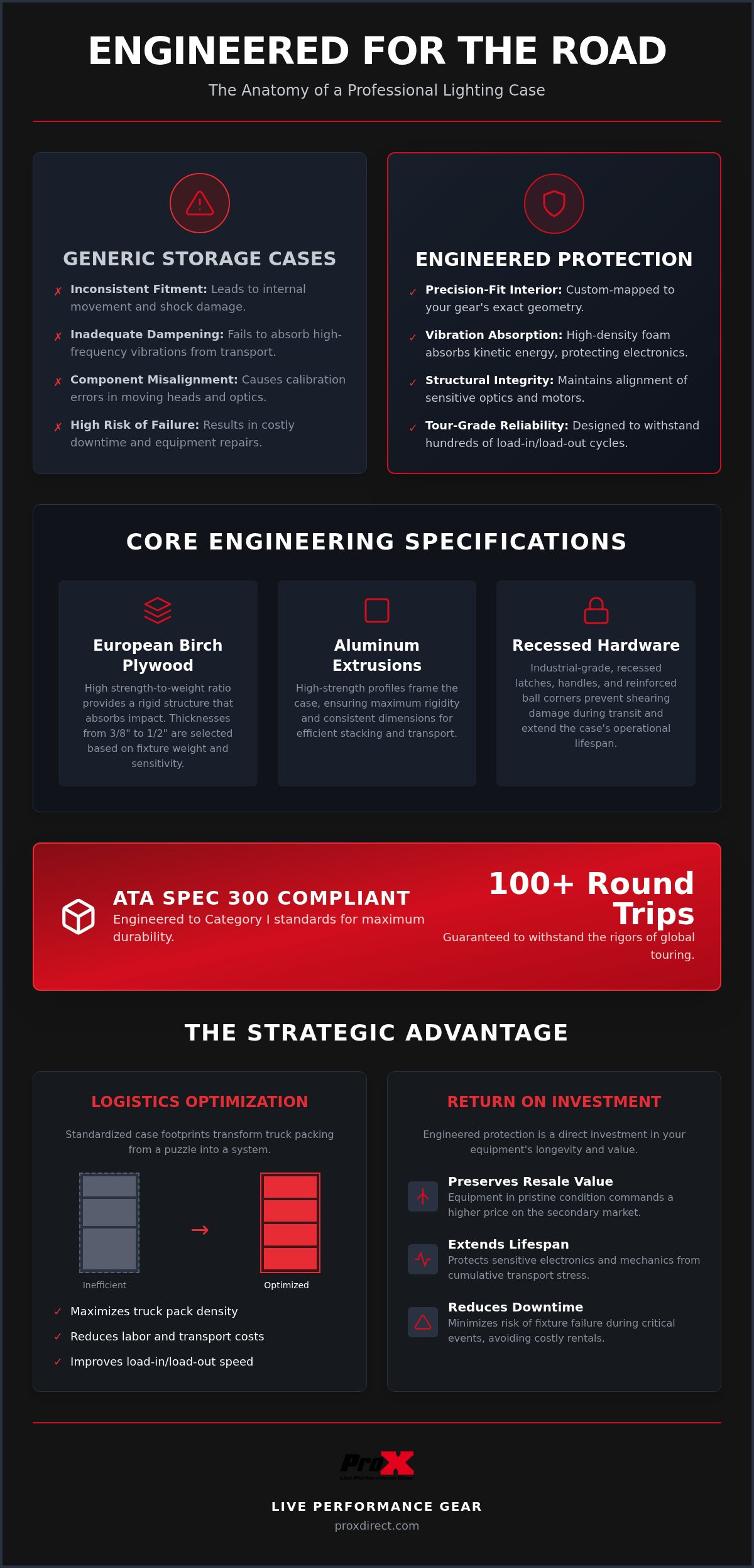
Professional production environments subject lighting equipment to extreme mechanical stress. High-value fixtures, particularly automated moving heads, require more than simple containment. They demand a shipping container specifically designed to mitigate the unique physical demands of global touring. Generic storage solutions often fail because they lack the structural specificity needed to secure delicate internal components. This neglect often leads to internal misalignment, which compromises the fixture's performance during critical events.
Utilizing custom lighting cases ensures that the internal architecture of the fixture remains aligned. Moving heads rely on precise stepper motors and optical sensors; even minor shifts in the chassis can lead to calibration errors or mechanical binding. Engineered housing provides a rigid exterior shell while maintaining a decoupled interior environment through specialized dampening. This transition from basic storage to engineered transport solutions allows touring crews to maintain high production standards across multiple venues without recurring hardware failure.
Protecting Sensitive Optics and Electronics
Standard foam inserts often provide inadequate protection against the high-frequency vibrations encountered during long-haul transit. These vibrations can cause solder joint fatigue in LED diodes or loosen the microscopic mounting hardware within lens assemblies. Precision-cut, high-density foam, designed through 3D mapping of the fixture's geometry, provides uniform support. This prevents "hot spots" of pressure on the fixture's housing while ensuring that the center of gravity remains stable within the ProX Cases framework. Professional-grade materials, such as those used in ZCASE custom lighting cases, are selected for their ability to absorb kinetic energy rather than transferring it to the electronics.
The ROI of Engineered Protection
The financial justification for bespoke housing centers on the reduction of equipment downtime. A single fixture failure during a high-profile event can result in significant labor costs for emergency repairs or the need for immediate rental replacements. By investing in ruggedized housing like Santosom cases, production companies extend the operational lifespan of their inventory. These cases utilize reinforced corners and recessed hardware to maintain structural integrity over hundreds of load-outs. Maintaining the physical condition of the gear directly impacts its eventual resale value. Equipment that shows no signs of chassis wear or internal rattling commands a higher price on the secondary market. This effectively lowers the total cost of ownership by preserving the integrity of the initial capital investment.
Engineering Specifications: Materials and Structural Integrity
The structural integrity of custom lighting cases depends on the precise selection of raw materials and mechanical components. Engineering high-performance housing requires adherence to the ATA Spec 300 standard, specifically Category I, which ensures a container can withstand a minimum of 100 round trips. As of September 2026, the market price of aluminum was $3362.05 USD per metric ton, a factor that underscores the importance of utilizing high-strength extrusion profiles efficiently to ensure maximum rigidity without unnecessary weight.
Professional manufacturing relies on European birch plywood, which remains the preferred substrate for its high strength-to-weight ratio. This material provides the necessary flex to absorb impacts while maintaining the rigid geometry required for consistent truck packing. By selecting specific plywood grades and lamination types, engineers can tailor the case's performance to the weight and sensitivity of the lighting fixtures it contains.
Exterior Shell and Hardware Standards
Selecting the correct plywood thickness is a weight-to-strength calculation. 3/8-inch plywood is typically sufficient for medium-sized fixtures, while 1/2-inch thickness is required for heavy-duty moving heads or multi-fixture arrays. Honeycomb lamination provides a significant mechanical advantage; this hexagonal structure increases impact resistance and can contribute to a weight reduction of 30% to 50% compared to traditional solid laminates. This reduction is critical for managing shipping costs and improving maneuverability in tight venues.
Longevity in touring environments requires heavy-duty recessed hardware. Recessed latches prevent snagging during truck loading, while spring-loaded handles ensure ergonomic handling. Reinforced steel ball corners distribute the energy of an impact across the case's frame, protecting the internal contents from structural deformation. Standardizing these components across an entire inventory simplifies maintenance, as ProX Cases utilize consistent hardware specifications to ensure long-term compatibility.
Internal Architecture and Foam Engineering
The interior of a case is as critical as the shell. 2 lb. density etha foam is the preferred material for shock absorption in professional lighting housing. This closed-cell polyethylene foam provides superior cushioning without degrading over time. Precision CNC cutting allows for the integration of ventilation paths, which are necessary for fixtures that retain significant heat after a performance. Managing accessories requires integrated organization systems; high-quality hook-and-loop fasteners secure power cables and mounting clamps, preventing them from shifting and striking the optics during transit. This methodical approach ensures every component is immobilized and protected from high-frequency vibrations.
Specialized Configurations for Moving Heads and LED Arrays
The engineering of custom lighting cases extends beyond basic impact resistance to address functional deployment and logistical density. Modern touring requires a shift from universal storage to fixture-specific configurations that facilitate faster load-ins. Precision measurements of the fixture's yoke, base, and lens assembly are mandatory to ensure a secure fit that prevents mechanical drift. This technical approach guarantees that sensitive internal components, such as dichroic filters and gobo wheels, aren't subjected to lateral G-forces during transport.
Moving Head Transport: Single vs. Multi-Fixture
Selecting between single and multi-fixture housing depends on the unit's weight and the crew's logistical workflow. Single-fixture cases are the standard for high-output moving heads exceeding 35kg. These individual containers allow for easier manual handling in venues without loading docks and prevent the excessive weight accumulation that strains casters and flooring. For smaller wash lights and spot fixtures, dual-fixture tray-style designs optimize truck space by doubling the fixture count per square meter of floor space.
Efficient internal design includes dedicated compartments for rigging hardware and safety cables. Storing clamps and power looms within the same unit as the fixture reduces the risk of missing components at the truss. This organization is maintained through high-quality hook-and-loop fasteners and CNC-routed dividers. Balancing the case weight is a primary engineering concern; cases designed for forklift logistics may utilize thicker plywood, while those intended for manual ramps prioritize weight reduction through honeycomb materials.
Console and Control Protection
Workstations and control surfaces represent the most significant capital investment in a lighting rig. Custom lighting cases for consoles must integrate complex monitor arrays and power distribution systems into a single, deployable unit. ZCASE Custom Build Cases provide the specialized engineering required for these high-value surfaces. These builds often feature integrated network switches and cooling fans to maintain hardware performance in high-temperature environments.
Specific designs, such as Flip Ready Cases Made by ZCASE in Poland, utilize a mechanical hinge system that allows a single operator to transition the console from a vertical transport position to a horizontal operational state. This eliminates the need for heavy lifting and reduces the crew size required for front-of-house setup. These workstations act as a mobile command center, housing not just the console, but also the processing racks and secondary displays necessary for complex timecoded shows. This level of integration ensures that the entire control system remains interconnected and protected throughout the tour's duration.
Optimizing Production Logistics and Truck Pack Efficiency
Professional touring logistics depend on the mathematical precision of the truck pack. While the primary function of custom lighting cases is equipment protection, their secondary role as standardized logistical units is equally vital. Efficient production management requires cases that function as modular components within a larger transport system. When dimensions are inconsistent, the resulting gaps in a trailer lead to equipment shifting, which is a primary cause of structural damage during transit. Standardizing the footprint of your inventory ensures that every cubic meter of transport space is utilized effectively.
Engineered solutions like TruckPaX™ Truck Pack Cases are designed specifically to address these logistical challenges. By utilizing uniform exterior dimensions, touring crews can predict exactly how much trailer space a lighting rig will occupy before the first case is loaded. This predictability reduces the time spent on "puzzle-solving" during load-out, directly lowering labor costs and ensuring that tight travel schedules are maintained between tour stops.
The Science of the Truck Pack
Industry standards for exterior case widths are typically set at 22.5 inches or 45 inches. These specific measurements allow for a "quarter-pack" or "half-pack" configuration within standard 90-inch or 96-inch wide trailers. For example, four 22.5-inch cases side-by-side perfectly occupy a 90-inch width, leaving no room for lateral movement. This tight-tolerance packing is essential for long-haul stability. Beyond width, stackable designs featuring recessed wheel dishes allow for vertical optimization. This prevents cases from migrating during transit and maximizes the vertical clearance of the trailer, which is often underutilized in poorly planned packs.
Maneuverability and Handling
The efficiency of a load-in is often dictated by how easily a case moves from the ramp to the stage. High-quality, industrial-grade casters are non-negotiable for custom lighting cases. These components must withstand transit over uneven asphalt, gravel, and high-friction venue flooring without failure. Balanced weight distribution is a key engineering metric; a case that is "nose-heavy" or "tail-heavy" presents a safety risk to the crew and is difficult to maneuver in tight backstage corridors.
Rapid inventory tracking is further enhanced through integrated labeling systems. Implementing color-coded plates or standardized tour labels allows technicians to identify fixture types and patch assignments at a distance. This organizational clarity is critical during the high-pressure environment of a festival changeover or a one-night-only performance. If you're looking to streamline your touring inventory, you can view the full range of TruckPaX™ and professional transport solutions to find the right fit for your rig.
Bespoke Engineering Services: The ProX and ZCASE Advantage
Achieving the highest level of protection for specialized production gear requires direct collaboration with manufacturing engineers. Off-the-shelf solutions often fail to account for the unique center of gravity or delicate external sensors found on modern fixtures. ZCASE Custom Build Cases address this by utilizing a meticulous design-and-build process that transforms technical specifications into ruggedized transport assets. This partnership ensures that custom lighting cases are not merely boxes, but precision-engineered components of a professional touring rig.
The Custom Design-and-Build Process
The engineering workflow begins with the submission of accurate physical dimensions or manufacturer CAD files for the specific lighting fixtures. Engineers use this data to create a 3D map of the fixture's geometry, allowing for the design of internal bracing and foam inserts that provide uniform support. Before full-scale production commences, clients review detailed technical drawings and, in complex scenarios, foam prototypes to verify fitment and accessibility. You can learn about ZCASE bespoke engineering and how these standards are applied to high-value production gear.
Santosom Cases represent another tier of European engineering excellence available through the ProX network. These cases are built to withstand global touring standards, utilizing premium materials and construction techniques that have been refined since 1984. Accessing this expertise is facilitated through a global dealer network, providing production companies with local support and technical consultation for project-specific needs. This infrastructure allows for the delivery of high-performance housing that meets the rigorous demands of international logistics.
Durability and Maintenance
Long-term operational reliability is a hallmark of professional-grade equipment. Even the most rugged custom lighting cases eventually require maintenance due to the high-stakes environment of international touring. ProX maintains a comprehensive inventory of replacement parts, including casters, latches, and handles, to extend the service life of every unit. This availability ensures that a damaged component does not render an entire transport system obsolete, allowing for rapid field repairs that maintain the integrity of the rig.
Production companies have relied on these engineering standards for over four decades. The commitment to functional excellence over aesthetic trends has established ProX as a reliable backbone for the industry. To explore the diverse options available for your inventory, you can browse our full range of professional cases and technical transport solutions. By prioritizing structural integrity and logistical compatibility, these bespoke services provide the security necessary for modern, high-value lighting investments.
Securing the Future of Your Touring Inventory
The protection of high-value fixtures requires a transition from generic storage to engineered logistical assets. By utilizing precision-cut foam and standardized exterior dimensions, professional custom lighting cases eliminate the mechanical risks of vibration while maximizing truck pack density. We've examined how technical specifications, such as those found in ZCASE custom designs made in Poland and rugged Santosom touring-grade cases, ensure that sensitive optics remain calibrated throughout the most demanding schedules.
Since 1984, ProX has provided the industrial authority needed to support global production. Maintaining a standardized inventory with accessible replacement parts extends the operational lifespan of your gear and protects your capital investment. It's a calculated decision that prioritizes functional excellence over temporary fixes. To optimize your production logistics, you can Request a Quote for Custom Lighting Case Engineering to find a solution tailored to your specific fixtures. Investing in professional housing today ensures that your rig remains functional and reliable for every performance on the tour.
Frequently Asked Questions
How do I measure my lighting fixture for a custom case?
To measure a fixture, you must record the maximum height, width, and depth including all protrusions like clamps or handles. It's best to provide the manufacturer's CAD files to ensure the foam insert accounts for the yoke position and center of gravity. Accurate measurements prevent the fixture from shifting during transit. This precision ensures that custom lighting cases provide the immobilization necessary to protect delicate internal motors and optical sensors.
What is the difference between etha foam and standard packing foam?
2 lb. density etha foam is a closed-cell polyethylene material that offers superior shock absorption and won't degrade over time. Standard polyurethane packing foam is open-cell, meaning it can absorb moisture and eventually crumble into abrasive dust. Etha foam is non-abrasive and maintains its structural integrity through hundreds of tours. This durability is essential for securing high-value lighting components against high-frequency vibrations during long-distance transport.
Can I customize the interior of my lighting case for cables and clamps?
You can integrate dedicated compartments for power looms, rigging hardware, and safety cables within the case architecture. Utilizing CNC-routed dividers and high-quality hook-and-loop fasteners allows technicians to secure accessories without them striking the fixture. This organization streamlines the setup process at the venue. Custom workstations can also be engineered to include integrated power distribution and network switches for complex control systems.
What are the benefits of standardized truck pack dimensions?
Standardized dimensions allow for a quarter-pack or half-pack configuration that perfectly fits trailer widths of 90 to 96 inches. Using 22.5-inch or 45-inch exterior widths eliminates lateral gaps where equipment could shift. This density maximizes transport efficiency and significantly reduces loading times. Uniform case footprints also improve warehouse storage by allowing for stable vertical stacking and better inventory management.
How do I maintain the casters and latches on my lighting cases?
Proper maintenance involves regular inspection of mechanical components and the use of ProX Cases replacement parts when wear is detected. You should lubricate recessed latches with a dry silicone spray and tighten caster mounting bolts periodically. Removing debris from wheel bearings ensures smooth transit over venue surfaces. Checking the structural integrity of the reinforced corners prevents minor impacts from developing into significant housing failures over time.
Why should I choose a custom case over a universal fit model?
A custom case provides a precision fit that prevents the internal misalignment often caused by the "slop" in universal models. Universal cases rely on adjustable foam that can compress or shift, leaving sensitive optics vulnerable to impact. custom lighting cases are engineered to support the fixture at its strongest points, such as the base and yoke. This specific support extends the operational lifespan of the gear and maintains its resale value.
What plywood thickness is best for heavy moving head fixtures?
1/2-inch European birch plywood is the industry standard for heavy moving head fixtures exceeding 35kg. For smaller wash lights or LED par cans, 3/8-inch plywood offers a lighter alternative without compromising structural integrity. The choice depends on the total weight and the expected frequency of air transport. Thicker plywood provides better screw retention for heavy-duty hardware and handles the stresses of forklift logistics more effectively.
How do ZCASE custom builds differ from standard production cases?
ZCASE custom builds are bespoke projects manufactured in Poland that utilize advanced 3D design and engineering for project-specific needs. While standard production cases offer high-quality protection for common fixtures, ZCASE focuses on complex integration, such as flip-style console workstations. These builds often include specialized features like integrated cooling and custom internal routing for electronics. They are designed for high-value production gear where standard off-the-shelf housing is insufficient.
Disclaimer
Any trademarks, trade names or brand names appearing herein that do not belong to ProX are the property of their respective owners and/or companies, and such appearance doesn't and shall not constitute or imply endorsement, sponsorship or recommendation by ProX.


