

A sticker claiming compliance is not a substitute for the rigorous engineering required by the Airlines for America Revision 2020.1 specification. For production professionals, the gap between a marketing label and actual ATA 300 flight case requirements is often measured in thousands of dollars of damaged gear. You've likely faced the professional headache of navigating vague packaging standards only to have an insurance claim denied because a container failed to protect a high-value asset during air freight. It's a high-stakes environment where the physical demands of global logistics don't allow for technical ambiguity.
By mastering these technical specifications, you can ensure your production equipment survives the most punishing transit cycles. This article provides a professional breakdown of the engineering standards that separate Category I, II, and III containers. We'll examine the precise drop test heights and impact velocities required for Category I status, which demands a minimum of 100 round trips. You'll learn how to evaluate hardware, material density, and permanent cushioning systems to verify manufacturer claims with engineering precision. This methodical overview moves from broad utility to the specific mechanical assembly standards necessary for professional-grade protection.
Key Takeaways
- Identify the technical distinctions between Category I, II, and III classifications to ensure protective containers meet the required lifespan for global logistics.
- Master the specific ATA 300 flight case requirements regarding structural materials, including the use of architectural-grade plywood and high-pressure laminates.
- Understand the rigorous impact and drop test parameters required for Category I certification, ensuring a minimum of 100 round trips of service life.
- Evaluate interior cushioning standards by analyzing foam density and the functional differences between open-cell and closed-cell polyurethane materials.
- Learn how precision engineering and CAD-driven customization from Santosom and ZCASE provide documented compliance with the A4A Revision 2020.1 standard.
Understanding the ATA 300 Specification in Modern Production Logistics
The ATA 300 Specification serves as the primary engineering benchmark for protective packaging within the aviation industry. Established by the Air Transport Association, now known as Airlines for America (A4A), this document dictates the structural integrity required for containers shipped via air transport. It isn't a vague marketing claim. It's a rigorous set of guidelines for material science and mechanical assembly. While many manufacturers use the term "heavy-duty" to describe their products, that phrase lacks the technical validation found in actual ATA 300 flight case requirements. For production professionals, this distinction is critical for maintaining equipment longevity and securing insurance coverage during complex global deployments.
The Evolution of Protective Air-Freight Standards
The standard was first published on August 1, 1960, to provide a framework for how airline supplies were moved. Over the decades, it's undergone multiple revisions to keep pace with evolving logistics. The current Revision 2020.1 reflects modern demands for durability and reusability. Early containers relied on basic timber construction, but the standard now incorporates advanced materials like high-density polyethylene and architectural-grade plywood to improve compliance. What began as a necessity for military and aerospace components has become the backbone of professional entertainment production. Modern touring requires gear to move through high-volume global hubs, making these historical engineering benchmarks more relevant than ever for technical equipment safety.
Why Production Professionals Require Certified Packaging
Catastrophic equipment failure during a global tour can lead to massive financial losses and logistical delays. Certified packaging minimizes this risk by providing a documented level of impact resistance. Air freight carriers often mandate specific packaging grades to reduce their own liability. Failing to meet these can result in denied insurance claims if damage occurs during transit. Utilizing containers that adhere to The Ultimate Guide to Flight Cases: Engineering Protection for Professional Gear ensures your assets are protected by proven structural standards. For those managing high-value inventories, these requirements aren't suggestions; they're essential for operational reliability. You can view compliant solutions in the ProX Cases catalog to see how these standards are applied in real-world engineering.
Compliance with ATA 300 flight case requirements also impacts the long-term cost of ownership. Engineering-first choices like Santosom and ZCASE builds utilize precision CAD design to ensure every internal component is secured against G-force spikes. This meticulous approach to build integrity reflects a deep understanding of the physical demands placed on professional gear. When equipment failure is not an option, relying on verified technical standards is the only dependable strategy for global logistics.
The Three Classification Categories of ATA 300 Packaging
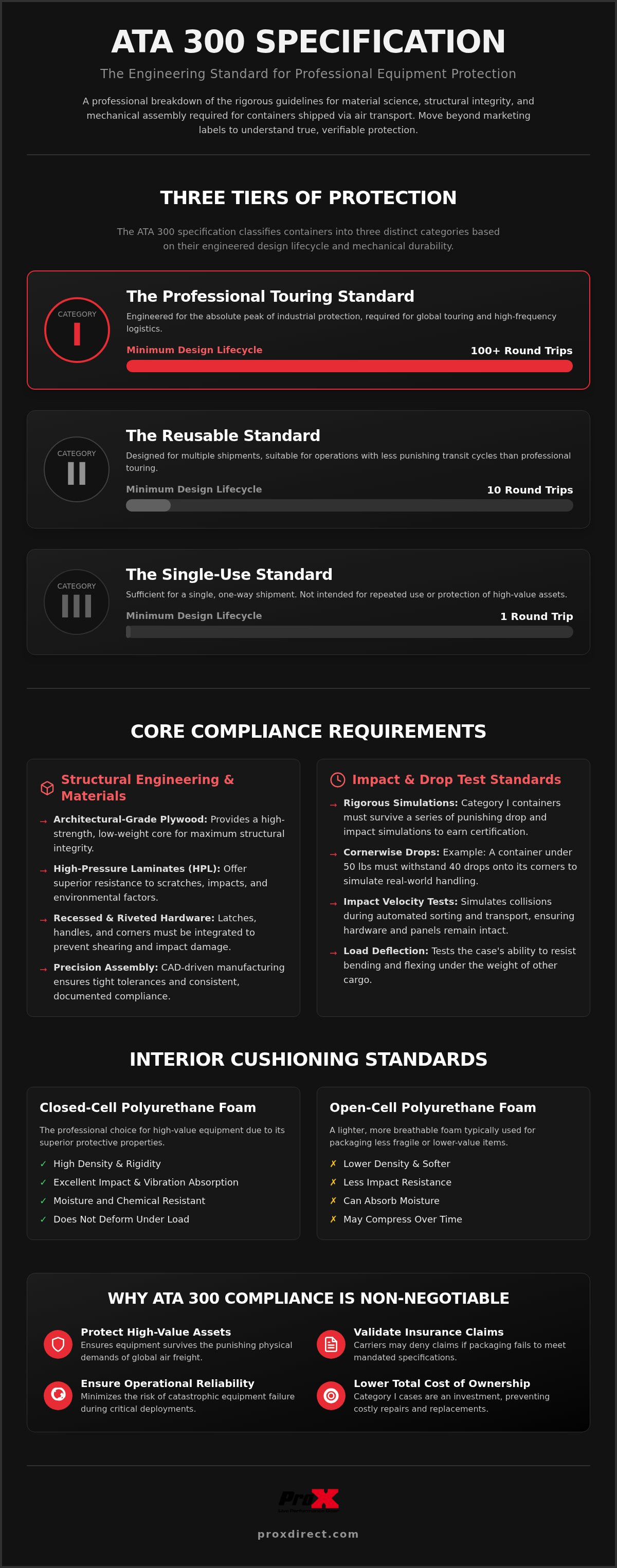
The ATA 300 specification classifies protective containers into three distinct tiers based on their design lifecycle and mechanical durability. These categories help professionals align their packaging choices with the specific demands of their logistical operations. While a single-use box might suffice for a one-way shipment of non-fragile parts, global touring requires the mechanical resilience found only in the highest classification of ATA 300 flight case requirements. Selecting the wrong category often leads to structural failure and compromised equipment during high-velocity air freight handling.
Category I: The Professional Touring Standard
Category I containers represent the peak of industrial protection. These cases are engineered for a minimum of 100 round trips. To achieve this rating, a container must pass rigorous ATA 300 testing standards, which include a series of drop and impact simulations. For instance, cases weighing under 50 pounds must survive 40 cornerwise drops from 36 inches and 160 face drops from 30 inches without structural degradation. The standard also mandates impact tests where edges and corners must withstand velocities up to 12 feet per second.
This classification is the baseline for high-value audio, lighting, and broadcasting equipment. The structural integrity is maintained through the use of architectural-grade plywood and reinforced hardware. When you invest in Santosom Cases: Engineering Excellence for Touring Pros, you're selecting equipment built to these exact Category I specifications. These containers don't just protect against impact; they're designed to withstand the cumulative stress of repeated loading, stacking, and environmental exposure over years of service.
Category II and III: Tactical and One-Way Logistics
Category II containers are designed for short-term use, typically rated for approximately 10 round trips. These are often used for regional transport or for less fragile components that don't require the extreme longevity of Category I. Materials in this category can include heavy-duty corrugated plastics or timber crates. While more durable than standard shipping boxes, they lack the recessed hardware and reinforced edges required for long-term global air freight. They serve as a middle ground for tactical logistics where a container is needed for a specific project duration but not a full touring cycle.
Category III packaging is intended for single-trip applications, usually consisting of high-test corrugated boxes. In the professional production environment, Category III is rarely suitable for sensitive electronics. It offers minimal resistance to the crushing forces and punctures common in high-volume logistics hubs. Understanding these ATA 300 flight case requirements ensures you don't compromise your gear by using a short-term solution for a long-term touring need. If your schedule involves frequent air transport, you should always prioritize the Category I standard found in the ProX Cases lineup to prevent equipment failure.
Structural Engineering and Material Requirements for Compliance
Adhering to ATA 300 flight case requirements involves a meticulous selection of materials designed to withstand extreme mechanical stress. The structural core of a compliant container is not merely a housing but an engineered system for energy dissipation. This begins with the selection of high-density panels, typically 3/8-inch or 1/2-inch architectural-grade plywood. These panels must maintain their alignment and integrity under the load of heavy internal components while resisting the crushing forces of stacked air cargo. The ATA Spec 300 Revision 2020.1 provides the comprehensive framework for these material choices, ensuring that every layer of the build contributes to the protection of the internal asset.
Exterior Panel Integrity and Laminate Specifications
Plywood remains the industry standard for Category I compliance because of its superior strength-to-weight ratio and natural impact absorption. Architectural-grade plywood is a core compliance material characterized by uniform veneer density and minimal internal voids. To enhance this core, manufacturers apply a high-pressure laminate (HPL) or ABS plastic skin. The chemical bonding process used to attach these laminates is critical. It creates a moisture-resistant barrier that prevents the plywood from warping in high-humidity cargo holds. This exterior layer also provides essential scratch and puncture resistance, ensuring the case survives the friction of automated sorting systems without compromising the structural wood underneath.
Hardware Precision: Recessed Latches and Handles
The mechanical assembly of a case is just as important as the panels themselves. Engineering standards for air freight mandate the use of recessed hardware. Protruding latches or handles are prone to snagging on conveyor belts or other containers, which can lead to catastrophic failure during transit. Recessed butterfly latches are the standard for secure closure. They must be engineered to stay locked under vibration and heavy G-force spikes. Similarly, handles must be spring-loaded to remain flush against the case when not in use. This hardware is often secured with reinforcement plates and specific rivet patterns to ensure the load is distributed evenly across the plywood panel.
Impact dissipation is further managed through the use of heavy-duty steel ball corners. These spherical components are designed to be the first point of contact during a drop. By transferring kinetic energy away from the corner joints and into the reinforced aluminum extrusions, they prevent the case from splitting at its weakest points. This focus on the hidden architecture of the container, from rivet spacing to handle load ratings, is what distinguishes Santosom and ZCASE builds as reliable solutions for professional production. Every hardware choice serves a functional purpose in meeting the rigorous ATA 300 flight case requirements for long-term global deployment.
Interior Protection and Environmental Resistance Standards
The internal engineering of a container is the final line of defense against G-force spikes and environmental exposure. While the exterior shell manages impact, the interior cushioning determines whether that kinetic energy reaches the sensitive electronics inside. Adhering to ATA 300 flight case requirements necessitates a precise calculation of foam density and material composition. High-value gear requires specific energy absorption rates that generic padding cannot provide. This technical approach prevents internal component shifting and ensures the equipment remains operational after heavy turbulence or mechanical handling.
High-Density Foam and Custom Interior Engineering
Calculating the proper foam-to-weight ratio is essential for heavy assets like large-format mixer consoles. If the foam is too soft, the equipment will bottom out during a drop; if it's too rigid, the shock is transferred directly to the gear. Closed-cell polyethylene foam is the industry standard for Category I compliance due to its resilience and moisture resistance. Open-cell polyurethane foam is better suited for lightweight accessories but lacks the structural memory needed for heavy touring cycles. Utilizing ZCASE Custom Build Cases: Engineering Bespoke Protection allows for CNC-cut inserts that mirror the equipment's geometry. This bespoke fit eliminates movement and provides uniform support across the entire chassis of the device.
Water Resistance and Environmental Sealing
Environmental protection is managed through the integration of tongue-and-groove aluminum valances. These extrusions create a mechanical seal that prevents dust and moisture ingress during outdoor load-ins or tarmac exposure. Precise valance alignment is critical for maintaining structural integrity and ensuring the load is distributed evenly across the case joints. Professionals must distinguish between standard water-resistant cases and fully watertight solutions. While a compliant ATA 300 case protects against rain and humidity, specialized builds like UltronX Watertight Cases are required for total submersion or extreme pressure changes. For those managing sensitive AV gear, ensuring these seals meet ATA 300 flight case requirements is a non-negotiable step in logistical planning. Explore the full range of AV Broadcasting Cases to find solutions engineered for high-stakes environmental resistance.
Implementing ATA 300 Standards with ProX Engineering
ProX engineering serves as a reliable backbone for production professionals who prioritize material integrity. Meeting ATA 300 flight case requirements is not a static achievement. It's a continuous engineering commitment. Through the integration of advanced CAD design, ProX ensures that every internal component and external hardware point aligns with the A4A Revision 2020.1 standards. This methodical approach allows for the development of bespoke solutions that address the specific physical demands of high-value gear. By prioritizing functional excellence over aesthetics, the brand provides the technical superiority required for global logistics.
Santosom Cases and Bespoke Engineering Excellence
The Santosom Cases Product Category represents a pinnacle of engineering precision for the A/V industry. These solutions are developed through specialized custom engineering services that solve unique logistical challenges. Whether the gear is a sensitive broadcasting console or a high-output lighting rig, the design process utilizes precision modeling to ensure exact tolerances. This eliminates the risk of component shifting during high-G air freight cycles. The partnership between ProX and Santosom focuses on the practical realities of professional use, delivering containers that exceed the baseline for Category I compliance.
Maintaining Hardware Integrity Over Time
Long-term compliance depends on a rigorous maintenance schedule. Even a case built to the highest ATA 300 flight case requirements can suffer from mechanical fatigue after years of global transport. Production managers should implement a methodical inspection checklist after every tour to ensure ongoing protection:
- Latches and Hinges: Inspect recessed butterfly latches for spring tension and mechanical alignment. Any warping in the tongue-and-groove valance can compromise the environmental seal.
- Casters and Hardware: Verify that load-bearing casters rotate smoothly and that rivet points remain secure against the plywood panels.
- Foam Integrity: Check interior cushioning for fatigue. If the foam has compressed by more than 60% of its original thickness, it no longer provides the necessary G-force reduction.
Securing Your Technical Assets for Global Logistics
Mastering the technical nuances of the A4A Revision 2020.1 standard transforms how you manage high-value production gear. You now understand that ATA 300 flight case requirements demand specific mechanical assembly and material science to survive 100 round trips of air freight. From the density of closed-cell foam to the structural dissipation of steel ball corners, every engineering choice serves to mitigate the risks of catastrophic equipment failure. These standards aren't just guidelines; they're the foundation of professional reliability in a high-stakes industry.
ProX has been engineering performance-gear since 1984, offering specialized ZCASE and Santosom engineering services to meet these rigorous benchmarks. Our global dealer network provides the professional support needed to maintain standardized fleet solutions for any production environment. By prioritizing functional excellence and material integrity, you can ensure your equipment remains a dependable asset rather than a liability. Explore Engineered ATA 300 Solutions at ProX. Implementing these industrial standards ensures your gear remains protected and operational, no matter where the tour takes you.
Frequently Asked Questions
What is the primary difference between ATA 300 Category I and Category II?
Category I containers are engineered for a minimum of 100 round trips, while Category II containers are designed for approximately 10 round trips. This distinction is defined by the Airlines for America Revision 2020.1 specification. Category I requires more rigorous drop and impact testing to ensure structural longevity. While Category II is suitable for short-term or regional logistics, professional production environments typically require the mechanical resilience of Category I to protect high-value assets during global air freight.
Can a plastic case meet ATA 300 requirements for professional gear?
High-density polymers and specialized plastics can meet ATA 300 standards if they pass the required impact and drop simulations. For example, UltronX watertight cases utilize rugged polymer construction to provide environmental resistance and structural integrity. Compliance is determined by the container's ability to survive specific velocities and heights, not just the material choice. While plywood is the traditional standard for large-format gear, engineered plastics are frequently used for smaller, sensitive electronics that require lightweight protection.
Are all recessed latches considered ATA 300 compliant?
Not all recessed hardware meets actual ATA 300 flight case requirements. Compliance depends on the latch's ability to remain secure under extreme vibration and G-force spikes. Professional-grade butterfly latches must be made from heavy-duty steel and recessed to prevent snagging on conveyor systems. Many generic cases use lighter hardware that fails under the stress of high-volume air cargo hubs. You should verify that the mechanical assembly uses industrial-grade components designed for repeated transit cycles.
How much weight can an ATA 300 handle typically support?
Handle load ratings are determined by the hardware's mechanical design and the method of attachment. Industrial spring-loaded handles used in Category I containers are engineered to support the gross weight of the case during rapid mechanical handling. The standard requires that handles don't fail when the container is subjected to the stress of air freight logistics. Proper rivet spacing and the use of reinforcement plates ensure the load is distributed evenly across the plywood panel.
Do ATA 300 requirements specify the thickness of the plywood panels?
The specification focuses primarily on performance outcomes like impact resistance rather than mandating a specific thickness. However, architectural-grade plywood at 3/8-inch or 1/2-inch thickness is the industry standard for meeting Category I durability. These thicknesses provide the necessary strength-to-weight ratio to pass rigorous drop tests from heights up to 36 inches. Thinner panels often lack the structural rigidity needed to prevent the case from splitting or warping during the cumulative stress of 100 round trips.
What type of foam is best for meeting ATA 300 interior standards?
Closed-cell polyethylene foam is the superior choice for meeting ATA 300 flight case requirements due to its resilience and moisture resistance. Unlike open-cell polyurethane, closed-cell foam maintains its structural memory and doesn't compress permanently under heavy loads. This material is essential for protecting sensitive electronics from shock during transit. The foam must be permanently attached to the interior walls and shouldn't compress more than 60 percent of its original thickness during a one-meter drop test.
Is an ATA 300 case automatically waterproof?
ATA 300 compliance doesn't guarantee a case is waterproof. The standard focuses on mechanical durability and reusability rather than total submersion protection. While tongue-and-groove valances provide a degree of moisture resistance against rain and humidity, they aren't airtight. For total protection against water ingress, you should specify a build like the UltronX series. These containers are engineered with specialized gaskets to provide a watertight seal that exceeds basic air freight packaging guidelines.
How does ATA 300 compliance affect equipment shipping insurance?
Shipping carriers and insurance providers often mandate specific packaging standards for high-value gear. If a claim is filed for damaged equipment, the insurer will inspect the container for ATA 300 compliance. Utilizing a case that fails to meet these engineering benchmarks can result in a denied claim due to improper packaging. Documenting that your gear was shipped in a Category I container provides a technical defense, ensuring that your assets are covered under standard logistical liability agreements.
Disclaimer
Any trademarks, trade names or brand names appearing herein that do not belong to ProX are the property of their respective owners and/or companies, and such appearance doesn't and shall not constitute or imply endorsement, sponsorship or recommendation by ProX.


