
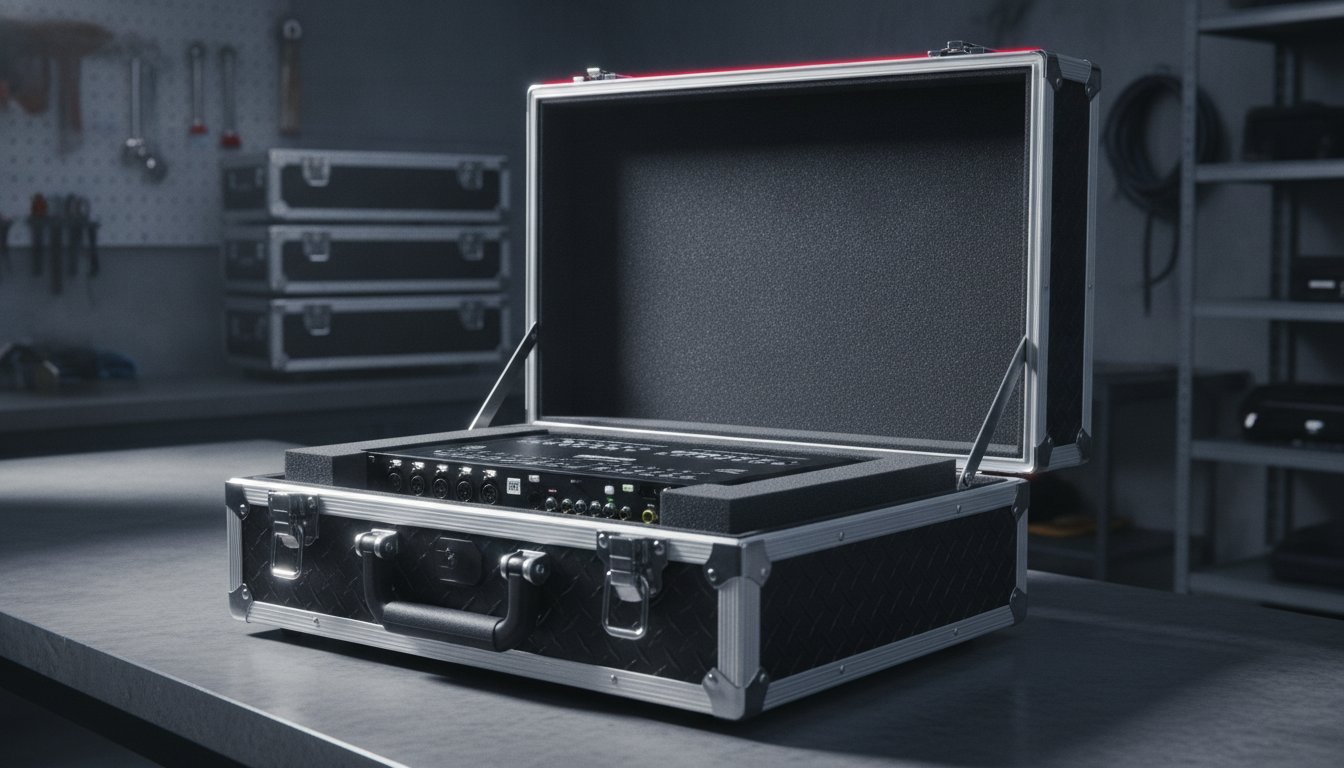
A piece of high-value electronic equipment that powers on after transit hasn't necessarily survived the journey in its optimal state. You're likely aware that hidden vibration damage and micro-fractures in solder joints often cause catastrophic failure weeks after a shipment arrives. Relying on standard packaging for professional grade gear is a calculated risk that eventually leads to a zero-sum outcome. To maintain mechanical integrity during long-haul logistics, you must deploy engineered protective cases for shipping electronics that meet rigorous ATA 300 Revision 2020.1 standards.
We understand that your primary objective is a zero-failure transit cycle where equipment arrives calibrated and ready for immediate deployment. This article outlines the specific structural requirements and technical protocols needed to safeguard sensitive components against moisture ingress and rough handling by third-party carriers. You'll master how to optimize weight without compromising structural rigidity, ensuring your logistics remain efficient while meeting the 2026 IATA requirements for lithium-ion battery state-of-charge limits. We'll examine the dual-layer engineering approach required to isolate internal components from external kinetic energy and environmental stressors.
Key Takeaways
- Identify the critical distinction between external impact resistance and internal harmonic vibration to prevent long-term mechanical fatigue in sensitive components.
- Select the appropriate structural housing by comparing the durability of plywood-based Santosom cases with the environmental sealing of UltronX™ watertight options.
- Implement a professional packing protocol that utilizes specific foam densities, such as EPE or EVA, to achieve optimal deceleration during high G-force events.
- Improve logistical efficiency through the deployment of protective cases for shipping electronics that feature standardized dimensions for high-density truck packing.
- Understand the technical requirements for custom-engineered solutions when off-the-shelf housing fails to meet the specific dimensions of bespoke production gear.
Assessing the Physical Risks to High-Value Electronics in Transit
The transportation of sensitive electronic systems requires an objective analysis of kinetic energy transfer. High-value electronics are vulnerable to complex physical stressors that extend far beyond simple drop damage. Professional logistics require an engineering-first approach to mitigate these risks. Standard packaging often focuses on cosmetic protection, yet it fails to address the underlying structural demands of international freight. Deploying high-performance protective cases for shipping electronics is the primary defense against the variables of third-party handling. It's the only way to ensure the internal circuitry remains intact during multi-modal transit cycles.
G-force impacts during loading and unloading represent the most visible threat. A sudden drop can exert force dozens of times the weight of the equipment, leading to chassis deformation. However, harmonic vibration during long-distance trucking often presents a more insidious risk. Sustained oscillation at specific frequencies leads to mechanical fatigue in internal components, specifically affecting PCB solder joints and delicate optical alignments. Without proper isolation, these vibrations cause hidden damage that results in failure only after the equipment is powered on at the destination. Logistics doesn't just involve moving an object; it involves managing energy.
Structural integrity is the metric of success for any technical housing. While a consumer-grade case might prevent scratches, it lacks the wall thickness and hardware reinforcement to maintain its shape under stack loads. Professional-grade solutions utilize heavy-duty materials and reinforced corners to ensure the case remains a rigid perimeter. This prevents the transfer of crushing forces to the internal payload, even when several hundred pounds of equipment are stacked on top in a crowded truck pack.
Shock vs. Vibration: Understanding the Difference
Shock refers to a sudden, high-magnitude event that occurs in milliseconds; it targets the external housing and structural mounts. Sustained vibration involves low-magnitude oscillation over hours or days. Professional Transit Cases manage these distinct forces through precision foam isolation. Engineering the internal environment requires selecting specific foam densities, such as EPE for high-load support or EVA for superior shock absorption, to decouple the equipment from the case shell. This isolation layer absorbs the energy before it reaches sensitive internal oscillators or connectors.
Climate Risks in Global Logistics
Environmental stressors introduce chemical and mechanical risks that standard cases don't address. In non-pressurized cargo holds, rapid pressure fluctuations stress sealed components. Temperature shifts during air or ocean transit lead to condensation cycles inside the case, which promotes corrosion on circuit boards. Maritime shipping introduces additional variables:
- Salt-laden air: A highly corrosive agent for exposed metal interfaces and connectors.
- Thermal expansion: Rapid temperature changes that can cause materials to expand or contract at different rates, stressing seals.
- Humidity ingress: Moisture that bypasses inadequate gaskets, leading to short circuits upon power-up.
To counter these threats, technical housings must incorporate environmental seals and pressure equalization valves to maintain internal atmospheric stability regardless of external conditions.
Selecting the Correct Protective Housing: Materials and Structural Standards
Achieving a zero-failure transit cycle requires more than a generic hard shell. It demands adherence to the ATA 300 Category 1 specification. This standard defines a reusable shipping container engineered to withstand a minimum of 100 round trips without structural degradation. When evaluating protective cases for shipping electronics, you must consider the structural integrity of the housing as the primary barrier against kinetic energy. The choice between fabricated plywood and injection-moulded plastic depends on the specific environmental stressors of the journey and the sensitivity of the internal components.
Hardware selection is equally critical to the survival of the internal payload. Surface-mounted latches are prone to shearing during rough handling by third-party logistics. Professional engineering dictates the use of recessed latches and spring-action handles that sit flush with the case surface to prevent snags. Heavy-duty steel ball corners are essential for distributing impact force across the aluminium extrusions rather than through the side panels. These components ensure the case maintains its geometric stability under the extreme stack loads common in international air freight.
Santosom Engineering: The Professional Touring Standard
The industry benchmark for high-durability transit remains 9mm to 12mm birch plywood construction. This material provides an exceptional strength-to-weight ratio and natural vibration dampening. In Santosom designs, the plywood is reinforced with high-grade aluminium extrusions that create a rigid skeleton. This prevents the "racking" or twisting of the case frame when it's loaded with heavy rack gear or consoles. You can explore Santosom engineering-grade cases to see how these structural elements integrate for professional touring gear.
UltronX™ and Environmental Sealing
For shipments involving maritime transit or extreme humidity, injection-moulded shells provide superior environmental protection. Our UltronX™ series carries an IP67 rating, indicating total protection against dust ingress and immersion in water up to one meter. These cases feature automatic pressure equalisation valves. These valves allow air to move freely during altitude changes in non-pressurised cargo holds while blocking moisture molecules from entering the interior. While plywood cases excel in custom sizing and mechanical durability, injection-moulded shells are the logical choice when internal humidity control is the priority.
Managing the landed cost of electronics requires balancing protection with weight. International freight carriers calculate costs based on dimensional weight, making the weight-to-protection ratio a vital logistical metric. Opting for optimized protective cases for shipping electronics allows you to maximize protection without incurring unnecessary surcharges. This methodical selection process ensures your equipment survives the physical demands of the supply chain while maintaining your operational budget. For those managing complex inventories, standardizing your housing facilitates more predictable logistics cycles.
A Professional Protocol for Securing Electronics Inside the Case
Securing high-value hardware requires a methodical internal preparation protocol. Even the highest quality protective cases for shipping electronics cannot compensate for improper internal loading. The objective is to decouple the equipment from the external shell while managing the internal physics of the payload. This process begins long before the case lid is latched. A failure at this stage often negates the engineering benefits of the outer housing.
- Step 1: Deep cleaning and component inspection. Remove all dust and particulate matter from the equipment chassis. Small debris trapped between the equipment and the foam can act as an abrasive during long-duration vibration cycles. Inspect for loose fasteners that could vibrate free under harmonic stress.
- Step 2: Selecting foam density. Match the foam type to the equipment mass. Expanded Polyethylene (EPE) offers excellent cushioning for mid-range weights, while Ethylene-Vinyl Acetate (EVA) provides the structural firmness required for high-mass items.
- Step 3: Cable management and connector isolation. Disconnect all external cabling to prevent leverage-based damage to PCB-mounted ports. If cables must remain connected, utilize dedicated relief cutouts to ensure no pressure is applied to the connector housing.
- Step 4: Creating "float" zones. For ultra-sensitive optical or storage devices, implement a "case-within-a-case" strategy or utilize secondary suspension layers to create a neutral zone that filters out high-frequency oscillations.
- Step 5: Final weight distribution check. Verify that the center of gravity remains low and centered. An unbalanced case is prone to tipping during forklift maneuvers and increases the risk of transit-related accidents.
Precision Foam Engineering
Off-the-shelf foam solutions rarely provide the consistent support needed for professional production gear. Precision engineering utilizes CAD-designed foam inserts within protective cases for shipping electronics to distribute the load across the largest possible surface area of the equipment chassis. This prevents "foam out," a failure state where the padding compresses completely under G-force, allowing the equipment to strike the interior case wall. For sensitive electronics, anti-static foam is mandatory. This specialized material prevents the buildup of triboelectric charges that could discharge into bare circuit boards or sensors during transit.
Rackmount Management and Shock Isolation
Standard rack rails transfer external kinetic energy directly to the equipment chassis. For sensitive AV and broadcasting gear, shock-mounted rack frames are the engineering requirement. These frames utilize internal rubber isolators to suspend the entire rack cage within the outer housing, providing a 360-degree buffer. When mounting heavy amplifiers or power supplies, don't rely solely on the front rack ears. Secure the rear of the unit using adjustable rear-support brackets to prevent the chassis from flexing or shearing the front mounting screws. For detailed mounting protocols, see our Professional Amplifier Rack Case Guide.

Logistics Management: From Truck Pack Density to Global Freight
Logistics management for high-value assets requires a shift in focus from individual unit safety to fleet-wide efficiency. While the structural integrity of protective cases for shipping electronics is paramount, the external dimensions determine the financial and physical viability of the shipment. Professional logistics managers prioritize cases that adhere to standardized footprints to maximize truck pack density. This approach minimizes "air space," which is a primary driver of transit-related movement and increased freight costs. Efficient packing isn't just about saving money; it's about reducing the kinetic energy available for cases to shift during transit.
TruckPaX™: Optimising the Load-In
Standardizing on 22.5 inch and 45 inch widths revolutionizes logistics efficiency by aligning with the 90 inch interior width of standard freight trailers. This precision allows for four 22.5 inch cases or two 45 inch cases to be packed side-by-side with zero lateral gap. This configuration eliminates the need for excessive dunnage or bracing. Reducing internal movement within the trailer is just as important as the foam isolation inside the case. You can view TruckPaX™ systems to see how these dimensions facilitate professional logistics and zero-gap packing.
Handling and Manoeuvrability
The physical demands of global freight require hardware that facilitates rapid, safe movement. For large electronics cases, 4-inch heavy-duty casters are mandatory. Smaller wheels often fail when encountering warehouse floor expansion joints or truck lift-gate gaps. These casters must be paired with integrated caster dishes on the case lids. These dishes allow for secure stacking by locking the wheels of the upper case into the structure of the lower one. This interlocking design prevents shifting during sudden braking or cornering, maintaining the center of gravity across the stack.
Ergonomic handle placement is a technical requirement, not a convenience feature. Spring-action handles should be positioned to allow for a natural lifting posture, which reduces the risk of crew injury and accidental equipment drops. When managing international customs, each case must feature recessed labeling plates. These plates protect tracking barcodes and manifest documents from being sheared off during transit. High-value electronics shipments often face delays at borders due to illegible documentation; recessed plates ensure that tracking data remains intact from the point of origin to the final destination.
Maintaining a standardized inventory of protective cases for shipping electronics allows for predictable load-out times and consistent freight billing. This methodical approach to logistics ensures that your engineering-grade protection translates into a reliable, cost-effective supply chain. For professionals managing high-density truck packs, standardized housing is the only way to guarantee both safety and speed.
Engineering Custom Solutions for Bespoke Electronics Protection
Standardized housing provides the backbone of professional logistics, but specialized equipment often requires a departure from off-the-shelf dimensions. When you're dealing with unique form factors or high-density electronic assemblies, custom engineering becomes a necessity. Utilizing protective cases for shipping electronics that are precision-built for a specific chassis ensures that the internal foam isolation and external structural reinforcements align perfectly with the equipment's center of gravity. This bespoke approach eliminates the compromises associated with generic internal layouts, providing a zero-tolerance fit that prevents internal shifting during high-G events.
The decision to move toward a custom solution often stems from the need to integrate peripheral hardware directly into the transit frame. Off-the-shelf cases can't always accommodate the specific thermal requirements or cable exit points of high-performance servers or broadcasting consoles. Custom builds allow for the inclusion of ventilation paths and shock-isolated mounting points that are specific to the hardware's heat signature and mechanical sensitivity. This level of detail is what separates a simple shipping box from an engineering-grade transit system.
ZCASE: Made in Poland Precision
For production environments where equipment failure is not an option, ZCASE provides a higher tier of technical housing. These units are manufactured in Poland with a focus on non-standard dimensions and integrated functionality. Unlike basic containers, these custom builds often incorporate specialized connectivity ports and cooling solutions. This allows the equipment to remain protected during operation, which reduces the number of handling cycles and the risk of accidental drops during setup. You can read about ZCASE Custom Build Cases to understand the engineering behind bespoke protection for high-value gear.
AV and Broadcasting Workstations
The modern broadcasting environment demands immediate deployment upon arrival. This requirement has led to the "case-as-a-workstation" model, where the protective housing serves as the permanent operating frame for mixers, monitors, and processing units. By integrating the equipment directly into the case structure, you eliminate the risks associated with repeated mounting and unmounting. You can browse AV Broadcasting Cases to see how these mobile productions are designed for rapid setup and maximum structural rigidity.
Investing in engineering-grade protection offers a quantifiable return on investment. The cost of a custom-engineered solution is a fraction of the capital expenditure required to replace a damaged console or specialized sensor. Beyond the physical hardware, the true value lies in professional uptime. Ensuring that gear arrives in peak operational condition prevents the catastrophic costs of show-site failures and emergency repairs. High-performance protective cases for shipping electronics aren't just shipping containers; they're a vital component of your technical infrastructure that guarantees your equipment's longevity across its entire lifecycle.
Advancing Your Technical Logistics Strategy
Achieving a zero-failure transit cycle requires a synthesis of material science and methodical packing protocols. You've seen how ATA 300 Category 1 standards and precision foam engineering decouple sensitive circuitry from the kinetic energy of global freight. Integrating these structural requirements into your supply chain ensures that high-value assets arrive ready for immediate deployment. Standardizing your inventory with professional protective cases for shipping electronics is the most effective way to eliminate hidden vibration damage and manage long-term mechanical fatigue.
We've been engineering performance gear since 1984, providing the industrial reliability that professional production demands. Our equipment is trusted by industry leaders like Pioneer DJ, QSC, and Roland to safeguard their most sensitive hardware during international transit. With a global dealer network for professional support, we provide the technical infrastructure your business needs to scale safely. Find a Dealer for ProX Engineering-Grade Cases and secure your operational uptime by choosing protection built for the physical realities of professional use.
Frequently Asked Questions
What is the ATA 300 Category 1 standard?
The ATA 300 Category 1 standard is an specification established by the airline industry for reusable shipping containers. It requires the housing to withstand a minimum of 100 round trips without structural failure. This standard ensures that the case maintains its geometric stability and mechanical integrity under the extreme stressors of international air freight and repeated manual handling cycles.
Is plywood or plastic better for shipping electronics?
The selection depends on the primary transit risk. Fabricated plywood cases, such as the Santosom line, offer superior mechanical durability and natural vibration dampening for heavy touring gear. Injection-molded plastic shells, like the UltronX™ series, provide a higher level of environmental protection. These plastic cases are ideal for maritime transit where IP67-rated watertight seals and dust ingress protection are the technical priorities.
How much foam padding is needed for expensive electronics?
Engineering best practices dictate a minimum of 2 inches of high-density cushioning on all sides of the equipment. The specific foam density must be calculated based on the equipment's mass to prevent "foam out," where the padding compresses completely during an impact. Utilizing precision-cut EPE or EVA foam within protective cases for shipping electronics ensures that G-forces are distributed across the largest possible surface area.
What is the best way to prevent moisture damage during shipping?
The most effective method for moisture control is utilizing a case with an integrated O-ring gasket and an automatic pressure equalization valve. This setup creates an airtight seal that blocks humidity and salt air while allowing the internal atmosphere to stabilize during altitude changes. For long-duration storage or maritime shipping, adding desiccant packs inside the sealed environment provides an additional layer of protection against internal condensation cycles.
Do I need to remove cables before shipping electronics in a case?
You must disconnect all external cabling to prevent leverage-based damage to sensitive PCB-mounted ports. If cables remain connected, transit-related vibrations cause the connectors to exert mechanical stress on internal solder joints. Disconnecting cables and securing them in a dedicated accessory compartment eliminates this risk and prevents loose cable ends from scratching the equipment chassis during the journey.
How does truck pack density affect my shipping costs?
Truck pack density directly impacts freight efficiency and dimensional weight billing. Standardizing on 22.5-inch or 45-inch case widths allows for zero-gap packing in standard trailers, which eliminates the need for expensive dunnage and bracing. By reducing "air space" in the load, you lower the landed cost of your equipment and minimize the kinetic energy available for cases to shift or tip during sudden braking.
Can I ship rackmount gear without a shock-mount frame?
Shipping sensitive rackmount gear without a shock-mount frame is not recommended. Standard rack rails transfer kinetic energy and harmonic vibrations directly from the external environment to the equipment chassis. A shock-mount system utilizes internal rubber isolators to suspend the rack cage, effectively decoupling the internal components from the external shell. This isolation layer is essential for protecting delicate oscillators and optical alignments in broadcasting gear.
How do I maintain my cases for long-term protection?
Regular maintenance involves inspecting recessed latches, spring-action handles, and casters for signs of mechanical fatigue or shearing. Clean the gaskets after every transit cycle to ensure no debris compromises the environmental seal of your protective cases for shipping electronics. Lubricating the hinges and checking the integrity of the internal foam inserts prevents equipment from shifting and ensures the housing continues to meet ATA 300 durability standards.
Disclaimer
Any trademarks, trade names or brand names appearing herein that do not belong to ProX are the property of their respective owners and/or companies, and such appearance doesn't and shall not constitute or imply endorsement, sponsorship or recommendation by ProX.


