
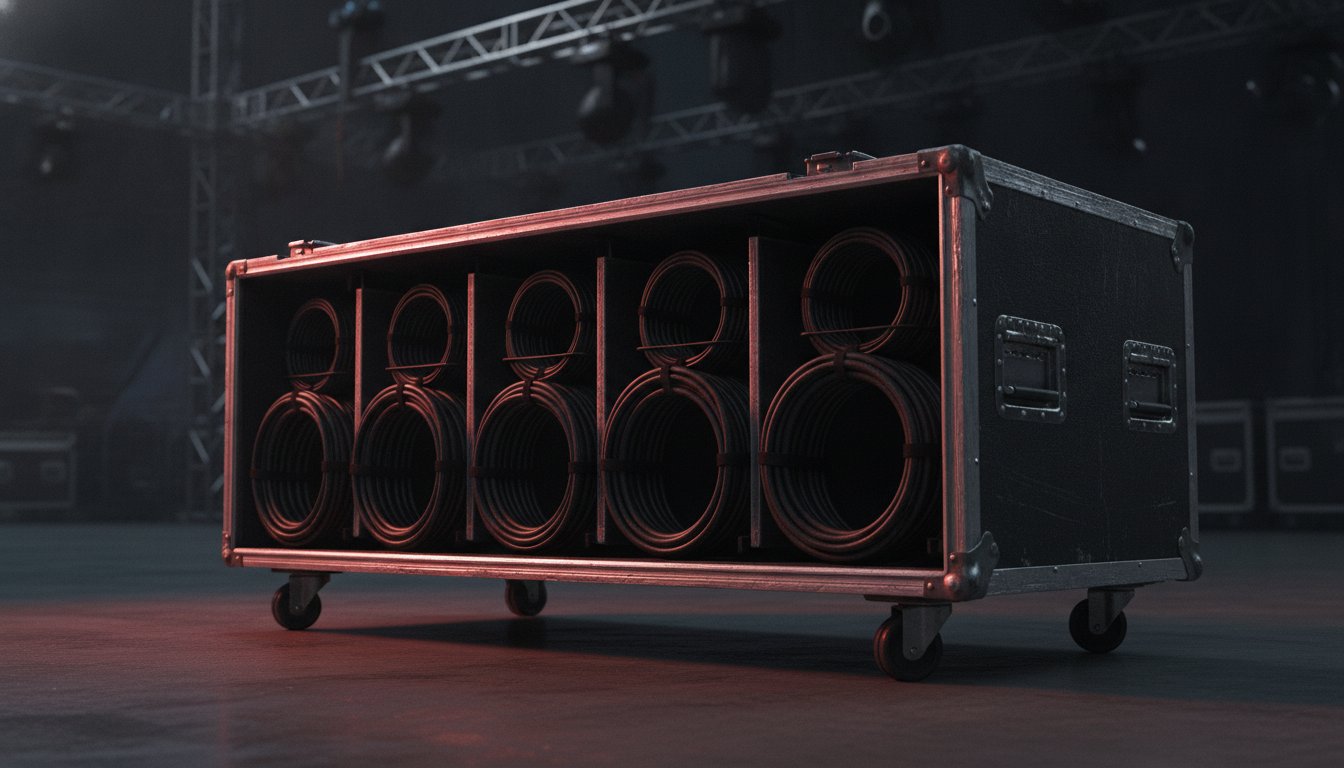
Every minute spent untangling a knot during soundcheck is a direct failure of your logistical infrastructure. You understand that cables are the literal nervous system of any production, yet they are frequently the most neglected assets in a pack. Improper stacking and disorganized bins lead to jacket abrasions and internal copper fatigue that simply can't be repaired on-site. Maintaining the integrity of expensive 12-gauge wiring requires more than just a box. It requires a systematic approach to mechanical protection and material science.
This guide provides the technical framework for selecting an audio cable storage case that secures your signal chain while optimizing your transport footprint. We will demonstrate how to implement professional systems that eliminate tangles and protect your investment from the physical demands of high-frequency use. By standardizing your storage, you can ensure that every loom is protected and ready for immediate deployment, effectively slashing your load-out times.
We will examine the structural specifications of industrial housing, the logistical benefits of truck-pack optimization, and the engineering behind rapid-deployment cable management. This methodical overview ensures your gear remains reliable from the first strike to the final load-in.
Key Takeaways
- Identify how specialized housing prevents copper fatigue and signal degradation caused by improper mechanical stress and stacking.
- Evaluate the structural integrity of case materials to ensure long-term protection for high-gauge wiring in high-density environments.
- Maximize cargo efficiency by utilizing an audio cable storage case engineered for precise integration into professional truck-pack configurations.
- Streamline onsite operations through the implementation of adjustable internal dividers and rapid-identification labeling strategies to eliminate cable tangles.
- Maintain cable memory with technical coiling methods to ensure tangle-free deployment during time-sensitive production schedules.
Why Audio Cable Storage Cases are Critical for Production Longevity
In professional audio production, the signal chain is only as robust as its weakest physical link. Cables represent a significant capital investment that requires a systematic approach to protection. An audio cable storage case serves as a critical protective barrier for the signal chain. It isn't merely a transport bin; it's a structural necessity for maintaining the electrical and mechanical integrity of copper wiring. Effective cable management starts with a trunk designed to withstand the compressive forces and vibrations inherent in professional touring.
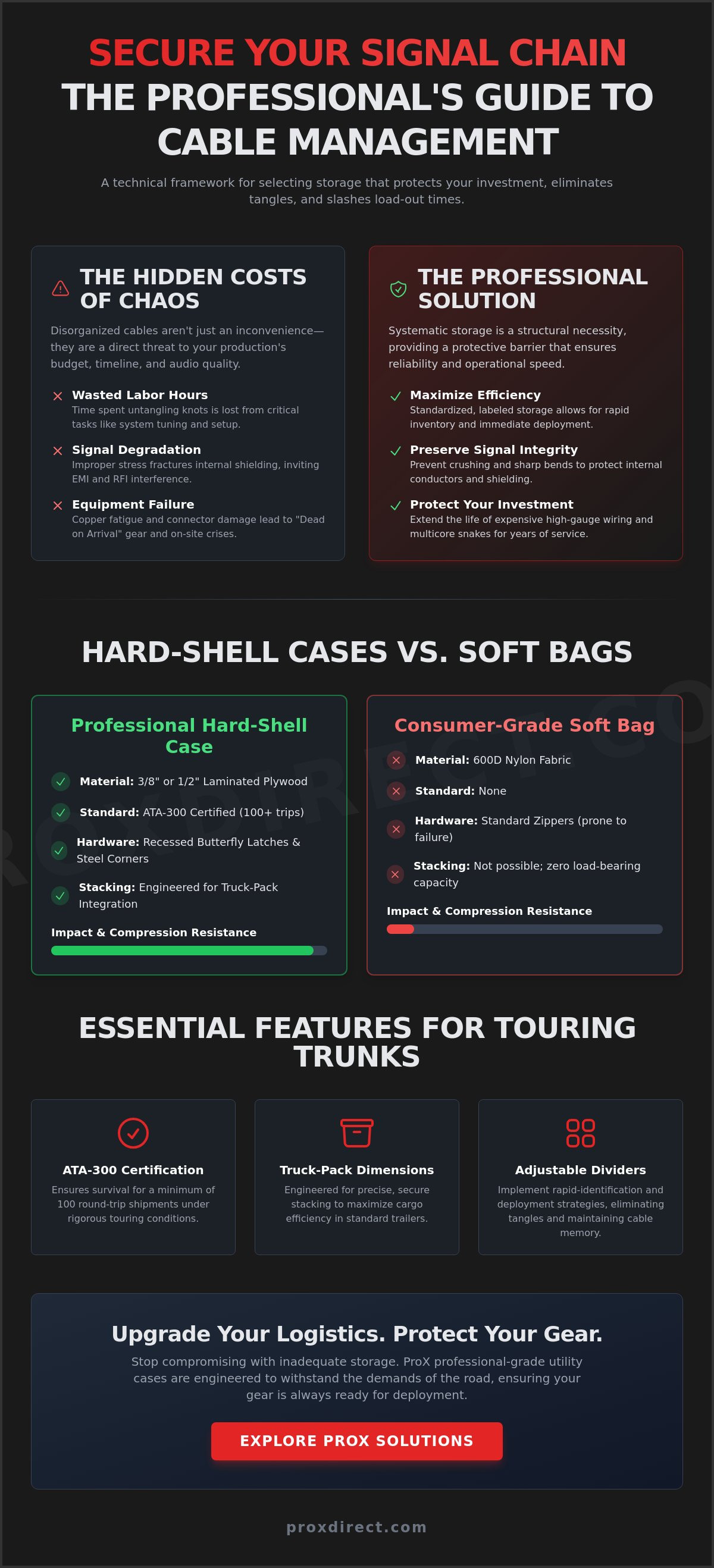
Disorganized "cable spaghetti" introduces hidden costs that impact both the budget and technical performance. Labor hours spent untangling knots are hours lost to high-value tasks like system tuning or stage setup. Beyond labor, physical mismanagement leads to signal degradation. When cables are forced into tight, irregular bends, the internal shielding can fracture. This introduces electromagnetic interference (EMI) and radio frequency interference (RFI) into the signal path, compromising the audio quality of the entire production.
Protecting the Integrity of Your Copper
Improper storage is the primary cause of internal wire breakage and copper fatigue. Constant mechanical stress on 12-gauge speaker wire or heavy multicore snakes leads to micro-fractures in the conductor. Over time, these fractures increase resistance and can cause total signal failure during a performance. Hard cases are essential for these heavy-gauge assets because they provide a rigid structure that prevents the cable from being crushed under the weight of other equipment in a truck pack.
Environmental factors also play a role. Specialized industrial cases provide a controlled environment that mitigates the impact of temperature fluctuations and moisture. Excessive humidity can lead to connector oxidation, which compromises the electrical contact point. Industrial-grade housing ensures that jackets aren't punctured or abraded, preserving the cable's memory and flexibility for years of service.
Operational Efficiency on the Road
The return on investment for organized storage is calculated through the reduction of "dead on arrival" (DOA) equipment. A standardized inventory system allows for rapid inventory counts and faster load-outs. When every cable has a dedicated, labeled position within a trunk, technicians can identify missing assets instantly. This level of organization is the difference between a smooth soundcheck and a logistical crisis.
Standardizing your inventory with high-grade utility cases ensures that gear arrives at the venue in the same condition it left the warehouse. This reliability eliminates the need for last-minute troubleshooting and emergency cable repairs. It creates a predictable workflow where technical staff can focus on the performance rather than the logistics of damaged wiring.
Hard Flight Cases vs. Soft Bags: Evaluating Your Storage Needs
Selecting the appropriate audio cable storage case requires an analysis of transport frequency and load density. While consumer-grade soft bags offer portability for individual musicians, they lack the structural integrity required for professional production environments. The primary distinction lies in material composition. High-performance trunks utilize 3/8" or 1/2" plywood laminated with high-pressure plastics, whereas soft bags typically rely on 600D nylon. This difference dictates the equipment's ability to withstand the compressive forces of high-density storage.
ATA-300 Category 1 standards are the benchmark for technical housing. These specifications ensure the case can survive a minimum of 100 round-trip shipments. In contrast, soft-sided storage provides zero impact resistance against the shifting loads of a 53-foot trailer. Hardware reliability is another critical factor. Recessed butterfly latches and steel ball corners provide mechanical security that standard zippers cannot match. Zippers are prone to "teeth" failure under the weight of heavy Speakon or 12-gauge power cables, leading to total containment loss.
When to Choose a Hard-Shell Utility Case
Professional touring demands equipment that integrates into a standardized truck pack. Hard-shell trunks provide the necessary stackability to utilize vertical space in a trailer. For high-volume cable management, integrated casters are non-negotiable. They allow a single technician to move hundreds of pounds of copper with minimal physical strain. The rigid exterior of a professional trunk protects against forklift punctures and the crushing weight of stacked speaker cabinets. If your logistics involve frequent loading and unloading by third-party stagehands, industrial-grade Utility/Storage Cases are the only viable solution for asset protection.
The Limitations of Soft Accessory Bags
Soft bags serve a specific, limited role in the industry. They are suitable for local, self-contained gigs where the owner maintains direct control over the gear. However, they are unsuitable for professional truck packs. Common failure points include seam splitting and handle detachment when loaded with heavy XLR kits. Soft bags also lack internal reinforcement, meaning the cables themselves bear the weight of any equipment placed on top of them. This leads to the copper fatigue and jacket damage discussed in the previous section. In a high-stakes environment, relying on soft-sided storage often results in compromised signal integrity and increased replacement costs.
Engineering Your Cable Trunk: Essential Features for Touring
A professional audio cable storage case is more than a container; it is a precision-engineered component of a logistical system. While previous sections established the need for protection, the engineering of the trunk itself determines the speed of your deployment. High-volume touring environments require internal architectures that can be reconfigured as inventory changes. Adjustable internal dividers are critical for this purpose. Unlike fixed partitions, adjustable systems allow technicians to segment the trunk based on specific cable lengths or connector types. These dividers must be constructed from rigid materials to prevent heavy looms of 12-gauge wiring from shifting and creating mechanical imbalances during transport.
Logistical efficiency is further defined by how a case integrates into a standard 53-foot trailer. Professional production relies on standardized dimensions to maximize floor space and prevent load shifting. Most trailers have an internal width of approximately 90 to 96 inches. Cases engineered for this environment typically utilize widths of 22.5 inches or 45 inches. This mathematical approach allows for a "tight pack" where four 22.5-inch cases or two 45-inch cases fit perfectly across the trailer width, eliminating the need for excessive strapping and reducing the risk of transit damage.
Mobility is another engineering priority. The industry standard for high-capacity trunks is the 4-inch blue rubber caster. These wheels are selected for their high load-bearing capacity and shock-absorption properties. They roll over uneven stage lips and stray cables without flat-spotting, a common failure in cheaper plastic alternatives. Additionally, even a sealed audio cable storage case requires strategic ventilation to prevent moisture buildup. Trapped humidity leads to the connector oxidation mentioned previously; therefore, high-end designs often incorporate small, recessed vents that allow airflow without compromising the case's structural seal against dust.
Optimizing for TruckPaX™ and Logistical Standards
The TruckPaX™ Truck Pack Cases are designed specifically around the 22.5-inch and 45-inch modular standards. This sizing ensures that the footprint of your inventory is always a multiple of the trailer's dimensions. To maximize vertical space, these cases feature integrated stacking cups. These recessed dishes on the lid align with the casters of the case stacked above it. This mechanical locking mechanism prevents top-heavy loads from sliding during sharp turns or sudden stops, allowing for safe multi-tier storage in the warehouse and the truck.
Hardware That Survives the Road
- Recessed Spring-Loaded Handles: These are essential for safe lifting and prevent the handles from being sheared off during tight loading procedures.
- Industrial-Grade Ball Corners: Steel ball corners are engineered to deflect impact energy away from the plywood joints, preserving the case's structural integrity.
- Reinforced Plywood: Professional trunks utilize 3/8-inch or 1/2-inch plywood to support the significant weight of bulk copper without bowing or cracking.
By prioritizing these technical specifications, production managers can ensure their gear survives the physical rigors of the road while maintaining a highly organized and efficient inventory system.
Best Practices for High-Volume Cable Organization
Operational efficiency in professional production is a product of rigorous protocol. The utility of an audio cable storage case is maximized only when the internal assets are managed with technical precision. High-volume environments require more than just containment; they demand a systematic approach to cable memory and identification. The foundation of this system is the "over-under" coiling method. This technique neutralizes the natural twist of the cable's internal conductors, ensuring that the loom lays flat during deployment and resists the formation of internal "bird-caging" or conductor fatigue.
Maintenance protocols are equally critical. Before any asset is returned to its designated audio cable storage case, it must undergo a standardized inspection. This includes wiping down jackets to remove stage grime and chemical residues that can degrade the outer insulation over time. Technicians should perform continuity tests on all high-rotation cables before storage. Identifying a failed cable at the warehouse is a routine maintenance task; discovering it during a high-stakes soundcheck is a failure of the logistical chain.
Systematic Labeling and Inventory Tracking
Permanent identification is the only way to maintain a large-scale inventory. Heat-shrink labeling at the connector ends provides a durable surface for length and type identification that won't peel off under heat or friction. For larger fleets, integrating QR codes or RFID tags allows for digital asset tracking through inventory management software. Case-top labeling is also essential. High-visibility placards on the exterior of the trunk allow technicians to identify contents in low-light environments without breaking the stack. Browse our full range of Racks & Case Accessories to optimize your labeling and organization systems.
The "First-In, Last-Out" Deployment Strategy
Deployment strategy must align with the stage plot and load-in schedule. The "First-In, Last-Out" (FILO) method dictates that cables required for the final stages of a setup are placed at the bottom of the trunk. This prevents unnecessary handling and keeps the workspace clear. Many professional crews utilize "Daily Trunks" for high-rotation assets like standard XLR and power cables, while keeping specialized looms and multi-pin connectors in dedicated housing. This separation prevents smaller cables from becoming entangled in the heavy hardware of complex looms, further reducing the risk of jacket abrasions and connector damage.
Implementing a "Workbox" workflow on stage ensures that technicians have immediate access to the most frequently used tools and short-run patch cables. By standardizing these organization practices, production managers can ensure a repeatable, high-speed workflow that protects the integrity of the signal chain across multiple tour dates.
ProX Solutions for Professional Cable Management
ProX provides a comprehensive catalog of industrial-grade housing designed for the high-stakes environment of professional production. An audio cable storage case from ProX is built to exceed the standard requirements of local transport. These solutions prioritize functional excellence through the use of high-strength materials and precision hardware. Production houses choose these systems because they provide a reliable backbone for complex logistical operations where equipment failure is not an option. Each case is a result of meticulous engineering, focusing on the physical demands placed on professional gear during high-frequency touring cycles.
The manufacturing process emphasizes durability and compatibility. By utilizing standardized hardware and assembly techniques, ProX ensures that every trunk in your inventory maintains a consistent level of quality. This reliability is essential for maintaining the integrity of the signal chain, as it prevents the mechanical failures that lead to downtime. Whether you are transporting bulk XLR runs or complex multi-core snakes, these cases offer the structural capabilities required to secure your investment against the rigors of the road.
TruckPaX™: The Professional Standard in Utility Cases
The TruckPaX™ series represents a significant advancement in modular utility design. These cases utilize honeycomb digital laminated plywood, which provides a high-grip surface and superior impact deflection compared to standard smooth laminates. This material science ensures that cases remain secure during transit, even in high-humidity environments. The system is engineered around the logistical standards of 22.5-inch and 45-inch widths, providing a seamless fit within global touring trailers. This modularity allows for a standardized truck pack that minimizes movement and maximizes cargo density, reducing the risk of internal cable damage during long-haul transport.
Santosom and ZCASE: Premium Options for High-Value Gear
For elite tours requiring specialized configurations, ProX offers the Santosom Case series and ZCASE custom builds. Santosom, engineered in Portugal, provides a level of precision ideal for complex audio snakes and fiber optic looms. These designs incorporate ergonomic features that reduce crew fatigue during daily load-ins and load-outs. ZCASE solutions, manufactured in Poland, offer bespoke internal architectures for high-value signal chains. These premium options ensure that even the most delicate 12-gauge wiring and multi-pin connectors receive maximum mechanical protection within a dedicated audio cable storage case.
Selecting the right housing is a strategic decision that impacts the longevity of your technical assets. ProX remains a partner for industry professionals by focusing on the integrity of the build rather than aesthetic trends. This commitment to engineering excellence ensures that your gear is always protected and ready for immediate deployment. View the full ProX Utility Case Catalog to explore the complete range of bulk cable transport and storage solutions.
Optimizing Your Technical Infrastructure for the Long Term
Transitioning from basic containment to a systematic logistical framework is essential for maintaining signal integrity and operational speed. Professional production requires equipment that adheres to ATA-300 style construction to ensure survival in high-density truck packs. By prioritizing structural features like adjustable dividers and modular dimensions, you effectively eliminate the hidden costs of cable fatigue and disorganized load-outs. This methodical approach to storage isn't just about protection; it's about building a repeatable, efficient workflow for every venue.
ProX has been engineering performance gear since 1984, establishing a reputation for functional excellence and technical precision. This expertise is why major industry brands such as Pioneer DJ and QSC trust our housing solutions for their high-stakes deployments. Implementing a standardized audio cable storage case into your inventory ensures that your expensive copper assets remain protected and ready for immediate use. It's a strategic decision that pays dividends through reduced labor hours and increased equipment lifespan.
Explore ProX Professional Utility and Cable Storage Cases and secure your signal chain with professional-grade housing. Your commitment to high-quality storage today will define the reliability of your productions for years to come.
Frequently Asked Questions
What is the best way to store long XLR cables to prevent tangling?
Over-under coiling is the industry standard for preventing tangles in long XLR runs. This method neutralizes the natural torque of the internal copper conductors, allowing the cable to lay flat without developing permanent kinks. By coiling in alternating directions, you preserve the cable's memory and prevent internal wire fatigue. This technique ensures that even 100-foot runs deploy smoothly without the risk of signal failure during high-stakes productions.
How do I choose the right size utility case for my cable inventory?
Select a size based on the total cubic volume of your inventory and the dimensions of your transport vehicle. Professional logistics rely on 22.5-inch and 45-inch modular footprints to maximize floor space in standard trailers. An audio cable storage case should be sized to prevent excessive shifting of internal contents while remaining light enough for a two-person lift. Calculate your total cable weight to ensure the case's plywood thickness is sufficient for the load.
What does ATA-300 rated mean for an audio cable storage case?
ATA-300 Category 1 is a technical specification established by the Air Transport Association. It indicates that the case is engineered to survive a minimum of 100 round-trip shipments via common carrier without structural failure. This rating requires specific hardware like recessed butterfly latches, steel ball corners, and high-density plywood. It ensures the housing can withstand the high-impact environment of professional touring and automated sorting systems while protecting the internal signal chain.
Should I use soft bags or hard cases for my touring audio gear?
Hard cases are the only viable option for touring and high-density truck packs. Soft bags lack the structural integrity to support stacked loads, which leads to cable jacket damage and connector deformation. While soft bags are acceptable for local, self-contained gigs, they offer zero protection against forklift punctures or the compressive forces of a 53-foot trailer. Hard-shell trunks provide the stackability and impact resistance required for long-term production reliability.
How many feet of cable can fit in a standard 22-inch utility trunk?
Industry professionals report that a standard 22.5-inch utility trunk typically accommodates between 60 and 80 standard 25-foot XLR cables depending on the coiling diameter. If you are storing heavy 12-gauge speaker wiring or multi-pin looms, this capacity decreases to approximately 10 to 15 units. Using adjustable dividers allows you to segment the interior by cable length, which optimizes the available volume and prevents smaller patch cables from being crushed by heavier assets.
What are truck-pack dimensions and why do they matter for cable cases?
Truck-pack dimensions refer to modular case sizes designed to fit perfectly across the 90-96 inch internal width of a standard trailer. Utilizing 22.5-inch or 45-inch footprints ensures a tight pack that eliminates the need for excessive strapping. This standardization prevents equipment from shifting during transit, which is the leading cause of external case damage and internal hardware failure. It maximizes cargo density and streamlines the load-out process for touring crews.
How do I maintain my flight case hardware to prevent rust and sticking?
Maintain hardware by applying a silicone-based lubricant to recessed latches, hinges, and caster bearings every six months. This prevents oxidation and ensures the mechanical components continue to operate smoothly in high-humidity environments. Wipe down steel ball corners and aluminum extrusions with a dry, non-abrasive cloth to remove road salt and grime. Regular inspection of the plywood rivets is also recommended to ensure the structural integrity of the audio cable storage case remains intact.
Can I customize the interior of a ProX utility case for specific connectors?
Yes, ProX offers extensive customization through the ZCASE Custom Build Cases - Made in Poland service. You can specify CNC-cut foam inserts for delicate connectors or bespoke internal partitions for complex signal looms. For standard trunks, adjustable plywood dividers provide a high degree of flexibility for organizing inventory by length or type. This allows production houses to tailor their storage systems to the specific requirements of their tour or permanent installation.
Disclaimer
Any trademarks, trade names or brand names appearing herein that do not belong to ProX are the property of their respective owners and/or companies, and such appearance doesn't and shall not constitute or imply endorsement, sponsorship or recommendation by ProX.


