

The best-looking truss layout may be the wrong choice for your next venue. Mobile DJ lighting truss setup ideas need to account for room size, audience views, available floor space, and how your equipment will get in and out. A rig that provides broad coverage in a large room may take up too much space or add unnecessary setup work in a compact one.
Choosing a layout means balancing fixture coverage with venue geometry, crew capacity, transport space, and cable routing. A strong visual result matters, but the setup also needs to be manageable to assemble and repeat. Check fixture positions and loading against equipment requirements and venue conditions before settling on a design.
This guide compares four practical layouts, from compact to wider configurations, and explains their trade-offs. Use the examples to identify a starting point for your venues and gear, then verify component compatibility and any rigging requirements with manufacturer documentation and qualified professionals. Once you have defined the layout, consider truss products and suitable cases as part of the equipment plan.
Key Takeaways
- Compare mobile DJ lighting truss setup ideas by venue footprint, audience sightlines, and the fixtures you need to support.
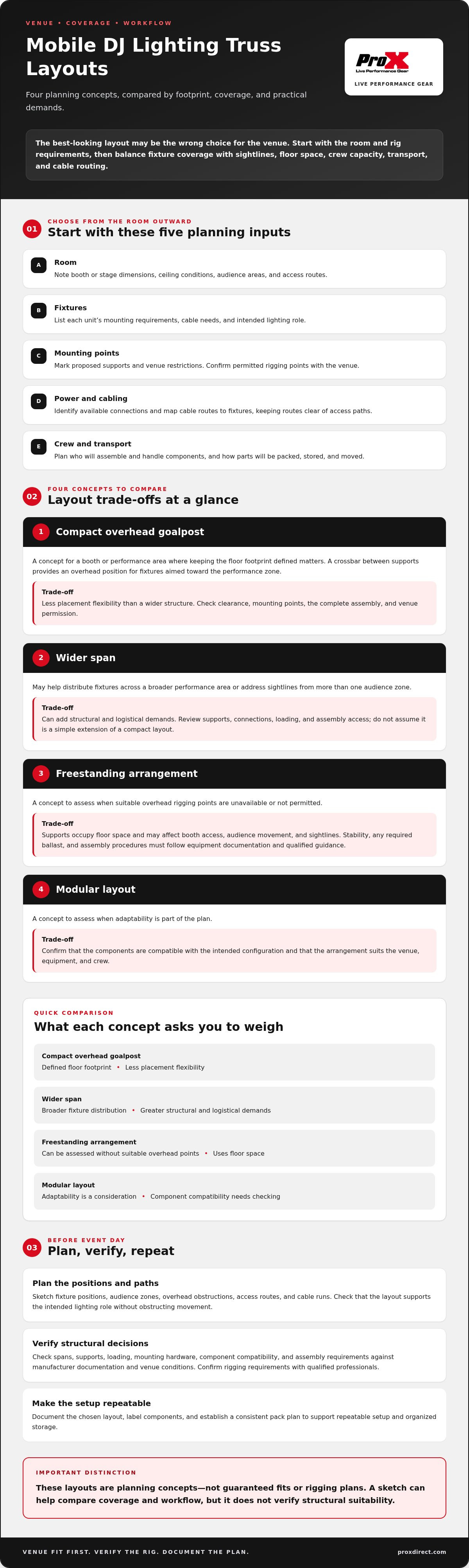
- Assess compact overhead, wider-span, freestanding, and modular layouts as concepts, not guaranteed fits or rigging plans.
- Weigh coverage, adaptability, transport, and setup complexity against your crew and event format.
- Plan fixture positions and cable routes before event day. Confirm structural decisions with manufacturer documentation and qualified rigging professionals.
- Document your chosen layout, label components, and establish a consistent pack plan to support repeatable setup and organized storage.
Mobile DJ lighting truss setup ideas: start with the room and the rig
Start with the venue, not a preferred truss shape. Room dimensions, audience sightlines, fixture requirements, and available equipment all affect where the structure can go and what it needs to support. Treat mobile DJ lighting truss setup ideas as planning concepts, not confirmation that a particular arrangement is structurally suitable.
A mobile DJ lighting truss setup is a planned arrangement of lighting fixtures and cabling around a booth or performance area. A drawing can help you assess coverage and workflow, but appearance is only one part of the decision. Check structural choices, including spans, supports, loading, and mounting hardware, against manufacturer documentation and venue conditions. Once you have defined the layout requirements, explore ProX stage truss options as one product category to consider.
Before sketching, make a short planning record:
- Room: Note stage or booth dimensions, ceiling conditions, audience areas, and access routes.
- Fixtures: List each unit’s mounting requirements, cable needs, and intended lighting role. A foundation in stage lighting principles can help clarify how different instruments contribute to a scene.
- Mounting points: Mark proposed support locations and any venue restrictions. Confirm permitted rigging points with the venue.
- Power: Identify available connections and plan cable routes to each fixture. Keep routes clear of access paths.
- Crew and transport: Decide who will assemble and handle the components, and how the parts will be packed, stored, and moved.
What information should you gather before sketching a layout?
Measure the performance area and note changes in ceiling height, overhead obstructions, audience zones, and entry or exit routes. List each fixture’s mounting and connection requirements, then check venue restrictions and equipment documentation. This review can catch practical conflicts early, such as a proposed span blocking an access route or a fixture position that does not suit its intended role.
How do venue size and sightlines change the design?
A narrow room may call for a compact footprint that stays within the performance area. In a wider venue, consider views from several audience zones rather than designing only for the center of the room. Confirm overhead clearance and permitted rigging points with the venue. A sketch helps compare options, but it does not verify structural suitability.
Four mobile DJ lighting truss layout ideas for different event needs
Compare these mobile DJ lighting truss setup ideas against the actual room and operating plan. None is a certified rigging plan or guaranteed fit. Before choosing or building a configuration, confirm component compatibility, support conditions, loading, and assembly requirements with manufacturer documentation and qualified rigging professionals.
1. Compact overhead goalpost
A compact goalpost concept may suit a booth or performance area where keeping the floor footprint defined is important. A crossbar between supports creates an overhead position for fixtures aimed toward the dance floor or performance zone. The trade-off is less placement flexibility than a wider structure. Check the complete assembly, fixture mounting points, available clearance, and whether the venue permits the proposed supports.
2. Wider span
A wider span may help distribute fixtures across a broader performance area or address sightlines from more than one audience zone. It can also add structural and logistical demands. Review the support arrangement, connections, loading, and access to assembly positions. Do not assume that adding length is a simple extension of a compact layout. Confirm that the components and support points are compatible with the intended configuration.
3. Freestanding arrangement
A freestanding concept may be worth assessing when suitable overhead rigging points are unavailable or not permitted. Supports occupy floor space, so consider their effect on booth access, audience movement, and sightlines. Stability, any required ballast, and assembly procedures must follow equipment documentation and qualified guidance. If work at height is involved, consult applicable requirements and qualified personnel. OSHA provides an interpretation on fall protection for relevant workplace conditions.
4. Modular layout
A modular concept uses compatible sections to adapt the arrangement to different room shapes or event briefs. It may let a crew revise the footprint between gigs, but each configuration still needs its own checks for components, connections, supports, and clearance. Document the approved arrangement rather than relying on memory. Do not assume parts can be combined simply because they connect.
After defining the room and use case, review ProX stage truss options as a product category. Verify current specifications and compatibility before choosing components for a layout.
Compare truss configurations by coverage, setup effort, and flexibility
A layout that looks balanced in a sketch may be awkward to assemble, transport, or operate in a particular venue. Compare each option with the room, fixture package, available crew, and event format in mind. Visual impact is one goal, but appearance cannot establish structural suitability or safe loading. Confirm structural decisions using component documentation and qualified guidance.
| Configuration | Footprint and coverage goal | Adaptability | Transport and setup considerations |
|---|---|---|---|
| Compact overhead | Defined area; focused coverage around the booth or performance zone | Lower if the arrangement is built for one room profile | Fewer layout decisions, but still check assembly sequence, supports, and cable access |
| Wider span | Broader footprint; may address sightlines across a wider audience area | Depends on compatible components and available support points | More planning for handling, support arrangements, connections, and routing |
| Freestanding | Uses floor space around the performance area | Can be considered where overhead points aren’t permitted or available | Account for support placement, access, stability requirements, and component handling |
| Modular | Varies with the selected arrangement | Can be reconfigured for different room shapes and event briefs | Requires clear component identification and configuration-specific checks |
Which layout suits a compact room, a wide stage, or changing venues?
For a compact room, start with a contained concept and check views from the sides and rear, not just from the center of the dance floor. A wider stage may justify considering broader coverage, but room geometry and permitted support arrangements determine whether that concept is workable. If venues change often, weigh reconfiguration options against the added handling, assembly, and transport demands. No layout suits every gig.
How should you compare setup time and operating complexity?
Do not estimate setup time without information about the actual components, crew, and workflow. Instead, compare the assembly sequence, crew roles, cable routing, access to lighting controls, and how much needs to change between event formats. For a verified configuration, mark repeatable fixture and cable positions in a documented plan. For broader context on technical practices, ESTA describes its work developing entertainment industry standards.
Use these mobile DJ lighting truss setup ideas as a comparison framework, then check your chosen configuration against qualified guidance. For related planning on truss storage and transport, see the stage truss and base plate guide.
Plan fixture positions, cabling, and safe assembly before event day
A workable plan connects the venue layout with the fixtures, cable paths, power access, and assembly process. Treat mobile DJ lighting truss setup ideas as starting points for review, not structural approval. Confirm load, support, and connection decisions against manufacturer documentation and with qualified rigging professionals who understand the equipment and site conditions.
How do you plan fixture placement and cable routes?
Start with a room sketch showing the booth, audience areas, access routes, overhead obstructions, and available power connections. Place each fixture where it can serve its intended lighting role, then review sightlines from more than one audience position. Map cable routes from power and control sources to each fixture. Routes should reduce snagging and trip exposure without obstructing exits, work areas, or access to controls. Confirm electrical requirements and cable management with qualified event professionals.
What checks belong in a pre-event assembly plan?
Work through the plan in sequence and record who is responsible for each task. A documented process helps the crew catch changes in venue conditions before assembly instead of relying on assumptions from a previous gig.
- 1. Review the venue: Confirm room dimensions, overhead conditions, access routes, permitted support points, and site restrictions with the venue.
- 2. Confirm the equipment: Match fixtures, truss components, connections, and mounting hardware to manufacturer instructions. Check that the planned combination is compatible.
- 3. Verify structural details: Have qualified personnel confirm support arrangements, loading information, and suitability for the site. Do not infer safe loading from a layout sketch or visual appearance.
- 4. Assign crew responsibilities: Identify who directs assembly, who performs the required checks, and who controls access around the work area during assembly and operation.
- 5. Document pre-use checks: Record component and connection inspections in line with manufacturer instructions. Reassess if the equipment, venue conditions, or arrangement changes.
Keep the final plan with the event documentation so the crew can refer to fixture positions, cable routes, responsibilities, and inspection notes. To explore truss options for a reviewed layout, browse ProX stage truss and verify current specifications before selecting components.
Make the lighting truss setup repeatable, portable, and easier to manage
A repeatable rig takes more than using the same components each time. Record the venue-specific arrangement, assembly sequence, and pack plan so the crew can identify what changes from one event to the next. These mobile DJ lighting truss setup ideas are more useful when you document the chosen configuration instead of reconstructing it from memory.
How can a DJ make a setup consistent from event to event?
Create a plan for each recurring venue or room type. Show truss component positions, fixture locations, cable paths, access routes, and who is responsible for each assembly task. Keep an inventory with the layout, then compare it with the equipment before and after use. This helps identify omissions and gives the crew a prompt to flag damage for assessment before the next setup.
Consistency still requires review. Reassess the plan if the room, equipment, crew, or event format changes. A familiar layout is not automatically appropriate for a different venue or configuration. Verify structural suitability for the actual site and components.
How should truss components be handled between events?
Plan transport and storage separately from structural design. The rigging plan addresses the assembled configuration. The pack plan addresses how parts are handled, protected, stored, and moved between gigs. Follow equipment documentation for disassembly and handling, and avoid placing components where they may be exposed to avoidable impact or other damage. Inspect them before use and refer any concerns to qualified personnel.
Suitable cases can help organize and protect equipment during storage and movement. Explore the ProX cases category for relevant options, and see the DJ equipment case purchase guide for broader equipment protection considerations.
- Document: Keep the venue plan, component inventory, and assembly responsibilities together.
- Label: Identify components and pack locations clearly to support inventory checks.
- Inspect: Record visible damage or missing parts and resolve concerns before assembly.
- Reassess: Update the layout and pack plan when equipment or event conditions change.
Once you have defined the venue, fixtures, and structural requirements, explore truss options that can be checked against your plan. Confirm current specifications and compatibility before selecting components.
Build a rig that fits the next gig
The right layout starts with the venue, audience sightlines, fixtures, and available crew. The mobile DJ lighting truss setup ideas in this guide offer concepts to compare, from compact overhead arrangements to wider, freestanding, and modular configurations. Each has different trade-offs in coverage, footprint, transport, and assembly.
Before choosing, map fixture positions and cable routes, review venue conditions, and confirm structural decisions against manufacturer documentation with qualified rigging professionals. A venue-specific plan, clear component labels, and a consistent pack list can help your crew follow a repeatable process and spot changes or missing equipment.
ProX has engineered performance gear since 1984 and serves customers worldwide through a dealer network. Once you have defined your requirements, explore ProX truss options and verify that any components you consider match your planned configuration.
Frequently Asked Questions
What is a good mobile DJ lighting truss setup for a small venue?
A compact layout may suit a small venue where floor space is limited, but the room, sightlines, fixtures, and support options determine whether it works for a specific event. Treat diagrams as planning concepts, not structural instructions. Check venue restrictions and equipment documentation, then consult qualified rigging professionals before selecting or loading a configuration. Include audience views and access routes in your assessment.
How do you choose a truss layout for mobile DJ lighting?
Start with venue dimensions, ceiling conditions, audience areas, and available support points. List each fixture’s mounting and connection requirements, then compare layout concepts against coverage, cabling, power access, assembly, and transport needs. These mobile DJ lighting truss setup ideas are starting points, not universal plans. Confirm component compatibility and structural limits using current manufacturer documentation and qualified professional guidance for the actual venue.
Can a mobile DJ use freestanding truss instead of overhead rigging?
A freestanding concept may be considered where overhead rigging points are unavailable or unsuitable, but the term alone does not establish stability or safety. Suitability depends on the components, site conditions, and complete configuration. Follow manufacturer instructions and obtain qualified advice on supports, loading, and any additional measures before use. Also consider floor space, audience movement, access routes, and whether the venue permits the arrangement.
How many lights should go on a DJ truss?
There is no universal fixture count for a DJ truss. The appropriate number depends on the truss system, fixture weights and mounting requirements, the complete load, and venue conditions. Do not estimate capacity from appearance or copy a fixture count from another setup. Review current manufacturer documentation and have a qualified professional assess the planned configuration before installation or use. Recheck the plan if any component or fixture changes.
What should you check before assembling a DJ lighting truss?
Before assembly, confirm venue conditions, access routes, permitted support points, component compatibility, and the manufacturer’s assembly and loading instructions. Inspect components and connections, plan cable routes and power access, and assign responsibility for checks and access control. Structural suitability must be verified for the actual site and configuration. If any requirement is unclear, pause and consult qualified rigging professionals rather than improvising or relying on a previous setup.
How can mobile DJs make a truss setup faster to repeat?
Document the layout, component inventory, cable paths, assembly sequence, and crew responsibilities for each recurring event format. Clear labels and consistent pack and unpack checks can help the team identify missing or damaged components before use. Update the plan when the venue, equipment, or crew changes. Repeatability does not replace checking site conditions, equipment condition, and manufacturer instructions each time the system is assembled.
Do mobile DJs need cases for truss components?
Cases can help organize truss components during storage and transport, but the right option depends on the items and handling requirements. Check that the case dimensions and configuration suit the components, and do not assume protection beyond the case’s stated specifications. Include inventory and condition checks when packing and unpacking to identify missing or damaged parts before the next setup. Keep transport planning separate from structural rigging decisions.
Disclaimer
Any trademarks, trade names or brand names appearing herein that do not belong to ProX are the property of their respective owners and/or companies, and such appearance doesn't and shall not constitute or imply endorsement, sponsorship or recommendation by ProX.


