

A rugged exterior alone doesn’t make a case suitable for a tour. Flight cases for touring musicians need to match the equipment inside and the handling it will face, from repeated loading and stacking to movement between venues. Small gaps, awkward lifting points, or hardware that doesn’t suit the workflow can undermine an otherwise solid choice.
Impact protection matters, but reliable selection also depends on a secure equipment fit, appropriate interior support, durable construction, and practical handling. Marketing claims can’t replace checking those details against your gear and actual travel conditions.
This checklist helps you assess fit, construction, hardware, handling, and logistics before purchase. It also gives you a repeatable way to inspect cases and pack equipment for each tour. Start with verified dimensions and interior clearance, then examine closures and edge hardware. Consider how each case will be lifted, stacked, and stored along the route from load-in to venue storage. If standard dimensions don’t suit the equipment, custom case engineering may be worth investigating.
Key Takeaways
- Choose flight cases for touring musicians by matching verified equipment dimensions to actual transport and handling conditions.
- Inspect interior clearance and support, then check closures, handles, and access points in a consistent order.
- Compare dedicated-fit, adaptable-interior, and custom-engineered options against protection needs and handling requirements.
- Use a repeatable pre-departure check for equipment condition, packing, closure, labeling, and handoff.
- Confirm case-specific dimensions, materials, interior options, and hardware in the product documentation before purchase.
Flight cases for touring musicians: identify the equipment and transport risks first
Touring exposes equipment to repeated handling, storage, and transport. Start your case search with the specific gear and the route it travels, rather than assuming a general-purpose touring case will suit it. A flight case is protective transport housing designed around specified equipment and its handling requirements. For a foundational overview of shipping containers specifically designed for equipment transport, see the background on construction and case history.
Use this checklist to assess fit against verified equipment dimensions and actual use conditions. Protection requirements differ across instruments, audio, lighting, and DJ equipment. Confirm that the case category and configuration suit the item; a broad product label does not confirm compatibility. For foundational case concepts, consult the flight case engineering guide. If you’re assessing audio, lighting, or DJ gear, review the flight case category and compare the listed options with your equipment.
Map the gear that travels with the musician
List each item that needs its own transport solution before comparing cases. Record the equipment model, external dimensions, weight, and any components that stay attached during transport. Check manufacturer documentation, then measure the actual configuration you plan to pack. A detachable control, cable bundle, or accessory can change the space and support the packed gear needs.
- Identify each instrument, audio component, lighting unit, DJ device, and accessory requiring protection.
- Separate equipment that needs a dedicated fit from smaller items that can be organized in storage compartments.
- Note connectors, protrusions, and removable parts that affect the packed dimensions.
This inventory helps prevent a category mismatch. Don’t assume a case listed for audio or lighting equipment is compatible with a particular instrument unless you have verified the fit.
Describe the handling chain before comparing cases
Map what happens to each item from packing through storage. Note who handles it, how often it is loaded and moved, where it travels, and where it waits between performances. Vehicle capacity, venue access, storage space, and lifting requirements can vary across a tour. Assess the actual workflow instead of assuming every stop presents the same conditions.
Protection needs depend on the equipment, handling, and logistics together. A case can fit the gear and still be difficult to move or store in the available space. Define those constraints first, then compare case dimensions, construction, interior support, and handling features with the documented requirements. That makes selection an equipment-specific decision rather than a choice based on appearance.
How to inspect flight case fit, interior support, and construction
Use a fixed inspection order to establish compatibility before assessing protective features. A case’s protective features matter only after its interior fit has been confirmed against the equipment’s measured dimensions. This is especially important when comparing flight cases for touring musicians, since equipment models and attached components can differ even within the same category.
Confirm dimensions and interior fit
Measure the equipment at its widest and tallest points. Include protruding controls, connectors, or components that remain attached during transport. Compare those measurements with the case’s verified interior dimensions, not its exterior footprint. Check how the manufacturer defines each measurement and whether the listed clearance accounts for lining or interior support.
Then check closure with the equipment packed. The case should close without pressing on knobs, screens, connectors, or other vulnerable parts. If the interior dimensions or configuration aren’t published, request verified specifications before treating the case as compatible.
Assess construction and practical access
Inspect the case itself rather than relying on broad descriptions. Look over panels, edges, joints, closures, and handles. Check wheels only if the specific case includes them. For audio racks, the amplifier rack case guide offers further context for evaluating that equipment category.
Consider how the equipment is supported and restrained inside. Check for unwanted movement without assuming a particular interior material or design. Verify the stated configuration and assess it with the equipment in place. Rehearse removal and repacking, too. If the gear catches on an edge, requires awkward lifting, or contacts controls during handling, the fit or access may not suit the workflow.
Follow a repeatable inspection order
Work through these checks before comparing case options:
- Dimensions: Measure the equipment and compare it with verified interior measurements.
- Clearance: Account for protrusions and confirm vulnerable parts aren’t under pressure.
- Interior support: Check that the equipment is supported and movement is controlled.
- Closure: Confirm closures engage without forcing the lid or contacting the gear.
- Handles: Assess grip and access for the people who will lift and move the case.
- Access: Confirm the equipment can be removed and repacked without awkward contact.
When reviewing case construction and configurations, use the ProX case options as a starting point. Then verify the specific dimensions, interior details, and hardware against your equipment. This sequence helps separate confirmed compatibility from assumptions based on appearance or category names.
Dedicated, configurable, or custom flight cases: compare the trade-offs
A dedicated case can make repeat packing simpler, but it may add bulk that complicates lifting, vehicle loading, or storage. The right approach depends on confirmed equipment compatibility and the conditions the case needs to accommodate. Compare flight cases for touring musicians by fit, flexibility, access, and verifiable specifications, not by format alone.
| Approach | Fit confidence | Configuration flexibility | Access | What to verify |
|---|---|---|---|---|
| Dedicated-fit | High only when compatibility with the exact equipment is confirmed | Typically focused on specified gear | Assess how easily gear can be packed and removed | Equipment model, interior dimensions, clearance, overall case size |
| Adaptable-interior | Depends on the verified fit and available configuration | May accommodate changes in equipment arrangement | Check whether adjustments support consistent packing | Interior options, adjustment method, equipment support, dimensions |
| Custom-engineered | Designed around documented project requirements | Can address unusual dimensions or access needs | Specify how equipment must be accessed and handled | Required measurements, drawings, access needs, construction details |
When a dedicated case may suit the touring setup
Consider a dedicated case when compatibility with the exact equipment model is confirmed. A consistent fit can support repeatable packing and access across performances. Still, check the full exterior dimensions against storage space, vehicle capacity, and handling needs. A close fit around the equipment doesn’t establish that the case suits the rest of the workflow.
When custom engineering deserves consideration
Custom engineering may be worth exploring when equipment dimensions, attached components, or protection requirements don’t align with available standard dimensions. Prepare measured drawings or manufacturer documentation, identify which controls and connections need to remain accessible, and describe how the case will be handled and stored. Ask what project information is needed to specify a configuration. The custom case engineering guide outlines considerations for project-specific case requirements.
No approach is automatically superior. Confirm the selected case’s compatibility, interior options, dimensions, and construction details before purchase. To review available case categories, explore the ProX case options and compare the listed information with your documented requirements.
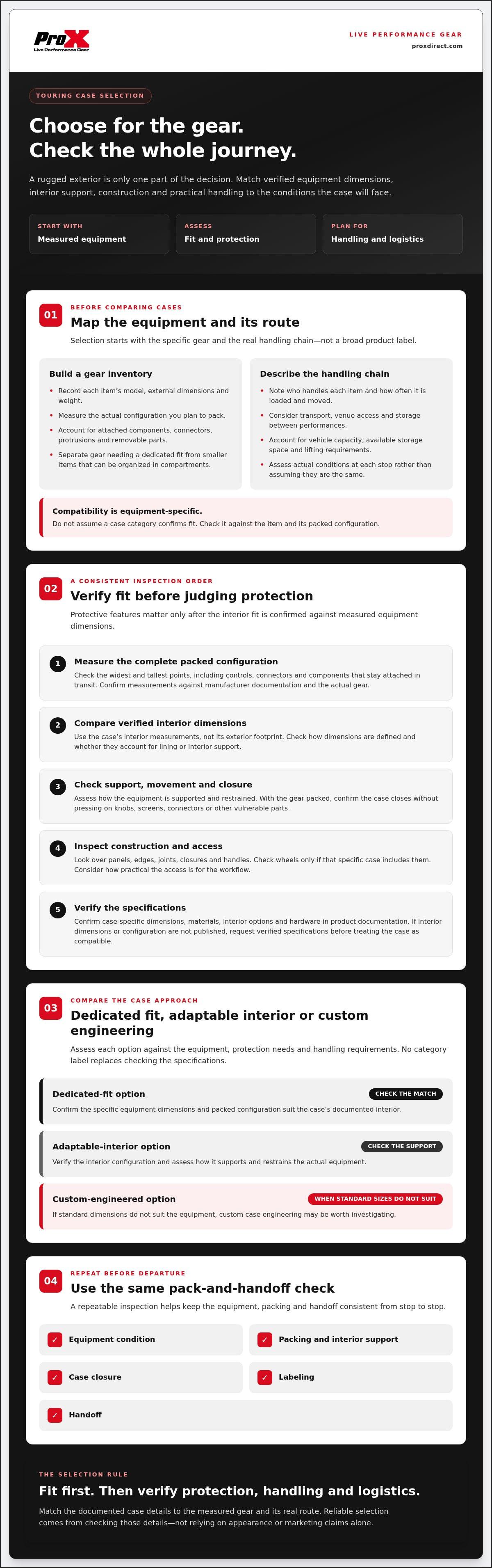
Touring flight case checklist: packing, handling, and pre-departure checks
A consistent check before and after each move helps crews spot changes before the next load-in. Follow the case and equipment manufacturers’ documentation for model-specific packing, closure, and handling instructions. A visual inspection is not a technical assessment. A condition record can help document changes, but it can’t guarantee that damage won’t occur.
Before packing and loading
Confirm the case is intended for the equipment configuration you’re packing. Inspect visible surfaces, then check closures, handles, and wheels if present. Photograph the equipment and case condition before travel, noting existing marks or issues to give the next inspection a clear reference.
Pack according to the equipment manufacturer’s guidance. Don’t force components into place or close the case against resistance. Label each case with its contents and any handling information relevant to the tour workflow, such as destination or department. Check that the labels remain legible.
- Equipment: Check its condition and confirm accessories are accounted for.
- Interior: Position the equipment as directed; verify it isn’t pressing against controls or connectors.
- Closure: Engage closures as specified, without forcing them.
- Exterior: Check visible damage and inspect handles, wheels, and accessible hardware.
- Identification: Confirm contents and handling labels are clear and current.
- Handoff: Tell the next handler about existing damage, unusual handling needs, or other relevant notes.
After each move and before the next date
Repeat a visual check after unloading and before the next departure. Look for new case damage, loose or displaced hardware, closure problems, and changes in how the equipment sits inside. Compare with the condition record when useful, and document new observations with notes or photographs.
Pause use of a case if damage or a change in fit raises a concern. Record the issue and arrange an assessment by qualified support before relying on the case again. Routine visual checks can flag concerns, but they can’t confirm structural integrity or determine whether a repair is suitable.
Update the checklist when equipment, crew responsibilities, or transport and storage conditions change. Keep current instructions with the tour packing process so each handler follows the same sequence. To compare case options with your equipment needs, review the case categories and confirm model-specific details before selecting a case.
Choose a touring case solution that fits the equipment and workflow
Follow a documented sequence when selecting a case: identify the equipment, record its dimensions and weight, define handling and storage conditions, compare case approaches, then verify the specifications for the selected configuration. This keeps the decision tied to the touring workflow rather than assumptions based on a product category or appearance.
For audio, lighting, or DJ equipment, browse the flight case category when its listed options match your requirements. Touring crews transporting relevant AV equipment can also review AV broadcasting cases. Neither category alone confirms compatibility with a particular model. Check dimensions, interior configuration, construction details, and hardware for the specific case before shortlisting it.
If verified standard options don’t meet the equipment dimensions or protection requirements, custom case engineering may be worth discussing. Prepare the measurements, equipment details, access requirements, and handling conditions so the project can be assessed against the actual use case.
Questions to resolve before requesting a case
- What are the equipment model, measured dimensions, weight, and attached components?
- How often will the case be handled, and what storage, access, or transport limitations affect the route?
- Which interior, construction, and hardware specifications can be confirmed for the case under consideration?
Use manufacturer documentation for equipment measurements and case-specific instructions. If a detail isn’t published, ask what can be verified before ordering rather than treating an estimate as a confirmed specification.
A practical next step for touring musicians
Shortlist options only after checking equipment compatibility and relevant dimensions. A dealer in the company’s worldwide network may help with purchasing guidance or questions about whether a project-specific requirement calls for custom engineering.
Compare your documented requirements with professional case options listed for the equipment category you need.
Make the next case decision with confidence
Effective case selection starts with the equipment, not a general product label. Confirm the model and dimensions, define handling and storage conditions, then compare fit, interior support, construction, and access. A repeatable packing and inspection routine helps the crew check case condition and equipment placement throughout the tour.
Choosing flight cases for touring musicians is a practical, equipment-specific decision. ProX engineers performance gear and offers custom case engineering for project-specific requirements. Its worldwide dealer network can help with purchasing guidance and questions about case options. Verify compatibility and case specifications for your equipment before making a selection.
Start with your documented requirements, then browse professional case options that match the gear and workflow. Contact a ProX dealer to discuss purchasing guidance or a custom case requirement.
Frequently Asked Questions
How do I choose a flight case for touring equipment?
Choose a case by matching verified equipment dimensions and transport conditions to confirmed case specifications. Start with the equipment model, measured dimensions, weight, and attached components. Then consider how the case will be loaded, moved, stored, and accessed during the tour. Compare interior support, closures, handles, and overall case dimensions. For flight cases for touring musicians, the equipment category alone doesn’t establish compatibility, so verify the specific case configuration before selecting it.
What should I check before buying a flight case?
Check measured equipment dimensions against the manufacturer’s verified interior measurements, and confirm how those measurements are defined. Assess clearance around controls, screens, connectors, and other vulnerable parts. Review available information on interior configuration, panels, edges, joints, closures, handles, and wheels if present. Also consider lifting, storage, and vehicle constraints. If specifications aren’t published, request confirmation rather than relying on appearance or general product descriptions.
Is a custom flight case worth considering for a musician?
A custom case may be worth considering when confirmed standard options don’t fit the equipment dimensions, attached components, access needs, or project-specific protection requirements. First document the gear and transport workflow, then compare those requirements with available case specifications. Custom engineering isn’t automatically the better choice; it should address a defined need. Ask what measurements and project details are required to assess whether a custom configuration is appropriate.
Can one case protect different pieces of touring equipment?
Possibly, but don’t assume a case suits multiple pieces simply because they fit inside it. Each item needs verified clearance, appropriate support, controlled movement, and access that doesn’t expose vulnerable parts to pressure or contact. Confirm the case’s specific interior configuration and compatibility with every equipment model. If gear travels together, assess the packed configuration as a whole and follow the equipment and case manufacturers’ instructions.
How should musicians inspect a flight case before a tour?
Check the case for visible damage and inspect closures, handles, and wheels if present. Confirm that the equipment sits as intended, can be packed without force, and isn’t under pressure when the case is closed. Record the case and equipment condition before travel, then repeat the visual check after moves. Document concerns and arrange assessment by qualified support if damage or a change in fit raises questions.
What information should I provide when asking about a custom case?
Provide the equipment model, manufacturer-published and measured dimensions, weight, and details of attached or protruding components. Include drawings or photographs if available, and describe which controls or connections need access. Explain handling frequency, storage limits, transport conditions, and any specific protection requirements. Ask which interior, construction, and hardware specifications can be confirmed for the proposed case before making a decision.
Disclaimer
Any trademarks, trade names or brand names appearing herein that do not belong to ProX are the property of their respective owners and/or companies, and such appearance doesn't and shall not constitute or imply endorsement, sponsorship or recommendation by ProX.


