
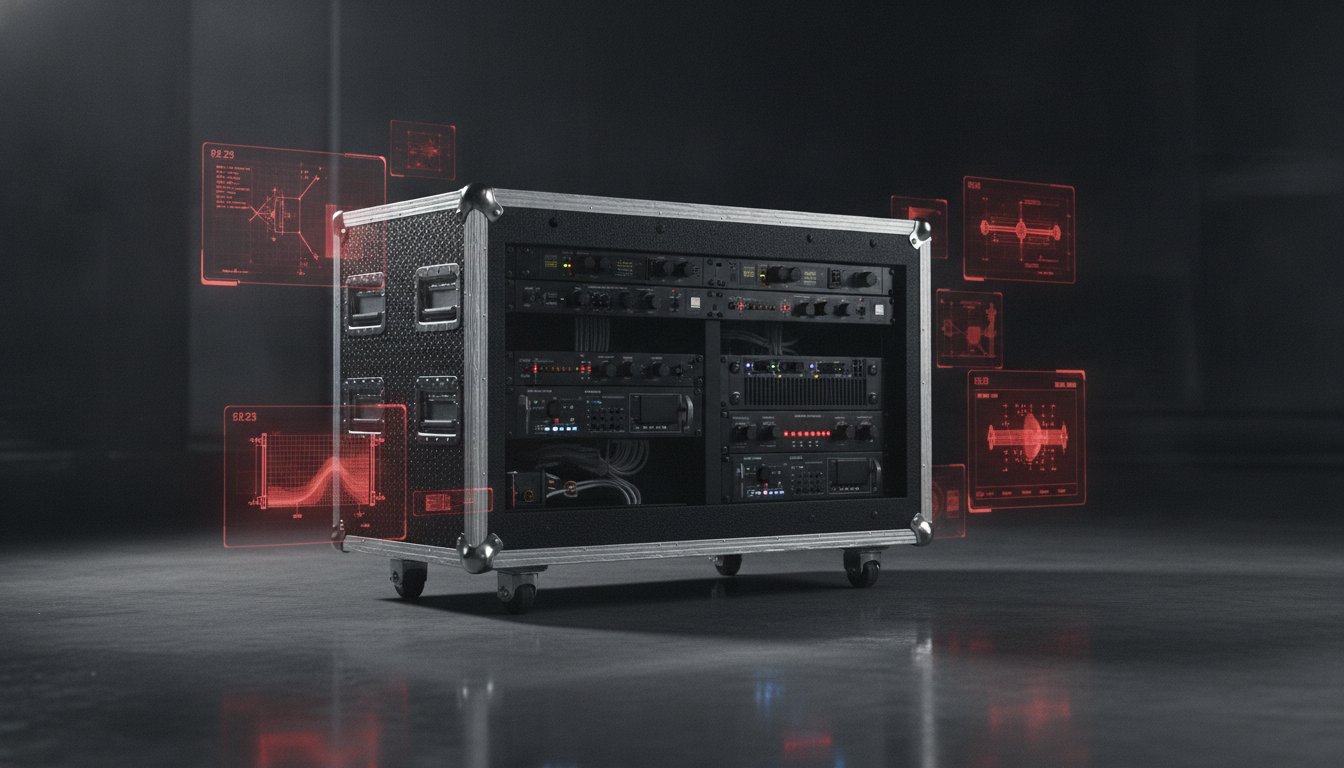
The structural integrity of a professional signal chain is only as secure as the mechanical architecture supporting it. For production engineers, the primary risk isn't just external impact; it's the internal thermal degradation that occurs when high-density amplifiers are housed in poorly ventilated enclosures. Mastering the deployment of Amp & Effects Rack Cases requires a move beyond simple storage toward a disciplined approach to mechanical load-bearing and heat dissipation. You already understand that equipment failure during a high-stakes production is an unacceptable variable that can be mitigated through precise engineering.
This 2026 production guide establishes the technical standards necessary to ensure zero-failure mechanical isolation and extended equipment lifespan. We'll analyze the critical requirements of ATA-300 Revision 2023 compliance and the structural demands of EIA-310-D rack unit spacing. This overview provides a blueprint for optimizing thermal regulation and achieving standardized logistical efficiency through TruckPaX™ integration and advanced shock isolation techniques. By focusing on these engineering benchmarks, you can maintain a stable operating environment for sensitive processors even in the most demanding tour environments.
Key Takeaways
- Quantify mechanical load requirements to prevent rack rail failure under the weight of high-density professional power amplifiers.
- Evaluate the structural specifications of 3/8" and 1/2" plywood laminates to ensure compliance with ATA-300 Category 1 standards.
- Implement advanced thermal regulation and shock isolation strategies to protect sensitive electronics within Amp & Effects Rack Cases.
- Optimize logistical efficiency by utilizing standardized rack depths designed for seamless TruckPaX™ palletization and transport.
- Leverage specialized engineering from Santosom and ZCASE to maintain the integrity of custom-built professional rack configurations.
Engineering the Foundation: Why Professional Rack Management Matters
In professional production environments, the rack case serves as the fundamental structural defense for the signal chain. It isn't just a transport container; it's a precision-engineered frame designed to maintain the mechanical alignment of high-value hardware. When deploying Amp & Effects Rack Cases, the focus must remain on the physical realities of the tour. Heavy power amplifiers exert significant downward force on mounting hardware. Without adequate housing, this weight leads to chassis deformation and internal component stress. The financial consequences of a single amplifier failure during a performance far outweigh the initial investment in engineering-grade protection. Professional rack management ensures that every piece of gear remains within its specified mechanical tolerances during every stage of the logistical cycle.
Selecting a case from the ProX Cases catalog involves understanding the specific load-bearing requirements of your equipment. A rack that fails to provide rigid support allows the equipment chassis to flex. This flexing causes micro-fractures in solder joints and puts unnecessary tension on internal ribbon cables. High-density builds require a housing that acts as an exoskeleton, absorbing kinetic energy and preventing it from reaching the sensitive electronics inside.
The Physics of Rack-Mounted Loads
The 19-inch rack standard provides a universal mounting framework, but it doesn't account for the extreme depth and weight of modern high-output amplifiers. A 4U or 6U power amp often exceeds 50 pounds, creating a massive cantilever effect when secured only by the front rails. Proper weight distribution requires rear rack rails to support the back of the chassis. This prevents "rack sag," a condition that causes connector strain and eventually shears the mounting ears. By utilizing internal support structures and rear-mounting points, engineers protect the solder joints and internal circuit boards from the constant vibrations inherent in transit. This mechanical isolation is critical for maintaining the longevity of sensitive effects processors that lack the heavy-duty chassis of power amps.
Workflow Efficiency and Strike Times
Operational speed is a core metric of professional production. Organized rack management directly impacts strike times and load-in efficiency. Integrated internal cable management reduces clutter and minimizes the risk of accidental disconnects during setup. When equipment arrives at a venue, it must be production-standard and ready for immediate deployment. Standardizing the layout within Amp & Effects Rack Cases allows technicians to troubleshoot faster and maintain a consistent signal flow across multiple stages. This level of organization prevents the chaotic cable management issues that often lead to signal degradation or ground loops. Effective rack engineering ensures that the focus remains on the performance, not on fixing damaged hardware or tracing faulty connections in a high-pressure environment.
Structural Integrity: Plywood Thickness and ATA-300 Standards
Structural durability in professional transit is governed by the ATA-300 Specification 300, Revision 2023. This standard dictates the construction requirements for Category I containers, which are engineered to withstand a minimum of 100 round trips in high-intensity logistical environments. For Amp & Effects Rack Cases, the choice of substrate is the most critical variable. While 3/8-inch plywood is common for lighter utility gear, 1/2-inch multi-layer plywood is the industrial requirement for racks housing heavy-duty power amplifiers. This increased thickness provides the necessary shear strength to prevent chassis warping when the case is subjected to vertical drops or lateral shifts during transport.
Reinforcing the plywood chassis requires more than just thickness. Steel ball corners are utilized to redirect impact energy away from the panel joints, while recessed hardware ensures that latches and handles remain protected from shearing forces. This integrated approach to mechanical assembly creates a rigid exoskeleton that maintains its geometry under the extreme pressure of stacked truck loads. To ensure your inventory meets these rigorous specifications, you can browse the ProX Cases collection for engineering-grade solutions.
Laminate Science and Impact Resistance
Laminate technology serves a dual purpose: aesthetic longevity and structural reinforcement. Signature honeycomb surfaces utilize a hexagonal grid pattern to dissipate kinetic energy across the panel surface, significantly reducing the depth of localized impacts. This textured finish also provides superior scratch resistance compared to traditional flat laminates. Industrial-grade adhesives are used to bond these laminates to the plywood core, preventing delamination caused by the extreme temperature fluctuations often found in unmanaged storage environments. The result is a high strength-to-weight ratio that doesn't compromise the protection of internal processors.
Hardware Engineering: Beyond the Surface
Hardware selection must account for the specific logistical demands of high-density amplifier racks. Recessed butterfly latches and spring-loaded handles are essential for maintaining a flush exterior profile, which is critical for efficient truck packing. High-load racks require 4-inch heavy-duty casters with reinforced mounting plates to handle the concentrated weight of multiple power amps. Over time, even the most durable hardware requires inspection. Maintaining these components is vital for operational safety; refer to the ProX Cases Replacement Parts guide for a comprehensive maintenance hardware checklist. This proactive approach to hardware upkeep ensures that your Amp & Effects Rack Cases remain functional throughout their multi-year service life.
Advanced Protection: Mechanical Shock Isolation and Thermal Regulation
Managing the internal environment of Amp & Effects Rack Cases requires a dual focus on kinetic energy absorption and heat dissipation. While standard rack rails provide a static mounting point, they offer no protection against the high-frequency vibrations and vertical shocks encountered during air or ground transit. For sensitive digital processors and high-power amplifiers, mechanical isolation is a technical requirement, not an optional upgrade. However, implementing shock protection introduces a significant engineering challenge: thermal insulation. The materials used to dampen vibration often trap the heat generated by power-hungry components.
Protecting the signal chain involves understanding how different frequencies of movement affect hardware. Low-frequency shocks, such as a case being dropped from a loading dock, can bend a chassis. High-frequency vibrations from truck engines or aircraft turbines are more insidious; they cause micro-fractures in solder joints and loosen internal connectors over time. Professional ProX Cases engineering addresses these risks by decoupling the internal rack frame from the outer shell, ensuring that the equipment remains in a controlled mechanical state regardless of external conditions.
Mechanical Isolation Methods
The most effective method for protecting internal circuitry is the "case-within-a-case" design. This configuration utilizes an internal rack chassis suspended within an outer shell by 2-inch high-density polyethylene foam. This foam layer acts as a shock absorber, decoupling the equipment from external impact forces. For sensitive digital effects, this isolation prevents mechanical fatigue. Engineers should specify this shock-mount architecture for any gear containing delicate optical components or processors that are susceptible to high-frequency resonance during long-haul transport.
Thermal Management Strategies
The physics of heat generation in enclosed racks is a critical safety variable. Power amplifiers convert a portion of their energy into heat, which quickly exceeds optimal operating thresholds in a sealed environment. Research indicates that internal temperatures should not exceed 29°C (85°F) to ensure equipment longevity. When using Amp & Effects Rack Cases with shock-mount foam, the insulation properties of the foam can lead to rapid heat buildup. To mitigate this, engineers must implement specific airflow strategies:
- Vented Rack Panels: Utilizing 1U or 2U perforated panels between high-heat components allows for passive convection.
- Deep Lids: Selecting cases with extended lid depths provides a larger air reservoir, which helps delay thermal saturation.
- Forced-Air Cooling: In high-density racks, integrated fan panels are necessary to maintain constant airflow and prevent thermal throttling of digital processors.
Maintaining a room temperature of approximately 24°C (75°F) is the recommended baseline for professional rack deployments. By balancing mechanical isolation with active thermal regulation, production teams can ensure zero-failure performance throughout a tour's duration.

Logistical Precision: Standardizing Rack Depths and TruckPaX™ Integration
Standardizing the external footprint of transport gear is a logistical necessity for high-volume production. When Amp & Effects Rack Cases vary in depth or width, they create "dead space" in a trailer, which leads to load shifts and equipment damage. Logistical precision requires a shift from viewing the rack as an isolated unit to seeing it as a modular component of a larger transport system. By adhering to standardized dimensions, production managers maximize truck pack density and ensure that every cubic foot of trailer space is utilized effectively. This approach eliminates the instability caused by mismatched case sizes and ensures a more secure environment for high-value electronics.
The TruckPaX™ system is engineered specifically to address these logistical bottlenecks. These cases utilize exterior dimensions designed to divide perfectly into standard 90-inch and 96-inch wide trucks. This mathematical approach to case design allows for zero-gap loading, which is the most effective method for preventing lateral movement during transit. When racks are built with consistent external footprints, they stack securely; this reduces the risk of a high-density amplifier rack tipping onto more sensitive processors during sudden stops or sharp turns.
Optimizing the Truck Pack
Zero-gap loading isn't just about space efficiency; it's a mechanical safety strategy. Uniform case footprints create a monolithic block within the trailer, distributing kinetic energy across the entire load rather than concentrating it on individual units. For a deeper understanding of these logistical standards, consult The Ultimate Guide to Flight Cases. Maintaining a standardized inventory reduces strike times and simplifies the palletization process for international freight, allowing for predictable logistics costs and faster deployment at the venue.
Choosing the Correct Depth
Internal rack depth must be selected based on the specific mechanical requirements of the hardware and the necessary cable clearance. Shallow 12-inch racks are suitable for effects processors and wireless receivers, while high-output amplifiers typically require 18-inch or 24-inch depths to accommodate their chassis and rear-mounted connectors. It's critical to account for the "bend radius" of heavy-duty power cables to prevent strain on the equipment's input jacks. For detailed specifications on amplifier dimensions and power requirements, refer to the Professional Amplifier Rack Case Guide. Balancing the number of rack units (U) with the total external weight is also vital; a 16U rack filled with power amps may exceed the safe lifting limits for a two-person team and require specialized handling equipment.
To streamline your logistical workflow and protect your inventory, you can explore the full range of ProX Cases designed for professional truck pack integration.
Professional-Grade Reliability: The ProX Approach to Rack Engineering
ProX has maintained a focus on engineering precision since 1984. This longevity is rooted in a deep understanding of the physical stresses placed on Amp & Effects Rack Cases in professional production environments. By prioritizing functional excellence over temporary trends, the brand provides a reliable backbone for the global touring industry. This commitment extends to the integration of specialized technologies like Santosom Cases and ZCASE custom builds. These partnerships offer tailored solutions for complex broadcast arrays and bespoke touring rigs that require more than off-the-shelf housing. Every design choice is a response to the practical realities of the industry; it's a meticulous approach that values structural integrity above all else.
Industrial-grade material selection is the primary driver of long-term value. Utilizing multi-layer plywood and heavy-duty steel hardware ensures that the case maintains its structural geometry through years of logistical cycles. This high-standard construction prevents equipment depreciation by providing a stable environment that shields high-value processors from mechanical shock and environmental contaminants. Custom engineering services allow for the development of bespoke rigs that accommodate non-standard broadcast arrays, ensuring every component of a complex system is protected by the same engineering standards as standard rack gear. It's a comprehensive strategy designed to eliminate equipment failure as a variable in high-stakes environments.
The ProX Engineering Advantage
Precision in rack design begins with CNC-machined components. This automated process ensures perfect rail alignment, which is critical for preventing chassis stress during equipment installation. You can explore the current inventory in the ProX Cases category to find configurations that match your specific RU requirements. Signature honeycomb laminates provide an additional layer of protection; their hexagonal structure increases surface rigidity while maintaining a professional appearance that resists the typical wear and tear of a production schedule. This surface technology doesn't just look professional; it's a functional component of the case's impact-resistance strategy.
Maintenance for Touring Longevity
Maintaining the integrity of a rack system requires a systematic approach to hardware upkeep. Routine inspections of rack rails and fastener integrity are essential to ensure that heavy amplifiers remain securely mounted during transit. Technicians should regularly clean and lubricate butterfly latches and spring-loaded handles to ensure smooth operation in high-pressure environments. Over time, the build quality of Amp & Effects Rack Cases becomes a critical factor in a tour's overhead. A professional case effectively pays for itself by extending the service life of the equipment inside and preserving its resale value. By treating the rack as a precision instrument rather than a simple box, production teams ensure zero-failure reliability for every performance. Consistent maintenance paired with superior engineering is the only way to guarantee equipment safety in the field.
Securing the Future of Professional Production Architecture
Professional rack management is a technical discipline that balances mechanical load-bearing with thermal stability. As production requirements become more complex, the need for standardized logistical footprints and advanced shock isolation becomes a mandatory engineering requirement. Utilizing Amp & Effects Rack Cases built to ATA-300 Category 1 standards ensures that your signal chain remains operational through the most demanding logistical cycles. By prioritizing 1/2-inch plywood construction and precise thermal regulation, you protect both your hardware and your performance integrity from the physical realities of the tour.
ProX has provided engineering precision for live events since 1984. Our designs are trusted by global touring professionals and production houses to maintain zero-failure reliability in high-stakes environments. You can Browse Professional Amp & Effects Rack Cases at ProX Direct to find the exact configuration for your next deployment. Investing in high-grade protection is the most effective way to ensure your inventory remains production-standard and maintains its value for years to come. Build your next rig on a foundation of industrial-grade reliability.
Frequently Asked Questions
What is the difference between an effects rack and an amp rack case?
Internal depth and load-bearing capacity are the primary differentiators between these two configurations. Effects racks are typically shallower, ranging from 12 to 14 inches, as they house lightweight signal processors and wireless receivers. Amp racks feature depths of 18 to 24 inches and utilize reinforced rack rails to support the significant weight of power transformers and high-density heat sinks.
How many rack units (U) do I need for a standard touring rig?
A standard touring rig usually requires between 4U and 8U of space depending on the complexity of the signal chain. Most professional setups allocate 2U for a primary power amplifier, 1U for a power conditioner, and 1U or 2U for digital effects or wireless management. It's often beneficial to include an extra 1U for a vented panel to assist with thermal regulation.
Does my amplifier need a shock-mount case or a standard case?
High-value digital processors and heavy amplifiers with sensitive internal components require shock-mount protection to survive long-haul transit. While standard Amp & Effects Rack Cases provide excellent impact resistance, shock-mount versions utilize a floating inner chassis to decouple gear from high-frequency vibrations. This mechanical isolation is essential for preventing micro-fractures in solder joints and protecting delicate internal circuit boards.
How do I prevent my gear from overheating inside a rack case?
Maintaining thermal stability requires removing both the front and rear lids during operation to facilitate natural convection. Engineers should leave at least 1U of space between high-output amplifiers and install perforated vent panels to prevent heat pockets. In high-density configurations, integrated fan panels are a technical requirement to ensure internal temperatures remain below the recommended maximum of 29°C (85°F).
What is the standard depth for professional amplifier racks?
Professional amplifier racks feature a standard depth of 18 or 24 inches to accommodate the equipment chassis and the necessary rear cable clearance. This depth ensures that heavy-gauge power cables and XLR connectors don't press against the rear lid. Proper depth selection prevents mechanical strain on input jacks, which is a common cause of equipment failure during high-intensity touring cycles.
Are 1/2-inch plywood cases significantly better than 3/8-inch for touring?
1/2-inch plywood is the industrial requirement for heavy-duty touring because it offers the shear strength necessary to support high-density loads. While 3/8-inch panels are suitable for lighter utility gear, they lack the structural rigidity required for stacking multiple Amp & Effects Rack Cases in a trailer. The thicker substrate ensures the case maintains its geometry even when subjected to the extreme pressures of a full truck pack.
Can I stack different brands of rack cases in a truck pack?
Stacking different brands is possible but often leads to logistical instability due to inconsistent external dimensions and varying caster plate alignments. Utilizing a standardized system ensures that cases interlock securely, which eliminates "dead space" and prevents dangerous load shifts. For maximum efficiency, engineers should prioritize cases with uniform footprints designed for zero-gap loading in standard 90-inch or 96-inch wide trailers.
How do I maintain the rack rails to prevent stripping the threads?
Prevent thread stripping by using high-quality rack screws and ensuring that the equipment mounting ears are perfectly aligned before applying torque. It's essential to use plastic cup washers to distribute pressure and protect the equipment finish. Periodically inspect the rails for debris or cross-threading; if a thread feels resistant, use a tap to clear the threads rather than forcing the screw.
Disclaimer
Any trademarks, trade names or brand names appearing herein that do not belong to ProX are the property of their respective owners and/or companies, and such appearance doesn't and shall not constitute or imply endorsement, sponsorship or recommendation by ProX.


