

A case that fits the speaker but leaves the rest of the PA system exposed is only a partial solution. A custom case for portable PA system equipment should be designed around the complete configuration, including the components and accessories you need to store and move together.
Accurate measurements matter, but they’re only the starting point. You also need to consider how the system is packed, accessed, and handled during setup and transport. A general-purpose case may not match the equipment’s shape or your workflow, while added protection can affect weight and accessibility. A useful design balances these requirements.
This guide explains how to define the complete equipment configuration, identify protection priorities, and plan access and handling features before a custom case project begins. You’ll learn what measurements and workflow details to gather so the case can be designed around how your PA system is used. ProX offers custom case design-and-build projects tailored to equipment dimensions and protection requirements.
Key Takeaways
- A custom case for portable PA system equipment can address unusual dimensions, attached components, or workflow needs that standard case layouts don’t accommodate.
- Inventory the complete system, configure it as it will be stored, then record its widest, deepest, and highest points.
- Compare custom and general-purpose cases by fit, access, accessory organization, and handling needs.
- Build a useful specification by documenting the equipment, measurements, protection priorities, access points, and handling requirements.
- Clear equipment details help ProX tailor custom case design-and-build projects to the system’s dimensions and protection requirements.
When Does a Custom Case for a Portable PA System Make Sense?
A custom case is designed around the equipment’s dimensions and protection requirements, rather than chosen by comparing a case’s external measurements with a speaker cabinet. A custom case for portable PA system equipment can make sense when the complete setup has an unusual footprint, protruding controls, attached components, or workflow needs a general-purpose case can’t accommodate. The right design depends on what travels together and how the case is handled during storage, loading, unloading, and use.
A general-purpose option may suit a straightforward setup with basic storage needs. But external dimensions alone don’t tell you whether the equipment will fit securely, whether sensitive areas need protection, or whether the system can be removed and accessed efficiently. A Road case is intended to protect sensitive equipment during transport. Custom design applies that purpose to the equipment’s actual configuration and requirements.
Which portable PA setups benefit from tailored dimensions?
Tailored dimensions are useful when the equipment’s shape or arrangement doesn’t fit a standard enclosure well. Consider the complete setup, not just the speaker: power components, integrated parts, and accessories that travel with the system all affect the design brief.
Document the equipment as it will be stored. Note nonstandard footprints, protruding controls, components that remain attached, and items that need their own space. This gives the case design a clear picture of the real configuration instead of an assumed package based on the speaker cabinet alone.
What should a case protect beyond the speaker cabinet?
Identify vulnerable controls, connection points, handles, and removable parts. These areas may need protection from contact with other equipment or from handling during storage and repeated loading and unloading. Consider how the system will be placed into and removed from the case, too. A design that protects the equipment but obstructs routine access may not suit the way the PA is used.
Separate protection requirements from operator conveniences. Protection addresses the equipment’s exposure to handling and contact. Access and handling features support the person moving and using the system. For example, a layout can provide access to a control panel or organized storage for accompanying accessories. These workflow decisions don’t replace defining what needs protection, so state both clearly in the project brief.
ProX custom case engineering tailors design-and-build projects to equipment dimensions and protection requirements. A precise description of the complete configuration and intended handling gives the design a practical basis, especially when standard dimensions or workflows don’t fit.
How to Measure a Portable PA System for a Custom Case
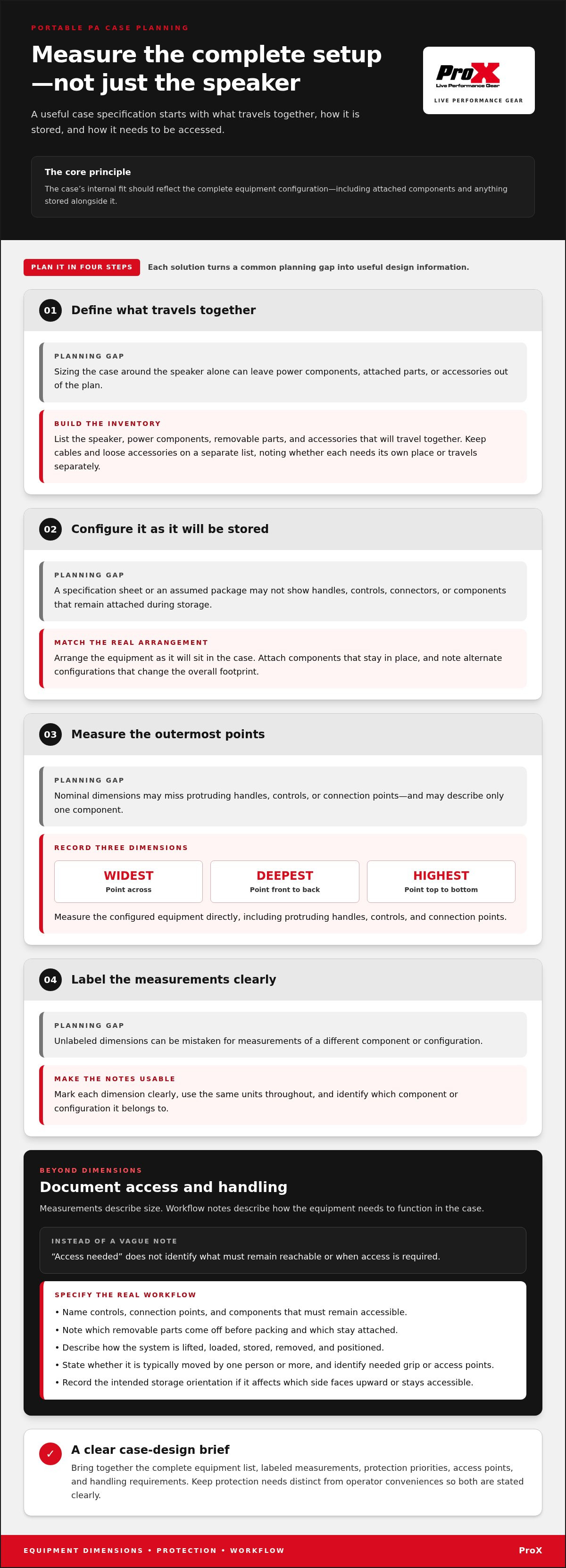
Start with the equipment as it’s actually used, not a specification sheet or an estimate based on the speaker cabinet. For a custom case for portable PA system equipment, follow a consistent sequence: inventory the items, configure them for storage, measure the complete arrangement, then document access and handling requirements.
The case’s internal fit must reflect the complete equipment configuration, including attached components and anything stored alongside it.
What dimensions and equipment details should you record?
Measure the physical equipment directly. Published nominal dimensions may not account for handles, controls, connectors, or accessories attached during storage. Configure the system as it will sit in the case, then identify its widest, deepest, and highest points.
- Inventory: List the speaker, power components, removable parts, and accessories that will travel together.
- Configure: Attach components that remain in place during storage. Note alternate configurations that change the overall footprint.
- Measure: Record the widest, deepest, and highest points, including protruding handles, controls, or connection points.
- Label: Mark each dimension clearly and use the same units throughout. Identify which measurement belongs to which component or configuration.
Keep cables and loose accessories on a separate list. Note whether each item needs a dedicated place in the case or travels separately. This prevents measurements for the speaker from being mistaken for measurements of the complete system.
How should you document access and handling requirements?
Measurements describe size; access notes explain how the equipment needs to function in the case. Mark controls, connection points, and components that must remain accessible without unnecessary handling. Note which removable parts need to come off before packing and which stay attached.
Describe the handling sequence in practical terms: how the system is lifted, loaded, stored, removed, and positioned at an event. Include whether it’s typically moved by one person or more, and where the operator needs a clear grip or access point. Record the intended storage orientation if it affects which side should face upward or remain accessible.
Make the notes specific. “Access needed” is less useful than naming the control panel or connection area and explaining when access is required. A clear equipment list, labeled measurements, and handling description give custom case engineering a sound basis for design. Explore ProX case solutions for professional audio and event equipment.
Custom Case vs. General-Purpose Case for a Portable PA System
The right case depends on how closely an available option matches the equipment and its handling workflow. A general-purpose case can be practical when the complete PA setup fits and needs straightforward storage. A custom case can address project-specific dimensions, protection priorities, and access requirements. Neither approach is automatically better. Compare both against the same equipment configuration and day-to-day use.
Fit: A general-purpose case works when the complete setup fits without interference. Custom design can accommodate unusual shapes, attached components, or dimensions that standard options don’t suit.
Equipment access: Standard layouts may meet simple access needs. A tailored design can account for controls and connection points operators need to reach.
Accessory organization: Basic storage may be enough for a compact setup. A custom layout can account for accessories that travel with the system and need defined storage positions.
Handling: Evaluate how the case is lifted, loaded, stored, and used at events. A suitable design should support the actual workflow, not just contain the equipment.
When is a general-purpose case a practical fit?
Choose this route when the speaker and everything stored with it fit the available internal space, access is uncomplicated, and the case supports routine handling. Assess the complete configuration, including power components and accessories, rather than checking only the speaker cabinet. A compromise matters if it restricts fit, blocks necessary access, or makes loading and removal less practical.
Look beyond the listed external dimensions. Usable internal space and layout determine whether the equipment can be accommodated as intended. If the setup must be rearranged, packed separately, or handled awkwardly to fit, the case may not support your workflow even if its overall size appears suitable.
When does custom case engineering add value?
Custom case engineering is worth considering when standard dimensions don’t fit the configuration or the equipment’s protection requirements call for a project-specific design. ProX tailors custom case design-and-build projects to equipment dimensions and protection requirements, connecting the layout to how operators load, store, access, and set up the system.
Document the requirements before comparing options: what travels together, what needs protection, which components require access, and how the case is handled through the work cycle. That record makes the trade-offs clear. A custom case for portable PA system equipment is most useful when a general-purpose option can’t meet those documented needs without affecting fit, access, organization, or handling.
Build a Clear Specification for Your Portable PA Case
A clear project brief turns equipment and workflow needs into design priorities. For a custom case for portable PA system equipment, document the complete configuration, measured dimensions, protection concerns, access points, and handling conditions. Separate essential requirements from preferences so the design can address critical fit and protection needs first, while also accounting for convenience features.
How should you prioritize protection and access?
Rank sensitive areas by their exposure during storage, loading, unloading, and routine handling. Identify controls and connectors that need access during setup or operation, and explain when access is required. Describe the protection objective in practical terms, such as shielding a control surface from contact, without prescribing materials or construction details.
Use two priority levels:
- Essential: Requirements necessary for equipment fit, protection, and operation.
- Preferred: Layout or handling features that improve convenience but aren’t critical to the system’s use.
What should a custom case project brief include?
Make the brief specific enough to describe the complete equipment package and the problem the case needs to solve. Include:
- Equipment: Make, model, and configuration of the speaker and power components.
- Dimensions: Measured width, depth, and height, with units labeled, plus protrusions or attached parts.
- Accessories: Cables and other items that will travel with the system, listed separately.
- Protection: Sensitive areas and the handling or storage conditions they need to withstand.
- Access: Controls, connectors, and components that must remain reachable during setup or operation.
- Handling: How the equipment is lifted, loaded, stored, removed, and positioned at events.
- Current challenge: The specific fit, access, organization, or handling problem with the existing approach.
Be clear about what’s mandatory and what’s a preference. For example, protection for a vulnerable connection point may be essential, while a particular accessory arrangement may be preferred. This distinction keeps design decisions tied to operating requirements. ProX custom case projects are tailored to equipment dimensions and protection requirements. For more context on case design, see the flight case engineering guide.
Use your specification to explore ProX cases for professional equipment and identify the right direction for your project.
How ProX Custom Case Engineering Moves a PA Project Forward
A custom case project works best when design decisions start with defined equipment and workflow requirements. ProX tailors custom case design-and-build projects to equipment dimensions and protection requirements, connecting the case layout to how the PA system is stored, transported, accessed, and used. The project moves from defining requirements and providing equipment details to developing a design and building to the project’s needs.
ProX has engineered performance gear since 1984. That experience supports a practical approach: translating the equipment configuration and protection priorities into a case design that addresses the project’s specific requirements.
What information helps begin a custom case project?
Prepare measurements and configuration details for the complete PA setup, including components and accessories that travel together. Describe how the system is stored, moved, loaded, and accessed, and identify any controls or connections that must remain reachable. Include constraints such as handling workflow, available storage space, or a current fit or access problem. Clear details help define the design brief.
Useful project information includes:
- Equipment: Make, model, and configuration of the speaker and related components.
- Dimensions: Measured width, depth, and height, with protrusions and attached parts noted.
- Accessories: Items that travel with the system, identified separately.
- Priorities: Sensitive areas requiring protection and components requiring access.
- Workflow: How the system is handled during storage, transport, setup, and use.
How do design requirements shape the custom build?
Equipment dimensions establish the fit requirements. Protection priorities and access needs inform the layout, while the handling workflow helps define practical loading and removal considerations. Manufacturing complexity also informs project design. ProX develops the design around these project-specific inputs and builds to the defined needs, rather than assuming one configuration or solution suits every PA system.
A concise project brief keeps the design discussion focused on required functions and preferred features. Separate essentials, such as protecting a vulnerable control area, from preferences, such as a particular accessory arrangement. This gives the project a clear basis for design decisions.
Organize your equipment details and discuss a custom case project with ProX using your prepared requirements.
Put Your PA Case Requirements Into Action
A sound case decision starts with the complete system, not the speaker cabinet alone. Record the equipment configuration and dimensions, identify sensitive areas and access points, then describe how the system is stored, moved, and set up. Compare general-purpose and custom options against those requirements so fit, protection, and handling work together.
A custom case for portable PA system equipment can address project-specific dimensions and protection requirements when a standard option doesn’t fit the equipment or workflow. ProX custom case projects are tailored to those needs, drawing on its experience engineering performance gear since 1984.
With your measurements and priorities organized, take the next step and discuss a custom case project. A clear brief gives the project a practical starting point. ProX can help turn your equipment requirements into a considered case design.
Frequently Asked Questions
What information is needed to design a custom case for a portable PA system?
A useful design brief includes the equipment make and model, complete configuration, measured dimensions, accessories, protection priorities, and access requirements. Describe how the system is stored, handled, and set up, including attached components or controls that need access. Explain the problem the case needs to solve. These details give ProX a practical basis for tailoring a custom case for portable PA system to its dimensions and protection requirements.
How do I measure a portable PA system for a case?
Measure the equipment in the configuration that will be stored, including attached parts and components traveling together. Record the widest, deepest, and highest points, accounting for protruding handles, controls, and connectors. Label each dimension and state the units used. Measure the equipment itself rather than relying only on published nominal dimensions. List removable components and accessories separately, and note any alternate configuration that changes the overall footprint.
Is a custom case better than a general-purpose case for a PA system?
Neither option is automatically better. The right choice depends on the complete setup and how it’s handled. A general-purpose case may work when the system fits the available dimensions and requires basic storage and straightforward access. Custom case engineering can address project-specific dimensions, protection priorities, or workflow needs. Compare fit, access, accessory organization, and handling against your documented requirements to decide whether a standard option is suitable.
Can a custom PA case accommodate accessories and cables?
Yes. A custom case project can account for accessories and cables that travel with the PA system. Include them in the equipment inventory and identify which items need to be stored together, along with any access or organization priorities. List loose accessories separately from attached components. This helps the design reflect the complete package rather than only the speaker cabinet.
How much does a custom case for a portable PA system cost?
ProX quotes custom case engineering fees per project, based on engineering, materials, and manufacturing complexity. The project’s dimensions, protection requirements, and design needs inform its scope. Provide the equipment configuration and measurements, then describe the protection and access requirements. A detailed brief gives the project a clear basis for determining the work involved without relying on a generic price range that may not match your case requirements.
How long does it take to make a custom PA case?
Build duration depends on the requirements and scope of the individual project, so a single turnaround estimate won’t apply to every case. The design must account for equipment dimensions, protection needs, access points, and manufacturing complexity. Preparing those details at the outset helps define the project clearly and supports schedule planning. Include any timing constraints in the project brief.
What should a portable PA case protect?
A portable PA case should address the parts most exposed to contact and handling, not just the speaker cabinet. Identify vulnerable controls, connection points, handles, and removable components. Consider protection during storage, loading, unloading, and repeated use. Also distinguish protective needs from operator conveniences, such as quick access to a control panel or organized cable storage. Clear priorities help align the case design with the equipment and workflow requirements.
Disclaimer
Any trademarks, trade names or brand names appearing herein that do not belong to ProX are the property of their respective owners and/or companies, and such appearance doesn't and shall not constitute or imply endorsement, sponsorship or recommendation by ProX.


