

The most specialized case isn’t automatically the best way to manage cables. The right cable management solutions for road cases depend on what your crew carries, how cables are identified and retrieved, and how the load fits into available transport space. A storage approach that works for a small, consistent inventory may not suit a larger mix of cable types and lengths.
Tangled cables and inconsistent packing can slow setup and make it harder to confirm what’s in the case. The case layout matters, but so does the workflow: how cables are grouped, accessed, and returned after use. Choosing a configuration without accounting for those habits can leave valuable space underused or make retrieval less consistent.
This guide compares dedicated cable storage with compartmentalized case layouts, then explains how to assess each option against your cable inventory, handling needs, and transport constraints. You’ll also learn what to check when reviewing a case’s dimensions and organization features, since details such as dividers or cable-retention provisions should be confirmed for the specific configuration. The goal is a practical fit for your equipment and workflow, not a one-size-fits-all solution.
Key Takeaways
- Match a cable storage approach to your inventory and crew workflow, rather than choosing by case type alone.
- Compare dedicated cable trunks, divided interiors, and separate storage units for capacity, access, and transport fit.
- Use cable length, bundle size, retrieval frequency, and case placement to guide your selection.
- Plan zones and labels, then test the packing sequence and adjust it to support consistent setup and return.
- Explore cable management solutions for road cases through ProX utility and storage cases, and confirm dimensions and features for the selected configuration.
Cable Management Solutions for Road Cases: Start With the Workflow
Start with the way cables move through a production, then choose the storage approach. The main options are dedicated cable storage, a divided interior, or a combined workflow that uses a larger case alongside separate storage units. Each can support organized packing, but the right fit depends on cable inventory, access needs, and available transport space.
A road case is a shipping container specifically designed to protect equipment during transport. For cable management, the case also needs to support identification, retrieval, and repeatable packing. Poor organization can make the required cable harder to locate and leave the crew without a consistent way to return items after use.
This section focuses on case-based organization, not cable repair or cable specifications. The goal is to determine how storage should serve the crew’s routine. Cable management is a workflow and storage decision: it defines how cables are grouped, identified, accessed, and returned to the case.
What makes cable storage different from general equipment storage?
Cables vary by length, connector type, quantity, and how often they’re used. Keeping them together can make efficient use of a single storage area, but separating groups can make identification and retrieval more direct. A production crew preparing a show, for example, might store audio, power, and data cables in distinct groups rather than sorting them from one mixed bundle at setup.
That distinction informs the case choice. A dedicated cable trunk can centralize a larger inventory; divided storage can separate groups within a case; and a combined arrangement can keep frequently used cables apart from reserve or specialty items. Any specific divider or retention feature should be checked against the selected case configuration.
Which workflow details should shape the case choice?
Identify who packs and retrieves the cables, where the case will be opened, and how often its contents change. A fixed inventory assigned to the same crew may benefit from stable storage zones. A mixed or frequently changing collection may need a layout that can be reorganized without disrupting access to the cables used most often.
Consider the full handling sequence, not just storage volume. If the case opens near the work area, the crew may need common cable groups accessible first. If multiple people handle packing, clear group assignments can make returns more consistent. As you compare ProX case categories, match the intended layout to verified dimensions and listed features rather than assuming a case includes specific compartments.
Compare Cable Trunks, Divided Cases, and Separate Cable Storage
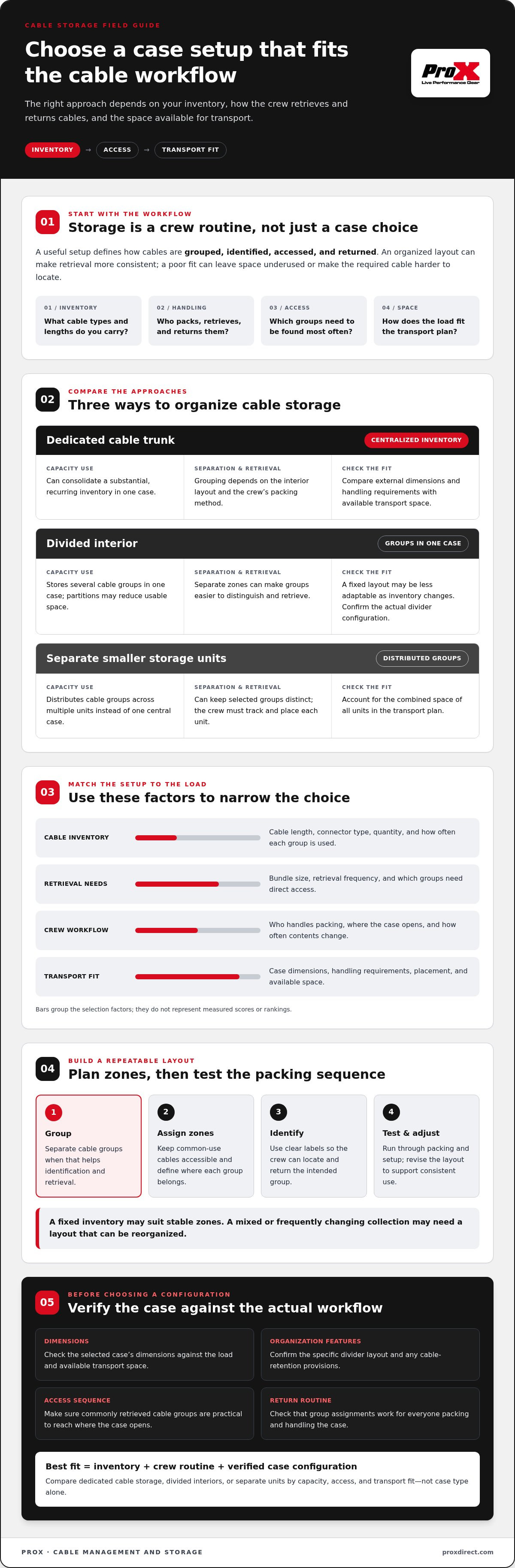
These three approaches solve different storage problems. A dedicated cable trunk centralizes an inventory, a divided interior assigns groups to separate areas, and smaller storage units let crews keep selected cable groups apart. The best fit depends on how much cable you carry, how quickly staff need to identify it, and how the case fits your transport plan.
| Approach | Capacity use | Separation and retrieval | Reconfiguration and transport fit |
|---|---|---|---|
| Dedicated cable trunk | Can consolidate a substantial, recurring inventory in one case. | Grouping depends on the interior layout and the crew’s packing method. | Check external dimensions and handling requirements against the available transport space. |
| Divided interior | Uses one case for several cable groups, though partitions may reduce usable space. | Separate zones can make groups easier to distinguish and retrieve. | A fixed layout may be less adaptable as the inventory changes. Confirm the actual divider configuration. |
| Separate smaller storage units | Distributes cable groups across multiple units instead of one central case. | Can keep selected groups distinct, but the crew must track and place each unit. | May suit a changing workflow; account for the units’ combined space in the transport plan. |
When is a dedicated cable trunk the practical choice?
Choose a dedicated trunk for a substantial inventory that recurs across productions and benefits from a defined storage location. It can make the overall packing plan easier to standardize, but the case still needs to fit the actual load and transport arrangement. Measure the available case location, check the product’s external dimensions, and account for how staff will access and handle it. Don’t assume a particular internal layout or handling feature without checking the product details.
When do dividers or separate storage units help?
Dividers can separate cable groups inside one case, while pouches or smaller units can keep selected groups together as a general workflow choice. Both approaches can support identification, but a fixed layout may become restrictive if cable types and quantities change often. Confirm whether the selected case includes dividers, and whether their arrangement suits the inventory.
For safe electrical work, storage organization should complement established handling procedures, not replace them. Richard Cadena’s resource on the safe application of electricity for event production provides relevant industry context. As you compare cable management solutions for road cases, use your inventory and transport measurements to narrow the options, then review ProX case categories for configurations to evaluate. Confirm dimensions and listed features for each selected case.
Choose Road-Case Cable Storage by Inventory, Access, and Fit
A case selection should account for both what the crew stores and how the storage location works in practice. Cable count alone doesn’t describe the load: a few large bundles may need a different layout from many smaller groups. Separate the number of cable groups from the total amount of cable before comparing case capacity.
Choose cable storage by four inputs: inventory, access, separation, and fit. Use this checklist to turn those inputs into a clear specification:
- Inventory: List cable groups, connector types, approximate quantities, and the largest or bulkiest bundle.
- Access: Note how often each group is retrieved and the order crews need it during setup.
- Separation: Decide which groups must remain distinct for identification or workflow.
- Fit: Measure the proposed storage location and transport space, then compare those measurements with verified product dimensions.
How should cable inventory and access needs be assessed?
Record approximate quantities by group, then identify high-use items that should be reachable without removing unrelated contents. For example, a crew might need frequently used signal cables before less common spares. The layout should account for the sequence of retrieval, not just the total volume.
Before finalizing a case specification, test the proposed arrangement with representative cables, including the largest bundle. This can reveal whether groups fit as planned and whether frequently accessed items remain reachable. Review handling procedures alongside the storage plan; the Health and Safety Executive’s Electrical Safety Guidelines provide event-specific safety context.
How do case dimensions and transport constraints affect selection?
Measure the space available in the vehicle, storage area, or production workspace. Compare it with the candidate case’s listed external dimensions, and account for where the case will sit and how it will be opened at the venue. A case that fits the transport plan must also allow the crew to access its contents in the intended position.
Confirm dimensions and any relevant internal layout details in the specific product information; don’t rely on assumptions about dividers or cable-retention features. For broader case-selection context, review the ProX case categories alongside your measurements. The right cable management solutions for road cases are determined by the inventory and workflow as well as the available physical space.
Plan a Cable-Case Layout That Supports Packing and Setup
A repeatable layout gives each cable group a defined place during setup and pack-down. It also makes handoffs clearer: crews can see which zones are in use and check whether items have been returned without relying on one person’s memory. The layout can use compartments if the selected case has them, but assigned zones can also be established through the crew’s packing method. Verify any case-specific features against its product information.
How can crews group and identify stored cables?
Choose grouping rules that match the production workflow. Cables can be organized by function, destination, or department, such as audio, lighting, or a particular equipment position. Keep the method simple enough for every crew member to apply consistently. Use durable, readable identification on the cable group or its assigned storage zone, and use the same naming convention across cases shared by different crews.
Build the layout in sequence:
- Inventory: Record the cable groups and items assigned to the case.
- Group: Sort cables according to the crew’s function, destination, or department conventions.
- Assign zones: Give each group a consistent location, placing frequently retrieved groups where they’re easiest to access.
- Label: Identify groups and zones with clear wording that crew members can recognize.
- Test: Load representative cables, then run a typical setup and return sequence.
- Revise: Adjust the arrangement if retrieval is awkward, groups become mixed, or the inventory changes.
How should a layout be tested before regular use?
Use the actual cable inventory for a representative load-in and pack-down. Check whether commonly used items can be retrieved without shifting unrelated groups, and whether cables return to their assigned zones after use. Note where the process breaks down: a label may be unclear, a zone may be difficult to reach, or the layout may not reflect the order of work. Correct the process before adopting it across the crew.
Keep the layout current. New equipment, changing cable quantities, or a different handoff between departments can make an established arrangement less useful. Update group assignments and identification together so the case contents and crew routine stay aligned. This approach improves consistency without assuming the case includes labels, partitions, or other specific organization features. Review ProX case options as you match the planned workflow to a case configuration.
Select a ProX Case or Custom-Built Solution for the Cable Workflow
Use your completed inventory, access, separation, and fit checklist to compare standard Utility/Storage Cases with a custom-engineered option. A standard configuration may suit a defined cable inventory and established packing routine. If equipment dimensions or protection requirements call for a tailored case, consider ZCASE Custom Build Cases made in Poland. The choice should follow the specified load and workflow, not assumptions about what a case includes.
For cable collections supporting broadcast equipment, AV Broadcasting Cases may also be relevant. Compare the case category with the intended contents, then confirm the chosen product’s dimensions and listed configuration. A category name alone doesn’t confirm that a particular case has the internal layout or features your crew needs.
When should a standard case be compared with a custom build?
Start with standard case options when their verified dimensions and configuration appear to suit the equipment and storage plan. Consider custom engineering if equipment dimensions, protection requirements, or a specified arrangement don’t align with available standard configurations. Prepare the measurements, cable inventory, largest bundle dimensions, separation needs, and access sequence before discussing a project. These details help clarify the requirements without assuming a particular design, price, lead time, or availability.
What information should buyers confirm before ordering?
Check the product information for internal and external dimensions, case configuration, and any stated construction details. Then compare those specifications with the space available in the transport plan and the position where the case will be opened. Confirm that the intended cable groups can be arranged and retrieved as planned. Verify any divider, compartment, or cable-retention feature against the specific product listing rather than assuming it comes with the case.
This final check connects the storage layout to the physical case. If a standard configuration doesn’t match the measured equipment or workflow, use those requirements to guide a custom-build discussion. For a relevant starting point, explore ProX case solutions, including AV Broadcasting Cases where appropriate. The right cable management solutions for road cases depend on confirmed product details as well as the crew’s handling needs.
Put Your Cable Workflow Into Practice
The right cable management solutions for road cases start with your inventory and crew routine. Compare dedicated storage, divided layouts, and separate units based on cable grouping, access frequency, and available transport space. Before selecting a case, verify its dimensions and listed configuration, then test whether your planned layout supports consistent packing and retrieval.
ProX has engineered performance gear since 1984 and offers utility and storage cases alongside custom case engineering for equipment dimensions and protection requirements. If a standard configuration doesn’t match your specified layout, use your measurements and workflow needs to guide a custom-build discussion. ProX serves customers worldwide through a dealer network.
When you’re ready to compare options, explore ProX case solutions. A measured, workflow-based choice can make cable storage clearer for the crew and more consistent from setup to pack-down.
Frequently Asked Questions
What is the best way to organize cables in a road case?
Group cables by function, destination, or production department, then assign each group a consistent storage location. Keep frequently retrieved cables accessible and use clear identification that every crew member understands. The best cable management solutions for road cases reflect the inventory and setup sequence, rather than relying on a universal layout. Test the arrangement with the actual cables and revise it if retrieval or pack-down becomes awkward.
Should I use a cable trunk or a divided road case?
Choose a dedicated cable trunk when a substantial, recurring inventory benefits from one storage location. A divided case may suit a smaller set of distinct cable groups that need separation within the same case. Compare usable capacity, retrieval order, and external dimensions against your transport plan. Don’t assume every case includes dividers or an adjustable layout; verify the selected product’s configuration before deciding.
How do I choose the right size case for my cable inventory?
List cable groups and approximate quantities, then identify the largest or bulkiest bundle. The number of groups and total cable volume are different measures, so account for both. Measure the space available for the case and compare it with verified product dimensions. Also consider where the case will be positioned and opened. Confirm that the proposed layout fits the inventory without blocking access to commonly used cables.
Can dividers help prevent cables from becoming mixed together?
Yes. Dividers can create separate zones for cable groups, which can make identification and return packing more consistent. Their usefulness depends on the inventory and the divider arrangement. Fixed divisions may be less suitable if cable types or quantities change often, and not every case includes them. Check the selected product listing to confirm whether dividers are included and whether their configuration matches your planned groups.
What information should I measure before selecting a cable case?
Measure the largest cable bundle and note the dimensions of other items that need to share the case. Also measure the available transport and storage space, including the location where the case will sit and open. Compare these measurements with the product’s verified internal and external dimensions. Check the listed configuration as well, since an advertised case size alone doesn’t establish usable space or internal organization.
How can a crew make cable packing and retrieval more consistent?
Set a shared grouping method, assign each group a defined case zone, and use clear, readable identification. Agree on which cables should be retrieved first and where they return after use. Test the routine with a representative load-in and pack-down, then correct unclear labels or inconvenient zones. If several crews share the equipment, keep the same group names and storage assignments across cases where practical.
Can I request a custom-built case for a specific cable layout?
ProX offers custom case engineering for specified equipment dimensions and protection requirements. If a standard configuration doesn’t suit your cable inventory or intended layout, prepare measurements, the largest bundle dimensions, storage-group details, and access requirements for a project discussion. The exact fit, internal arrangement, and included features need to be confirmed for the proposed case. Don’t assume a particular design, price, lead time, or availability without confirmation.
Disclaimer
Any trademarks, trade names or brand names appearing herein that do not belong to ProX are the property of their respective owners and/or companies, and such appearance doesn't and shall not constitute or imply endorsement, sponsorship or recommendation by ProX.


