

A case can be correctly labeled and still leave a critical accessory behind. At load-out, a console may be packed while its power supply, control surface cover, or signal leads remain at the venue. A touring equipment road case checklist helps close that gap by tracking equipment, case assignments, and handoffs in one workflow.
Each department needs a clear view of what is packed and where it belongs. The challenge is keeping that information consistent while accounting for differences in equipment dimensions, protection needs, and setup access. A useful checklist does more than name items: it connects each piece of gear to its accessories, assigned case, internal arrangement, and packing status.
This guide explains how to build a reusable inventory, match equipment to suitable case types, and establish repeatable checks for packing, handoffs, and load-out. It also covers the fields crews need to identify gear, record fit and protection requirements, and confirm what has been checked. The result is a practical system for managing equipment throughout a production.
Key Takeaways
- Build a touring equipment road case checklist that connects each item to its assigned case and verification status.
- Organize inventory by production department so teams can track equipment within their responsibilities.
- Record confirmed equipment dimensions, protection requirements, and access needs before assigning a case.
- Set a clear crew role and repeatable sequence for packing, handoffs, and final load-out checks.
- Use case categories that suit the equipment, and consider tailored case engineering when specific dimensions or protection needs call for it.
What a Touring Equipment Road Case Checklist Should Cover
A touring equipment road case checklist connects three things: the equipment in the production inventory, the case assigned to each item, and verification at key handoff points. It helps crews plan packing and confirm what moves between locations. It can reduce avoidable omissions, but completing a checklist cannot guarantee that equipment will avoid damage in transit.
A road case is a protective enclosure used to transport equipment such as sound, lighting, and video gear. The checklist should reflect each case’s actual contents and configuration, not an assumed standard layout. Case options vary by equipment group. Browsing professional road case categories can help teams organize assignments around the gear they use.
Which details belong on every touring checklist?
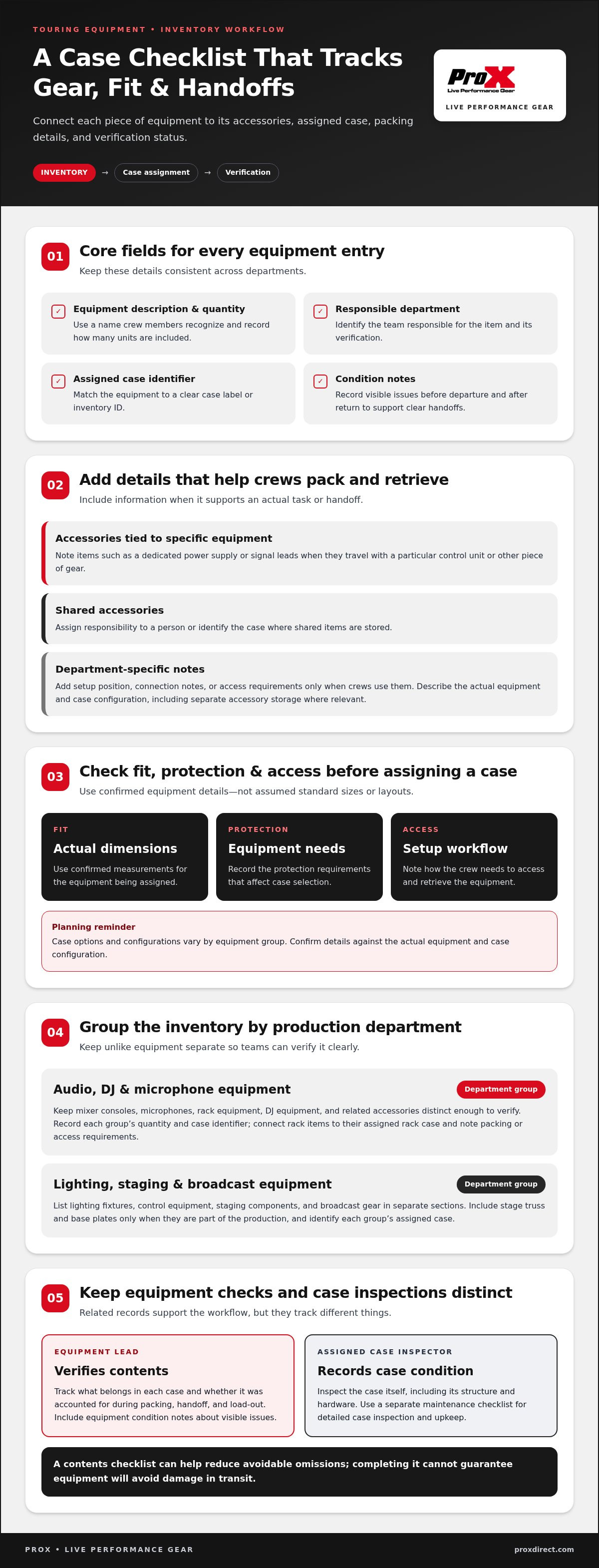
Keep the core fields consistent across departments, then add details only when they support a real task. Every equipment entry should include:
- Equipment description and quantity: Use a name crew members can recognize, and record how many units are included.
- Department: Identify the team responsible for the item.
- Assigned case identifier: Match the equipment to a clear case label or inventory ID.
- Condition notes: Record visible issues before departure and after return so the handoff reflects the equipment’s observed state.
Accessory and cable fields are useful when an item depends on them, such as a control unit with a dedicated power supply or signal leads. Add department-specific details, such as setup position or connection notes, only if crews use them. Describe the equipment and case configuration in use, including any separate accessory storage. Don’t assume every department packs the same way.
How does a case checklist differ from a maintenance checklist?
A packing inventory tracks what belongs in each case and whether it was accounted for during packing, handoff, and load-out. It can also include equipment condition notes about visible issues. A case inspection focuses on the case itself, including its structure and hardware. Keep the responsibilities clear: the equipment lead verifies contents, while the person assigned to inspect the case records its condition.
Use a separate maintenance checklist for detailed case inspection and upkeep. Keep this touring equipment road case checklist focused on inventory, case assignment, and equipment handoffs. Both records support the workflow, but neither replaces the other.
Build the Touring Equipment Inventory by Production Department
Structure the touring equipment road case checklist around the departments and responsibilities your crew uses. A production’s inventory varies with the event, so treat examples as prompts, not a complete gear list. Department-level ownership makes handoffs clearer: each team can verify its equipment and case assignments without relying on another department to interpret the inventory.
For each equipment group, record its quantity, assigned case, and the details needed to pack and access it correctly. Note fit, protection, and access requirements when they affect the case assignment. A searchable, shareable inventory management system can help crews organize equipment records and share access to them.
Audio, DJ, and microphone equipment
Keep audio and DJ entries distinct enough to verify at a glance. Depending on the production, list mixer consoles, microphones, rack equipment, DJ equipment, and related accessories as separate groups. Record the quantity and case identifier for each group. Include power supplies, signal cables, or other accessories when they travel with specific equipment. For shared items, assign responsibility to a person or name the case where they are stored.
For rack equipment, connect each item in the inventory to its assigned rack case and note any access or packing requirements the crew needs to follow. This makes it easier to verify the contents and retrieve equipment in the intended order.
Lighting, staging, and broadcast equipment
List lighting fixtures, control equipment, staging components, and broadcast gear in separate department sections. This prevents different equipment groups from being combined under a broad label that is difficult to verify during packing. Include stage truss and base plates only when they’re part of the production, and identify the case assigned to each group. For related case categories, see stage truss cases.
Department-specific details should serve a practical purpose. For example, record a control unit’s associated accessories or an access requirement that affects how it’s packed. Skip fields crews won’t use. The inventory works best when it reflects the actual equipment, case configuration, and handoff process.
Match Each Equipment Group to Case Fit, Protection, and Access
Assign cases according to equipment dimensions, protection requirements, and setup workflow. One case configuration won’t suit every touring group: a console, a lighting fixture, and a set of microphones can differ in shape, handling needs, and how quickly crew members need access. Use confirmed equipment measurements rather than assumed standard sizes, and record the reason for each assignment in the touring equipment road case checklist.
Use this comparison as a planning tool. These examples are prompts, not specifications. Confirm the details against the actual equipment and case configuration.
Fit information
Protection and access
Record actual dimensions, attached components, and removable parts.
Note supported orientation, required clearance, and which controls or connections need access during setup.
Record item dimensions and the number of units packed together.
Identify the protection each item needs and whether it must be removed individually or as a group.
Document the equipment configuration and components that affect how it fits.
Note connection access and the sequence for removing or installing equipment.
These fields connect inventory control with practical case use. Internal layout affects more than fit: if one item must be lifted out before another, or a cable compartment is difficult to reach, packing order can slow setup and complicate handoffs. Record removal order and access needs where they matter. Don’t assume that a case suitable for one model or configuration will fit another.
What fit and layout details should crews record?
Capture confirmed dimensions for the equipment and any connected or removable components that change its packed shape. Note the intended orientation, necessary clearance, and access points without assuming unverified tolerances. If the gear needs a dedicated layout or a specific internal arrangement, document it clearly so the packing crew can reproduce it.
When should a crew consider a custom-built case?
A tailored case configuration can help when equipment dimensions, protection needs, or the crew’s workflow don’t align with an existing layout. Provide actual equipment measurements and explain how the gear is packed, protected, and accessed during setup. These requirements inform the case design. Compare road case categories when reviewing case options.
Use a Repeatable Checklist for Packing, Handoffs, and Load-Out
A touring equipment road case checklist is most useful when every crew member follows the same sequence and knows who records each check. Assign ownership by role, such as the department equipment lead, rather than leaving completion to whoever handles the last case. Use the same case identifiers on the checklist, physical labels, and production records. Consistent identifiers help crews trace equipment during warehouse dispatch, venue returns, and transfers between touring teams.
Use a repeatable workflow:
- Review the inventory: The department lead confirms equipment descriptions, quantities, accessories, and assigned case identifiers.
- Check before packing: Compare each item with the inventory, note visible condition issues or missing components, and confirm the documented internal arrangement.
- Verify the handoff: The person receiving the equipment checks the case identifiers and records the transfer according to the production’s process.
- Close out after use: Compare returned gear and cases with the departure record, then document discrepancies and configuration changes.
What should crews check before equipment is packed?
Before closing a case, the responsible crew member should confirm that the equipment identity and quantity match the inventory, relevant accessories are present, and the assigned case is correct. Record visible issues and missing items before the case leaves the department. Check the internal arrangement against the documented configuration so removable components and accessories are placed where the next crew member expects them.
How should load-out checks close the loop?
At load-out or return, compare case identifiers and equipment against the departure inventory. Record discrepancies promptly, assign an owner for follow-up, and track their status so they aren’t lost between departments. If the crew changes how an item is packed or assigned, update the production record and checklist. The next dispatch can then follow the current configuration rather than an outdated one.
Keep the procedure practical for each location and handoff. Warehouse dispatch, venue load-out, and touring transfers may involve different crew roles, but the record should still show what was checked and by whom. To align case assignments with your equipment workflow, explore road case options.
Turn the Checklist into a Reliable Touring Case System
A dependable case system connects inventory records to physical case assignments and crew handoffs. Each equipment entry should point to the case that carries it, while the handoff record shows whether the item and case were checked at dispatch and return. Together, these records make the touring equipment road case checklist a working reference, not a static packing document.
Keep the system current. Assign a department or inventory owner to maintain quantities, case identifiers, and configuration notes. Review entries after equipment or production changes, and use recorded discrepancies to identify details that need correction. Shared field names across departments make records easier to interpret when equipment moves between crews.
How can crews keep a checklist usable over time?
Use consistent terms and a clear update process. If a case identifier changes, update the checklist, case label, and production records together. When a packing arrangement changes, revise the configuration note so the next crew follows the current setup. Short, specific entries are easier to verify than general comments, particularly during a venue return or warehouse dispatch.
Where can touring professionals explore relevant case options?
An existing case category may suit equipment when its dimensions, protection needs, and access requirements align with the case configuration. ProX’s range includes options for equipment groups such as microphones, mixer consoles, lighting, broadcast gear, and stage truss. The correct fit depends on the actual equipment and how the crew packs and uses it. A category name alone doesn’t establish compatibility.
Custom case engineering can help when equipment dimensions, protection requirements, or workflow call for a specific layout. Clear inventory details give the design process a practical starting point: the equipment to be housed, its measured dimensions, and how crew members need to pack and access it.
Use the checklist to guide case selection, then explore ProX case categories for options relevant to your production equipment.
Make Every Load-In and Load-Out More Consistent
A touring equipment road case checklist works best as part of a shared crew process. Organize inventory by department, connect each equipment group to a case that fits its measured dimensions and protection needs, and use consistent identifiers for packing and handoffs. Assigning responsibility for checks and updates helps keep the record aligned with the gear and workflow in use.
Case selection is part of that system. ProX designs and manufactures cases for professional live-event equipment and has engineered performance gear since 1984. Its case range includes options for audio, lighting, DJ, broadcast, and staging equipment, with custom case engineering for specific equipment dimensions or protection requirements. Customers worldwide can access products through a dealer network.
Use your inventory and case assignments to identify the categories that fit your production. Explore ProX case options for touring equipment, and put a clear, repeatable process in place for your next load-in and load-out.
Frequently Asked Questions
What should a touring equipment road case checklist include?
A touring equipment road case checklist should connect each inventory item to its department, quantity, assigned case identifier, and verification status. Include accessory details when they’re relevant, plus condition notes for visible issues before departure and after return. Add equipment dimensions, protection needs, and access requirements where they inform case assignment. Keep the core fields consistent across departments, then add only the details each crew uses.
How do you organize equipment for a touring load-out?
Organize equipment by the production departments and responsibilities your crew actually uses. List distinct groups, such as audio, lighting, staging, and broadcast equipment, then record quantities and case identifiers for each. Assign shared accessories to a responsible person or a specific case. Before dispatch, have each department lead compare its entries with the packed equipment, note discrepancies, and complete the handoff record.
Should every piece of touring equipment have its own road case?
No. Some equipment can share a case if the actual fit, internal arrangement, protection needs, and access sequence suit the group. Other items may need a dedicated configuration because of their dimensions, shape, or setup requirements. Record the equipment assigned to each case and confirm the arrangement against measured dimensions. Don’t assume one case layout is appropriate for every equipment type or model.
How can crews prevent equipment from being left behind?
Use one shared inventory and a repeatable verification process at packing, handoff, and load-out. Give a specific crew role responsibility for checking equipment, accessories, and case identifiers against the record. At return, compare the equipment with the departure inventory and log missing items or other discrepancies promptly, with an owner and follow-up status. A checklist helps reduce omissions, but it can’t guarantee that none will occur.
What information is needed to plan a custom touring equipment case?
Start with confirmed equipment dimensions, including connected or removable components that affect the packed configuration. Document protection requirements, orientation, clearance needs, and how crew members must access or remove the equipment during setup. Include the intended internal arrangement and relevant workflow requirements. These details give case engineering a practical basis for tailoring a configuration to the equipment and its use.
How often should a touring equipment checklist be updated?
Update the checklist whenever equipment quantities, case assignments, or packing configurations change. Review it after production changes and recorded discrepancies, and revise the relevant entries before the next dispatch. Assign an owner to maintain the record and keep field names consistent across departments. This keeps case labels, inventory details, and handoff records aligned without relying on a fixed review interval that may not match the production schedule.
What is the difference between a road case checklist and a case maintenance checklist?
A road case checklist tracks equipment inventory, case assignments, packing status, and handoffs. It helps crews verify what is packed and what returns. A case maintenance checklist focuses on inspecting the case itself and recording upkeep needs. Keep the records distinct so equipment teams can verify contents while the person responsible for case inspection documents the case’s condition and maintenance requirements.
Disclaimer
Any trademarks, trade names or brand names appearing herein that do not belong to ProX are the property of their respective owners and/or companies, and such appearance doesn't and shall not constitute or imply endorsement, sponsorship or recommendation by ProX.


