

A subwoofer transport case should fit the exact cabinet and work with the way your crew loads, moves, and stores equipment. Start by recording the subwoofer’s model and external measurements, then compare them with the case’s stated fit information. A broad size label alone won’t account for handles, connectors, or other protrusions.
The case format matters too. A rigid enclosure and a padded transport option have different constructions, so compare their stated features rather than assuming either format provides a particular level of protection. Your vehicle space, venue access routes, and handling routine can help narrow the choice.
This guide walks through measuring a subwoofer, checking case listings, comparing rigid and padded options, and building a practical transport checklist. It also explains how to keep verified product details separate from preferences about handling or storage.
ProX Live Performance Gear offers Speaker & Subwoofer Cases for live-event professionals, DJs, AV technicians, and touring crews. Define your equipment and workflow first, then compare the relevant case options against those requirements.
Key Takeaways
- Start with the subwoofer’s exact model and measurements before comparing case options.
- Distinguish equipment dimensions from external case dimensions when reviewing specifications.
- Compare a subwoofer transport case’s stated fit and handling features with your production workflow.
- Account for loading methods, storage space, crew handling, and venue transport routes.
- Once you’ve defined your requirements, browse Speaker & Subwoofer Cases to compare relevant options.
Why a Subwoofer Transport Case Must Match Your Equipment and Workflow
A subwoofer transport case needs to accommodate a specific piece of equipment and suit the way your crew handles it. Assess these as two separate questions: does the case fit the subwoofer, and does its format work for loading, storage, and movement through production spaces? A case can appear suitable by size yet prove awkward to handle during a load-in.
Start with the equipment. Cabinet dimensions, handles, connectors, and other projections affect how it sits inside an enclosure. The subwoofer’s design and configuration can help you confirm the exact model. Then consider the workflow: a cabinet moved occasionally between nearby venues may have different handling demands from one repeatedly loaded and unloaded for a touring production.
What does a subwoofer transport case need to do?
First, it needs to accommodate the subwoofer according to the product’s stated fit information. Compare the case listing with the exact model and its measurements. A model name alone isn’t enough to establish compatibility, especially if the cabinet has protruding hardware or an irregular profile.
Protection and handling are related but distinct requirements. Protection refers to the case’s stated construction and specific capabilities described in its listing. Handling refers to how the crew will lift, carry, roll, load, position, and store it. Don’t assume that a case resists impacts, moisture, or stacking pressure unless its product information says so. Confirming fit answers only one part of the selection.
Which production workflows place different demands on transport?
For occasional local transport, the case may spend more time in storage than on the move. Consider where it will be kept, how much space is available, and whether one person or a crew handles the subwoofer during load-in and load-out. A case that fits the cabinet but is awkward to maneuver through a venue can complicate movement at doorways, backstage areas, or storage locations.
Frequent venue changes mean repeated loading, unloading, and movement. Touring crews may navigate different access routes and production layouts, so the case’s carrying or rolling approach matters alongside its fit. Trace the actual route from vehicle to performance area, including tight turns, ramps, and storage constraints. These details help you identify a practical format without assuming every venue or crew works the same way.
Keep fit and workflow assessments separate as you compare options. Equipment-fit questions establish whether the case accommodates the subwoofer. Workflow questions establish whether the format suits your production routine. Evaluate protection claims using the details in the applicable listing, not general assumptions about case types.
How to Check Subwoofer Fit Before Selecting a Transport Case
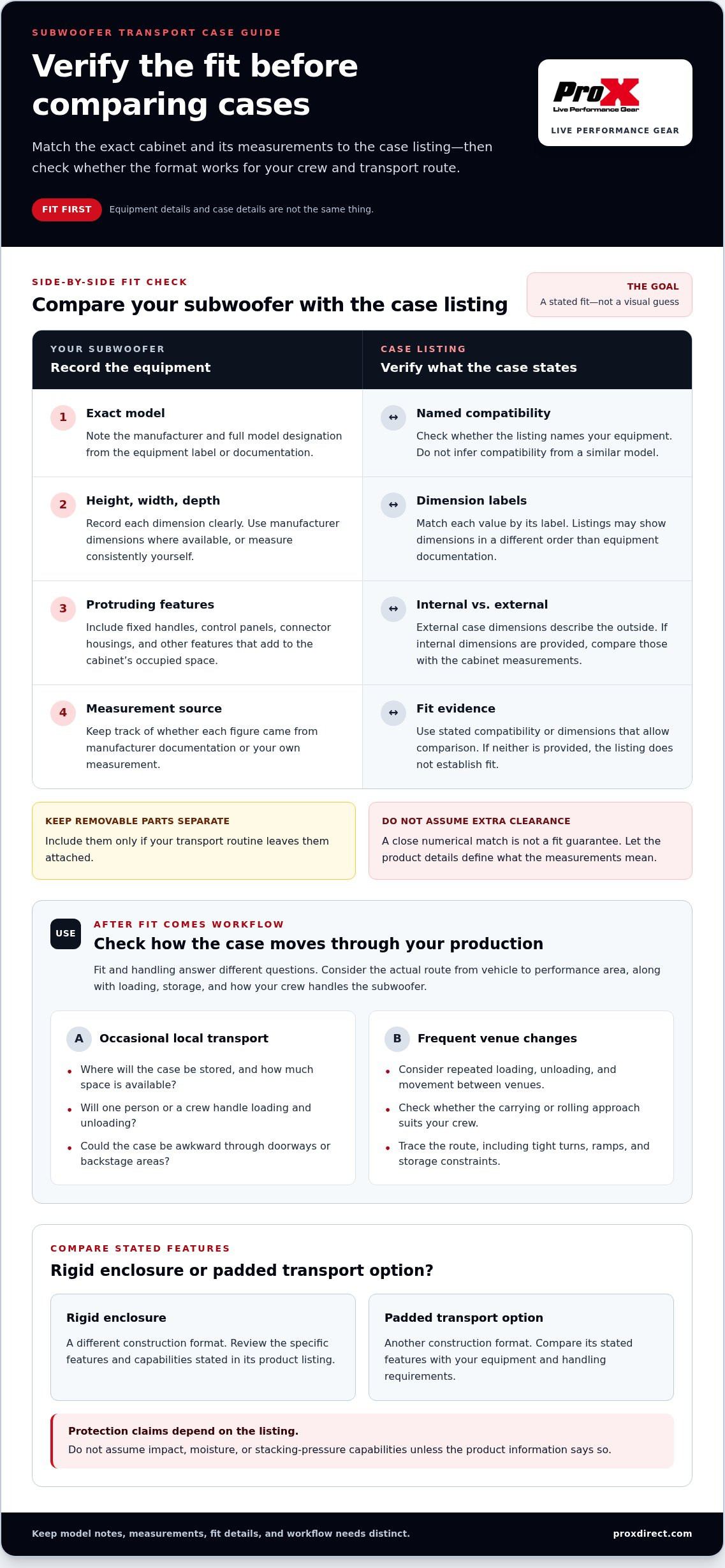
Follow a consistent sequence before comparing products: identify the exact subwoofer model, record its dimensions, then compare them with the case listing. This prevents a broad product name or similar-looking cabinet from standing in for verified compatibility. Treat a subwoofer transport case as a fit only when the applicable listing states compatibility or provides dimensions you can compare with the equipment.
- Identify the model. Record the manufacturer and full model designation from the equipment label or documentation. If the cabinet has been modified, note any changes that affect its overall dimensions.
- Gather the measurements. Find the manufacturer’s published dimensions where available. If you measure the cabinet yourself, use a consistent method for height, width, and depth, and label each measurement clearly.
- Compare the listing. Check the case’s stated fit information and dimensions. Confirm whether each measurement describes the equipment it accommodates or the exterior of the case.
Which subwoofer dimensions should you record?
Record height, width, and depth at the cabinet’s widest or tallest points. Include fixed features that add to the space it occupies, such as handles, control panels, connector housings, or other projections. Treat removable components separately, and only if your transport routine actually removes them. Note the source beside each measurement, such as manufacturer documentation or your own measurement, so you don’t mix figures from different models.
Check the measurement orientation too. A listing may present dimensions in a different order from the equipment documentation, so match each value by its label instead of assuming the first number is height. For general guidance on preparing audio equipment for movement, packing home audio equipment offers relevant handling context, but it doesn’t establish fit for a specific case.
How should you compare measurements with a case listing?
Read the listing’s dimension labels closely. External case dimensions describe the outside envelope, not the space available to the cabinet. If internal dimensions are provided, compare them with your subwoofer measurements, including any fixed protrusions. If the listing names compatible equipment, use that information rather than inferring compatibility from a similar model or one matching dimension.
Don’t assume a clearance allowance or treat a close numerical match as a fit guarantee. Listings can present measurements in different ways, and the product details determine what those figures mean. When a listing doesn’t state compatibility or provide dimensions sufficient for comparison, it doesn’t establish a fit. Keep your model and measurement notes together as you browse Speaker & Subwoofer Cases, and compare the details in each relevant listing.
Rigid Case or Padded Transport Option: Which Suits Your Subwoofer?
Choose between a rigid case and a padded transport option by considering what the equipment and workflow require, not by assuming one format is always superior. Compare the stated fit, construction, carrying or rolling approach, and intended use. A subwoofer transport case should be assessed against its own listing because a format label alone doesn’t establish a particular protection level.
| Comparison point | Rigid case | Padded transport option |
|---|---|---|
| Format | Structured enclosure; assess the construction stated in the listing. | Cover or other padded format; assess the stated coverage and construction. |
| Stated fit | Use the listed compatible model or dimensions. | Use the listed compatible model or dimensions. |
| Handling approach | Check the listed carrying or rolling features, if specified. | Check the stated method for carrying or moving the equipment. |
| Workflow prompt | Does the production routine call for a structured enclosure? | Does the routine prioritize the listed carrying format and coverage? |
When might a rigid case fit the transport plan?
A rigid case may suit a workflow that calls for a structured enclosure during storage and movement. That preference doesn’t establish a particular material, impact rating, or other performance capability. Review the individual listing for construction details, stated fit, closures, and handling features. Base your decision on the attributes it actually describes and how they align with your production requirements.
When might a padded transport option be worth comparing?
A padded option is worth comparing when its carrying format and stated equipment coverage suit the crew’s routine. A transport cover isn’t automatically equivalent to a case. Its listing and construction determine what it is designed to cover, and padding alone doesn’t establish a defined protection level. Compare the specified features, then consider how the option will be carried, stored, and used between venues.
Keep the comparison practical. If a subwoofer is moved by hand through venue access routes, the stated carrying approach may influence your choice. If equipment is repeatedly loaded with other production gear, review the enclosure format and its described use. These are workflow considerations, not evidence that either format provides a particular level of protection.
The same evidence-led approach applies to flight case engineering principles: assess construction and stated features rather than relying on a category label. Compare options with your handling routine, and use the product details to understand what each case or cover is designed to support.
Build a Subwoofer Transport Checklist Around Loading and Storage
Start a case comparison with your production routine, not an assumption about a product feature. Record how the subwoofer is loaded, moved, and stored, then use that information to assess which listed format suits the job. Keep operational preferences, such as a preferred carrying approach, separate from product claims about construction or protection, which need to be supported by the applicable listing.
What should crews assess before moving a subwoofer?
Map the equipment’s route from storage to vehicle, then from vehicle to its position at the venue. Note who handles each stage, where the subwoofer is placed during transit, and how frequently it moves. A local DJ setup with occasional venue changes may follow a different routine from a touring production with repeated load-ins and load-outs. Document the workflow rather than assuming one case format suits every crew.
Include practical constraints that shape the move. Vehicle capacity affects how equipment is arranged, while venue access may involve narrow doorways, backstage corridors, ramps, or limited storage areas. Record these conditions alongside the handling method. They define what the case needs to accommodate operationally, but they don’t prove that a product has a particular rolling, carrying, or protective feature.
- Loading: Note how the subwoofer enters and leaves the vehicle and who handles it.
- Storage: Record the available space and how the enclosed equipment is positioned between events.
- Movement: Track how often it travels and the typical route through each venue.
- Handling: Describe the crew’s preferred way to move the equipment without assuming a feature the listing doesn’t state.
How can teams standardize case selection across a production?
For crews managing multiple subwoofers, keep one shared record for each model. Include the manufacturer and model designation, equipment measurements, measurement source, preferred transport format, and relevant case-listing details. If a listing names compatible equipment or gives dimensions, preserve that information in the record. This makes case selection more consistent across purchasing, storage, and event preparation.
Keep observations separate from verified product details. “Needs to pass through the venue’s narrow access route” is a workflow note. “Has a specified carrying feature” is a product claim, so include it only if the listing states it. This distinction helps the team compare options without turning a preference into an assumed specification.
For broader context, case engineering principles can help crews think about enclosure construction and intended use. Use this checklist as a final comparison tool:
- Does the listed fit information correspond to the recorded subwoofer model or measurements?
- Does the listed transport format align with the crew’s loading and movement routine?
- Can the case be stored within the available vehicle and venue space?
- Are protection and handling claims supported by the listing, rather than inferred from the format?
With the workflow documented, browse Speaker & Subwoofer Cases and compare each relevant listing against the checklist.
Find a Subwoofer Transport Case That Matches Your Requirements
A reliable shortlist follows a clear sequence: confirm the subwoofer model, compare its dimensions with the case’s stated fit information, then assess whether the transport format suits your production workflow. Keep those checks in order. Handling preferences can narrow the options, but they can’t replace product information that establishes equipment compatibility.
What details should you have ready when browsing listings?
Keep equipment and workflow information together so you can assess each option against the same requirements. Record:
- Equipment identity: The exact manufacturer and model designation.
- Published dimensions: The source and measurement labels, including whether the figures describe the subwoofer or the case.
- Transport routine: How frequently the equipment moves and how the crew loads and handles it.
- Storage constraints: The available space in vehicles, storage areas, and relevant venue locations.
Then review each listing for the specific information it provides. A compatible model name or stated dimensions can support a fit comparison. Treat construction, coverage, and carrying features as product attributes only when the listing describes them. Don’t turn a preference, such as wanting a particular way to move the equipment, into an assumption about what a case includes.
How do you move from requirements to a shortlist?
Set aside listings that don’t identify a compatible model or provide dimensions you can meaningfully compare with the equipment. This keeps your shortlist grounded in stated fit information, not visual similarity or a broad category label. If the listing gives measurements, distinguish the case exterior from figures that describe usable interior space.
Next, compare the remaining options with the crew’s priorities. A production storing equipment in a constrained vehicle may place greater weight on case dimensions and available space. A crew moving between venues may focus on the listed handling approach and the route from vehicle access to the performance area. These are selection criteria, not proof of a product feature or protection level.
Before deciding, review the listing alongside your workflow notes. The best-aligned option is the one whose stated fit and features meet your documented requirements without relying on unstated clearance, compatibility, or performance assumptions. If the requirements change, for example, because you use a different subwoofer model or storage arrangement, reassess the shortlist rather than carrying over the previous selection automatically.
Once you’ve defined the model, fit information, and handling priorities, browse subwoofer case options in the Speaker & Subwoofer Cases category. Compare relevant listings with your requirements, then select based on the details each one states.
Make Case Selection Part of Rig Planning
Include case selection in the rig’s equipment record so production teams have a consistent reference for storage, vehicle loading, and venue logistics. Keep the selected listing details with the subwoofer’s inventory information. That ties the case choice to the equipment rather than to a general format. If the rig changes, the record gives you a clear starting point for reviewing the selection.
ProX states “Manufacturing Cases Since 1984” and serves customers worldwide through a dealer network. Its Speaker & Subwoofer Cases category is a place to explore options once your requirements are defined. Compare the relevant listings against your rig’s needs and use their stated details to guide your selection.
Browse subwoofer case options and compare the listed fit and features with your equipment and production workflow.
Frequently Asked Questions
How do I choose the right transport case for my subwoofer?
Check the case’s stated fit against your equipment, then compare its listed handling features with your production routine. For example, a crew loading from a vehicle and moving through several venue spaces may prioritize a different carrying approach from a setup stored mostly in one location. Keep the listing details with the equipment record so a subwoofer change prompts a new compatibility check.
How do I measure a subwoofer for a transport case?
Measure the cabinet in its usual transport configuration and record height, width, and depth using the units shown in the case listing. Use a consistent orientation and label each measurement so the figures aren’t compared in a different order. If you measure the cabinet yourself, repeat any uncertain measurement and note the source, such as your own measurement or manufacturer documentation.
Are subwoofer cases universal?
No. Subwoofer cabinets can differ in footprint, control layout, handle placement, and connector location, including models within the same product range. Don’t assume a case identified for one model fits a similar-looking cabinet. If you replace a subwoofer, start a new compatibility check using its model information rather than relying on the previous equipment’s fit.
What is the difference between a subwoofer case and a padded transport cover?
A case is an enclosure, while a padded transport cover is a covering format. Construction and stated capabilities vary, so the category name alone doesn’t establish equivalent protection. Read the listing for specified coverage, closure, compatibility, and handling details. Check which parts of the equipment the description says are covered instead of assuming that a cover encloses the cabinet in the same way as a case.
Can I transport a subwoofer on its side?
Follow the subwoofer manufacturer’s transport instructions and the case listing, since there isn’t one orientation rule for every cabinet. Case dimensions alone don’t establish that sideways transport is appropriate. Check whether the documentation describes a permitted position and consider how that orientation affects access and handling during loading. If the equipment instructions don’t address side transport, don’t treat the case’s fit as approval to move it that way.
Do subwoofer transport cases come with wheels?
Some case listings may specify wheels or another rolling feature, but don’t assume every case includes one. Review the exact listing for its stated handling features and distinguish them from separate equipment used to move a case. If rolling isn’t specified, plan around the handling method the listing describes. Consider the route, including thresholds and vehicle access, when deciding whether a rolling format suits your setup.
How can I tell whether a case fits my exact subwoofer model?
Look for an explicit compatibility statement naming the full subwoofer model, or for case dimensions you can compare with the equipment. Match the complete model designation, including any suffix that distinguishes a version. A listing for a related model or product series doesn’t establish compatibility. Keep the case details with the equipment record so you can review the fit if the subwoofer is replaced or revised.
Disclaimer
Any trademarks, trade names or brand names appearing herein that do not belong to ProX are the property of their respective owners and/or companies, and such appearance doesn't and shall not constitute or imply endorsement, sponsorship or recommendation by ProX.


