

A trailer without suspension can still carry sensitive equipment over washboard roads, but the load needs careful management. Protecting gear in a trailer without suspension starts with placing heavier items low and slightly forward of the axle, centering the load from side to side, and securing it against movement in every direction.
Rough-road vibration can loosen restraints and transmit repeated impacts to cases and equipment. Careful packing cannot change the trailer’s suspension, but it can reduce unnecessary movement and help stabilize the load. The right restraint points and packing materials matter, especially when equipment could shift, collide, or press against the trailer during travel.
This guide explains how to balance trailer weight, maintain a low center of gravity, and restrain equipment on uneven terrain. It also covers ways to limit vibration, choose protective packing materials, and inspect the load and trailer during travel, so you can make practical adjustments before a small shift becomes a larger problem.
Key Takeaways
- Place heavier equipment low and slightly forward of the axle, while keeping the load centered from side to side.
- Account for all cargo and attachments within the trailer’s payload capacity, and secure equipment against movement in every direction.
- Use padding and edge protection to limit contact damage and reduce wear where straps meet the load.
- Choose tie-downs by their working load limit and attach them to approved securement points, not components that are not designed for cargo loads.
- Inspect the load and trailer during travel, especially if you notice unusual bouncing, sway, pulling, or noise.
Keeping the load’s center of gravity low
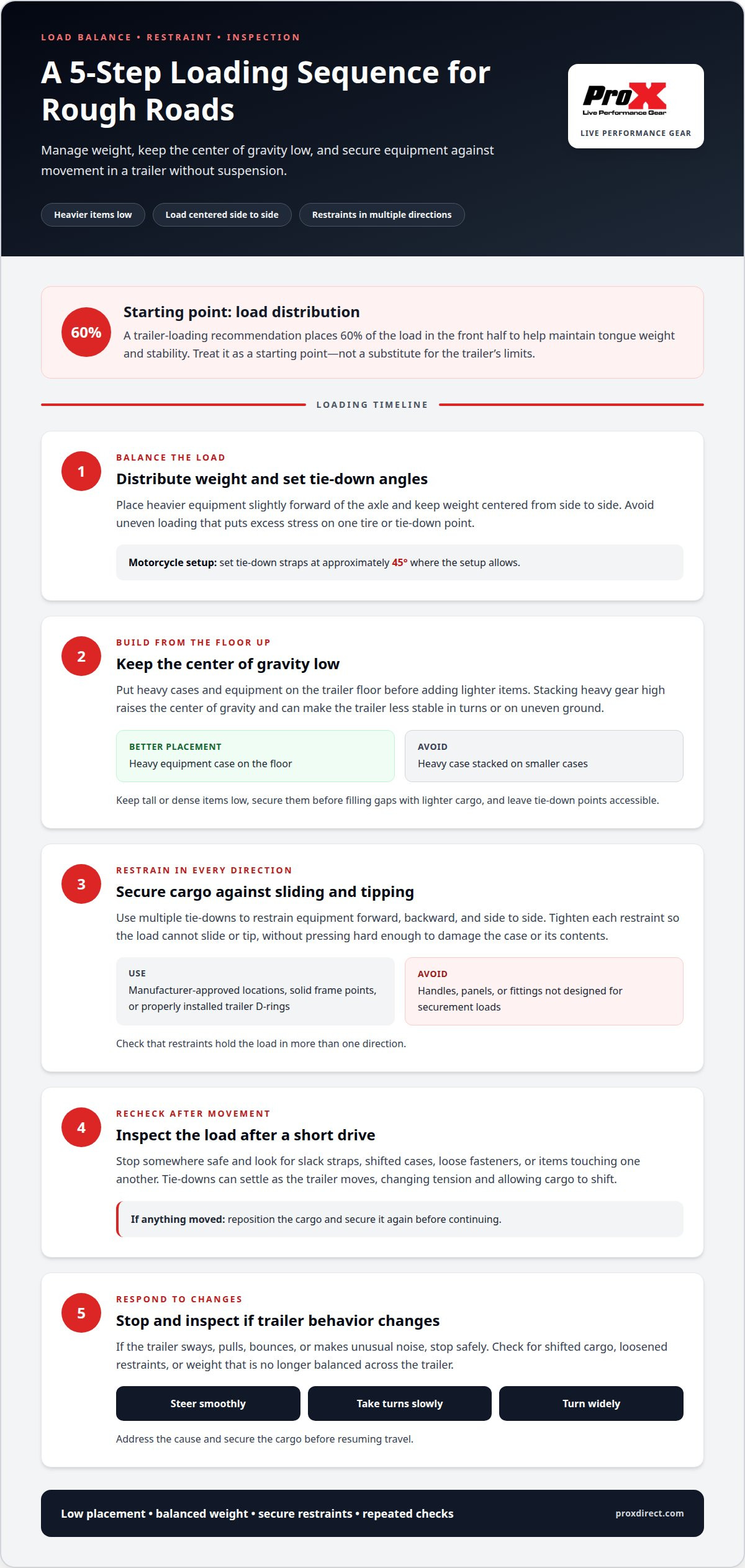
Use a deliberate loading sequence to balance cargo and limit movement during towing. Each item’s placement affects trailer stability, tongue weight, and tie-down performance.
-
Distribute the Load and Set Tie-Down Angles
Load heavier equipment slightly forward of the trailer axle, while keeping weight centered from side to side. A recommendation for trailer loading places 60% of the load in the front half to help maintain tongue weight and stability. Treat this as a starting point, not a substitute for the trailer’s limits. For a motorcycle, set tie-down straps at approximately 45 degrees where the setup allows. Avoid uneven loading that places excess stress on one tire or tie-down point.
-
Position the Load to Keep Its Center of Gravity Low
Place heavy cases and equipment on the trailer floor before loading lighter items. Stacking heavy gear high raises the center of gravity and can make a trailer less stable in turns or on uneven ground. Keep tall or dense items low and secure them before filling gaps with lighter cargo. For example, place a heavy equipment case on the floor, not on top of smaller cases. Keep tie-down points accessible.
-
Secure the Load Against Movement
Use multiple tie-downs to restrain cargo forward, backward, and side to side. Attach them to manufacturer-approved locations, solid frame points, or properly installed trailer D-rings. Avoid handles, panels, or fittings not designed to bear securement loads. Tighten each restraint so the equipment cannot slide or tip, without applying pressure that could damage the case or its contents. Check that straps restrain the load in more than one direction.
-
Inspect the Load After the Trailer Moves
After driving a short distance, stop somewhere safe to inspect the cargo and restraints. Tie-downs can settle as the trailer moves, changing tension and allowing movement. Look for slack straps, shifted cases, loose fasteners, or items touching one another. If anything has moved, reposition the cargo and secure it again before continuing. Even a stable load at departure needs inspection once travel begins.
-
Respond to Changes in Trailer Behavior
If the trailer sways, pulls, bounces, or makes unusual noise, stop safely and inspect it. Check whether cargo has shifted, a restraint has loosened, or the weight is no longer balanced across the trailer. Avoid abrupt steering while towing, and take turns slowly and widely. These steps help limit additional movement while you assess the load. Resume travel only after addressing the cause and securing the cargo.
Trailer weight and sensitive equipment
Calculate the complete loaded weight before towing. Equipment mass affects the trailer’s payload and the forces transmitted through its structure on rough roads. Protecting gear in a trailer without suspension starts with accounting for every item, not just the main equipment.
- Add the weight of every item and attachment. Include fuel, tools, cases, and other cargo, not just the primary equipment. The trailer’s payload capacity must account for the full load. For example, a production setup includes equipment, protective enclosures, cables, accessories, and accompanying tools. Leaving out small additions can make the estimated total differ from the actual loaded weight.
- Separate fragile equipment from heavier cargo before packing. Identify items with delicate controls, displays, connectors, or exposed components, then arrange them so heavier objects cannot press against them. For example, do not place a dense tool case against a mixer’s control surface. Restrain each sensitive item in its own space instead of relying on neighboring cargo to prevent movement.
- Consider how total mass changes the impact of rough roads. A trailer weighing 4,000-7,000 lb needs better suspension to help prevent bumps from damaging its frame. A 2,000-lb teardrop may be light enough to bounce over obstacles without much damage, but that example doesn’t establish a safe weight for every trailer. Construction, cargo, and road conditions also affect the load.
- Account for the mass of individual items, not only the trailer total. A motorcycle example illustrates the scale: the author’s Suzuki Bandit 1200 weighs more than 500 pounds when wet. Sensitive audio or lighting equipment may weigh less, but hard impacts can still stress connectors, housings, and mounted components. Treat each heavy item as a separate load that needs support and restraint.
- Match the packing arrangement to each item’s weight and vulnerability. Group compatible items, separate components that could collide, and keep loose accessories away from delicate surfaces. For example, contain small fittings rather than letting them move freely inside a larger equipment space. A snug arrangement limits contact between items, while restraints prevent the packed group from shifting over bumps.
- Reassess the load whenever equipment or supplies change. Adding fuel, tools, or production gear changes the total weight, even if the trailer layout looks familiar. A practical approach to protecting gear in a trailer without suspension accounts for every new item before departure. Compare the complete cargo load with the trailer’s payload capacity, then revise the arrangement if the added weight changes where sensitive equipment can go.
Washboard-road ride and vibration
Washboard surfaces send repeated impacts through the wheels and trailer frame. Use these steps to reduce cargo movement and spot signs of excessive vibration.
- Reduce speed and steer smoothly on corrugated sections. Repeated bumps can make an unsuspended trailer bounce, transmitting motion to its frame, fasteners, and cargo. Leave extra following distance behind the tow vehicle so you can slow gradually before rough patches. Avoid abrupt braking or steering, which can add lateral movement while the trailer responds to uneven ground.
- Watch how the trailer tracks behind the tow vehicle. A stable trailer should travel straight rather than sway or pull unexpectedly. If it bounces excessively, pulls, or makes unusual noise, stop somewhere safe and inspect it. Look for shifted cargo, loose fasteners, cracked panels, or uneven tyre wear. These signs may indicate repeated impacts or inadequate suspension.
- Inspect the trailer’s suspension components and mounting points before traveling on rough roads. Check for cracked welds, broken mounts, worn bushings, and damaged leaf springs. Standard leaf spring suspension can deliver harsh jolts and transmit more vibration through the trailer body. Also examine the frame and joints, where repeated impacts may loosen fasteners or crack panels.
- Understand how independent suspension changes wheel response. Each wheel can move with the terrain without directly affecting the other wheel. For example, if one wheel crosses a 6-inch rock, its movement doesn’t require the opposite wheel to follow the same path. This arrangement can help maintain tyre contact on uneven ground and reduce the impacts transferred to cargo and trailer components.
- Assess the route before deciding whether the trailer’s suspension is suitable. Gravel or washboard roads extending beyond 20 miles at a time are a reason to prioritize independent suspension. Suspension helps keep tyres in contact with uneven ground, reduces stress on the frame and joints, and limits cargo-damaging jolts. If the trailer repeatedly bounces or gear shifts after rough travel, treat that pattern as a warning, not a normal operating condition.
- Secure sensitive components so they cannot strike one another as vibration continues. Separate delicate equipment from hard accessories, and prevent loose items from moving inside their storage space. After a rough section, check for new contact marks, shifted equipment, or slack restraints. Reposition and secure affected items before continuing, because repeated impacts can worsen movement and stress.
Off-road suspension kits absorb impacts rather than transfer them, helping keep a trailer’s load stable and reduce structural fatigue. The page estimates independent suspension can improve stability and cargo protection by 50-70% on suitable terrain.
How to choose packing materials for transporting gear in a trailer
Choose materials according to each item’s surfaces, edges, and likely contact points. In an unsuspended trailer, packing should limit abrasion and keep equipment from striking nearby cargo.
- Start by identifying exposed controls, connectors, screens, handles, and corners. For example, a mixer may need protection around its control surface, while a lighting fixture needs clearance around protruding components. Choose padding that separates these vulnerable areas from hard cargo. Packing material should stay in place during loading and travel, rather than sliding away from the surface it protects.
- Cushion equipment from the trailer floor and walls. Foam pads, folded blankets, or other suitable protective layers can reduce direct contact with hard surfaces. Place material where a case or item could strike during bumps, such as beneath a heavy case or between a case and a side panel. Keep cushioning clear of tie-down hardware and access points.
- Separate items that could collide or abrade one another. For instance, place a divider between a metal stand and a finished equipment case. Keep small accessories in closed containers instead of loose beside delicate gear. This reduces direct contact and makes it easier to spot movement after rough travel.
- Protect exposed edges where restraints contact the load. Edge protection can help prevent tie-down straps from being cut or worn through during a trip. Place guards between straps and sharp corners, then confirm they remain aligned as the straps tighten. Do not position a guard where it could slip out or interfere with secure contact around the cargo.
- Choose material thickness and placement to avoid an unstable fit. Excess padding can compress or shift, while too little may leave hard contact points exposed. For example, fill the gap between two cases with a fitted divider instead of loose scraps that can move. Support each item without putting pressure on controls, connectors, or delicate housings.
- Keep packing materials clean, dry, and suitable for the surfaces they touch. Grit trapped beneath a pad can scratch a painted panel as it moves. Before loading, shake out reusable blankets and check foam or dividers for debris, tears, or flattened sections. Replace damaged material when it no longer separates equipment from nearby surfaces.
- After packing, apply controlled hand pressure to each item to test the arrangement. If a case shifts, add a fitted divider or adjust the padding before tightening restraints. Check that straps do not crush soft covers or press against delicate parts. After a rough section, look for scuffs, displaced padding, or new gaps at contact points, then correct the packing before continuing.
Your trailer
Inspect the trailer structure and securement hardware before loading sensitive equipment. A sound trailer and suitable attachment points help restrain cargo on rough terrain.
- Examine the frame, panels, mounts, and welds before each trip. Look for cracked welds, broken mounts, loose fasteners, and damaged panels. Repeated impacts can worsen these defects. Check the floor for damage that could affect case support, and inspect the suspension for worn leaf springs or bushings.
- Identify securement locations designed to carry cargo loads. Attach tie-downs to manufacturer-approved locations, solid frame points, or properly installed trailer D-rings. Avoid attaching straps to trim, light brackets, handles, or other components not designed for securement. A strong strap cannot compensate for an attachment point that shifts or fails under load.
- Read each tie-down’s working load limit before use. Assess securement capacity using that limit, not the breaking strength. Match the restraint to the cargo and its attachment points. For heavier loads with approved chain attachment points, chains and binders may be preferable to ratchet straps. Keep securement hardware compatible with the trailer and load.
- Choose restraints that control cargo in multiple directions. Ratchet straps, tie-downs, or nets can secure trailer cargo when attached correctly. Do not use bungee cords for this purpose, as they can stretch and break under tension. After tightening a ratchet strap, close and lock its handle. Fully secure chain binders so vibration cannot release them.
- Inspect the hitch and connections before towing. Confirm that the coupler is locked onto the hitch ball, safety chains are connected, the breakaway cable is attached, and trailer lights work. Check each essential connection between the tow vehicle and trailer methodically instead of relying on a quick glance from one position.
- If the trailer’s behavior changes, stop somewhere safe. Swaying, pulling, bouncing, or unusual noise can signal a problem with the trailer or its load. Inspect the securement and visible components before continuing. If a strap or binder has loosened, secure it again and check nearby attachment points for damage.
- Use a trailer case suited to the equipment’s handling and storage needs. For audio, lighting, or production gear, explore protective case options that provide a dedicated enclosure between the equipment and trailer environment.
Motorcycle loads call for a setup matched to the wheel chock and approved securement points. A motorcycle trailer business commenter recommends using two 2-inch straps at the rear, pulling the motorcycle forward into the wheel chock. Judge each restraint by its working load limit, not its breaking strength; elastic bungee cords are unsuitable because they can stretch and break under tension. After tightening ratchet straps, close and lock each handle, and make sure any chain binder is fully secured so vibration cannot release it.
After departure, check that a trailered motorcycle remains stable after the first fifteen minutes of travel. For a longer-term purchase, the page recommends independent suspension for buyers who plan to keep a trailer for at least 5 years.
Protective Storage
Protective storage helps production teams choose enclosures for equipment transported in trailers on rough roads. Cases and storage options provide dedicated enclosures for gear, while workstations support organized equipment handling. The right format depends on the equipment, its dimensions, and how it needs to be packed and secured. Protective storage complements careful load distribution, suitable tie-downs, and regular inspections; it does not replace them.
Available options include protective cases, transport cases, utility and storage cases, and workstations. Consider these options when loose or exposed equipment needs a more structured transport setup, or your current packing leaves gear vulnerable to contact with other cargo. Contact a protective storage supplier to discuss storage for the equipment you transport.
Make Your Transport Setup Repeatable
Make your loading approach a repeatable production workflow. Record how equipment is arranged, note which items need dedicated protection, and keep the plan with your transport checklist. This makes consistent preparation easier when crew members, cargo, or venues change. A practical system for protecting gear in a trailer without suspension accounts for the equipment and the demands of each trip, rather than relying on improvised packing at departure.
For equipment that needs a dedicated enclosure or organized storage, storage options include protective cases, truck pack cases, and utility or storage cases. Choose a storage format suited to the gear and how your team handles it. These options support a more structured setup alongside sound loading and securement practices.
Set your next load up with a clear equipment plan and suitable protective storage. Contact us for trailer advice and take the next step toward a more consistent transport process.
Frequently Asked Questions
How to protect cargo in a trailer with no suspension?
Protect cargo by placing each item in a case, preventing movement inside it, and securing the case so it cannot slide or tip. Place heavier cases low and near the trailer axle, with lighter items around them, and balance the load side to side. For protecting gear in a trailer without suspension, use fitted cushioning around delicate equipment and fill empty space so items cannot shift and strike the case in transit.
How to reduce vibration and shock in an unsuspended trailer?
Reduce shock transferred to equipment with cushioning beneath cases and between items, while keeping every case firmly secured. Use padding that stays in place under load instead of loose material that can bunch up or leave gaps. Avoid stacking fragile equipment beneath heavy cases. Check tire pressure against the trailer manufacturer’s guidance, since incorrect pressure can affect its response to road impacts. Cushioning limits movement but cannot eliminate road shock.
How to secure fragile equipment in a trailer?
Place fragile equipment in a case sized for it, then secure the case to the trailer so it cannot slide, tip, or collide with other cargo. Keep accessories and cables from pressing against delicate surfaces, and use stable padding to prevent internal movement. For equipment with unusual dimensions, custom-built cases can be designed for specific equipment dimensions and protection requirements. Confirm the equipment and case are immobilized before the trip.
Prices, specifications, and images are subject to change without notice. We are not responsible for typographical or illustrative errors.
Disclaimer
Any trademarks, trade names or brand names appearing herein that do not belong to ProX are the property of their respective owners and/or companies, and such appearance doesn't and shall not constitute or imply endorsement, sponsorship or recommendation by ProX.


