

A case that fits one deck isn’t automatically suitable for two. A road case for a pair of Technics 1200 turntables needs enough usable interior space for both units, with foam that holds them securely without pressing on controls or exposed components. Dimensions, layout and protective hardware all affect the fit.
It’s reasonable to start with the turntable model, but model compatibility alone doesn’t settle the question. You also need to account for the case’s interior dimensions, lid depth, foam configuration and loaded weight, then assess how its panels, corners, latches and handles are built for handling.
This guide explains how to assess those details before choosing a case. It covers turntable fit, measuring usable space, checking foam support and retention, and evaluating construction and hardware. Use these checks to judge whether a case can hold both turntables in the arrangement you need and suit your transport setup.
Key Takeaways
- Assess whether the interior layout can accommodate both full-size turntables, including their height and any components that need clearance.
- Use interior dimensions to judge fit, and consider exterior dimensions and case weight separately when planning handling and storage.
- Evaluate foam by how it supports and retains the equipment without putting pressure on controls or exposed components.
- Look beyond the ATA-300-style design: panel construction, corners, latches, handles and feet all contribute to the case’s protective structure.
- Compare the case’s materials and hardware with the handling demands of your transport setup before choosing a configuration.
ATA-style flight and road case construction
The best cases for transporting two Technics 1200 turntables provide a compartment layout that fits both decks and limits movement. Choose an ATA-300-style case with suitable internal support, protective hardware, and enough space for the actual equipment configuration.
In the United States, the cost of a dual-turntable case depends on its dimensions, materials, interior layout, and hardware. Those specifications define the build and distinguish a basic enclosure from a case configured for specific equipment.
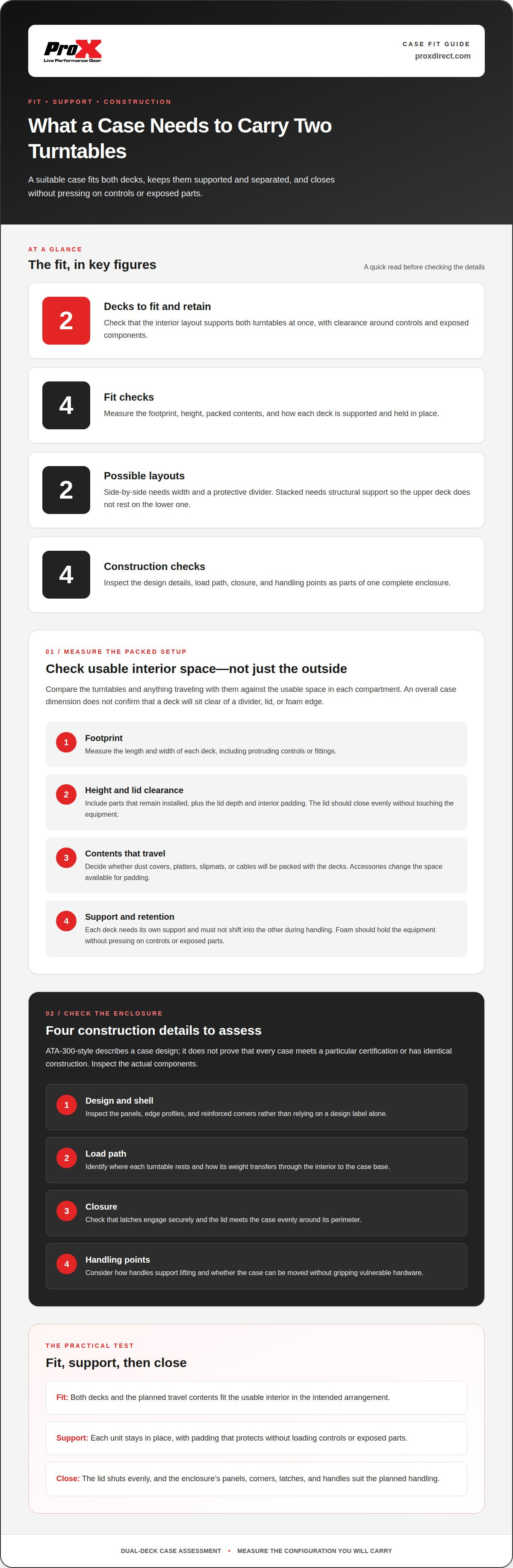
ATA-300-style describes a case design, not proof that every case meets a particular certification or has identical construction. Assess the enclosure by its components: panels resist external contact, edge profiles protect panel joints, and reinforced corners help manage impacts during handling. Latches keep the lid closed, while handles provide controlled lifting points.
For two decks, the layout matters as much as the outer shell. Side-by-side placement requires enough interior width for both turntables and a protective divider. Stacked placement requires a structural support that carries the upper deck without placing its weight on the lower one. In either layout, the lid must close without touching controls or exposed parts.
Use this sequence to assess the construction before choosing a case:
- Confirm the design: Treat ATA-300-style construction as a useful design description, then inspect the actual panel, edge, corner, and closure details.
- Map the load path: Identify where each turntable rests and how its weight transfers through the interior to the case base.
- Inspect the closure: Check that latches engage securely and that the lid meets the case evenly around its perimeter.
- Review handling points: Consider how the handles support lifting and whether the case can be moved without gripping vulnerable hardware.
A road case for a pair of Technics 1200 turntables should be evaluated as a complete enclosure, not by a construction label alone. For example, a rigid shell cannot compensate for a layout that lets either deck shift, while secure retention cannot make up for a lid that presses on the equipment. Match the interior arrangement to the two-deck configuration, then evaluate how panels, joints, corners, closures, and handles work together. That method gives the construction assessment practical value without treating a style description as a guarantee of performance.
Choose a dual-deck ATA-style case with an interior that supports both turntables securely and leaves enough clearance around controls and exposed parts. Assess the panels, joints, corners, latches and handles together, since they all contribute to the case’s construction.
Proper foam lining absorbs transport shock and cradles the decks while preserving their protective separation. ProX has manufactured flight and road cases since 1984, a history that identifies its experience in this product category but does not replace inspection of a particular case. Compare the interior dimensions and restraint points with the turntables, and check that padding cannot obstruct controls or prevent an even closure. Confirm that the completed case can be lifted and moved using its intended handles.
Compatibility with Technics SL-1200-size turntables
In the United States, look for a case supplier that specifies a two-deck layout for full-size turntables. A description naming Technics SL-1200-size compatibility is more useful than a generic turntable-case label.
The T-TTBL case is designed for full-size 1200-style turntables, including Technics models. That compatibility statement describes a turntable fit, so it should not be read as proof that one case holds two decks. A pair requires a layout that accommodates both units at once.
Start with the packed equipment configuration. Measure each turntable, including any parts that stay attached during transport. Compare those measurements with the usable space in each compartment, not the case’s overall dimensions. A deck may fit through an opening but still hit a divider, lid or foam edge when seated.
Decide how you will carry the two turntables. Side-by-side placement needs enough width and separation between the Technics units. Stacked placement needs separate support for each deck so the upper turntable does not rest on the lower one. Check that the case’s description or interior layout specifies the arrangement it is designed to hold.
- Measure the footprint: Record the length and width of each SL-1200-size turntable, including protruding controls or fittings.
- Measure the height: Include the parts that remain installed, then account for the lid and any interior padding.
- Review the contents: Decide whether dust covers, platters, slipmats, or cables travel inside the same case.
- Assess retention: Confirm that each deck has its own support and cannot shift into the other unit during handling.
Accessories can affect the fit. A dust cover changes the turntable’s outer profile, while a loose cable can take up space needed for padding. Decide which components will travel with the decks, then assess the complete packed setup rather than measuring the turntables alone.
A road case for a pair of Technics 1200 turntables should explicitly accommodate two full-size decks, with space for their actual travel configuration. Treat compatibility with one Technics SL-1200-size turntable as a starting point, not a guarantee of dual-deck capacity. The decisive details are the internal layout, clearance, and support for each unit. These checks distinguish a case sized for a single turntable from one designed to carry both.
Look to a United States case supplier that clearly offers a road case for two full-size turntables and describes its internal layout. Confirm that the configuration supports both Technics 1200-size decks and the parts you plan to transport with them.
Exterior dimensions and weight
Separate interior dimensions, exterior dimensions, and shipping measurements before assessing a turntable case. Each describes a different constraint: equipment fit, storage clearance, or package handling. The reference turntable-case dimensions are 18.00 inches long by 15.00 inches wide by 4.30 inches high inside, plus a 3.00-inch lid.
Those specifications describe a turntable case, not a confirmed two-deck layout. Don’t treat its 18.00-by-15.00-inch interior footprint as proof that two Technics 1200 turntables fit together. For a pair, assess the specified internal layout and usable space for both units. A case’s outer size cannot establish how much room remains inside after panels, padding, and dividers are accounted for.
Interior height also needs careful interpretation. The listed 4.30-inch interior height and 3.00-inch lid are separate measurements, not a single clearance figure. The lid’s depth contributes to the closed case profile, but it does not necessarily provide usable equipment space. Assess the deck’s height against the case interior and the lid clearance independently. Controls or other raised parts can affect whether the lid closes without contact.
Exterior dimensions matter at the venue, in storage, and during vehicle loading. A 21.00-inch length and 17.00-inch width define the reference case footprint, while its 9.00-inch height affects stacking and clearance. Compare those dimensions with the available storage opening or transport compartment. Check orientation as well: a case that fits lengthwise may not fit when turned across a shelf or vehicle bay.
- For equipment fit: Use the 18.00-by-15.00-inch interior footprint and 4.30-inch height as reference measurements, not as dual-deck specifications.
- For clearance: Use the 21.00-by-17.00-by-9.00-inch exterior dimensions when assessing storage or vehicle space.
- For handling: Account for the 19.00-pound case weight separately from the packed equipment weight.
Shipping measurements differ from the case’s built dimensions. Use these package figures for shipment planning, rather than substituting the 21.00-by-17.00-by-9.00-inch exterior measurements. The 19.00-pound figure describes the case itself; the shipping weight describes the packaged shipment.
For a two-turntable setup, compare the case’s stated internal capacity with both decks, then check its external footprint and handling weight. Keep the 18.00-by-15.00-inch interior and 19.00-pound weight in context: they are reference figures for a turntable case, not specifications for carrying a pair.
High-density foam interior
Pack each Technics 1200 flat in its assigned compartment, with foam supporting the base and preventing side-to-side movement. Keep the lid clear of controls, tonearms, and other raised components. The foam should retain each turntable without forcing pressure onto vulnerable parts.
Foam thickness alone does not determine fit; contact points matter. The interior should support stable areas of each turntable’s base without obstructing delicate components. Check both positions separately. A divider should separate the decks without pressing against either one or reducing necessary clearance.
High-density foam can support and cushion equipment, but it must fit the turntable’s shape. Oversized cavities may allow movement; tight ones may make loading difficult or press against controls. Assess the full profile, including parts that remain attached during transport. The lid should close without compressing protruding components.
Use this packing sequence for a pair of decks:
- Prepare the turntables: Remove loose accessories from the equipment surface and secure components according to their design.
- Position each deck: Place one turntable in each designated cavity, with its base resting on the foam support.
- Assess retention: Check for side-to-side movement and contact between the deck, cavity walls, and divider.
- Close the lid carefully: Confirm that it seats without pressing on the tonearm, controls, or other raised parts.
Give accessories their own defined storage space. A loose cable beside a Technics deck, for example, can shift during handling and hit the turntable. Use a separate pocket or compartment if the case has one. Do not use a cable or loose padding in place of fitted support.
Foam material information can also help assess the interior. Of the recycled content in case foam, 80% comes from recycled plastic bottles. Hard rubber foams contain 70% recycled content. These figures describe recycled content, not cavity dimensions or the amount of cushioning around a particular turntable. Fit still depends on the layout and the way each deck is supported.
For two turntables, the interior should have separate positions that hold both units without transferring pressure between them. Check the divider, side supports, base contact and lid clearance together. A secure fit keeps each deck in place while leaving space around sensitive components. If either deck shifts or the lid touches raised parts, the packed arrangement is not suitable.
Protective case materials and hardware
For air travel, prioritize a rigid enclosure, secure closures, and interior support that prevents turntable movement. A case with 3/8-inch plywood panels, protective feet, and reinforced attachment points offers concrete construction details to assess.
Panel material forms the main enclosure. A turntable case made with 3/8-inch plywood has a defined panel thickness; the full protective structure also depends on how its edges and corners are assembled. Examine whether the panels meet securely and whether corner hardware shields exposed joints. Construction details matter because impacts can reach edges and seams as well as broad panel faces.
Hardware has specific functions. Four industrial-grade rubber feet lift the case base off the floor when set down and provide stable contact points. Dual anchor rivets reinforce attachment points in the case structure. Before loading equipment, check that the hardware is secure and shows no visible damage.
Use a practical inspection sequence:
- Review the panels: Confirm that the enclosure uses 3/8-inch plywood and inspect the panel joints for gaps or damage.
- Check the feet: Look for all four industrial-grade rubber feet and ensure each sits firmly against the base.
- Assess the anchors: Inspect the dual anchor rivets for secure attachment and surrounding material integrity.
- Test the closure: Close the case and confirm that its latches hold the lid in position during handling.
Rubber components and foam have separate roles. The four feet contact the ground, while interior foam supports the turntables. Hard rubber foams in the case contain 70% recycled content. That material figure describes recycled content, not impact performance or foam fit. Evaluate the interior support and the external hardware as distinct parts of the protection system.
Air travel can involve lifting, setting down and moving the case between locations. A rigid shell helps shield equipment from external contact, while secure hardware and fitted interior support address different risks. No single feature replaces the others: plywood panels cannot stop a deck shifting inside, and foam cannot shield exposed panel edges from direct contact.
Choose construction details that work together: 3/8-inch plywood, four stable rubber feet, securely fixed anchor rivets, effective latches, and interior support suited to the equipment. For a closer look at protective case options, consider how each case’s materials and hardware align with your handling requirements. Examine the completed enclosure, not just one material specification, before selecting protection for two turntables.
The case has 4 industrial-grade rubber feet. When assessing this feature, check each foot at its attachment point and look for looseness, visible wear, or damage before travel. Consider whether the feet sit evenly when the case is placed down, rather than relying on the material description alone. A careful check helps establish that the case can be set down and moved as intended. Reinspect the feet after handling, and address any concern before loading equipment. Treat them as one part of the overall protection system, alongside the enclosure, closures, and interior support.
Racks & Case Accessories
Racks & Case Accessories are available for production equipment, alongside cases for transport, truck packs, and utility/storage. These offerings are relevant when your setup needs more than turntable protection, such as organized storage for related equipment or cases for other production gear.
For a pair of 1200 turntables, base your choice on the fit, interior support, dimensions, materials, and hardware covered above. Explore case options when comparing equipment protection and storage needs. Contact your case supplier to discuss the requirements for your setup.
Build a repeatable transport workflow
Choose a road case for a pair of Technics 1200 turntables as part of a consistent equipment workflow, not as an isolated container. A defined packing routine helps crews return each deck to the same position after use and reduces variation between setup and teardown.
Give the case a clear role in your inventory. Keep its contents and handling responsibilities consistent across events, and make sure everyone moving it understands the intended packing arrangement. This helps keep handoffs between storage, transport and production straightforward.
Consider how the turntables fit into your broader equipment plan. If your setup also requires cases for other gear or organized storage, choose options that suit the same handling process. A consistent approach makes equipment easier to protect and manage from one event to the next.
Set the case requirements around your workflow, then take the next step with Contact ProX about your case needs. A clear equipment plan makes the right configuration easier to define.
Frequently Asked Questions
What are the dimensions and weight of two Technics 1200 turntables in a case?
Don’t double these figures to estimate a dual case.
Are dual Technics 1200 cases compatible with SL-1210 and newer 1200 models?
A case described as fitting full-size 1200-style turntables includes Technics models, but that description alone doesn’t establish compatibility with every SL-1210 or newer 1200 revision. Nor does single-turntable compatibility establish capacity for two decks. Fit depends on the specific turntables’ dimensions, attached components, and the case’s internal layout. A dust cover or other installed accessory can also change the packed profile and required clearance.
Where can I buy a road case for two Technics 1200 turntables in the United States?
Look to a United States case supplier that clearly offers a road case for two full-size turntables and describes an internal layout that supports both Technics 1200-size decks and the parts you plan to transport.
Disclaimer
Any trademarks, trade names or brand names appearing herein that do not belong to ProX are the property of their respective owners and/or companies, and such appearance doesn't and shall not constitute or imply endorsement, sponsorship or recommendation by ProX.


