
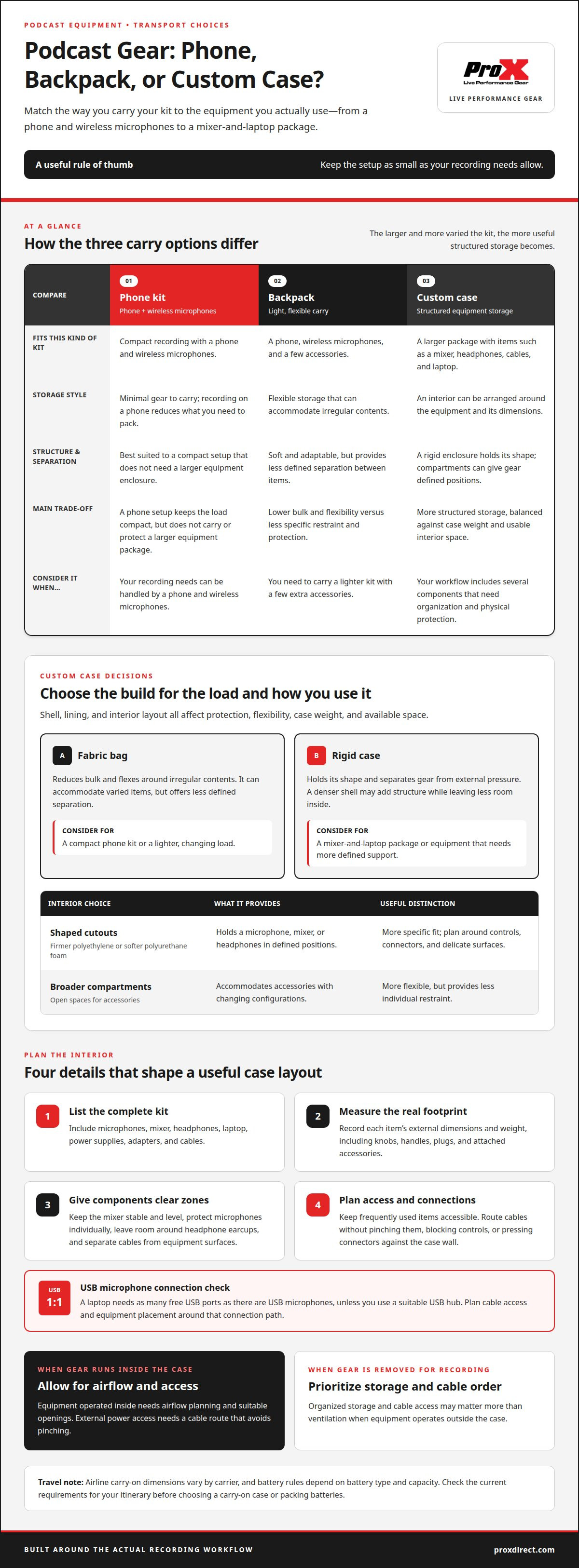
A phone with wireless microphones can handle a compact podcast recording, but it does not provide the carrying capacity or physical protection a larger equipment package needs. A custom case for a mobile podcasting setup makes more sense when you carry a mixer, headphones, cables, and a laptop. For a lighter kit that needs to stay portable, a backpack may be more suitable.
Choose the smallest setup that meets your recording needs. Recording on a phone reduces what you need to carry; a case or backpack helps organize and transport the extra components a more involved session requires.
This comparison explains how recording on a phone with wireless microphones differs from carrying podcast equipment in a case or backpack. It covers practical trade-offs, including which equipment you need, how to pack it, and what to consider when planning a custom case layout. The goal is a transport solution that suits your actual recording workflow, without adding unnecessary bulk.
Key Takeaways
- Match the transport option to the recording kit: a phone and wireless microphones suit a compact setup, while a larger equipment package calls for more structured storage.
- Prioritize protection, organization, and practical access when deciding what a custom case needs to accommodate.
- Give a case designer complete equipment dimensions and weight so the proposed fit reflects the actual load.
- Choose materials and interior protection according to how the equipment will be handled and transported.
- Plan the layout around the recording workflow, with dedicated space for microphones, mixer, headphones, cables, and laptop.
Cases and backpacks for podcast equipment
A backpack favors low weight and flexible storage for a phone, wireless microphones, and a few accessories. A case provides a more structured enclosure for a mixer, laptop, headphones, and cables, with an interior arranged around the equipment.
Custom Case Materials for Travel
Case construction balances shell material, protective lining, and the conditions in which you transport the equipment. Fabric bags reduce bulk and flex around irregular contents, while a rigid case holds its shape and separates gear from external pressure. Choose based on the load: a compact phone kit has different support needs from a mixer and laptop package.
For a custom case, a designer matches the enclosure and interior to the equipment’s dimensions, weight, and handling needs. Material choice also affects the case’s weight and usable interior space. A dense shell may add structure but leave less room for equipment, while a softer bag can accommodate varied items but offer less defined separation.
Foam Types and Cutout Options
Common interior choices include firmer polyethylene foam and softer polyurethane foam. A case designer can use shaped cutouts to hold a microphone, mixer, or headphones in defined positions, or broader compartments for accessories with changing configurations. Cutouts provide a more specific fit; open compartments offer flexibility but less individual restraint.
Foam thickness and spacing affect how equipment sits inside the enclosure. The design should account for controls, connectors, and delicate surfaces, not just the equipment’s outer dimensions. For example, a microphone compartment needs room for the body and attached components, while a cable compartment should keep loose leads from pressing against a mixer.
Microphone, Mixer, and Accessory Layouts
A useful layout separates the mixer, microphones, headphones, cables, and laptop into accessible zones. The mixer often benefits from a stable, level compartment; microphones need individual protection, and headphones need space that avoids pressure on their earcups. Dedicated cable storage limits tangling and keeps connectors from contacting equipment surfaces.
For USB microphones, the laptop needs as many free USB ports as there are microphones, unless you use a suitable USB hub. A designer can account for that connection path when planning cable access and equipment placement. The layout should also provide a clear route for cables without forcing connectors against the case wall or blocking essential controls.
Custom cases differ from standard cases because the interior can be planned around specific equipment and accessories. Rack cases suit equipment designed for rack mounting, organizing compatible units vertically, while a general custom case can accommodate a mixed podcast kit. A standard case offers a simpler, general-purpose fit but may not provide a dedicated position for every component.
A designer measures each item’s external dimensions and weight, including protruding knobs, handles, plugs, and attached accessories. Those measurements inform internal clearance, compartment placement, and the case’s exterior footprint. The design balances fit, protection, access, and transport requirements before construction begins.
Airline carry-on dimensions vary by carrier, and battery rules depend on battery type and capacity. Confirm the current limits for your itinerary before choosing a carry-on case or packing batteries. The case’s exterior size and the battery’s identifying specifications determine which requirements apply.
There is no single United States price for a custom mobile podcast equipment case. The cost depends on the case dimensions, construction materials, interior design, hardware, and access features. A more complex layout or specialized requirements change the scope of the build, so the equipment list and intended use shape the specification.
Ventilation, power, and cable access depend on whether equipment operates inside the case or is removed for recording. Operating equipment inside requires airflow planning and suitable openings; external power access requires a route that protects cables from pinching. If you use equipment outside the case, storage and organized cable access may matter more than ventilation.
What features should a custom case for a mobile podcasting setup include?
A useful case protects equipment and supports your recording workflow. First, list the full load: microphones, mixer, headphones, laptop, power supplies, adapters, and cables. Then define how each item should be stored, accessed, and connected. A case designed around that list can prevent loose accessories from pressing against delicate controls or connectors.
Start with the enclosure. Its size and construction should suit the equipment dimensions, total load, and expected handling. A rigid structure helps maintain a defined shape around fragile gear, while a softer bag offers flexibility for a lighter, changing kit. Choose handles and latches suited to how you will carry and open the case. Hardware should remain accessible when compartments are full.
Interior organization matters just as much. Use fitted areas for items that should not shift, such as a mixer or microphone, and a separate compartment for adapters and cables. Removable dividers can accommodate equipment changes, while shaped foam suits a stable inventory. Leave clearance around knobs, screens, and connectors. The fit should hold gear without pressing on controls or delicate surfaces.
- Equipment access: Position frequently used microphones, headphones, and cables where they can be removed without lifting heavier components.
- Connection paths: Plan openings for cables only when equipment needs to operate inside the enclosure; otherwise, protect connectors during storage.
- Power: Reserve space for the actual power supplies and batteries in the kit, keeping them separated from controls and cable ends.
- Identification: Use clear labels or marked compartments to distinguish similar adapters and leads during setup.
A custom case for a mobile podcasting setup should reflect whether you record inside or outside the enclosure. Operating a mixer inside a closed case raises airflow and cable-access considerations. If you remove equipment before recording, prioritize a secure fit, clear compartment access, and efficient repacking instead. Avoid openings or features your workflow does not require.
Before design begins, a case designer uses equipment dimensions, weights, connector positions, and handling requirements to plan the interior. Include accessories that travel with the core devices, not just the main equipment. For example, a laptop compartment needs clearance for its power supply, while a microphone area should account for its case or clip if those travel together. These details shape usable space and access.
For a setup that needs a purpose-planned enclosure, review case options for production equipment alongside the design requirements. Match the case structure, internal organization, and access features to the complete recording load, rather than selecting features by appearance alone.
What equipment dimensions and weight should I measure before ordering a podcast case?
A case designer needs your complete equipment inventory, not just the mixer and microphones. Include the laptop, headphones, power supplies, adapters, cables, stands, and protective covers that travel with the setup. This information helps plan interior space, compartment placement, and the case’s overall load.
For each item, record its length, width, and height in its normal transport configuration. Include protruding knobs, connector housings, handles, feet, and attached antennas. Measuring a mixer without its control knobs, for example, gives an incomplete footprint. A microphone with a clip or transmitter attached may also take up more space than its bare body.
Weight matters as much as dimensions. Provide the weight of each component and the combined equipment load, including accessories stored in the same enclosure. A laptop power supply or dense mixer can shift the load distribution, affecting compartment support, handle placement, and carrying balance.
- Microphones: Include microphone bodies, clips, windscreens, transmitters, and any protective sleeves.
- Mixer and interface: Record the full exterior dimensions, including controls, sockets, and attached rack fittings.
- Laptop and headphones: Include the laptop power supply and headphone case if those items travel together.
- Cables and adapters: Describe their quantity and approximate packed form, such as coiled leads or a small accessory pouch.
- Power equipment: List batteries and power supplies separately, with their dimensions and weights.
Configuration affects measurements. If a stand folds for transport, provide its folded dimensions; if it remains attached, the designer needs its assembled footprint. Also note whether microphones travel in their own sleeves or beside other equipment. These details determine whether the case needs separate compartments or a shared storage area.
Use consistent units throughout the inventory, and label each measurement clearly. For example, identify which figure is length, width, or height instead of sending three unexplained values. Manufacturer model numbers, product manuals, and photographs can help a designer identify connectors and protrusions. They supplement measurements, but do not replace the actual configuration you plan to pack.
If you cannot measure an item accurately, provide its exact model name and make it available for professional assessment. A case designer can then account for its outer profile and intended orientation. This is especially useful for unusual equipment, such as a mixer with side-mounted connectors or a microphone with a fixed mounting bracket.
Finally, describe the recording workflow for the custom case for a mobile podcasting setup. Specify which components must remain accessible, which travel separately, and whether any equipment operates inside the enclosure. A case designer can combine that workflow with the dimensions and weight to establish clearances, layout, and handling requirements before construction begins.
What are the best custom case materials for protecting podcast equipment during travel?
The right material depends on equipment weight, handling conditions, and the protection your setup needs. A rigid case and a padded backpack solve different transport problems. Compare the outer shell, edge protection, hardware, and lining as a system, rather than choosing material by appearance alone.
Plywood with a durable laminate surface is a common choice for rigid equipment cases. Its panels create a defined enclosure for items such as a mixer, interface, and laptop. A protective outer surface helps resist routine scuffs, while the structured shell separates stored equipment from external contact. Panel thickness, internal supports, and case size affect overall weight and usable space.
Molded plastic offers a different balance. Its continuous shell can suit compact kits that benefit from a formed enclosure, such as wireless microphones, adapters, and small recording devices. The shape and wall design determine how much space remains inside. Check how the interior accommodates your actual equipment, since a molded shell may be less adaptable to unusually shaped components.
A fabric backpack prioritizes portability and flexible storage. Padded compartments can separate a phone, headphones, microphones, and cables without the footprint of a rigid enclosure. However, soft walls can compress under external pressure. For a kit with a heavy mixer or sensitive controls, pay particular attention to the backpack’s structure and compartment arrangement.
Metal components often supplement rather than replace the main shell material. Corners, handles, latches, and edge sections contribute to how the case is assembled and handled. Their placement matters: a handle should support the loaded case, and latches should close without interfering with connectors or protruding controls. A case designer selects hardware suited to the case dimensions and expected load.
- For a heavier mixed kit: Consider a rigid shell with internal support and separate storage for loose accessories.
- For a compact recording package: A padded backpack can reduce bulk and keep frequently used items accessible.
- For changing equipment: A case design with adaptable internal organization can accommodate different component shapes.
- For frequent handling: Give attention to corners, handles, latches, and the surfaces most exposed to contact.
Interior material also affects protection. Foam can cushion equipment and keep components from shifting, while dividers create separate zones for items such as headphones and adapters. The fit should protect equipment without pressing on knobs, screens, or cable sockets. A designer balances foam selection, compartment geometry, and shell construction against the equipment inventory.
For a custom case, specify whether you prioritize reduced carrying weight, a rigid enclosure, flexible storage, or a combination. Choose material that supports your podcast kit and its handling conditions, without adding unnecessary structure or sacrificing useful interior space.
How should a mobile podcast case be laid out for microphones, mixer, headphones, cables, and laptop
A designer begins with the recording signal path and the order of setup tasks. The layout should let you reach microphones, mixer controls, headphones, and connections without unloading unrelated equipment. That sequence informs compartment positions, access direction, and cable storage.
Place the mixer where its controls and connectors remain accessible. If it operates inside the case, the designer plans cable routes and ventilation around its position. If you remove it before recording, a fitted compartment can keep it secure during transport. In either layout, avoid placing heavy accessories on controls or delicate connection points.
Microphones need their own protected positions, particularly when your kit includes different shapes or accessories. A handheld microphone, wireless transmitter, and microphone clip each need space that prevents contact with other components. Store headphones where the laptop or loose accessories will not compress the earcups. Keep these components easy to retrieve during setup.
Arrange cables by connection and use. Separate microphone leads, power cables, and computer connections so you can identify each group quickly. A dedicated cable compartment also keeps plugs from rubbing against mixer controls or laptop surfaces. Include adapters and any hub used by the recording system in the equipment inventory and planned layout.
For USB microphones, the laptop needs as many free USB ports as there are microphones, unless you use a suitable USB hub. A designer can use this connection requirement to plan the relationship between laptop storage, microphone placement, and cable access. Cable paths should reach their intended devices without crossing access areas or being pinched by a compartment lid.
- Primary equipment: Position the mixer and laptop for stable storage and convenient removal.
- Audio components: Separate microphones and headphones from hard accessories and cable bundles.
- Connections: Group leads and adapters by function, with routes to the equipment ports.
- Power items: Give power supplies and batteries designated storage, apart from controls and connectors.
Next, consider how you will handle the loaded case. A heavy compartment concentrated on one side can affect balance, while scattered accessories can make unloading less orderly. Arrange equipment around your workflow so you can remove one component without shifting others. The layout should also leave room for the protective inserts and dividers you will use.
Before production, the designer translates the equipment list and connection plan into a compartment layout. That plan should reflect which items stay connected, which are removed for recording, and which need frequent access. Discuss a podcast case layout that matches your equipment and recording workflow.
Mobile DJ Cases
Mobile DJ cases can hold portable production equipment, while custom-built cases made in Poland suit projects that call for a tailored enclosure. A podcast kit combining microphones, a mixer, laptop, headphones, and accessories may need an interior arranged around its specific equipment and workflow.
Choose a custom build when standard compartments do not match your equipment layout or required access points. Case accessories and other case options can suit different production requirements. The right direction depends on the equipment you carry and how you use it during recording.
Contact a case supplier to discuss a case for your podcast equipment and its transport requirements.
Plan for the next recording location
Your recording location may change what equipment you carry or how quickly you need to set up the kit. Treat the case as part of your production plan: account for the current setup, how it travels, and equipment changes you are already considering. This gives a case designer a clear basis for creating a custom case for a mobile podcasting setup without adding unnecessary compartments.
Protective cases, transport cases, and utility or storage cases serve different equipment and transport needs. The right choice depends on your podcast kit’s structure and intended use, not just the case name. A defined equipment list and recording workflow help identify a suitable case solution.
Move from planning to a case discussion with the information that will shape the build: what travels, how it is used, and what may change. Contact ProX about your setup and take the next step toward a transport solution that supports your production workflow.
Frequently Asked Questions
Which custom case makers build cases for podcasting and portable audio equipment?
The company designs and manufactures cases for audio equipment, including custom-built options. Its custom case options are relevant when a portable podcast kit needs an enclosure tailored to the equipment’s dimensions and protection requirements. Describe the complete setup, including recording components and accessories, to define the design requirements. The case project is then tailored to the equipment and its intended use.
Prices, specifications, and images are subject to change without notice. We are not responsible for typographical or illustrative errors.
How much does a custom mobile podcast equipment case cost in the United States?
There is no single price. Cost depends on the case dimensions, materials, interior design, hardware, access features, and specialized requirements.
Disclaimer
Any trademarks, trade names or brand names appearing herein that do not belong to ProX are the property of their respective owners and/or companies, and such appearance doesn't and shall not constitute or imply endorsement, sponsorship or recommendation by ProX.


