
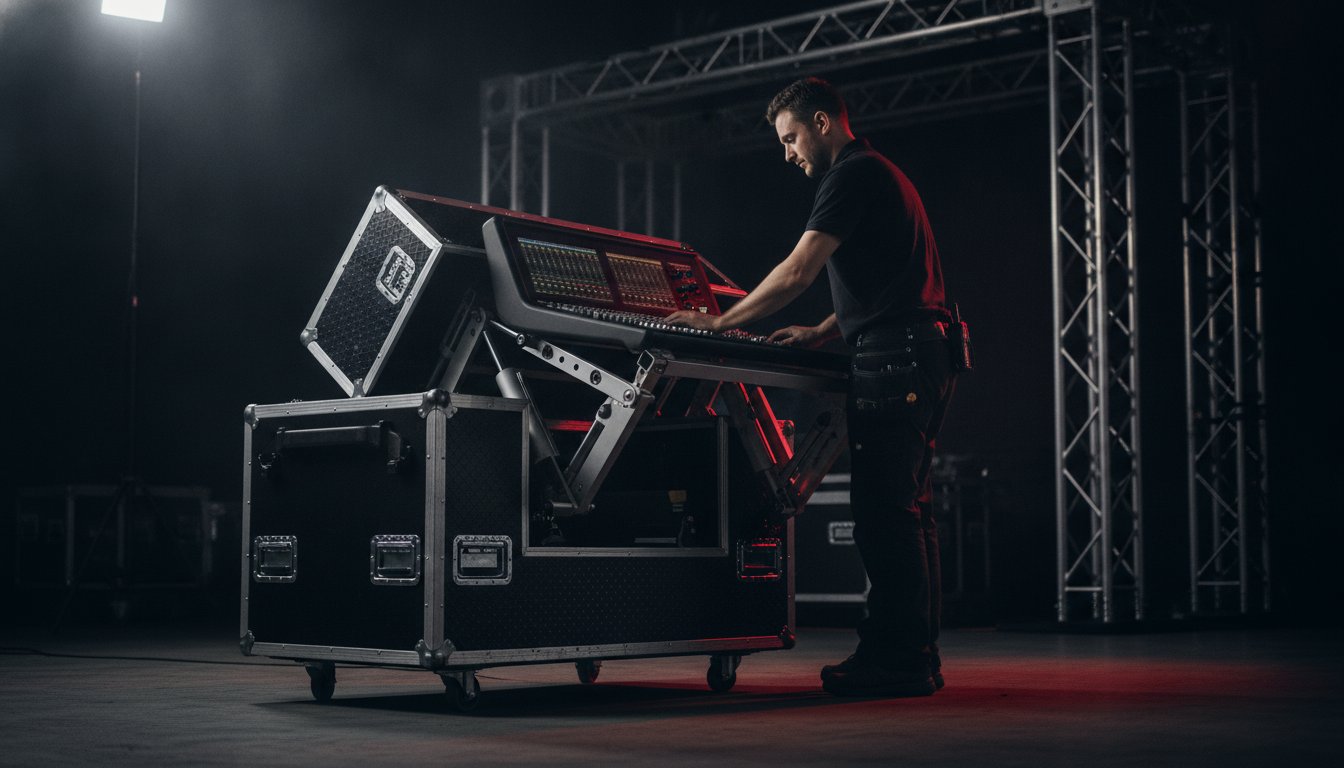
A four-person lift for a mixing console isn't just a labor expense; it's a logistical liability that increases the risk of equipment damage and personnel injury. In the high-stakes environment of professional touring, the physical demands of manual setup often conflict with the narrow windows of festival changeovers. Utilizing Flip Ready Cases represents a shift from brute force to mechanical precision. These units integrate the transport case and the console stand into a single, cohesive system, allowing for deployment that was previously impossible for a solo technician.
You know that equipment failure isn't an option when the show depends on your console's integrity. This guide explains how hydraulic-assist technology slashes setup times and transforms your logistical workflow. We'll examine the technical engineering behind ZCASE's patented systems, including their adherence to ATA-300 standards and the use of specialized vibro-insulation. You'll learn how these cases provide a zero-effort transition from transport to operational mode, ensuring your gear is protected while your labor costs remain controlled.
Key Takeaways
- Learn how hydraulic-assist technology facilitates a single-person setup, reducing the physical strain and logistical complexity of deploying heavy mixing consoles.
- Examine the mechanical engineering of the ZCASE system, focusing on how hydraulic strut tension provides a controlled, zero-effort transition from transport to operational mode.
- Quantify the return on investment by comparing the labor costs of traditional lift-off cases against the rapid deployment capabilities of Flip Ready Cases.
- Understand the critical role of console-specific internal bracing and high-density foam in maintaining equipment integrity during rigorous touring schedules.
- Discover how integrating the case and stand into a single unit optimizes logistical workflows for professional engineers using industry-standard consoles.
The Evolution of Console Deployment and Setup Logistics
Traditional console protection relied on static containment. These ATA flight cases provided structural security but offered zero assistance during the transition from transport to operation. As digital mixing consoles increased in complexity and weight, the manual requirements for setup became a bottleneck in production schedules. Modern touring environments, particularly high-density festival circuits, operate on precision timing where every minute lost to equipment positioning translates to potential technical delays or increased labor overhead.
Flip Ready Cases represent a shift in engineering philosophy. Instead of acting as a simple shell, the case functions as an active component of the console's deployment mechanism. This integration addresses the physical limitations of legacy designs, where the lid and base had to be managed separately, often cluttering the limited footprint of a front-of-house position. Transitioning to automated mechanical assistance allows a production to move faster without sacrificing the safety of the hardware or the crew.
The True Cost of Manual Console Setup
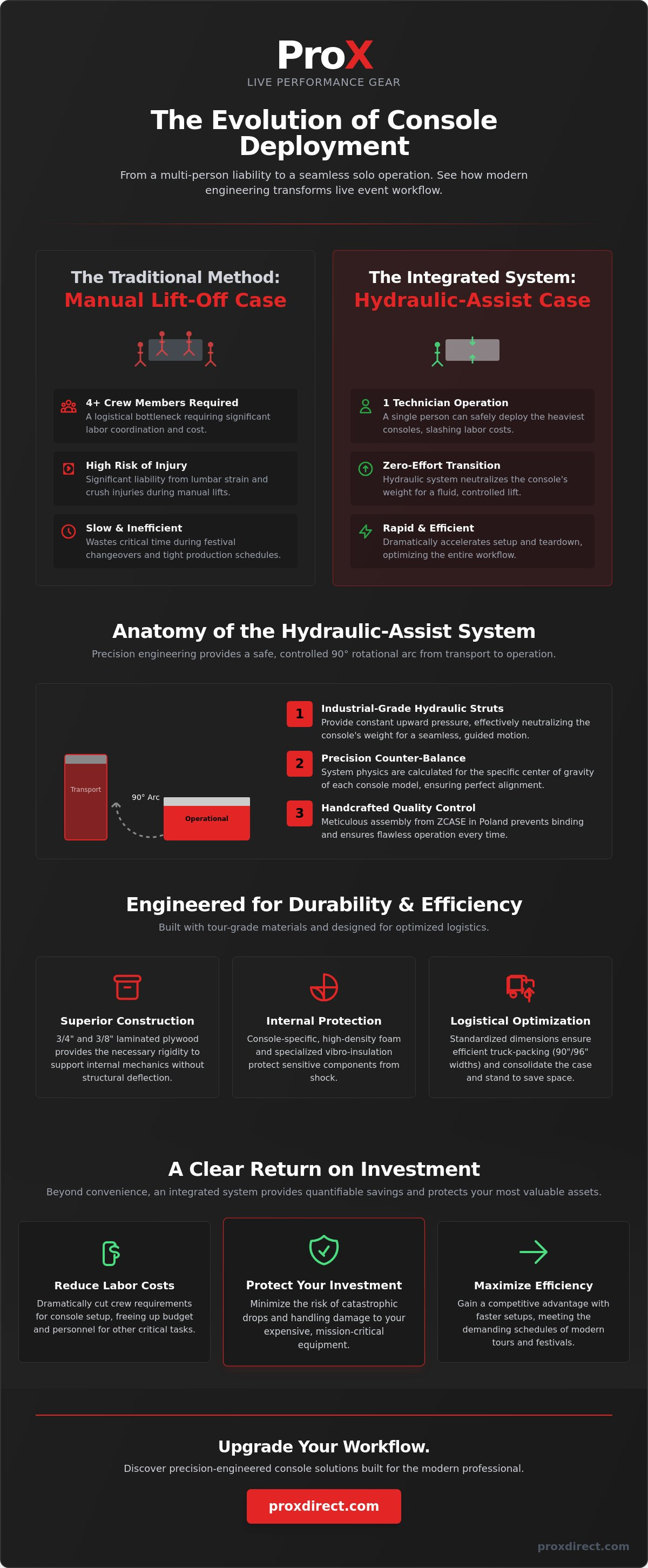
Modern digital consoles often exceed 200 lbs. Moving these units from a transport case to a separate stand requires a minimum of four qualified stagehands to ensure safety. The risk of workplace injury, particularly lumbar strain or crush injuries, is a significant liability for production companies. Beyond personnel safety, the risk to the equipment itself is substantial; a single slip during a manual lift can result in catastrophic damage to fader banks or touchscreens. By utilizing a mechanical-assist system, a single technician can manage the transition safely, effectively removing the "four-man lift" requirement from the load-in sequence.
Standardizing for the Modern Tour
Logistical efficiency depends on the predictability of equipment footprints. Traditional setups require space for the console, the transport case components, and a separate stand. Flip Ready Cases eliminate this redundancy by combining the housing and the stand into a single unit. This consolidation is critical for optimizing truck-pack logistics.
Standardized exterior dimensions are essential for professional case solutions. When cases follow uniform width and height increments, they interlock more effectively within a standard 90-inch or 96-inch truck width. This prevents load shifts and maximizes cubic volume utilization. Maintaining equipment integrity through high-frequency deployments requires this level of structural consistency. The mechanical components must withstand the vibrations and mechanical stresses of constant transit without compromising the hydraulic lift's precision.
Mechanical Precision: How the Hydraulic Flip System Operates
The engineering behind Flip Ready Cases originates from the ZCASE manufacturing facility in Poland. This partnership with ProX Live Performance Gear ensures that touring professionals have access to European mechanical precision. Unlike standard enclosures, these units utilize a complex counter-balance system. The physics of hydraulic strut tension are calculated based on the center of gravity for specific console models. This ensures that the transition from a vertical transport state to a horizontal mixing position is fluid and controlled.
Precision alignment is critical for heavy consoles. When dealing with hardware that represents a significant capital investment, a mechanical failure isn't an option. Handcrafted quality control protocols at the ZCASE factory verify that every hinge and strut mounting point aligns perfectly. This meticulous approach to assembly prevents the binding or uneven weight distribution that often plagues lower-tier mechanical cases. The material science involved includes the use of 3/4-inch and 3/8-inch laminated plywood, which provides the necessary rigidity to support the internal hydraulic pressure without structural deflection.
The Anatomy of a Hydraulic Flip Mechanism
The operational sequence of the hydraulic system follows a precise 90-degree rotational arc. This movement is managed by industrial-grade struts that provide constant upward pressure, effectively neutralizing the console's weight. The system supports the hardware through the entire range of motion, requiring only minimal guidance from a single operator. Safety is maintained through several integrated features:
- Primary Hydraulic Struts: These provide the lifting force and dampening required for smooth, predictable operation.
- Reinforced Pivot Points: Heavy-duty steel hinges manage the rotational stress during every setup and strike cycle.
- Automatic Safety Locks: These mechanisms engage once the console reaches the horizontal position, preventing accidental closure or shifting.
Reducing manual lifting isn't just a convenience. It's a strategic move for workplace safety. The CDC offers resources for quantifying the ROI of ergonomic interventions in industrial settings. Implementing mechanical assistance directly mitigates the risks associated with high-mass manual handling.
Durability in Extreme Touring Environments
Touring hardware must perform in diverse climates, from frozen storage containers to hot outdoor stages. ZCASE engineers test hydraulic performance across a wide temperature spectrum to ensure the fluid viscosity remains stable. This prevents the struts from becoming sluggish in cold environments or losing resistance in extreme heat. The mounting points for the consoles are reinforced to withstand the constant vibrations of transit. Maintenance-free operation is a core design requirement; the internal mechanical components are sealed against dust and debris. For those seeking long-term reliability, exploring the technical specifications of these console cases reveals the industrial-grade hardware used in their construction.
Quantifying the ROI: Labor Reduction and Equipment Longevity
Calculating the return on investment for professional production gear requires an analysis of both immediate labor savings and long-term asset preservation. Traditional lift-off lid designs necessitate a multi-person crew for every deployment. For a digital console weighing over 200 lbs, this usually involves four stagehands. Flip Ready Cases eliminate this requirement by enabling a single-person setup. This mechanical efficiency directly impacts the bottom line by reducing the billable hours required for local stage labor during load-in and load-out.
Setup times dictate the profitability of a touring schedule. When a crew must coordinate four stagehands to position a single mixing surface, the resulting downtime accumulates across a multi-city schedule. Switching to a hydraulic-assist system transforms the console from a logistical hurdle into a tactical asset. This shift allows the lead engineer to maintain control over the hardware without waiting for a full crew to become available.
Operational Efficiency Benchmarks
Industry data indicates that switching to a hydraulic flip system saves an average of 15 to 20 minutes per load-in cycle. In high-pressure broadcast environments or tight festival changeovers, these minutes are critical for technical troubleshooting and soundcheck availability. The transition from a four-person lift to a one-person flip operation allows production managers to reallocate crew members to other technical tasks. This optimization ensures that the technical staff remains focused on show quality rather than repetitive heavy lifting.
Protecting the Asset Investment
Equipment longevity is often compromised by improper manual handling. Repeatedly lifting a heavy console can lead to chassis warping or structural stress on internal PCB components. Flip Ready Cases provide a stable, balanced transition that maintains the console's structural integrity. Integrating the case and stand into a single unit also minimizes the risk of drops during the positioning phase. Several specific features enhance this protection:
- Integrated Doghouse: This rear compartment protects sensitive connectors and provides cable management that reduces strain on the console's I/O ports.
- Vibro-Insulation: Advanced internal foam densities protect the hardware from high-frequency vibrations during truck transit.
- Resale Value: Professional buyers prioritize consoles maintained in ZCASE systems. The presence of a high-end mechanical case indicates that the asset has been subjected to minimal physical stress.
Maintenance and protection are inseparable from the console's lifecycle. Utilizing specialized console cases ensures that the hardware remains in factory condition, even after hundreds of deployments. This level of care prevents the hidden costs of equipment downtime and expensive chassis repairs.
Compatibility Standards: Custom-Engineered Fits for Global Brands
Engineering precision requires a departure from generic interior dimensions. Flip Ready Cases are designed with console-specific internal bracing that accounts for the unique weight distribution and connector placement of each hardware model. This ensures that the hydraulic system's center of gravity remains perfectly aligned with the console's physical center. High-density foam is utilized not just for padding, but as a structural component that prevents lateral movement during the 90-degree rotational arc.
Maintaining the integrity of industry-standard consoles like those from Allen & Heath, Midas, and Yamaha requires a meticulous understanding of their chassis design. A case for a Yamaha Rivage PM series must handle different stress points than one built for a compact Midas M32. ZCASE engineers in Poland analyze the structural weaknesses of each console to place support where it's most effective. This prevents frame torque and protects sensitive touchscreens from pressure points during repeated deployments.
Digital Console Specific Engineering
Specific bracing patterns are developed for the Allen & Heath dLive and Avantis series to accommodate their unique rear I/O configurations. Similarly, the custom internal architecture for Midas M32 and Heritage-D consoles ensures that the doghouse area provides sufficient clearance for complex cable looms without compromising the case's exterior footprint. For professionals operating in the media sector, exploring AV Broadcasting Cases reveals how these engineering standards extend to specialized media rigs and video switching surfaces from Avid and Blackmagic Design.
The DJ Command Center
The application of hydraulic-assist technology isn't limited to large-format mixing consoles. Hydraulic solutions are now engineered for Pioneer DJ and Denon flagship controllers, creating a unified command center. These designs integrate laptop stands and peripheral storage within the flip frame, allowing a single technician to deploy a complete performance rig in seconds. Thermal management is a priority in these compact configurations. Vented panels and specific foam cutouts ensure that heat-generating components receive adequate airflow during extended performances. This engineering prevents the thermal throttling that can occur when equipment is housed in poorly ventilated enclosures.
Choosing a case that matches your specific hardware is the only way to ensure the hydraulic system operates at its peak performance. You can browse the full range of Flip Ready Cases to find the exact match for your console or controller.
Selecting Your Integrated Command Station: ProX and ZCASE Solutions
The "Made in Poland" ZCASE label isn't merely a point of origin; it serves as a technical benchmark for mechanical enclosure design. Flip Ready Cases produced in this facility undergo rigorous structural testing to ensure the hydraulic mechanisms maintain their tension ratings over thousands of cycles. This engineering heritage allows for extensive custom build options. Professionals can specify tailored exterior finishes, choose between various plywood thicknesses, and select specific hardware configurations, such as recessed handles or heavy-duty latches, that meet the exact requirements of a specific touring inventory. Every unit is a product of meticulous assembly where the goal is long-term operational reliability rather than mass-market speed.
Integrating this technology with Control Tower DJ Stands Made by ZCASE in Poland provides a cohesive command station for mobile performers. This synergy between the case and the stand eliminates the need for external support structures, further reducing the logistical footprint of the performance rig. The result is a streamlined workstation that maintains the professional aesthetics and structural integrity required for high-profile events. By consolidating the transport and performance platforms, you minimize the number of failure points in your setup.
Beyond the Mixer: Expanding the Flip Ecosystem
The utility of this system extends beyond audio surfaces. Lighting professionals utilize these systems for MA Lighting and Avolites consoles, where rapid deployment is equally vital during complex show files. By centralizing a full touring inventory through ProX Cases, production companies can standardize their load-in procedures across all departments. This standardization often includes the use of ProX Truss systems to create integrated stage environments where every component works in mechanical harmony. Standardizing your hardware allows for more predictable truck packs and faster site strikes.
The ProX Advantage: Global Support and Dealer Network
ProX Live Performance Gear provides the necessary support infrastructure for ZCASE products in the North American market. Professional users gain access to a comprehensive dealer portal for technical support and replacement parts, ensuring that a single worn component doesn't sideline a critical piece of gear. Warranty coverage specifically protects the integrity of the hydraulic struts and mechanical hinges, which are the core components of the flip system. For non-standard equipment or unique broadcasting surfaces, technicians can request a custom engineering quote. This process involves a detailed analysis of the hardware's dimensions and weight distribution to ensure the resulting case provides the same zero-effort operation as standard models.
Before finalizing your professional case purchase, utilize this final verification checklist:
- Verify the exact console model and version to ensure internal bracing alignment.
- Confirm exterior dimensions match existing truck-pack standards for your transport vehicles.
- Assess the required doghouse depth for specific cable loom thicknesses and connector types.
- Check for integrated peripheral storage needs, such as laptop trays, rack spaces, or additional monitor mounts.
- Verify that the hydraulic strut tension is rated for the specific weight of your console plus any permanently mounted accessories.
Optimizing Your Touring Infrastructure
High-stakes production environments don't leave room for inefficient workflows or manual lifting hazards. Integrating handcrafted ZCASE engineering ensures your consoles are deployed with mechanical precision rather than brute force. These systems, manufactured in Poland, provide hydraulic-assist technology that enables a single-person operation. This shift reduces labor overhead while providing specialized protection for flagship hardware from brands like Allen & Heath, Midas, and Pioneer DJ. Every component is designed to withstand the rigors of the road without compromising the safety of the technician or the integrity of the console.
Implementing these standards allows your crew to focus on technical show quality instead of the physical strain of load-in. By centralizing your logistical strategy around Flip Ready Cases, you ensure that every deployment is consistent, safe, and professional. This level of technical superiority is essential for maintaining a competitive edge in modern touring and large-scale event production. It is an investment in both your personnel and your high-value hardware assets.
Explore the full range of Flip Ready Cases and revolutionize your setup.
Standardizing your inventory with these integrated solutions secures your technical assets for years of high-frequency deployment and reliable performance.
Professional Technical FAQ
How many people are required to set up a console in a Flip Ready case?
One technician can complete the setup. The hydraulic-assist mechanism is specifically calibrated to the console's center of gravity, neutralizing its mass during the transition. This eliminates the traditional four-person lift requirement, making it an ideal solution for solo operators or small crews. The system supports the unit's weight throughout the entire 90-degree arc, ensuring a controlled and safe deployment that doesn't require additional manual assistance.
Do hydraulic struts lose pressure over time or in cold weather?
ZCASE utilizes industrial-grade struts containing temperature-stable hydraulic fluid. These components are engineered to maintain consistent internal pressure across a wide operational spectrum. While extreme sub-zero temperatures can slightly increase fluid viscosity, the system's counter-balance physics remain effective for professional use. The mechanical seals are designed to prevent pressure loss during high-frequency transit and repeated deployment cycles in varying climates, ensuring long-term reliability.
Can I use these cases for lighting consoles as well as audio mixers?
Yes, the flip system is adaptable to various high-value control surfaces. While frequently used for audio mixers, custom-engineered versions are available for lighting consoles such as MA Lighting and Avolites. The internal bracing and strut tension are modified to match the specific chassis requirements and weight distribution of these units, providing the same single-person setup capability across all technical departments regardless of the console's primary function.
What happens if a hydraulic strut fails during a tour?
Hydraulic struts are modular and replaceable. While these systems are designed for long-term durability, any mechanical component can eventually require service. ProX maintains a global dealer network that provides technical support and access to replacement parts. If a strut fails, it can be swapped out using standard tools, ensuring your console remains operational with minimal disruption to your touring schedule or performance deadlines.
Are Flip Ready cases significantly heavier than standard flight cases?
There is a slight weight increase compared to basic lift-off lid designs. This is due to the integration of the hydraulic struts and the heavy-duty steel hinges required for the rotational mechanism. However, this extra mass is functionally offset because you no longer need to transport a separate external stand. The consolidated design simplifies your inventory and reduces the total number of items in your truck pack.
Is there enough room for a doghouse and cable management in these cases?
Integrated cable management is a core design priority in Flip Ready Cases. Each unit features a dedicated doghouse compartment with sufficient clearance for large snakes and complex I/O configurations. This design allows you to keep the console patched during transit and deployment. The rotational arc is calculated to prevent cable binding or strain on sensitive connectors throughout the entire 90-degree setup process.
Do I need an extra table or stand when using a flip-style case?
No additional support hardware is required for operation. The case is engineered to function as its own stand, positioning the console at an ergonomic height once it's flipped into the horizontal position. This integrated approach saves valuable floor space at front-of-house positions and removes the logistical burden of managing separate stands, tables, or mounting brackets for your mixing surface. It's a self-contained workstation solution.
Are these cases compatible with standard truck-pack dimensions?
These units are built to standard logistical specifications. Flip Ready Cases utilize exterior dimensions that are compatible with professional truck-pack standards. This allows them to interlock effectively within 90-inch or 96-inch wide trailers. The uniform sizing prevents load shifts during transit and ensures that your cubic volume is utilized efficiently, which is critical for managing the costs of large-scale touring logistics and transport.
Disclaimer
Any trademarks, trade names or brand names appearing herein that do not belong to ProX are the property of their respective owners and/or companies, and such appearance doesn't and shall not constitute or imply endorsement, sponsorship or recommendation by ProX.


