

The right mixer console case is defined by fit, protection, and practical handling, not by its label alone. Case configurations differ, so the exterior footprint, caster arrangement, and mixer-compartment design all matter when assessing how a case will work in production use.
Before choosing a case, look for clear specifications. Compare the configuration, rolling hardware, and space around the console. The right match depends on the mixer format and how the equipment will be transported and handled.
The sections below cover exterior measurements, rolling hardware, and compartment layout, then explain how to assess compatibility with your console and accessories. Use these details to narrow down a configuration that suits your handling and storage needs.
Key Takeaways
- Compare case configurations by their caster hardware, caster-board construction, and handling features.
- Use the closed-case exterior measurements to assess storage space, transport access, and placement.
- Learn how shaped foam and a separate accessory compartment support the mixer and its related equipment.
- Compare price listings by configuration and included features rather than treating different case designs as equivalent.
- Plan handling around the combined load of the case and mixer, not the exterior dimensions alone.
Caster size and caster board
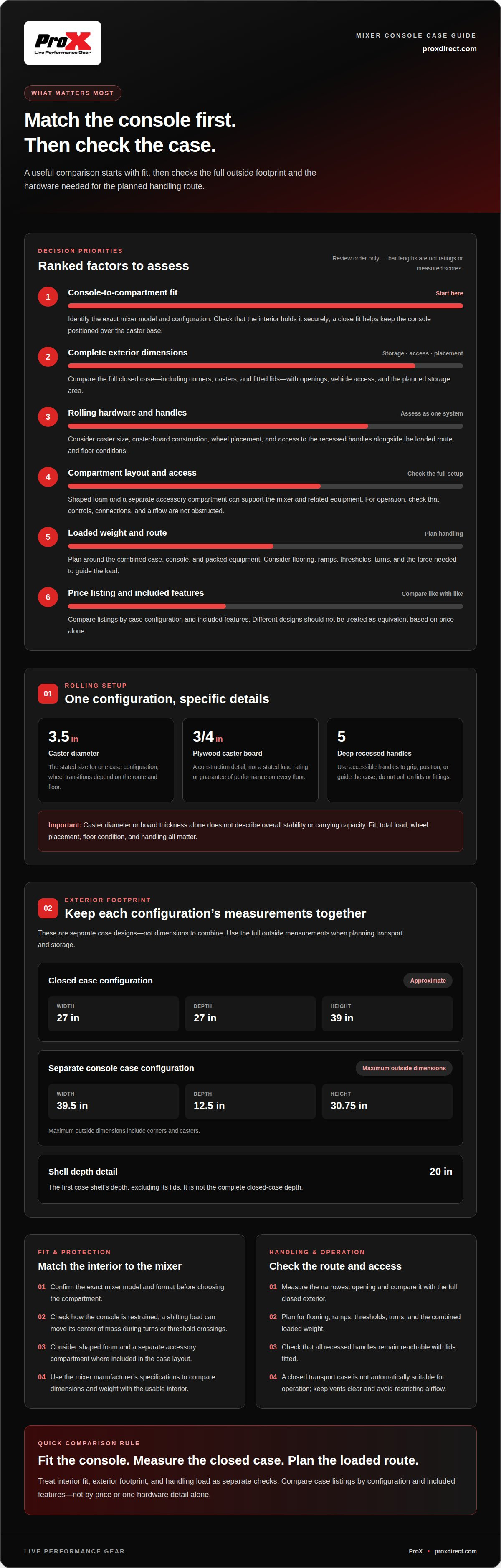
A mixer console case needs rolling hardware suited to its loaded weight and handling route. One configuration uses 3.5-inch casters and a 3/4-inch-thick plywood caster board. Those dimensions describe specific components, not every console case. Match the case interior to the mixer format before judging how the assembly will move through a venue.
The caster diameter affects how wheels meet floor transitions. A 3.5-inch wheel is the stated size for this configuration. The board beneath the case provides the mounting surface for the caster hardware. Its 3/4-inch plywood thickness is a construction detail, but it doesn’t establish a load rating or guarantee performance on every floor.
The described case includes heavy-duty casters and five deep recessed handles. They serve different purposes: casters enable rolling, while recessed handles provide a grip for lifting, positioning, or guiding. Before loading, check that each wheel turns and the handles are accessible. When moving the case, use the handles to guide it rather than pulling on lids or fittings.
Are custom-fit or universal cases better for a mixer console? A custom-fit case is the more direct choice when its compartment is designed for the exact mixer model and configuration. A universal case can suit changing equipment needs, but its interior fit and restraint must match the console’s dimensions.
Fit also affects handling. If the console shifts inside the case, its center of mass can move during turns or when crossing thresholds. A close fit helps keep the equipment positioned over the caster base, but caster size alone does not determine stability. The total load, wheel placement, floor condition, and force applied by the operator all matter.
Use this sequence when evaluating the rolling setup:
- Identify the exact mixer model and case configuration.
- Compare the stated 3.5-inch caster size and 3/4-inch board thickness.
- Check access to all five recessed handles with lids fitted.
- Consider the route, including flooring, ramps, and thresholds.
These checks distinguish rolling hardware from mixer fit. The professional equipment case range provides useful context for evaluating case construction. For a mixer setup, prioritize the compartment match and caster-board assembly together. Neither wheel diameter nor board thickness alone describes the complete handling system.
For the Behringer X32 Mixing Console Case, the plywood caster board is .75” thick. Treat that measurement as a description of the board, rather than as evidence of a particular carrying capacity. Its usefulness is best judged alongside the console’s fit, the mounted casters, and the route the loaded case will take. The board is part of the rolling assembly, but the stated thickness alone does not establish how the complete case will behave under every handling condition.
Recessed handles can provide a grip for positioning or guiding a case. Their placement and accessibility matter when the case is being positioned or guided, especially when the lids are fitted. Check that the handles can be reached without obstructing the rolling setup, and use them for controlled handling rather than treating them as a substitute for secure equipment fit. Together, the board and handles describe construction and handling features; they do not, by themselves, answer whether a case suits a particular mixer or route.
Exterior dimensions
Case measurements affect storage, doorway clearance, and vehicle loading. The figures below refer to different case configurations, so keep each set of measurements together.
Exterior Case Measurements
One closed case configuration measures approximately 27 inches wide, 27 inches deep, and 39 inches high. A separate console case lists maximum outside dimensions of 39.5 inches wide, 12.5 inches deep, and 30.75 inches high, including corners and casters. These measurements belong to different designs and shouldn’t be combined.
The first case shell measures 20 inches deep, excluding its lids. That shell depth differs from the complete closed-case depth, which includes protruding components. For transport planning, use the full outside measurements rather than the shell figure alone. Compare the widest and tallest points against storage openings, vehicle access, and the planned placement area.
Console Size and Weight
The case measurements above describe enclosures, not mixer dimensions or weight. Console formats differ, so identify the exact model before matching an interior. The loaded weight also depends on the console and equipment packed with it. Treat the case footprint and equipment load as separate measurements when planning placement or handling.
Can a mixer stay in its case during operation, and what ventilation does it need? That depends on whether the case design leaves controls, connections, and airflow unobstructed. A closed transport case is not automatically suitable for operation. Keep vents clear and avoid setups that restrict airflow.
Use measurements consistently. Record width, depth, and height in the same order, then compare like with like. Include corners, casters, and fitted lids when considering the external footprint. The approximately 27-by-27-by-39-inch closed dimensions provide one planning reference. The separate maximum measurements of 39.5 by 12.5 by 30.75 inches belong to another case configuration.
- Measure the available opening at its narrowest point.
- Allow for the full closed exterior, not only the shell.
- Match the case interior to the exact console format.
- Plan the loaded weight around the mixer and packed equipment.
These checks help prevent fit and access problems during load-in. A case that fits through a storage opening may still need a suitable setup for operation. Consider ventilation and access alongside the exterior footprint. Case dimensions describe the enclosure; the exact mixer model determines interior fit, while packed equipment affects handling load. Use the mixer’s manufacturer specifications for its dimensions and weight, then compare them with the usable interior and planned handling arrangements before choosing a case.
Foam-lined mixer compartment
A fitted foam compartment helps keep an X32 positioned inside its case. One case configuration has a 1-inch PE foam-lined interior. Its CNC-cut foam side pieces follow the console’s contours. That shaped contact supports a closer fit than a plain, open cavity. Match the compartment to the exact X32 model before relying on its form-fit design.
Foam thickness and shape describe different aspects of the interior. The 1-inch PE lining describes one configuration’s interior, while CNC-cut side pieces describe how foam conforms to the console. Another listed case detail is 4-inch-thick PE foam side blocks. Treat these specifications as distinct configurations, not as features that necessarily occur together.
Fit depends on more than foam thickness. The console should sit in its intended position, with the controls and edges aligned to the shaped supports. A mismatch between mixer format and cavity can leave gaps or create pressure points. For example, an X32 Compact and a full-size X32 should not be assumed to share the same interior dimensions.
Check fit in a deliberate sequence. First, identify the exact mixer model. Compare its profile with the compartment’s foam contours, then confirm that the console sits evenly without rocking or forced compression. Close the case carefully and check that the lid does not press against the controls. These steps can reveal fit issues before transport.
In the described case configuration, the accessory compartment sits beneath the console. This keeps related items separate from the mixer’s shaped seating area. Use it for compatible accessories that fit without obstructing the console compartment. Do not assume the compartment has unlimited capacity: extra items can affect closure and load distribution.
- Keep cables and small accessories below the mixer, in the designated compartment.
- Keep loose items out of the foam contact area.
- Arrange accessories so they don’t press against the console when closed.
Foam condition also matters. Inspect the CNC-cut side pieces for displacement, tears, or compressed areas. Check the 1-inch PE lining for separation from the case walls. A damaged or shifted insert may change the console’s seating position. Reposition removable foam only according to the case design, rather than forcing it around the mixer.
Choose the compartment by matching the mixer model, foam profile, and accessory layout. The 1-inch lining, contoured CNC-cut sides, 4-inch side-block specification, and under-console storage each describe useful design details, but not necessarily one shared build. Distinguishing those features helps you assess fit without confusing separate case configurations.
Product price
Behringer X32 case prices depend on the configuration being compared. A compact mixer case, a console case with a doghouse, and a mixer-and-rack design are different builds. Compare their included features before judging value. A listed amount for one configuration does not establish the price of another.
Start with the case’s intended layout. A doghouse compartment changes the available connection space. Caster wheels add rolling hardware. A rack section adds storage capacity and changes the case structure. Each feature affects what the case is designed to carry, so compare like configurations rather than relying on the X32 name alone.
Construction also matters. Case designs described for the X32 use plywood, laminate, aluminum extrusions, and foam. Material type and thickness affect the build. A case with shaped foam and a dedicated accessory compartment differs from a basic enclosure. Compare those details alongside the console fit, not as isolated specifications.
Use a consistent comparison process:
- Identify the exact X32 model and case format.
- Separate compact mixer cases from console-and-rack configurations.
- Note whether caster wheels or a doghouse compartment are included.
- Compare the foam layout, rack capacity, and construction materials.
- Review what the listed configuration includes before comparing amounts.
For example, an X32 Compact case with a rack section serves a different equipment arrangement than a mixer-only enclosure. Its added rack capacity may be useful when related units travel with the console. A simpler configuration may suit setups that don’t need that storage. The relevant comparison is the complete build against the required equipment layout.
Compare any advertised savings with the case’s listed configuration and offer terms. A discount figure has little meaning without that context. Compare amounts in the same currency, and distinguish a current offer from other listing conditions to avoid mismatched comparisons between case designs.
Price assessment should include practical fit. A case that accommodates the X32, required connections, and accessories may serve a different purpose than one with only a mixer compartment. Avoid paying for an unused rack layout, but don’t overlook storage or handling features that the production setup requires. The case’s materials, fitted interior, and hardware provide the basis for that decision.
In short, compare complete configurations, not product labels alone. Match the mixer format, storage layout, foam design, and included hardware first. Then assess the listed amount against those details. This method gives a more useful price comparison for an X32 case than a single figure separated from its build.
In short, compare complete configurations, not just advertised listings.
Case weight
Plan around two separate loads: the empty case and the packed case. The empty weight includes the shell, lids, hardware, foam, and casters. The packed weight adds the Behringer X32 and any stored accessories. Those totals answer different handling questions, so don’t treat one as a substitute for the other.
Construction affects the empty case weight. A listed X32 case uses 3/8-inch plywood, while another configuration includes a 3/4-inch plywood caster board. Laminate, aluminum extrusions, recessed handles, and wheel assemblies also contribute. These components vary by design, so a mixer-only case and a case with extra rack space won’t necessarily weigh the same.
Interior features also contribute to the overall build. Foam lining and shaped side pieces take up space inside the case, while a separate accessory compartment adds storage. Casters, lids, and a doghouse compartment further affect the configuration. Assess the complete case rather than estimating from the plywood shell alone.
The loaded total depends on what goes inside. A Behringer X32 with cables and accessories weighs more as a packed unit than the empty enclosure. A rack configuration adds the weight of any equipment placed in its rack spaces. Keep those components separate in your planning, especially when comparing a console-only setup with a mixer-and-rack arrangement.
Use this sequence to assess the handling load:
- Record the case’s empty weight from its product specification.
- Weigh the X32 and the accessories packed with it.
- Add the case, mixer, and packed contents for the total.
- Repeat the calculation for each case configuration under consideration.
Use a scale to check the complete packed load. Weigh the closed case with the equipment arranged as it will travel. For a rack case, include installed rack units; for an accessory compartment, include its cables and other contents. Keep the result tied to that exact setup, since changing the mixer or packed equipment changes the total.
Weight affects handling. Compare the packed total with the crew’s lifting and rolling method. A wheeled case still needs controlled positioning, and handles support lifting and guidance. Factor in door thresholds, ramps, and storage placement along the route. Plan around the packed case weight, not the empty enclosure.
Compare case designs by their material, hardware, storage layout, and empty weight. Then calculate the loaded total using the exact X32 configuration. Explore case configurations to match the build to the equipment and handling requirements.
Mixer Console Cases
Mixer Console Cases protect and transport mixing equipment. If your X32 setup needs a case matched to its console format, storage layout, and handling requirements, this is the relevant category to consider. Racks & Case Accessories can also suit configurations that need compatible rack or case components.
Use the measurements and fit details above to define the required configuration. Assess the console model, foam arrangement, accessory storage, and packed load together. This helps determine whether a mixer-focused case or a rack-oriented setup better suits your production needs.
Contact a case supplier to discuss a case configuration for your X32 setup.
Choose the Case That Fits Your Next Setup
Use your X32 configuration to guide the next decision. A Behringer X32 console road case should suit the way your production team stores, handles, and deploys its equipment. ProX offers Mixer Console Cases for mixer transport, alongside Racks & Case Accessories for compatible case and rack needs. The right direction depends on the equipment arrangement, not simply the console name.
ProX offers Santosom Cases, TruckPaX™ Truck Pack Cases, Utility/Storage Cases, and Mixer Console Cases. The broader case categories suit different equipment and storage needs; Mixer Console Cases are the natural starting point for a mixer-focused setup. Consider how the console fits into your workflow, then choose the case category that matches its role.
For a case discussion centered on your X32 setup, contact ProX about your X32 case. Share the console configuration and the case functions your production requires. That gives the conversation a practical starting point, so you can move forward with a case choice aligned with your equipment plan.
Frequently Asked Questions
How much does a Behringer X32 road case cost in the United States?
Case pricing depends on the selected configuration, so one amount cannot represent every X32 setup. A mixer-only enclosure and a case with rack or accessory storage serve different layouts. Compare the included construction, interior, and hardware rather than product names alone. ProX offers Mixer Console Cases for mixer equipment. Prices, specifications, and images are subject to change without notice. We are not responsible for typographical or illustrative errors.
What case features matter for protecting an X32 during transport?
Prioritize a close-fitting interior, a rigid case structure, and hardware suited to the handling route. During packing, keep loose accessories from pressing against controls, close every lid fully, and make sure cables don’t obstruct closure. For a touring changeover, this packing check helps prevent misplaced items from pressing against the mixer. Product information includes a California Proposition 65 section and a PROP65 compliance note.
How do you measure an X32 to choose the correct road case?
Measure the exact console with removable cables disconnected, then record its maximum width, depth, and height, including protruding controls or connectors that remain attached in storage. Compare those figures with the case’s usable interior, not its outside footprint. For a Behringer X32 console road case, repeat the fit check with the intended foam and accessory arrangement; the model and packed layout determine usable clearance.
Disclaimer
Any trademarks, trade names or brand names appearing herein that do not belong to ProX are the property of their respective owners and/or companies, and such appearance doesn't and shall not constitute or imply endorsement, sponsorship or recommendation by ProX.


