
A rugged case is not automatically ATA-certified. To understand what ATA certified means for cases, start with the claim itself: it generally means a case has been evaluated against relevant ATA requirements, rather than simply being described as durable because of its construction.
That distinction matters when equipment is packed, handled, and moved between venues. A certification claim is useful only when you know which standard it refers to and what testing supports it. The label alone does not explain test conditions or guarantee that a case will prevent damage in every situation.
This article explains what ATA certification means for equipment cases, how to assess a testing claim, and what quality-control records can help support it. You’ll also learn how to consider certification alongside case construction and intended use, so you can judge what the designation does and does not tell you about a case.
Key Takeaways
- Distinguish ATA’s translator certification from ATA Specification 300, which is the relevant reference when discussing shipping cases.
- Identify the specific specification or test a case claim refers to, rather than relying on the word “certified” alone.
- Assess certification alongside case construction, intended use, and the quality-assurance practices behind the claim.
- Use the differences between case types and accessories to narrow down a protective transport solution for your equipment.
ATA certification requirements and examination
ATA certification can refer to two different things: a translator’s professional credential or a shipping case tested against an ATA specification. The distinction matters. The American Translators Association’s exam assesses translation skills in a specific language combination. It does not certify equipment cases or show that a case passed a handling test.
The translator exam is a three-hour, open-book, proctored examination. Candidates may need relevant academic qualifications and documented translation experience. The exam presents three passages, each around 225-275 words, and candidates must translate two. The scoring threshold is 17 or fewer error points. These requirements concern a professional translation credential, not case construction or transport performance.
Preparation also involves formal eligibility steps. ATA membership is required for at least four weeks before the exam, and candidates may sit for it only once a year in each language combination. ATA offers exams for some combinations, not all. Results can take up to 16 weeks. Together, these conditions show why a translator’s credential cannot serve as evidence that a shipping case meets a particular test level.
For cases, categories and required round trips relate to the applicable ATA Specification 300 test level. The required cycle count differs by category, so identify the category and its test documentation rather than treating “ATA certified” as one universal rating. A case label alone does not tell you which test level was applied or how many round trips its category requires.
There is no single cost for ATA-certified shipping cases. The final price depends on the case’s dimensions, construction, interior configuration, and the equipment it must accommodate. Audio consoles, lighting fixtures, and broadcasting equipment have different footprints and protection needs, which affect the specifications. Assess each case against its contents and transport conditions.
Cases for mixers, lighting, speakers, and AV equipment can be selected according to equipment dimensions and handling demands. ATA testing does not eliminate every risk: a case can still be damaged, and protection depends on suitable construction, fit, handling, and test level. Explore protective equipment cases by application, then compare the case’s stated test category with the handling demands it will face.
Translation certification exams assess a linguist’s ability to translate between languages. They are generally administered by a professional organization or a state or local government. The American Translators Association offers certification examinations for some language combinations, but not all, so the language pair matters when determining whether a credential is relevant to a translator’s work. This is separate from any assessment of a case’s construction, fit, or transport performance.
The American Translators Association describes its certification exam as a three-hour, open-book, proctored exam. The ATA certification exam has a pass rate below 20%. These details describe a professional examination of translation ability; they do not establish that a shipping case has passed a handling test or meets a case specification. When evaluating a translator’s credential, focus on the language combination and the professional skill it assesses. When evaluating a case, look instead to its category and test documentation, which address a different kind of performance.
Certification and quality-assurance practices
Quality assurance starts by identifying which ATA a claim refers to. The American Translators Association certifies translators, while ATA Specification 300 concerns shipping cases. These are separate forms of certification. A translator’s credential, language skills, or accurate translation does not show that a case passed an examination.
“Certified translation” describes a document accompanied by a signed statement about its completeness and accuracy. The translator does not necessarily hold ATA certification. For immigration benefit requests, USCIS requires a full English translation of foreign-language documents and a translator’s certification statement. This document process does not establish a case’s testing history.
For a case, look for records connecting the certification claim to the specific model and test basis. Useful documentation identifies the applicable ATA specification, the category or test level, and the model represented by the test. A general product description or association membership alone does not show that a particular case was examined.
Quality-control records can help show whether production matches the tested construction. A manufacturer may document materials, hardware, assembly steps, and inspection results for a case model. These records do not replace test evidence, but they can help establish whether the supplied case follows the construction associated with the tested example.
To verify that a case is genuinely ATA-certified, match its model and stated test category to documentation identifying ATA Specification 300 and the examination performed. Treat unrelated credentials, including a translator’s ATA certification number, as evidence of language qualifications only, not case testing.
Look for consistent terminology in product descriptions, labels, and supporting records. If a case is described as tested to a specific category, its documentation should identify that same category. A statement that says only “ATA certified,” without clarifying whether it refers to translation or case testing, does not establish what was examined.
Production inspections can support consistency by checking dimensions, panel fit, hardware attachment, and interior configuration against documented specifications. These are practical quality controls, not ATA requirements unless the relevant test documentation says so. A case may also be damaged during handling or used beyond its intended conditions, so interpret certification within its documented scope.
For production equipment, application-specific examples make the documentation easier to interpret. AV broadcasting case configurations illustrate why equipment fit and interior layout matter alongside a test claim. The certification evidence remains tied to the tested model and specification, not simply to an equipment category.
Meaning of ATA certification
ATA certification can refer to translator credentials or case testing, depending on context. For equipment transport, distinguish the case’s testing specification from descriptions of its intended use.
ATA-Certified and Air-Transport Cases
An ATA-tested case has a testing claim tied to a case specification, while an air-transport case is described by its intended application. The second description alone does not show that the case was tested. When reviewing documentation, separate intended-use statements from evidence identifying the test basis and the case configuration covered.
For example, a case may be designed around a console’s dimensions and transport needs. That design description does not establish an ATA test result. The specification and supporting records clarify the testing claim.
ATA Specification 300
ATA Specification 300 is the named reference associated with shipping-case testing. It gives a specific basis for interpreting a testing claim instead of relying on general descriptions such as “protective.” Its name alone does not identify which case configuration or category a record covers, so those details matter when evaluating a particular model.
Connect the specification reference to the model documentation. A case description and a test claim provide different information about the same equipment.
Carrier Requirements for ATA Standards
An ATA case-testing claim and an airline or freight carrier’s shipment requirements are separate considerations. The claim describes the testing basis for a case; it does not establish a carrier’s acceptance conditions. Equipment type, route, packing, and handling arrangements all inform shipment planning.
For a broadcast component, review the case documentation and the shipment requirements as separate records. Neither can replace the other.
ATA also appears in translation contexts. The American Translators Association awards credentials to translators who pass an examination assessing professional translation skills. That credential applies to a specific language pair and direction, so certification for Spanish-to-English translation does not establish certification in the reverse direction.
A certified translation is a document accompanied by a signed statement affirming that the translation is complete and accurate. Its translator does not necessarily hold ATA certification. For immigration benefit requests, USCIS requires a full English translation of foreign-language documents and a translator’s certification statement. This requirement concerns documents, not equipment cases.
These distinctions keep records relevant to their purpose. A government submission may rely on a signed translation statement, while a case assessment uses its testing documentation. Neither record establishes the other credential or claim. Before relying on an ATA reference, identify whether it concerns a translator, a translated document, or shipping-case testing.
What does ATA certified mean for shipping cases?
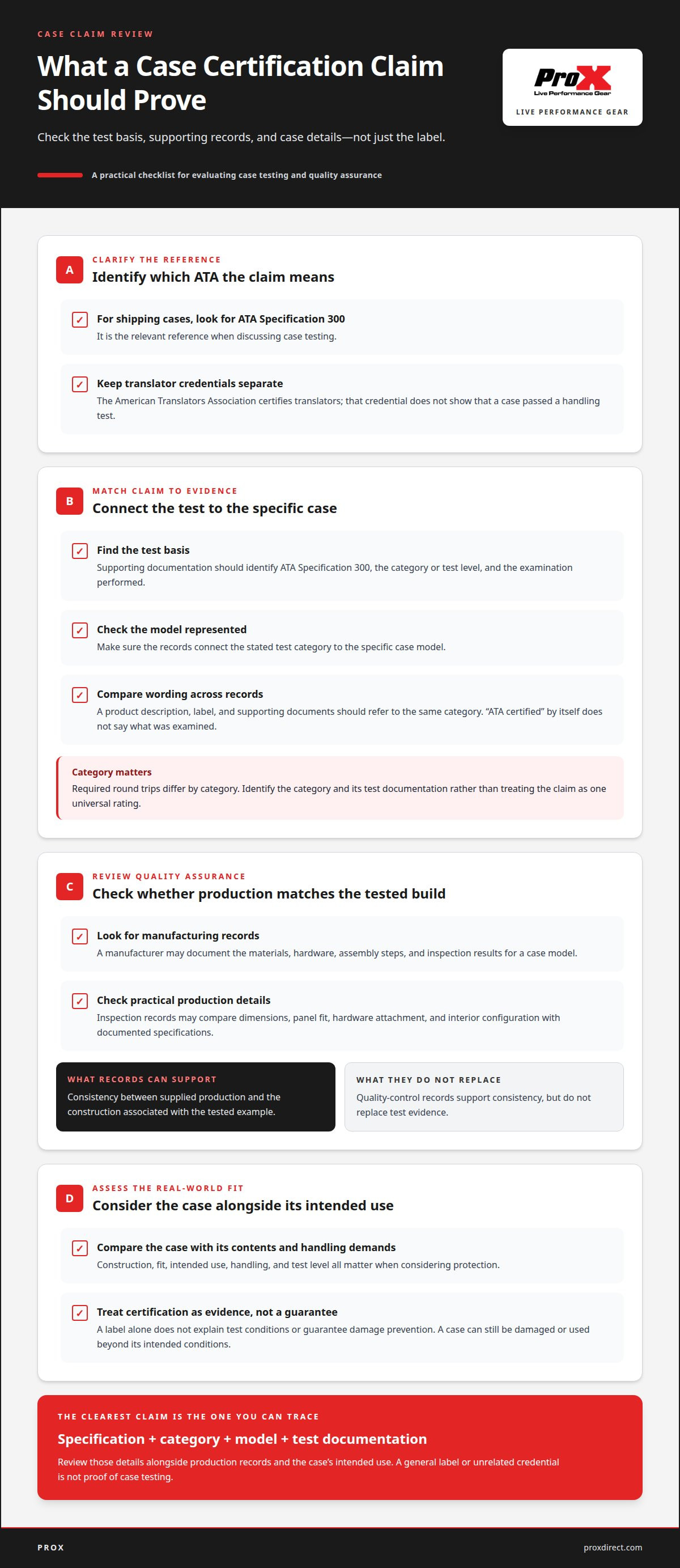
For shipping cases, an ATA certification claim refers to testing against requirements associated with ATA Specification 300. It indicates a test basis for evaluating a case, not a guarantee against every form of damage. Its practical value depends on the specific case model, the stated category, and how closely the tested configuration matches the case being used.
Read the wording carefully. “Tested to ATA Specification 300” points to a named specification, while “ATA certified” alone may leave the test basis unclear. The claim should connect to a particular case model and test category. For example, documentation for a mixer case should identify the tested configuration, rather than relying only on a general statement about protective cases.
The specification gives buyers a reference point for comparing case claims, but it does not mean every case in a product family has the same test history. Different dimensions, interiors, or hardware can change the finished configuration. If a console case has a custom interior, the standard description of another model may not explain how that configuration was evaluated.
Use the claim as one part of your case selection. First, identify the equipment and its dimensions. Then compare the case configuration with the product and test information. A lighting fixture, audio mixer, and broadcast component each have different fit and handling requirements. The ATA reference frames the testing claim, while the equipment and transport conditions guide the case design.
Documentation should make the connection between the specification and the case understandable. Look for a named reference to ATA Specification 300, the applicable test category, and identification of the model or configuration. These details help distinguish a documented test claim from broad descriptions such as “heavy duty.” A category name without model identification may not show which case design the claim covers.
Certification has limits. An ATA-related test claim does not establish that a case suits every route, shipment, or handling condition. It also does not show that contents are packed correctly or that the case remains undamaged after use. A case with a documented test basis still needs an interior layout suited to the specific equipment.
In practice, read “ATA certified” as a scoped statement: a particular case configuration is associated with testing under a named specification. The clearer the link between the model, category, and supporting records, the clearer the claim. This approach makes the designation useful without treating it as an all-purpose guarantee of shipping performance.
What is the Air Transport Association (ATA) Specification 300?
ATA Specification 300 is a named reference for evaluating shipping cases. It gives manufacturers and buyers a shared point of reference when discussing case testing. Understanding what ATA certification means for cases starts with separating that reference from general descriptions such as “rugged” or “protective.” The specification name is useful, but it does not identify every detail of a case’s design.
A case’s materials and construction are separate from its test claim. Reinforced panels, protective interiors, and durable hardware describe features, but they do not establish that a case was evaluated against ATA Specification 300. Likewise, a reference to the specification does not describe every material or assembly detail. Both kinds of information help explain different aspects of a case.
To interpret a claim, connect the specification to the relevant category and the specific model or configuration. This matters when cases have different dimensions, interiors, or hardware. Do not automatically apply a test record for one configuration to another. What ATA certification means for cases depends on the scope of the documentation.
ATA can also appear in translation discussions, where it refers to the American Translators Association. Its translator credential is separate from case testing. A translator’s qualification or a signed translation document cannot show whether a shipping case was tested. The surrounding context identifies which use of ATA applies.
Consider the specification reference alongside the equipment requirements. Identify the equipment’s dimensions, interior support needs, and expected transport conditions. Then compare those needs with the case configuration and its testing information. A broadcasting unit and a lighting fixture, for example, may need different interior layouts even when both travel in protective cases.
Specification 300 should not be treated as a guarantee against every type of damage or as proof that a case suits every shipment. Fit, packing, case condition, and handling also affect protection. Clear model identification helps show which case the test information describes, while the equipment and transport application determine whether that configuration is suitable.
Use the specification name as a starting point, then consider the case documentation and physical application together. This makes the claim more useful when comparing configurations and helps distinguish a defined testing reference from a broad product description. For equipment-specific planning, review protective case options by application and configuration.
The translation use of ATA has its own credentials and should not be confused with case evaluation. The American Translators Association has been described as a benchmark for professional translation services since 1973 and offers translator certifications in 27 language combinations. Check the ATA directory for the CT designation and verify that the translator’s certification covers the specific language pair. A university degree in translation is not the same as translation certification, and certified translations are certified by the language services company or linguist that provided the translation service.
Kent State’s translation programs received the American Translators Association’s Alexander Gode Medal in 2019, a detail relevant to translation programs rather than shipping-case testing.
Racks & Case Accessories
The product range includes Racks & Case Accessories to support professionals organizing and transporting production equipment. Once you have identified the ATA test documentation relevant to your case, match the equipment’s dimensions, rack requirements, and storage needs to the case configuration.
For audio and event production, the range includes protective cases, transport cases, and Utility/Storage Cases. These options suit different equipment and packing requirements; the right choice depends on what you need to contain and how it will be handled. Assess any certification claim through its supporting test records, not by inferring it from the product category.
Contact the supplier to discuss your equipment and case requirements.
Make the Next Case Decision Deliberately
Understanding what ATA certification means for cases helps you evaluate documentation. The next step is practical: match the case configuration to the equipment, interior support, and transport conditions. Keep the intended use in view and assess any testing claim against the specific case model it describes.
The available case options include cases for equipment transport, truck pack cases, and utility/storage cases for different equipment and storage needs. Choose according to the intended contents and handling requirements; a product category alone does not establish an ATA test result. Clear equipment specifications help narrow the suitable case format. Include dimensions, attached accessories, and whether cables or related components need to travel inside. These details help define the interior layout and usable space.
If you’re planning a case for production gear, share the equipment and application details with a case provider. Discuss your case needs to discuss a configuration that fits the job. A considered selection starts with the equipment itself, and you can take that next step with confidence.
Frequently Asked Questions
What does “Certified” Mean?
“Certified” means that a named organization or standard has assessed a specific qualification or product claim. A credential from the American Translators Association concerns professional translation skills, while an ATA case claim concerns shipping-case testing. The word alone does not identify what was assessed. Read the surrounding statement to determine whether it refers to a person, document, or case model.
What tests must an ATA-certified case pass?
The required examination depends on the applicable ATA Specification 300 category. A useful test record identifies the specification, category, and case model, so the result can be tied to the configuration being considered. Don’t infer a test protocol from a general durability description or from the word “certified.” Compare the documented claim with the case’s intended equipment and use.
Which case manufacturers offer ATA-certified cases?
Manufacturers offer cases in categories such as equipment cases, transport cases, and utility/storage cases. These product categories alone do not establish which specific models have ATA test documentation, so treat certification as a model-specific claim. Prices, specifications, and images are subject to change without notice. We are not responsible for typographical or illustrative errors.
What types of equipment need ATA-certified cases?
Mixers, lighting, speakers, and AV or broadcasting equipment may use protective cases selected to suit their dimensions and handling requirements.
Disclaimer
Any trademarks, trade names or brand names appearing herein that do not belong to ProX are the property of their respective owners and/or companies, and such appearance doesn't and shall not constitute or imply endorsement, sponsorship or recommendation by ProX.


