
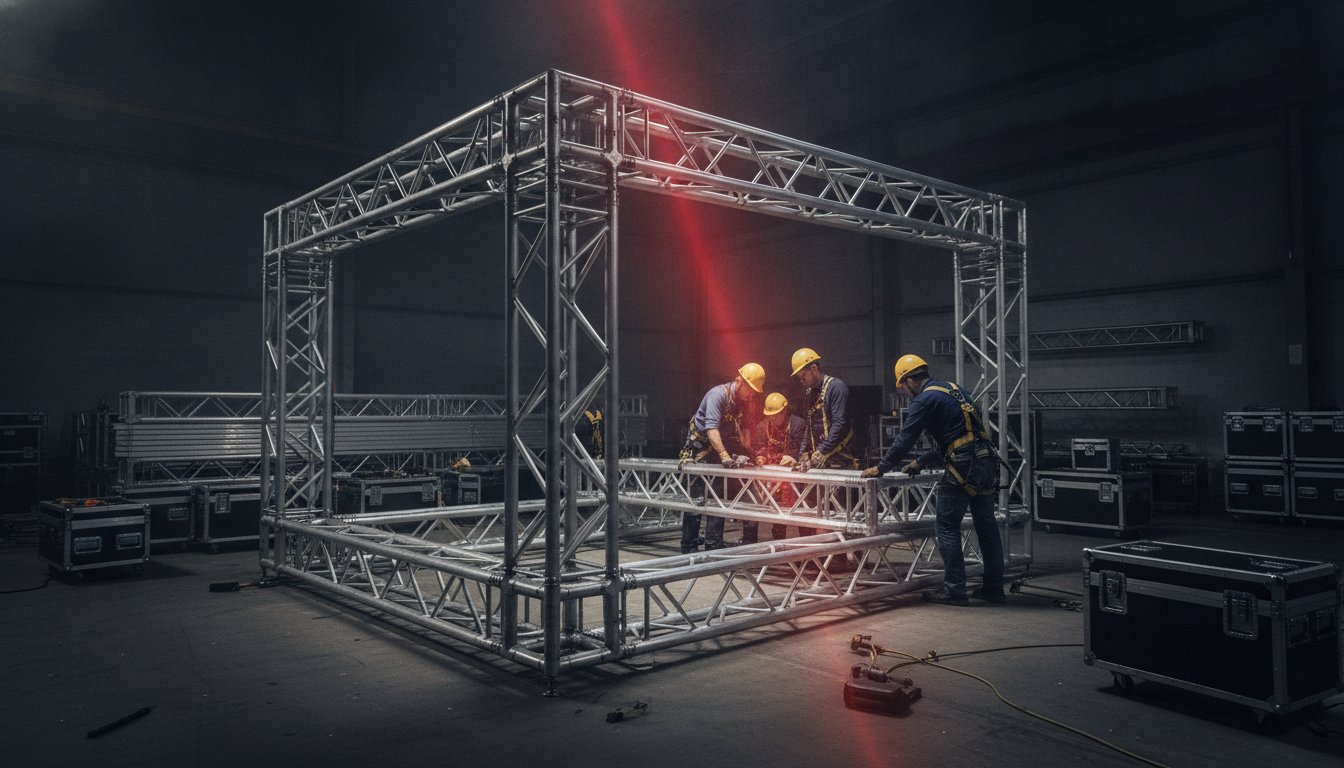
What if the capital saved on a decorative truss segment results in a catastrophic structural failure during a live production? For industry professionals, the distinction between aesthetic aluminum and load-bearing structural-grade material is a matter of safety rather than just budget. Determining the true truss system cost requires a meticulous analysis of engineering specifications, material science, and the logistical hardware necessary for secure assembly.
You likely understand that an initial quote rarely reflects the total investment needed for a compliant, modular rig. This guide provides the technical clarity required to master the factors and logistical requirements that dictate the total cost of professional event trussing. We will examine the impact of the January 2026 International Code of Practice for Entertainment Rigging (ICOPER) updates, the necessity of annual ANSI E1.47 inspections, and the essential role of specialized storage and transport systems in maintaining structural integrity over time.
Key Takeaways
- Distinguish between modular aluminum stage trussing and construction materials to ensure structural compliance for professional AV suspension.
- Identify 6082-T6 aluminum and TUV-certified welding as the non-negotiable engineering standards that define a realistic truss system cost.
- Compare the load-bearing capacities of Square F34 and Triangle F33 geometries to select the most efficient structure for your production requirements.
- Account for critical logistical components like heavy-duty base plates, corner blocks, and protective cases that significantly impact total project expenditure.
- Maximize long-term ROI by prioritizing equipment with standardized conical coupling for seamless integration with industry-standard rigging systems.
Understanding Stage Truss Cost vs. Construction Trusses
Professional production environments demand equipment that balances structural rigidity with rapid deployment. Many online search results for "truss" yield residential wooden roof units or permanent steel girders. These materials are entirely unsuitable for event production. Stage trussing consists of modular aluminum structures designed specifically for the temporary suspension of lighting, audio, and video equipment. Unlike static construction, these systems must endure repeated assembly and transport cycles without compromising safety.
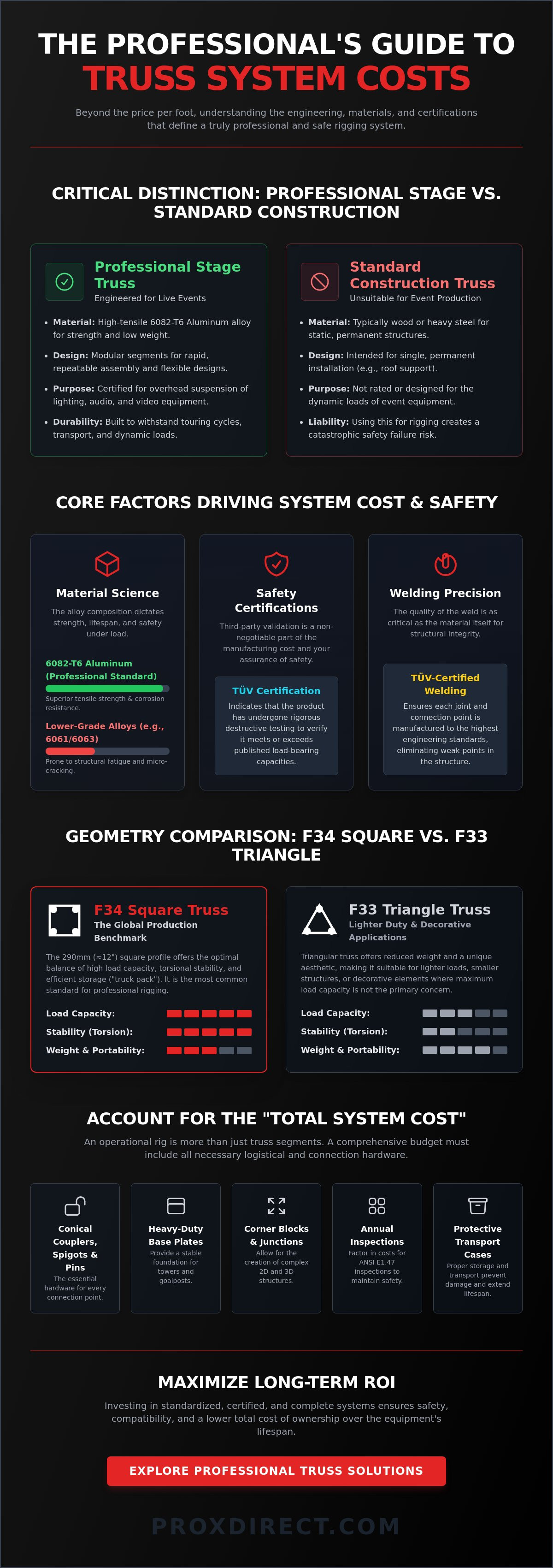
While a basic engineering overview of what a truss is applies to both fields, the material requirements differ drastically. Professional stage rigs utilize 6082-T6 aluminum. This specific alloy provides high tensile strength and excellent corrosion resistance. It's the industry standard for a reason. Steel is too heavy for efficient touring; wood lacks the precision needed for modular interlocking. Determining your truss system cost involves more than checking a price list for linear footage. You're investing in a certified structural system.
A comprehensive budget must account for the "Total System Cost." This includes the specialized hardware that bridges the gap between individual segments. You'll need conical couplers, spigots, and safety pins for every connection point. If you omit these from your initial calculations, you'll face unexpected expenditures during the build phase. Professional ProX Truss solutions provide the necessary engineering documentation to ensure these components work in unison under load.
The Modular Advantage: Why Event Pros Pay More
Touring schedules require hardware that technicians can assemble and strike in hours. This speed is the primary value proposition of modular aluminum. Every segment must feature universal compatibility within its series to allow for flexible stage designs. It's also vital to distinguish between decorative display truss and structural truss. Display units are often thinner and lack the load-bearing certifications required for overhead rigging. Choosing the cheaper, non-structural option to lower the truss system cost creates an unacceptable liability on site.
Defining the Industry Standard: F34 Square Truss
The 290mm (approximately 12-inch) square truss serves as the global production benchmark. This size offers the optimal balance between load capacity and truck pack efficiency. Because it's a standardized dimension, it integrates easily with various accessories and existing inventories. Standardized gear reduces long-term logistical costs by ensuring that parts are interchangeable across different setups.
The conical coupling system is the heart of the F34 design. It uses a tapered connector that fits into the main chords, secured by a pin and R-clip. This design eliminates the play found in older bolt-plate systems. It ensures a rigid connection that handles both shear and tension forces effectively. When you invest in F34 hardware, you're buying into a system that simplifies assembly while maintaining the highest safety standards in the industry.
Primary Factors Influencing Truss System Pricing
Raw metal weight is merely a baseline for equipment valuation. The final truss system cost is dictated by engineering precision, metallurgical properties, and manufacturing certifications that ensure long-term structural integrity. Professional buyers must look beyond the surface finish to evaluate the technical specifications that differentiate a structural asset from a decorative liability. Every design choice, from the alloy selection to the connection method, impacts both the initial purchase price and the total cost of ownership.
Material Science: 6082-T6 vs. Lower Grades
Alloy composition directly dictates the maximum load-bearing capacity and safety margin of a rig. Professional manufacturers utilize 6082-T6 aluminum as the primary alloy for professional-grade trussing. This specific grade offers superior yield strength and tensile properties compared to 6061 or 6063 alternatives. While cheaper alloys are available, they're prone to structural fatigue and micro-cracking at stress points over repeated load cycles. A lower-grade system might reduce capital expenditure initially, but it results in a shorter equipment lifespan and creates an unacceptable risk of catastrophic failure under load.
The Cost of Safety Certifications
TUV certification represents a significant portion of the manufacturing investment. This third-party validation involves rigorous destructive testing to verify that the truss meets or exceeds its published loading charts. In the global event market, certified trussing is a standard requirement for professional venues and municipal permits. These engineering testing phases are factored into the purchase price because they provide the technical data necessary for insurance compliance. Maintaining these standards requires diligent record-keeping and annual inspections to ensure the hardware remains within its original safety tolerances.
Welding precision is another critical cost driver. Hand-welded joints performed by certified technicians offer a level of penetration and consistency that automated systems often fail to replicate in complex geometries. This craftsmanship ensures that the heat-affected zone around the weld doesn't compromise the chord's structural integrity. Furthermore, the transition from traditional bolted truss to conical coupling systems has altered the pricing landscape. Conical couplers require more precise machining and higher-quality steel pins, but they significantly reduce labor costs during assembly and provide a more rigid, genderless connection.
Comprehensive engineering documentation, including point-load and distributed-load charts, is essential for any professional build. This data allows riggers to calculate safe working loads with precision, preventing the over-stressing of components. You can explore a wide range of certified ProX Truss components to build a system that meets these strict technical and safety requirements. Investing in documented hardware protects your personnel, your equipment, and your professional reputation.
Truss Geometry and Load Capacity Comparison
Structural geometry is the primary determinant of load capacity and logistical efficiency. While previous sections detailed material grades, the physical configuration of the chords and webbing dictates how a span handles tension and compression. A higher initial truss system cost for square profiles often yields better long-term value through increased weight limits and rigging flexibility. Square truss currently holds a 60% market share in the professional sector due to this inherent versatility.
Choosing the Right Shape for Your Budget
Square truss (F34) features a four-chord architecture that excels in managing torsional stress. It's the standard for heavy lighting rigs and large-scale deployments. Triangle truss (F33) utilizes three chords and is more cost-effective for medium-duty applications or where aesthetics are a priority. Recent market data shows a 269.82% increase in demand for triangle configurations, reflecting their popularity in retail and experiential setups. However, triangle segments require precise orientation; the apex must be positioned correctly according to the manufacturer's load charts to maintain structural integrity.
I-Beam or ladder truss consists of two main chords. It's the most affordable option but is limited to simple spans with minimal vertical load. It lacks the lateral stability of multi-chord designs. Conversely, circular and curved trusses involve specialized engineering. Bending 6082-T6 aluminum without compromising wall thickness requires precision manufacturing, which carries a premium price. When calculating the total geometry cost, remember that corner blocks and specialized junctions are often the most expensive individual components in the rig.
Load Charts and Structural Integrity
Reading a loading chart is a fundamental skill for any rigger. These documents specify the maximum weight a span can support over a given distance. For example, a 40-foot span of F34 truss has a significantly lower capacity than a 10-foot span of the same material. You must distinguish between point loads, where weight is concentrated in one spot, and distributed loads, where weight is spread evenly across the span. Point loads exert more stress on specific webbing members and chords, necessitating more robust hardware.
Exceeding these published limits creates a structural liability that far outweighs any initial savings. Adhering to these specifications is not merely a technical preference; it's a legal necessity aligned with OSHA safety standards for entertainment rigging. For complex installations involving heavy visual equipment, integrating LED Video Panel Wall Support hardware ensures that the load is distributed according to engineered safety margins. Always consult the specific load tables for your ProX Truss inventory before finalizing a rigging plan.
Hidden Costs: Accessories, Logistics, and Protection
Evaluating the truss system cost involves calculating the Total Cost of Ownership (TCO) rather than just the purchase price of straight segments. While used equipment listings might seem like a bargain, they often hide the expense of missing conical couplers, bent safety pins, or compromised chords. A professional rig requires a suite of specialized accessories and protective infrastructure to maintain safety standards and operational efficiency over multiple years of service. Every component, from the largest base plate to the smallest R-clip, contributes to the system's structural integrity and your bottom line.
Base Plates and Stability
The foundation of any vertical structure is the base plate. Aluminum plates are lightweight and suitable for indoor applications where floor protection is a priority. However, outdoor stability or tall totem configurations often necessitate heavy steel base plates. These oversized foundations provide the ballast required to prevent tipping, especially when top-heavy lighting fixtures are mounted. Protecting these heavy metal components is essential. Utilizing Stage Truss and Base Plate Cases prevents heavy hardware from damaging other sensitive equipment during transit and reduces the risk of oxidation from environmental exposure.
Logistics and Flight Case Protection
Physical damage during transport is a primary cause of premature truss retirement. Dents in the main chords or bent webbing members immediately disqualify a segment from professional use. Replacing damaged segments is a significant recurring expense that you can mitigate through proper logistics. Dedicated storage solutions and transportation dollies keep segments organized and secure. Adopting a standardized system like ProX-Truss ensures that your protective cases and transport hardware remain compatible as your inventory grows. This modularity simplifies truck packing and reduces labor time during load-ins.
Corner blocks and hinges are frequently the most expensive individual components in a system. These specialized junctions are engineered to maintain structural integrity across 90-degree angles or variable slopes. Unlike a simple straight segment, a corner block must handle multi-directional forces. Investing in high-quality junctions ensures that the entire rig remains rigid and square. Relying on inferior or mismatched corners introduces weak points that can lead to structural failure under load. Small hardware items like clamps, safety cables, and couplers also represent a cumulative cost that riggers often underestimate. Every lighting fixture requires a rated clamp and a secondary safety cable to meet modern safety protocols.
Losing pins or R-clips on a job site creates logistical delays and safety hazards. Maintaining a stocked inventory of replacement parts is a mandatory operational cost. You can secure your long-term investment by browsing the full catalog of ProX Cases and accessories to keep your system fully operational and compliant with current industry standards.
Maximizing ROI with ProX Professional Truss Solutions
Selecting a manufacturer with an established engineering heritage is the final step in managing your truss system cost. ProX has manufactured performance gear since 1984, establishing a reputation for functional excellence and engineering precision. This long-term expertise means the hardware is designed for the physical demands of professional production. The use of standardized conical coupling allows for seamless integration with existing industry-standard rigs. This compatibility prevents technical isolation and ensures your inventory remains a versatile asset as your production needs expand.
A global dealer network further enhances the value proposition by reducing logistical friction. Localized availability minimizes shipping expenses and provides immediate access to technical support. For complex broadcast or lighting installations that exceed standard configurations, custom engineering services provide bespoke solutions. These tailored designs maintain the same structural standards as off-the-shelf components, ensuring safety across unique architectures. This proactive approach to equipment selection minimizes the risk of structural failure and protects your financial investment.
The ProX Engineering Standard
Structural integrity is non-negotiable in high-stakes environments. ProX utilizes 6082-T6 aluminum combined with TUV-certified welding processes to meet international safety benchmarks. Every segment comes with comprehensive loading data, allowing technicians to verify spans with mathematical certainty. For high-value displays, specialized LED Video Panel Wall Support systems provide the necessary rigging points to handle the significant weight of modern video tiles. These systems are engineered to distribute loads safely, protecting both the display technology and the personnel on site.
Long-Term Value and Resale
Standardized professional trussing maintains a significantly higher resale value than generic, uncertified brands. Because the dimensions and coupling systems are industry-standard, the equipment remains liquid on the secondary market. The availability of replacement parts and compatible accessories ensures that a rig can be maintained in peak condition for decades. Investing in a proven system reduces the total truss system cost by extending the equipment’s service life and minimizing the need for premature replacement. For professional quotes and technical specifications, authorized users can access the ProX Dealer Portal to configure their next structural build.
Optimizing Your Next Structural Build
Professional rigging requires a commitment to engineering precision and material science. You've seen that a realistic truss system cost extends beyond the linear footage of aluminum. It encompasses the TUV-certified welding processes, the structural reliability of 6082-T6 alloy, and the critical logistical hardware that ensures every connection remains secure under load. Prioritizing these technical standards protects your personnel and your high-value production equipment from the risks associated with uncertified alternatives.
Standardized components provide the modular flexibility needed for complex event environments. Since 1984, production professionals have relied on ProX for hardware that integrates seamlessly with industry-standard rigs. By investing in certified structural assets and dedicated protection systems, you ensure long-term ROI and operational safety. Take the next step in securing your infrastructure by exploring our comprehensive range of certified hardware.
Browse Professional ProX Truss Systems and Components today and build with the confidence of a seasoned industry veteran.
Frequently Asked Questions
How much does a 10-foot section of stage truss typically cost?
The price for a 10-foot (3-meter) section is determined by its geometry, material grade, and load-bearing certification. Square F34 truss generally commands a higher price than triangle or ladder profiles due to its four-chord construction and increased weight capacity. Factors such as wall thickness and the precision of the conical coupling system also influence the final unit price. You should evaluate the truss system cost based on the structural requirements of your specific rig.
What is the difference between F34 and F33 truss systems?
F34 is a four-chord square truss, while F33 is a three-chord triangle system. The square profile of the F34 provides superior torsional rigidity and significantly higher load capacities, making it the industry standard for heavy lighting and video arrays. F33 is often selected for its aesthetic appeal and reduced weight in medium-duty applications. While both systems often share similar coupling hardware, their engineering load charts and structural applications are distinct.
Do I need a structural engineer to approve my truss system?
Yes, professional venues and municipal authorities often require a signed engineering report for overhead or complex ground-supported rigs. A structural engineer verifies that the load distribution, point loads, and ballast requirements comply with local safety codes. This approval is a mandatory step for permanent installations and large-scale public events to ensure the build remains within safe operating limits and to minimize liability for the production company.
Is aluminum truss better than steel for live events?
Aluminum is the industry standard for portable event production because of its high strength-to-weight ratio. It's significantly lighter than steel, which reduces transportation expenses and labor time during assembly and strike. The use of 6082-T6 aluminum also provides excellent corrosion resistance for outdoor deployments. Steel is generally reserved for permanent building infrastructure where modularity and transport weight are not primary operational concerns.
Can I mix different brands of truss together?
Mixing different manufacturers is technically possible with standardized conical couplers but is professionally discouraged due to liability and safety concerns. Even if dimensions appear identical, variations in alloy composition, welding tolerances, and manufacturing standards can create structural weak points. Using components from a single manufacturer ensures that the provided load charts and TUV certifications remain valid. Mixing brands can void warranties and complicate insurance claims in the event of a failure.
What are the most common hidden costs when buying a truss rig?
The most frequent hidden expenses involve the essential accessories required for a functional and safe rig. Heavy-duty base plates, corner blocks, and specialized junctions often represent a large percentage of the total truss system cost. Additionally, you must budget for protective storage cases, transport dollies, and secondary safety hardware like rated clamps and steel cables. These items are necessary for maintaining the structural life of the equipment and meeting safety protocols.
How often should truss systems be inspected for safety?
Industry standards, including ANSI E1.47, require a thorough professional inspection of all rigging equipment at least once a year. Technicians should also conduct a visual inspection before every load-in and after every strike to identify dents, cracked welds, or bent chords. Regular inspections ensure that the equipment remains within its original safety tolerances and complies with OSHA regulations regarding hoisting machinery. Documentation of these inspections is vital for insurance and compliance records.
Why is TUV certification important for truss system cost?
TUV certification indicates that the hardware has undergone rigorous third-party destructive testing to validate its structural integrity. This certification ensures that the published loading data is accurate and that the manufacturing process meets strict safety standards. While certified hardware may involve a higher initial investment, it's essential for securing insurance coverage and municipal permits. It provides the legal and technical documentation required for professional production environments where safety is the priority.
Disclaimer
Any trademarks, trade names or brand names appearing herein that do not belong to ProX are the property of their respective owners and/or companies, and such appearance doesn't and shall not constitute or imply endorsement, sponsorship or recommendation by ProX.


