
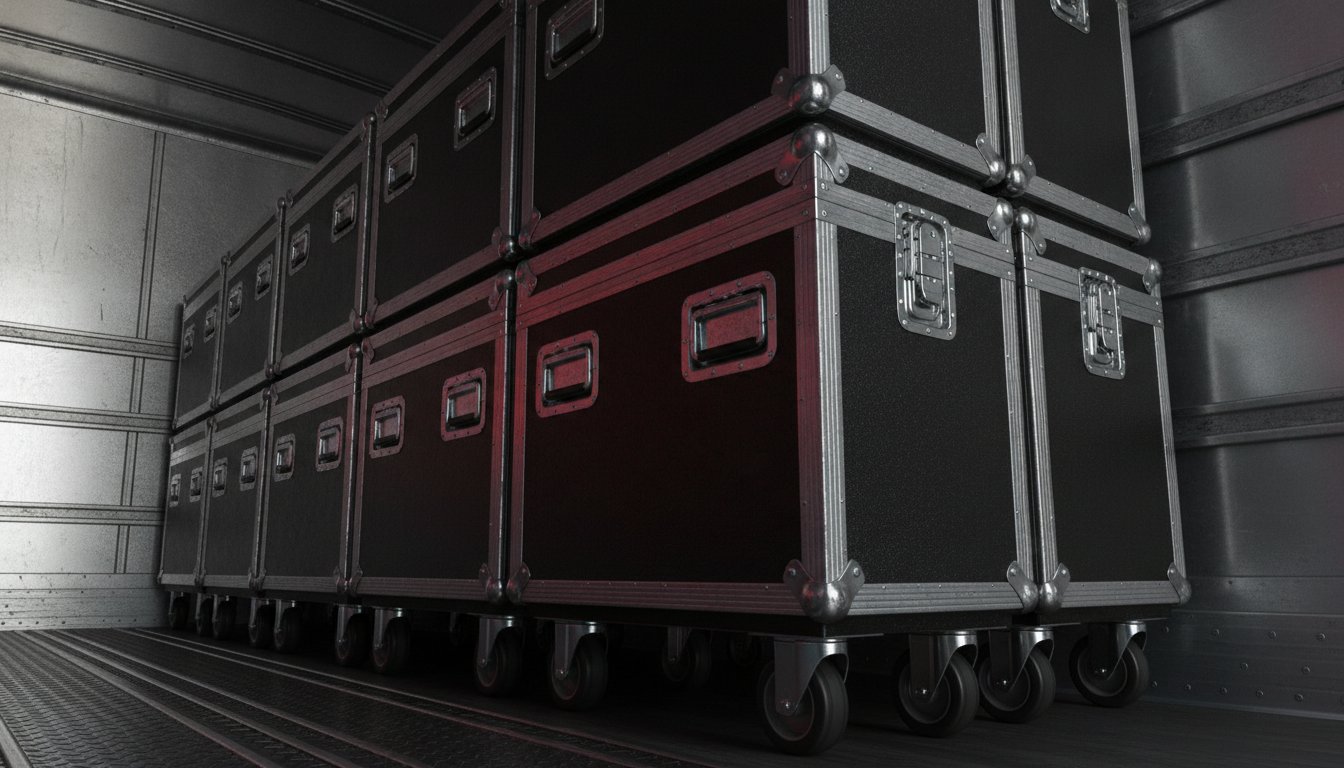
With powered speaker systems accounting for 67.55% of the professional market as of 2025, the integrated electronics and DSP in your cabinets are more susceptible to vibration damage than traditional passive components. You recognize that equipment failure isn't just a technical setback; it's a logistical failure that threatens the timeline of a professional tour. Shifting loads and non-stackable footprints don't just cause aesthetic cabinet damage. They create critical delays that impact the bottom line of every production.
This reference guide provides a technical analysis of how professional Speaker & Subwoofer Cases engineered to ATA 300 Revision 2023 standards mitigate these risks. You'll learn the material specifications required to ensure zero equipment failure and extend the functional lifespan of your transducers. We will examine the structural mechanics of Category I construction, the physics of vibration dampening, and the logistical math behind TruckPaX™ dimensions for optimized truck-pack density.
Key Takeaways
- Understand the mechanical principles of vibration dampening required to prevent driver failure and internal component damage during high-impact transit.
- Identify the structural requirements for ATA-300 Category 1 compliance, focusing on the load-bearing capabilities of 9mm and 12mm plywood architectures.
- Optimize logistical workflows by selecting Speaker & Subwoofer Cases that adhere to standardized truck-pack dimensions for maximum trailer density.
- Determine when custom-molded interior layouts are necessary for line array modules to mitigate the risks associated with oversized universal enclosures.
- Utilize a professional evaluation framework to assess hardware durability and caster performance before deployment in touring environments.
The Engineering of Protection: Why Speakers and Subwoofers Require Specialized Cases
Professional audio transducers are not merely speakers; they are high-precision mechanical assemblies that require specific environmental and structural conditions to function at peak performance. Standard Speaker & Subwoofer Cases serve as the first line of defense against the physical stresses of the touring cycle. These enclosures aren't just storage units. They are engineered systems designed to isolate sensitive components from external kinetic forces. In the high-stakes environment of professional production, touring-grade reliability is the baseline expectation. A failure during a show isn't an option, and that reliability starts with the integrity of the transport enclosure.
The physics of vibration mitigation is central to professional case design. During transport, equipment is subjected to constant low-frequency oscillation and high-impact shocks that can loosen internal fasteners or crack circuit boards in powered speakers. While some manufacturers suggest that soft covers or nylon bags are sufficient for transport, these options fail to address the structural requirements of high-impact touring. Soft covers protect against dust and light abrasions but offer zero defense against crushing forces or drops. Only a hard-shell enclosure can absorb and redirect impact energy away from the cabinet. This protection is a financial strategy as much as a technical one. Preserving the resale value of professional audio gear requires a commitment to zero-damage logistics.
Protecting the Transducer: Internal Mechanics
High-density ester or polyethylene foam prevents driver misalignment during transit by providing a custom-contoured fit. For heavy subwoofers, the magnet assembly's inertia can cause the frame to bend or the voice coil to shift if the case lacks proper dampening. Professional designs often incorporate "floating" internal architectures that isolate the speaker from the outer walls. This is vital during international shipping where containers face extreme thermal stress and high humidity. A sealed, gasketed case helps maintain a stable internal environment, protecting the paper cones and adhesives from moisture-related degradation and structural fatigue.
Cabinet Integrity and Professional Aesthetics
Structural cabinet warping is a common result of uneven pressure during stacking. Professional cases use reinforced 9mm or 12mm plywood to ensure the load is distributed across the case frame rather than the speaker itself. This prevents corner impact damage that could lead to air leaks in the enclosure, which would ruin the acoustic tuning of a ported system. Maintaining a professional appearance is non-negotiable for high-end corporate production. A scuffed or dented cabinet suggests a lack of professional standards. You can explore the full range of ProX Cases to find engineering solutions that maintain both the acoustic and aesthetic integrity of your inventory.
ATA-300 Standards and Material Science in Professional Case Manufacturing
The Air Transport Association's ATA 300 specification serves as the primary benchmark for industrial case manufacturing. Revision 2023 defines Category I containers as those capable of surviving a minimum of 100 round trips under rigorous shipping conditions. For professional Speaker & Subwoofer Cases, this standard isn't just a recommendation; it's a requirement for ensuring the safety of high-value audio components. Achieving this level of durability requires a specific combination of material thickness and structural reinforcement that exceeds consumer-grade storage options.
Structural rigidity begins with the choice of plywood. Most professional enclosures utilize 9mm or 12mm multi-layer plywood. The 9mm variant offers a balance of weight and strength for standard speaker cabinets, while 12mm plywood is typically reserved for heavy-duty subwoofer enclosures that must support significant internal mass. This material resists bowing and maintains its shape under the pressure of stacked loads, preventing the mechanical fatigue that leads to joint failure during multi-city tours.
Surface protection is achieved through specialized laminates like Honeycomb Digital™. This hexagon-patterned high-pressure laminate (HPL) provides superior impact resistance compared to standard flat finishes. The raised texture creates a sacrificial layer that absorbs minor abrasions, keeping the underlying plywood intact. These laminates are also engineered to withstand extreme temperature fluctuations. This prevents the bubbling or peeling common in lower-grade alternatives during transit between climate-controlled venues and unheated trailers.
The anatomy of a reinforced edge is defined by aluminum extrusions and steel ball corners. Heavy-duty tongue-and-groove aluminum extrusions ensure a precise, dust-resistant fit between the lid and the base. Steel ball corners are positioned at every intersection to redirect impact energy away from the plywood panels. These components work together to maintain the squareness of the enclosure, ensuring it remains stackable even after years of heavy use. If you're building a touring inventory, selecting an inventory of professional-grade enclosures built to these specifications is the most effective way to minimize long-term maintenance costs.
Laminate Technology and Surface Protection
The hexagon pattern on modern laminates isn't just for aesthetics. It significantly improves scratch resistance by reducing the surface area in contact with other cases. High-pressure laminates remain stable in temperatures ranging from sub-zero to high-heat environments. For maintenance, a simple wipe-down with a non-abrasive cleaner preserves the finish and prevents the buildup of road grime that can degrade the laminate's adhesive bond over time.
Hardware Specifications for Touring Reliability
Industrial hardware must withstand thousands of cycles. Spring-loaded recessed butterfly latches are the industry standard because they maintain tension despite the constant vibrations of travel. Reinforced handles should feature rubber grips and be rated for the specific weight of the speaker or subwoofer they support. Utilizing zinc-plated steel for all external hardware is essential to prevent oxidation and corrosion, especially in coastal or high-humidity touring regions.
Logistical Optimization: Casters, Stacking, and Truck-Pack Density
Logistics in professional touring is a matter of mathematical optimization. Standardized dimensions for Speaker & Subwoofer Cases aren't arbitrary; they're designed to interface with the internal width of standard trailers, which typically measure between 96 and 102 inches. When case footprints are engineered as sub-divisions of these dimensions, you achieve maximum truck-pack density. This reduces the number of vehicles required for transport and minimizes the risk of shifting loads that cause equipment damage. Standardizing your fleet ensures that every load-in is predictable and every trailer is utilized to its full volumetric capacity.
Caster quality directly influences crew fatigue and the speed of technical deployment. High-grade casters reduce the rolling resistance of heavy subwoofer enclosures, allowing for more efficient movement across varied surfaces. Beyond ease of movement, casters play a critical role in the safety of the crew and the equipment. A failure in a wheel assembly during a ramp transition can result in catastrophic equipment loss. Utilizing heavy-duty, non-marring polyurethane wheels ensures that your inventory moves safely without damaging venue flooring or compromising the stability of the stack.
Caster Engineering for Heavy Audio Gear
Industry standards favor 4-inch casters over 2-inch variants because they provide a superior center of gravity and better clearance over floor obstacles. Larger wheels distribute the weight of heavy subwoofers more effectively, preventing flat spots during long-term storage. Swivel locks and integrated brakes are essential for securing loads on inclines and during transit. For comprehensive production setups, integrating cases with ProX Truss systems allows for a unified logistical approach where all components share compatible transport footprints.
Truck-Pack Logic and Space Utilization
Truck-pack logic relies on "quarter-pack" and "half-pack" dimensions. In the US, this typically means case widths of 22.5 inches or 45 inches to fit four or two across a trailer. Precision-aligned stacking dishes are integrated into the lids to allow for secure vertical storage in the warehouse and the truck. These dishes lock the casters of the top case into the lid of the bottom case, creating a stable column that resists lateral movement. By optimizing volume utilization, production companies can significantly reduce their total shipping costs over the duration of a tour.
Safety is the primary concern when stacking heavy Speaker & Subwoofer Cases. You must ensure that the total weight of the stack does not exceed the load-bearing capacity of the bottom case's casters or plywood structure. Regularly inspecting caster plates and mounting bolts is a technical necessity. A well-maintained fleet of standardized enclosures doesn't just protect the gear; it streamlines the entire logistical workflow from the warehouse to the stage.

Precision Fitment: Custom Cases for Major Audio Brands vs. Universal Solutions
Precision fitment is the technical bridge between basic transport and professional transducer protection. While universal enclosures provide a cost-effective solution for rental inventories with high turnover, they often require excessive foam blocking to fill internal voids. This can be problematic as foam compresses over time, leading to equipment shifting within the case. In professional Speaker & Subwoofer Cases, a gap of even half an inch allows for the buildup of kinetic energy during sudden stops, which can shear internal fasteners or damage the speaker’s voice coil. Custom-engineered interiors ensure that the load is supported at the cabinet’s strongest structural points, effectively neutralizing the risk of internal movement.
For major audio brands such as JBL, QSC, RCF, and EV, custom-fit enclosures are the industry standard for touring. These cases are designed using the exact CAD specifications of the manufacturer. When measuring your equipment for a custom engineering project, you must provide precise dimensions for height, width, and depth. This data must include all protruding hardware such as rigging pins, handles, and rubber feet. Accurate measurement ensures that the high-density foam inserts provide a "glove-fit" that maintains the alignment of the speaker components regardless of the orientation of the case during transit.
Line Array Transport Systems
Line array modules require specialized transport systems that accommodate multiple units, typically in dual or quad configurations. These systems must account for the specific center of gravity of the array to prevent tipping during load-in on uneven surfaces. High-quality designs include dedicated compartments for integrated rigging hardware, ensuring that pins and brackets remain with the modules at all times. An example of this precision engineering is this RCF-compatible case, which is built to the exact tolerances of the cabinet to prevent finish abrasion and mechanical stress.
Subwoofer-Specific Engineering Challenges
Subwoofers present unique engineering challenges due to their high weight-to-volume ratio. A dual 18-inch subwoofer can exceed 200 pounds, requiring 12mm plywood and reinforced base plates to prevent floor-panel sagging over years of use. Ventilation is also a critical factor for long-term storage. Sealed cases can trap moisture if equipment is packed immediately after a high-humidity outdoor event, leading to cone degradation. Professional designs incorporate specific foam spacing or breather vents to allow for airflow. Selecting the correct enclosure is a critical technical decision. You can view the technical specifications for our custom-fit enclosures to ensure your inventory is protected by industry-standard engineering.
Choosing Your Protection Strategy: A Professional Reference for Production Crews
Selecting the appropriate Speaker & Subwoofer Cases requires a systematic evaluation of mechanical specifications rather than a reliance on aesthetic appeal. A professional procurement strategy prioritizes structural longevity and logistical compatibility over initial cost savings. Before adding new enclosures to your inventory, you must verify that the build quality meets the demands of high-frequency touring. This involves a rigorous assessment of the materials and hardware used in the assembly process. Use the following technical checklist to evaluate potential equipment:
- Verification of ATA-300 Category I material standards for reusable shipping.
- Assessment of recessed butterfly latch tensile strength and spring tension.
- Evaluation of caster load-bearing specifications and wheel durometer.
- Inspection of internal foam density and the quality of the adhesive bonding.
- Confirmation of truck-pack dimensional compatibility for optimized trailer density.
Balancing protection levels with weight requirements is a critical logistical decision. While 12mm plywood offers maximum rigidity for heavy subwoofers, it increases the total transport weight, which can impact fuel costs and stage weight limits. For smaller mid-high cabinets, 9mm plywood often provides sufficient impact resistance while maintaining a manageable footprint. You must also consider the availability of replacement parts. A case that cannot be repaired in the field becomes a liability. Relying on manufacturers with established dealer networks ensures you can source casters, handles, and latches quickly during a tour.
Evaluating Long-Term ROI
The financial justification for premium Speaker & Subwoofer Cases is found in the reduction of emergency repair capital. High-quality enclosures often lead to lower insurance premiums for touring acts because they demonstrate a commitment to risk mitigation. The structural integrity of a professional enclosure directly correlates with tour profitability by eliminating the capital expenditure associated with emergency transducer replacement and logistical downtime.
Maintenance and Lifecycle Management
Proactive maintenance extends the lifecycle of your transport inventory. Implement a 5-point routine that includes lubricating latch mechanisms, tightening caster bolts, and inspecting the integrity of the aluminum extrusions. Internal foam should be replaced if it shows signs of permanent compression, as this reduces its ability to absorb shock. Standardizing your production inventory with compatible hardware simplifies this process. You can find replacement parts and accessories to maintain your fleet at peak operational standards. Consistent maintenance ensures that your protection strategy remains effective for hundreds of shows, preserving both your gear and your professional reputation.
Implementing a Standardized Protection Framework
ProX has been engineering performance gear since 1984. We provide solutions trusted by touring professionals for JBL, QSC, and RCF equipment. Our global dealer network ensures your fleet doesn't face unnecessary downtime, regardless of the tour's destination. You can Browse the Professional Speaker & Subwoofer Case Catalog to secure your production assets. Investing in technical excellence today prevents the logistical failures of tomorrow. Your gear deserves the highest level of structural integrity.
Frequently Asked Questions
What is the difference between a standard shipping case and an ATA-300 compliant case?
ATA-300 compliant cases meet specific industrial engineering standards for repeated durability. Revision 2023 Category I requires the enclosure to survive at least 100 round trips under rigorous handling conditions. Standard shipping cases lack the reinforced aluminum extrusions and steel ball corners necessary for high-impact transport. These professional enclosures prioritize structural longevity and the safety of internal components over basic storage needs.
How do I determine if my speaker needs a custom-molded interior or a universal fit?
Custom-molded interiors are essential for equipment with irregular dimensions or sensitive rigging, such as line array modules. If your cabinet shifts even slightly within the enclosure, it requires custom foam to prevent mechanical damage. Universal Speaker & Subwoofer Cases are suitable for standard rectangular cabinets where high-density foam blocking can securely fill the internal void and provide adequate dampening.
Why should I prioritize 4-inch casters over smaller wheels for subwoofer cases?
4-inch casters provide superior load distribution and easier clearance over floor obstacles like cables or door thresholds. Subwoofers often exceed 200 pounds; smaller wheels increase rolling resistance and crew fatigue. Larger casters also help maintain a stable center of gravity during ramp transitions, which is critical for preventing equipment from tipping or sustaining impact damage during load-in.
Can I use these cases for international air travel with my audio equipment?
Yes, cases built to ATA-300 Category I specifications are engineered specifically for international air transport. These enclosures feature high-density plywood and reinforced hardware that withstands the mechanical stress of cargo handling. You should ensure that all latches and handles are recessed to prevent them from catching on automated sorting equipment. This design minimizes the risk of hardware failure during transit.
How does the weight of a professional flight case affect my logistical costs?
The weight of a professional case directly impacts fuel consumption and shipping rates. Utilizing 9mm plywood for mid-high speakers reduces total mass without compromising structural integrity. However, for Speaker & Subwoofer Cases containing heavy drivers, the increased weight of 12mm plywood is a necessary trade-off for protecting the cabinet from structural warping and ensuring long-term durability during transport.
What is the best way to clean and maintain the honeycomb laminate on my cases?
Use a non-abrasive cleaner and a soft cloth to maintain the Honeycomb Digital™ laminate surface. The hexagonal pattern is engineered to resist scratches, but road grime can accumulate in the texture over time. Avoid harsh chemicals that could potentially degrade the laminate's adhesive bond or the structural integrity of the underlying plywood panels. Regular cleaning prevents surface buildup from affecting the finish.
Are these cases stackable with other industry-standard brands?
Most professional enclosures utilize standardized stacking dishes compatible with other industry-standard brands. This allows for stable vertical storage in warehouses and trailers. Compatibility depends on the case footprint adhering to standardized truck-pack dimensions, which ensures the casters of the top case align precisely with the stacking dishes on the lid below. This standardization is a key factor in logistical efficiency.
What should I do if a latch or handle becomes damaged during a tour?
Professional cases are designed for field repairability using standardized industrial hardware. If a latch or handle fails, you can source replacement parts from a global dealer network. It's advisable to carry a small inventory of spare recessed butterfly latches and spring-loaded handles to ensure your gear remains secure throughout the duration of a tour. Quick repairs prevent minor damage from compromising equipment safety.
Disclaimer
Any trademarks, trade names or brand names appearing herein that do not belong to ProX are the property of their respective owners and/or companies, and such appearance doesn't and shall not constitute or imply endorsement, sponsorship or recommendation by ProX.


