
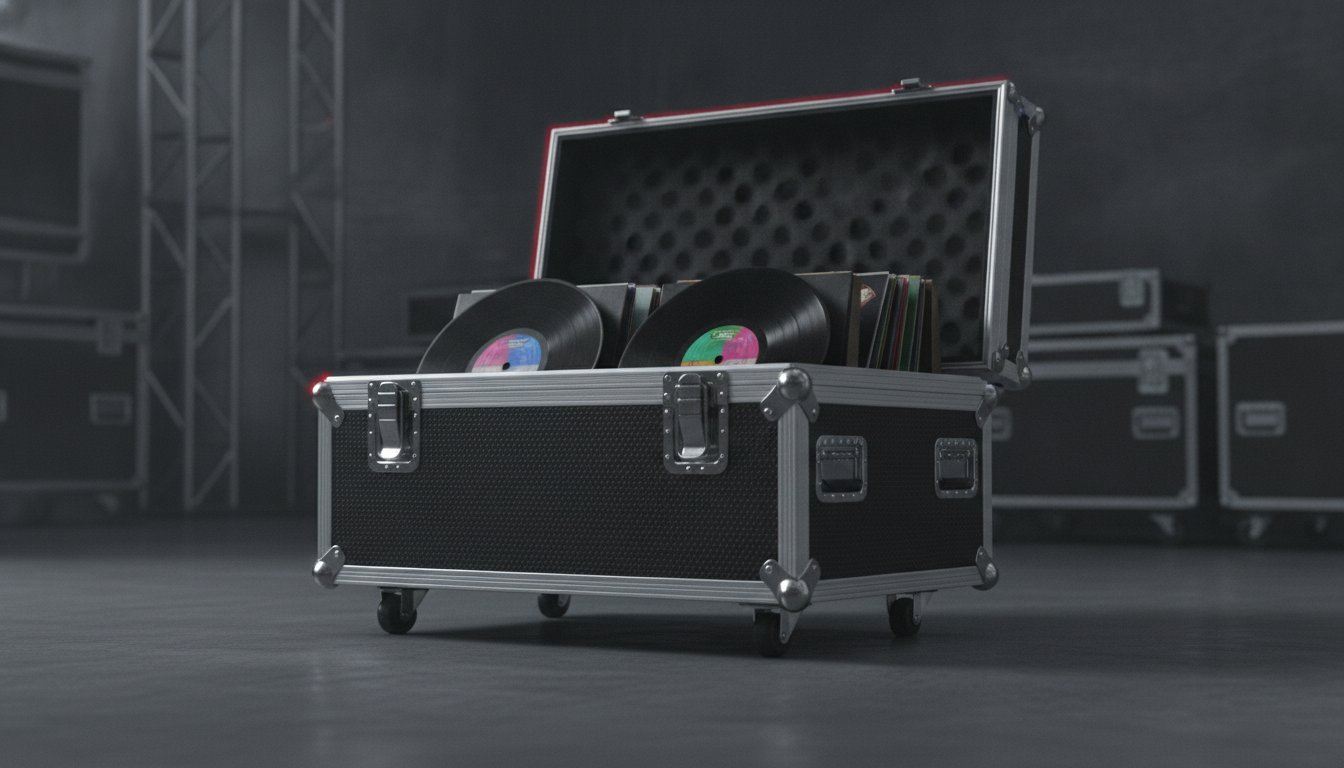
A vinyl record is a precision-engineered analog medium, yet many transport solutions fail to account for the mechanical stresses of professional touring. Selecting a professional vinyl carrying case is not an aesthetic choice; it's a matter of structural engineering and logistical reliability. You understand that corner damage, heat-related warping, and hardware failure aren't just inconveniences. They are systemic failures that compromise high-value assets during high-load logistics cycles.
This guide provides the technical framework needed to evaluate transport solutions based on industrial standards. You'll learn how to identify builds that meet the ATA-300 specification, which requires equipment to withstand at least 100 round trips. We'll examine the specifications of professional-grade builds, including honeycomb digital lamination and high-density foam interiors. By the end of this analysis, you'll have the expertise to select a solution that ensures zero-damage transit and seamless truck-pack compatibility for any touring environment.
Key Technical Insights
- Analyze the structural requirements of a professional vinyl carrying case, focusing on weight distribution and mechanical assembly for high-capacity loads.
- Distinguish between consumer-grade storage and industrial transport through technical standards like ATA 300 compliance.
- Evaluate material science specifications, comparing the durability of high-density plywood against molded plastic for touring environments.
- Apply a selection framework to calculate total load weight and verify hardware ratings for handles and latches.
- Review professional logistics solutions from Santosom and ProX that prioritize functional excellence and long-term reliability.
The Anatomy of a Professional Vinyl Carrying Case
Professional vinyl transport requires a fundamental shift in perspective from static storage to dynamic logistics. A standard vinyl carrying case designed for the touring circuit is not merely a container; it is a specialized enclosure built to manage the physical forces encountered during kinetic transport. While residential storage units prioritize accessibility and aesthetics, professional cases prioritize structural rigidity and load-bearing capacity. This distinction is critical for maintaining the archival quality of a collection over years of active use.
The physics of transporting 70 to 100 LPs present unique engineering challenges. A collection of this size typically weighs between 45 and 55 lbs, depending on the vinyl grammage and sleeve thickness. This mass exerts constant pressure on the bottom panel and creates significant inertia during movement. Without a reinforced frame, the enclosure can bow or fail at the seams. Using established principles found in Road Case Construction, manufacturers utilize heavy-duty plywood and steel ball corners to distribute these forces evenly across the chassis. This ensures that the structural integrity remains uncompromised even when the case is stacked at the bottom of a heavy truck pack.
Beyond Aesthetic: Why Construction Matters
High-fidelity audio depends on the microscopic integrity of the record groove. Impact shocks during transit can cause records to shift violently, leading to surface abrasions or sleeve burn from friction. Rigid external shells, such as those found in the ProX Cases lineup, prevent external compression from crushing the sleeves and warping the discs. A professional vinyl case serves as an engineered barrier against mechanical stress, isolating high-value media from the harsh realities of the logistical chain.
The Problem with Consumer-Grade Record Bags
Soft-sided nylon bags are prone to material fatigue. Under the weight of a full collection, the fabric stretches and the stitching at handle attachment points eventually fails. These bags also lack the corner reinforcement necessary to prevent corner dings, which significantly devalues a collection. Professional DJs and touring audiophiles avoid these risks by utilizing hard-shell vinyl carrying case solutions. These units provide the impact resistance and thermal insulation required for international travel where equipment is subjected to varying pressure and temperature shifts in cargo holds. The transition to hard-shell protection ensures that the hardware, rather than the media, absorbs the energy of any impact.
Engineering Standards: What Defines a Touring-Grade Case?
The term "touring-grade" represents a specific engineering benchmark, not a marketing label. For a vinyl carrying case to survive the rigors of professional logistics, it must adhere to the ATA 300 Category 1 specification. This standard, established by the Air Transport Association, mandates that a container must withstand a minimum of 100 round trips without structural failure. Achieving this level of reliability requires a meticulous selection of materials and mechanical components that prioritize functional longevity over weight reduction. In high-stakes production environments, a case that meets these criteria acts as the primary defense against equipment loss.
Laminated Plywood and Structural Integrity
The core of a professional enclosure is typically constructed from multi-layered plywood. High-grade birch or poplar ply provides the necessary density to resist warping under heavy loads. Professional manufacturers often employ a "Honeycomb Digital" laminated surface. This hexagonal pattern acts as a secondary layer of impact resistance, dispersing energy across the surface to prevent punctures during rough handling. While 3/8" plywood is the industry standard for 70-LP cases, 1/2" thickness is often utilized for larger utility configurations to ensure rigid support. Wood also offers superior thermal insulation compared to molded plastic. This characteristic is vital for preventing heat-related warping of vinyl records during extended periods in non-climate-controlled transport environments.
Industrial Hardware for High-Stakes Logistics
Hardware failure is the primary cause of equipment damage during transit. Standard clips or surface-mounted latches are prone to shearing off or accidental opening when subjected to the vibrations of a moving vehicle. Professional cases utilize recessed butterfly twist-lock latches. These mechanisms draw the lid and base together with high tension, creating a secure seal that resists vibration-induced loosening. Similarly, recessed spring-action handles are engineered to sit flush with the case exterior. This design prevents snagging during truck-pack maneuvers and protects the handle from impact damage.
Steel ball corners are another non-negotiable feature for professional use. These reinforced junctions protect the most vulnerable parts of the case and facilitate secure stacking. When cases are stacked four or five high, the ball corners interlock to prevent lateral shifting. Internal protection further differentiates professional gear. High-density foam, often made from recycled materials, absorbs kinetic energy far more effectively than thin velvet linings. This foam provides a precise friction fit, ensuring that the records do not shift and cause sleeve friction. For those managing specialized gear alongside their media, exploring professional case solutions ensures every component in your inventory meets these rigorous technical standards.
Roundup of Professional Transport Formats
Professional logistics demand varied form factors to accommodate different media types and operational scales. The standard 12-inch vinyl carrying case remains the primary tool for touring professionals. These units are engineered for specific capacities, typically ranging from 50 to 100 LPs. For high-density collections involving 45 RPM singles, 7-inch cases utilize narrower internal channels. This prevents the lateral shifting that occurs when smaller media is placed in oversized compartments. High-value rare pressings often require custom-engineered enclosures with specialized foam inserts to provide absolute immobilization during high-vibration transit cycles.
Single-Row vs. Multi-Row Case Configurations
Operational efficiency often dictates the choice between single and multi-row designs. A single-row vinyl carrying case holding approximately 50 records is widely considered the sweet spot for manual portability. At this capacity, the total weight remains manageable for a single technician to carry without mechanical assistance. In contrast, multi-row cases are designed for archival transport or comprehensive touring sets where volume is the priority. These larger units often feature integrated casters or are designed to interlock with standard pallet dimensions for efficient loading. Professionals can explore our range of ProX Cases for professional gear to find the configuration that matches their specific logistical footprint.
Specialized AV and Broadcasting Adaptations
The integration of analog media into digital workflows has led to the development of hybrid transport solutions. Modern mobile workstations now feature dedicated compartments for vinyl alongside racks for mixers and audio interfaces. These AV Broadcasting Cases for mobile production allow technicians to deploy a complete audio environment from a single enclosure. This design philosophy eliminates the need for multiple smaller cases and streamlines the load-in process at the venue. These hybrid units maintain the same industrial standards as standalone cases, utilizing recessed hardware and reinforced frames to protect both the records and the sensitive electronic components housed within the same chassis.

Selection Framework: How to Evaluate Your Next Case
Selecting a professional vinyl carrying case requires quantifying the physical demands of the logistical environment. A standard enclosure loaded with 100 LPs can exceed 50 lbs, placing significant stress on the mechanical fasteners and handle assembly. Professionals must verify hardware ratings to ensure the tensile strength of rivets and latches exceeds the maximum static and dynamic loads expected during transit. It is also necessary to evaluate the internal foam density; low-grade foam compresses under the weight of the records, allowing lateral movement that eventually leads to sleeve scuffing and impact damage.
Mechanical assembly quality is the most reliable predictor of long-term durability. Inspect the thickness of the aluminum extrusions and the gauge of the steel used for the butterfly latches. Recessed hardware is mandatory for any environment where cases are moved via ramps or lift gates, as surface-mounted components are prone to shearing. High-density, closed-cell foam provides the best protection against vibration, as it does not lose its shape after repeated use. This material ensures a consistent friction fit, which is the primary defense against the records shifting during high-acceleration events in a moving vehicle.
Logistics and Truck-Pack Density
Efficient loading depends on the standardization of external dimensions. When cases share uniform footprints, they interlock securely, preventing the dangerous load shifts that cause structural damage to the media and the enclosure itself. Standardized case sizes optimize cargo space in 2026 touring logistics by ensuring every cubic foot of a standard trailer or sprinter van is utilized without gaps. This uniformity allows production crews to establish repeatable loading patterns, which significantly reduces load-out times and labor costs at the venue. Cases that do not adhere to these standard dimensions create "dead space," leading to inefficient transport and increased risk of movement during transit.
Environmental Protection and Climate Control
Records are highly sensitive to thermal fluctuations and hygroscopic stress. Professional enclosures utilize non-breathable materials like laminated plywood or high-impact plastics to create a thermal barrier. This prevents the rapid temperature changes that lead to record warping. A secure lid seal, often reinforced with rubber gaskets or precision-milled aluminum tongue-and-groove extrusions, is essential for dust and moisture prevention. Unlike consumer bags, professional cases avoid fabric or "breathable" materials that trap humidity, which can lead to mold growth on vintage paper sleeves. For those managing large inventories that require maximum logistical efficiency, selecting TruckPaX™ Truck Pack Cases provides the modularity required for professional-scale production.
Stacking compatibility remains a critical pillar of the selection framework. Confirm that the ball corners are designed to interlock with the base of the case above it. This mechanical connection is vital for stability in high-vibration environments. If the corners do not seat properly, the stack becomes a safety hazard for the crew and a liability for the equipment. A professional-grade build will always prioritize these interlocking features to ensure the integrity of the stack throughout the entire transport cycle.
ProX and Santosom: The Future of Professional Vinyl Logistics
The evolution of professional media transport is defined by the collaboration between established manufacturing leaders and the technicians who operate in high-pressure touring environments. Selecting a vinyl carrying case from a proven manufacturer ensures that every component, from the dual anchor rivets to the high-density foam lining, meets a standardized benchmark of performance. ProX and Santosom represent the convergence of industrial-grade durability and precision engineering, providing the infrastructure required for global logistics where equipment failure is not an option.
Santosom Engineering Excellence
Santosom represents the pinnacle of European engineering, offering a professional line of enclosures that utilize 10mm birch-ply for maximum structural rigidity. This material choice provides superior resistance to mechanical stress compared to the 7mm poplar-ply often found in standard configurations. Their designs prioritize ergonomic efficiency, ensuring that high-capacity cases remain manageable for ground crews during rapid load-ins. By integrating specialized hardware and meticulous assembly techniques, Santosom has become the preferred choice for international touring professionals who require absolute reliability across multiple continents. Their commitment to precision manufacturing ensures that every case maintains its integrity throughout the most demanding touring schedules.
The ProX Advantage: Reliability by Design
Since 1984, ProX has maintained a commitment to rugged reliability, developing a catalog of products designed for the rigors of professional production. Every vinyl carrying case in the lineup undergoes rigorous testing for impact resistance and hardware longevity to ensure it survives the repetitive cycles of air and ground transport. This dedication to quality control supports professional DJs and production houses worldwide, providing a dependable backbone for their technical operations. ProX also incorporates sustainable practices, such as utilizing high-density foam made from 85% recycled materials, providing superior shock absorption while reducing environmental impact.
Complex logistical needs often require more than a standard off-the-shelf solution. For specialized collections or unique workstation configurations, technicians can contact our engineering team for custom case design. This bespoke service allows for the integration of specific compartment dimensions, specialized shock-mounting, and custom branding. Professionals looking to streamline their procurement can access these solutions through the global ProX dealer network, ensuring consistent support and replacement part availability regardless of their location. This comprehensive approach to manufacturing and support ensures that your high-value media remains protected for the long term.
Securing Your Analog Assets for Global Transit
Protecting a high-value record collection requires a commitment to industrial engineering standards. You've seen how ATA-300 compliance and material density serve as the primary defense against the mechanical stresses of the tour. By prioritizing recessed hardware and standardized dimensions, you ensure both equipment longevity and truck-pack efficiency. A professional vinyl carrying case is a specialized logistical tool that maintains the archival integrity of your media regardless of the environment. It's the difference between a damaged sleeve and a pristine performance.
Since 1984, we've engineered performance gear that meets the rigorous demands of the industry. Our solutions are trusted by Pioneer DJ and touring professionals worldwide to deliver consistent results in high-stakes production. Whether you require the precision of Santosom engineering excellence or the rugged durability of the ProX line, our catalog provides the infrastructure your collection deserves. Reliability is the backbone of professional production; your equipment should reflect that standard.
Browse Professional ProX Cases for Your Collection and secure your inventory for the next 100 round trips. Your collection is a significant investment that deserves the highest tier of protection available.
Frequently Asked Questions
How many vinyl records can a professional carrying case hold?
A standard professional vinyl carrying case typically accommodates between 50 and 100 LPs. Single-row configurations often target the 50-record mark to maintain manual portability for a single technician. Multi-row utility cases can scale this capacity higher for archival transport or large touring sets. The actual count depends on the grammage of the vinyl and the thickness of the outer jackets, as 180g pressings in gatefold jackets occupy significantly more cubic volume than standard 120g LPs.
Is a hard-shell case better than a soft bag for vinyl transport?
Hard-shell cases are the industry standard for professional logistics due to their superior impact resistance and structural rigidity. Unlike soft nylon bags, a hard-shell enclosure prevents sleeve compression and provides a physical barrier against external punctures and shearing forces. These cases utilize laminated plywood or high-impact plastics that do not suffer from material fatigue under heavy loads. Hard-shell protection is mandatory for any environment involving stacking or mechanized handling during transit.
What is an ATA 300-style case and do I need it for records?
The ATA 300 specification is a durability standard established by the Air Transport Association to define containers capable of withstanding at least 100 round trips. For touring professionals, this level of engineering is essential to ensure media survival during repeated logistical cycles. These cases feature reinforced steel ball corners and recessed hardware specifically designed to survive the high-vibration and impact events common in air and ground transport, providing a level of protection far beyond consumer-grade storage.
How do I prevent my records from warping inside a carrying case?
Preventing thermal warping requires a vinyl carrying case with high thermal insulation properties, such as those constructed from laminated birch-ply. Records must always be stored vertically and packed with enough tension to prevent leaning, which can cause long-term deformation. Avoid leaving the enclosure in non-climate-controlled environments for extended periods. A secure lid seal helps maintain a stable internal micro-climate and prevents rapid temperature fluctuations from affecting the analog medium during long-haul transport.
Can I stack vinyl carrying cases on top of each other safely?
Stacking is safe only when using cases engineered with interlocking steel ball corners. These components are designed to seat the base of the upper case into the corners of the lower one, preventing lateral shifting during transport. Professional production crews rely on this feature to maximize truck-pack density and ensure load stability. It's vital to ensure the total weight of the stack does not exceed the structural limits of the bottom case, typically by following established loading protocols for the specific hardware rating.
What hardware features are most important for heavy record cases?
Recessed butterfly twist-lock latches and spring-action handles are the most critical hardware features for heavy-duty transport. Recessed components are flush with the case exterior, which prevents them from being sheared off during loading maneuvers or caught on other equipment. Butterfly latches provide high closing tension to maintain a secure seal under constant vibration. Additionally, look for dual anchor rivets and industrial-grade aluminum extrusions that reinforce the structural seams where the plywood panels meet.
How do I clean and maintain a professional flight case?
Maintenance involves periodic inspection of all mechanical fasteners and cleaning the laminated surface with a mild detergent. Inspect the butterfly latches for smooth operation and apply a dry lubricant if the mechanism becomes stiff over time. Check the rivets for any signs of loosening due to vibration during transit. For the internal high-density foam, use a vacuum to remove dust and debris that could potentially scratch record sleeves or compromise the friction fit of the media.
Are professional record cases waterproof or just water-resistant?
Most professional cases are water-resistant, utilizing tongue-and-groove aluminum extrusions to prevent moisture ingress from rain or spills. They are not designed for full submersion. For environments requiring absolute protection against water and pressure changes, specialized solutions like UltronX™ watertight cases offer IP-rated seals and pressure equalization valves. Most touring professionals find standard water-resistant enclosures sufficient for typical outdoor stage environments and the logistical transitions between climate-controlled venues and transport vehicles.
Disclaimer
Any trademarks, trade names or brand names appearing herein that do not belong to ProX are the property of their respective owners and/or companies, and such appearance doesn't and shall not constitute or imply endorsement, sponsorship or recommendation by ProX.


