
Hard cases are projected to account for 63.6% of the $9.3 billion transport case market in 2026, yet many production teams still treat their hardware as an afterthought rather than a critical logistical asset. A single failed latch or a non-standard footprint can compromise an entire tour's schedule and budget. You likely recognize the high stakes of professional production where equipment failure isn't an option and wasted truck space translates directly to increased shipping costs. Selecting the right utility/storage cases is a matter of engineering precision and logistical strategy.
You'll learn how to master the science of production storage by selecting, organizing, and maintaining heavy-duty cases built for the rigors of professional touring. We'll cover technical specifications like ATA 300 durability standards and IP ratings for environmental protection. This guide details how to achieve maximum truck density for lower overhead while ensuring faster load-in times through modular organization and meticulous hardware maintenance. By the end of this article, you'll have a technical framework to reduce gear damage and optimize your entire transport workflow.
Key Takeaways
- Differentiate industrial-grade production trunks from consumer storage by analyzing specific engineering requirements for high-stakes touring environments.
- Examine critical structural components, including plywood thickness and caster load ratings, to ensure high-impact protection of sensitive electronics.
- Calculate equipment volume and department-specific needs to select the optimal utility/storage cases for your logistical workflow.
- Apply standardized footprint measurements to create efficient truck pack grids that maximize trailer density and lower transport costs.
- Implement professional maintenance routines for mechanical hardware and moisture control to extend the operational lifespan of your case inventory.
Defining Professional Utility/Storage Cases for Production
Utility/storage cases serve as the fundamental logistical units in live event production. While specialized cases house mixers or lighting consoles, the utility trunk accommodates the high-volume hardware that facilitates the entire build. These units are often referred to as a Road case, a term describing the heavy-duty enclosure designed for the repeated physical stress of professional transport. In 2026, the demand for these systems is driven by a need for standardized footprints that ensure equipment arrives at the venue in the same state it left the assembly floor.
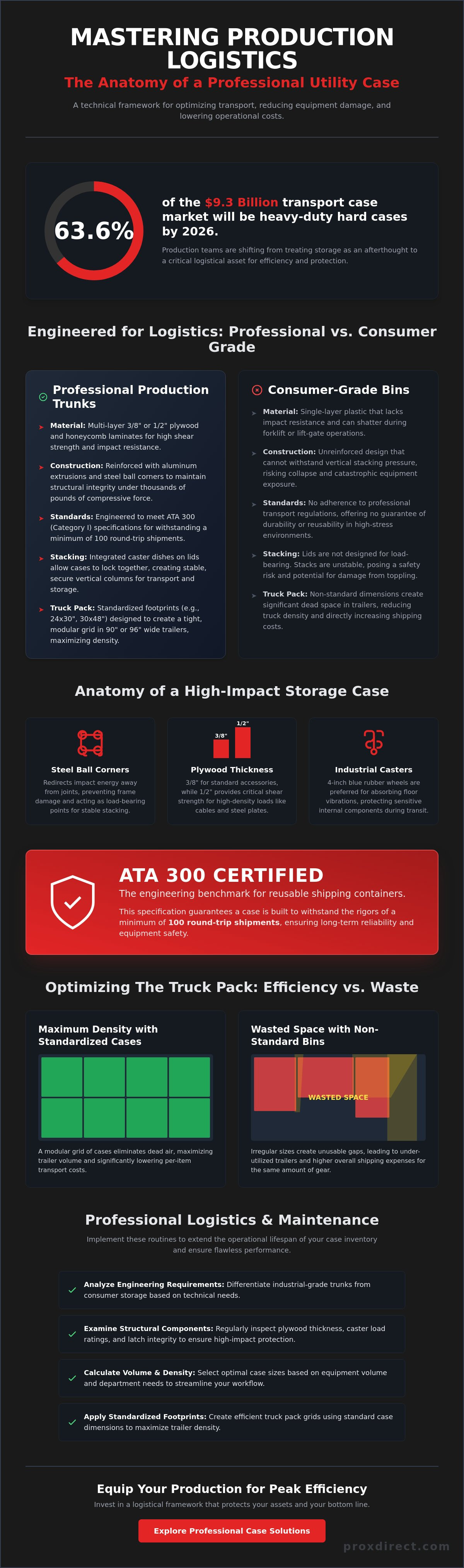
Industrial-grade production trunks differ from generic storage through material science and structural engineering. They utilize multi-layer plywood or honeycomb laminates, reinforced with aluminum extrusions and steel ball corners. This construction isn't merely for protection; it provides the structural integrity required for vertical stacking in high-density truck packs. Without this rigidity, the bottom units in a stack would succumb to the compressive force of thousands of pounds of overhead gear.
The Role of Utility Trunks in Touring
Professional utility/storage cases manage the high-value non-electronic assets that are often overlooked. This includes stage truss clamps, heavy base plates, and bulk inventory like 12-gauge speaker wire or heavy-duty power looms. These items are heavy and irregular. Without a dedicated trunk, they pose a significant risk to other sensitive electronics during transit. Proper containment ensures that small hardware components don't migrate or cause impact damage to neighboring racks.
Why Consumer-Grade Bins Fail the Industry
Consumer-grade plastic bins lack the impact resistance necessary for forklift and lift-gate operations. In a professional warehouse environment, cases are subjected to lateral forces and abrupt vertical shifts. Plastic enclosures often shatter under these conditions, leading to catastrophic equipment exposure. Additionally, consumer bins rarely adhere to the 90-inch or 96-inch width standards of professional trailers. This lack of standardization creates dead space, which reduces truck density and increases total shipping costs. Professional trunks are engineered as modular units that fit into a calculated grid, maximizing every cubic inch of available transport volume.
Engineering Standards: The Anatomy of a High-Impact Storage Case
High-performance utility/storage cases are defined by their ability to maintain structural integrity under extreme mechanical stress. The primary defense against corner-impact damage is the reinforced steel ball corner. These components redirect kinetic energy away from the plywood joints, preventing the skewing of the frame during a heavy drop. When cases are stacked four-high in a warehouse, the ball corners also act as load-bearing points that distribute weight evenly across the vertical column. This engineering ensures that the case remains a protective shell rather than a liability during transport.
Material Science in Case Construction
Industrial cases typically utilize 3/8-inch or 1/2-inch plywood. While 3/8-inch is sufficient for standard accessories, 1/2-inch provides the necessary shear strength for high-density loads like heavy-gauge power cables or steel base plates. Honeycomb laminates add a hexagonal surface layer that increases impact resistance while reducing the visibility of superficial scuffs. Aluminum extrusions are then riveted into the plywood edges to ensure the case remains square throughout its service life. The ATA Specification 300 Category I standard defines the engineering requirements for reusable shipping containers capable of withstanding a minimum of 100 round-trip shipments.
Mobility and Stacking Engineering
Mobility is anchored by 4-inch industrial casters. Blue rubber wheels are preferred over hard plastic because they absorb floor vibrations that could damage sensitive internal hardware. To facilitate secure storage, caster dishes are integrated into the case lids. This allows wheels from a top case to lock into the lid of the bottom case, creating a stable vertical column. Internal protection relies on high-density foam lining or adjustable divider systems to prevent collisions between heavy hardware components. When configuring utility/storage cases for long-term use, hardware durability is the primary factor in total cost of ownership. For detailed engineering specs, you can explore our full range of ProX Cases.
Selecting Utility Cases Based on Equipment Density and Weight
Selecting utility/storage cases requires a technical assessment of equipment density. Density is defined as the weight of the gear relative to the cubic volume of the enclosure. High-density items, such as 4/0 power cables or motor feeders, require deep basins with reinforced bottom plates to prevent structural sagging. Conversely, low-density but high-fragility items like wireless receivers require volume-efficient partitioning to prevent internal movement. Accurate volumetric calculations ensure that you aren't transporting air, which is the primary cause of logistical inefficiency in professional touring.
Caster load ratings are the primary bottleneck for heavy utility/storage cases. A standard 4-inch industrial caster is typically rated for a dynamic load of 300 to 350 pounds. In a standard four-caster configuration, this provides a maximum gross weight capacity of 1,200 to 1,400 pounds. Exceeding these ratings leads to flat spots in the rubber and eventual bearing failure during critical load-ins. Professionals must match the case size to the weight capacity of the mobility hardware to ensure long-term reliability on the road.
Categorizing Gear by Storage Needs
- Cable Trunks: These units feature deep basins designed for long-run snakes and power distribution. They prioritize volume over internal compartmentalization.
- Hardware Cases: Engineered with 1/2-inch plywood bottoms, these cases house heavy steel base plates and trussing components that would crush standard storage bins.
- Workstations: These specialized units integrate storage drawers with on-site technical surfaces, allowing technicians to maintain a mobile repair or control hub.
Specialized Utility Solutions
Sensitive electronics require more than just a plywood shell. Protecting delicate broadcast gear often necessitates AV Broadcasting Cases that utilize custom foam inserts to isolate components from vibration. Similarly, modular systems like LED Video Panel Wall Supports require specific internal bracing to prevent pressure on the mounting points of the support frames. When standard dimensions don't accommodate your inventory, custom engineering services provide the specific structural configurations needed for non-standard equipment. This methodical approach to selection prevents hardware failure and ensures that every piece of gear is housed in an environment suited to its physical requirements.
How to Optimize Your Truck Pack Using Standardized Storage Cases
Truck pack optimization is a technical exercise in geometric efficiency. In 2026, professional trailers typically provide internal widths between 90 and 96 inches. To maximize this volume, utility/storage cases must adhere to a modular grid system. This prevents lateral movement during transit and ensures every cubic foot of trailer space is utilized. Without standardized dimensions, "dead space" occurs, forcing teams to use more vehicles than necessary for a single production. It's a logistical failure that directly impacts the bottom line of a tour.
The Math of Truck-Pack Density
Modular grid systems rely on 1/2, 1/3, and 1/4 pack dimensions to create a seamless load. For a 90-inch internal trailer width, cases with a 22.5-inch width create a precise four-wide pack. Cases measured at 30 inches allow for a three-wide configuration, while 45-inch trunks fit two-wide. Industry data suggests that using standardized dimensions reduces shipping costs by 15-20% by increasing truck density and reducing the total number of required transport units. To execute a pack, measure the internal trailer width and calculate the case "multiple" to ensure no gaps remain between the case walls and the trailer's E-track system.
Weight distribution remains critical for vehicle safety and handling. Heavy hardware cases must be placed over the trailer axles to maintain a stable center of gravity. Lighter cable trunks and workstations can be stacked higher or placed in the nose of the trailer to balance the load. For high-density logistics, view our TruckPaX™ cases designed for modular trailer grids.
Loading Order and Accessibility
Effective logistics require a Last-In, First-Out (LIFO) strategy to speed up venue load-ins. Utility trunks containing rigging hardware, base plates, and primary power distribution must be loaded last. This ensures they're the first items accessible when the truck doors open. High-visibility labeling on at least two sides of each case is mandatory for quick identification in low-light backstage environments. Labels should include department codes and weight data to assist the loading crew in maintaining the truck's balance throughout the tour.
Securing the load involves integrating utility/storage cases with the trailer's internal E-track. Cargo straps must be ratcheted tight across each row of cases to prevent shifting during abrupt stops or turns. This mechanical lock-down is the final step in ensuring that sensitive production gear survives the vibration and G-forces of long-haul transport. It's a fundamental safety requirement that protects both the equipment and the transport personnel from shifting loads that can cause catastrophic trailer sway.
Professional Logistics: Long-Term Maintenance of Utility Storage Systems
The operational lifespan of utility/storage cases depends on a rigorous maintenance schedule. Unlike consumer-grade containers, these trunks are engineered for multi-year repair cycles rather than disposal. Routine inspections should focus on the mechanical integrity of spring-loaded latches and recessed handles. If a latch fails to draw the lid tight, it compromises the structural squareness of the case during stacking. Technicians must also examine plywood panels for signs of delamination or impact-induced splintering, which can weaken the enclosure's total load-bearing capacity over time.
Moisture management is a critical technical requirement for cases with foam interiors. While high-density foam provides excellent vibration damping, it can trap humidity if cases are closed immediately after a humid outdoor load-out. This leads to mold growth and the oxidation of internal metal hardware. Wiping down interiors and using industrial desiccants during long-term warehouse storage prevents these issues. Identifying signs of structural fatigue in rivets and aluminum extrusions early allows for proactive repairs that prevent catastrophic failure during transport.
Caster and Hardware Upkeep
Mobility is the most vulnerable aspect of any utility/storage cases inventory. Caster bearings require periodic lubrication with silicone-based sprays to prevent seizing and ensure smooth movement across venue floors. You should check for flat spots on blue rubber wheels caused by dragging cases across abrasive surfaces or improper weight distribution. Damaged rivets must be drilled out and replaced with genuine steel hardware to maintain the bond between the plywood and the aluminum frame. When a case exhibits significant structural fatigue, such as warped panels or compromised ball corners, it should be transitioned to static warehouse storage rather than active touring.
Reliability Through Engineering
ProX engineering emphasizes field-serviceable components to ensure that a production doesn't stop because of a broken latch or a missing caster. Using genuine ProX replacement parts maintains the original engineering specifications and safety ratings of the unit. The global ProX dealer network provides access to these components, ensuring that logistics managers can source hardware regardless of their geographic location. This commitment to maintenance-friendly design is what separates industrial equipment from temporary storage solutions. Investing in high-quality hardware and a consistent maintenance protocol ensures your inventory remains a reliable logistical asset for years.
Browse our catalog of professional utility cases to upgrade your production logistics.
Optimizing Your Touring Inventory for 2026
Master the logistics of professional touring by integrating modular standardization and technical maintenance into your operational workflow. As transport costs and safety regulations like OSHA’s warehousing standards evolve through 2026, the structural integrity of your utility/storage cases remains the primary variable in protecting high-value inventory. Selecting hardware based on precise equipment density and adhering to standardized truck pack grids ensures maximum trailer efficiency and reduced gear damage across every tour leg. These strategic choices in engineering precision lead to significant long-term gains in logistical speed and asset protection.
ProX has been engineering performance gear since 1984, earning the trust of major industry brands like Pioneer DJ and QSC. Our global dealer network provides the support and genuine replacement parts necessary to maintain your fleet's operational reliability across international borders. By prioritizing field-serviceable components and industrial-grade materials, you ensure that your equipment remains a professional asset rather than a liability. Upgrade your production logistics with ProX Utility Cases and secure the success of every load-in with hardware built for the physical demands of the industry. Your commitment to precision today ensures a reliable backbone for every production tomorrow.
Frequently Asked Questions
What are the standard dimensions for a truck-pack optimized utility case?
Standard dimensions are calculated to fit the internal width of professional trailers, which typically measure 90 or 96 inches. Common footprints include 22.5-inch, 30-inch, and 45-inch widths. These measurements allow for two-wide, three-wide, or four-wide configurations that eliminate lateral gaps and maximize truck density.
How do I know if a utility case is ATA-300 compliant?
ATA-300 Category I compliance is determined by a case's ability to withstand a minimum of 100 round-trip shipments. You should verify that the manufacturer specifies this rating, which involves testing for impact resistance, water tightness, and hardware durability. Compliance usually requires recessed latches, reinforced steel corners, and high-grade plywood or composite panels.
Can I stack different brands of utility trunks together?
Stacking different brands is possible only if the caster dishes and ball corners align precisely. Even minor deviations in hardware placement can create an unstable vertical column, increasing the risk of a tip-over during transport. For maximum safety and stability in high-density packs, it's advisable to maintain a uniform inventory of utility/storage cases.
What is the best material for internal dividers in a storage case?
High-density polyethylene (HDPE) and carpet-lined plywood are the most effective materials for internal dividers. These materials provide the structural rigidity needed to separate heavy hardware while resisting the shear forces of shifting loads. While foam is excellent for cushioning, it should be used as a lining rather than a primary structural divider for heavy items.
How much weight can a standard 44-inch utility trunk hold?
A standard 44-inch trunk typically supports a gross weight between 1,200 and 1,400 pounds. This capacity is limited by the dynamic load rating of the four 4-inch industrial casters, which are usually rated for 300 to 350 pounds each. Exceeding this weight can lead to caster failure or floor damage during load-ins.
Are utility/storage cases waterproof for outdoor events?
Most industrial utility/storage cases are water-resistant but not fully waterproof. They utilize tongue-and-groove aluminum valances to deflect rain, but they lack the hermetic seals found in specialized watertight enclosures. For environments requiring total protection against immersion, you must select cases with an IP67 or IP68 ingress protection rating.
Should I choose casters or a skid-base for my storage trunks?
Casters are the standard choice for touring applications where rapid manual mobility is required on-site. Skid-bases are preferred for permanent warehouse storage or for extremely heavy loads that are moved exclusively by forklifts. Skids provide better weight distribution for long-term stacking but lack the flexibility needed for fast-paced production environments.
How do I maintain the foam lining in my cases over long tours?
Effective maintenance requires managing moisture levels to prevent mold growth and adhesive failure. Always ensure cases are completely dry before closing them for long-term storage or transit. Using industrial desiccants and performing regular cleanings with non-abrasive solutions will extend the lifespan of the foam and protect the internal hardware from oxidation.
Disclaimer
Any trademarks, trade names or brand names appearing herein that do not belong to ProX are the property of their respective owners and/or companies, and such appearance doesn't and shall not constitute or imply endorsement, sponsorship or recommendation by ProX.


