
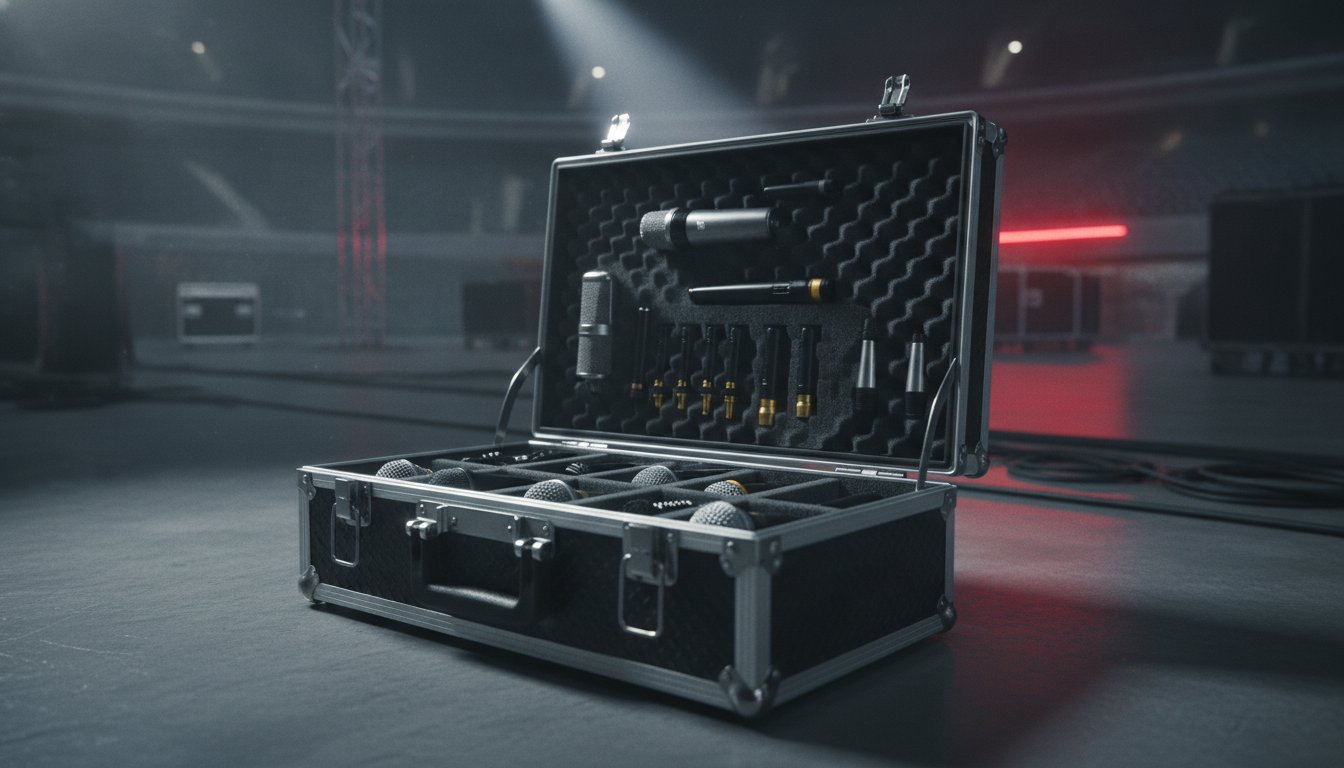
A professional touring microphone case is far more than a simple storage vessel; it's a critical piece of logistical infrastructure designed to prevent catastrophic equipment failure. You already know that in the high-stakes environment of global production, a single damaged diaphragm or a disorganized kit can derail an entire load-in schedule. With hard cases representing 63.6 percent of the transport market as of 2026, the selection process requires a focus on engineering precision rather than brand aesthetics. Selecting the wrong housing doesn't just risk the hardware; it compromises the efficiency of the entire tour.
This comparison details the technical differences between transport solutions to ensure your microphones and stands survive the rigors of global transit. You'll learn how to achieve zero equipment failure through superior vibration dampening and how to optimize logistics using standardized dimensions that fit 90 inch or 96 inch truck widths. We will analyze the structural capabilities of specialized inserts that facilitate rapid inventory checks and long term durability. This overview provides the technical data necessary to standardize your inventory and secure your audio assets against the physical demands of the road.
Key Takeaways
- Analyze the technical specifications of a touring microphone case, focusing on high-density foam isolation and structural engineering to protect sensitive condenser diaphragms.
- Maximize logistical efficiency by implementing TruckPaX™ cases with standardized 22.5 inch and 45 inch dimensions for precise truck pack alignment.
- Determine the optimal internal configuration by comparing rapid-access foam inserts for handheld kits with drawer-based systems for delicate ribbon microphones.
- Reduce long-term lifecycle costs and equipment downtime by selecting hard-shell transport solutions engineered for the rigors of frequent global transit.
What Defines a Professional Touring Microphone Case?
A professional touring microphone case acts as a specialized logistical asset designed to withstand the physical stresses of global production. Unlike padded bags that don't provide adequate impact protection, a touring-grade solution utilizes a rigid road case construction to ensure the survival of sensitive audio components. High-density foam interiors are essential for asset protection. They isolate condenser diaphragms from the constant vibrations inherent in semi-trailer transport, preventing the gradual mechanical fatigue that leads to capsule failure.
Exterior shell rigidity is non-negotiable for professional use. Cases must support the weight of stacked equipment without bowing or transferring pressure to the internal contents. It's common for a microphone trunk to sit at the bottom of a heavy stack, requiring the plywood and aluminum extrusion to maintain structural integrity under hundreds of pounds of pressure. This engineering precision ensures that the internal G-force experienced by delicate microphone capsules remains within safe limits during transit.
Recessed hardware is another critical requirement for any touring environment. It prevents protruding latches from snagging on other gear or getting sheared off during the rapid pace of a professional load-in. When cases are packed tightly into a trailer, flush-mounted components allow for a smoother transition and reduce the risk of damage to adjacent equipment. This attention to detail reflects a deep understanding of the physical demands placed on professional gear during high-frequency use.
ATA 300 Standards and Impact Resistance
The ATA 300 Category I specification requires a container to survive a minimum of 100 round-trip shipments. This standard involves rigorous testing, including multiple drop tests and resistance to water penetration. Most professional ProX Cases utilize either 9mm or 12mm plywood for the main shell. While 12mm plywood offers maximum durability, 9mm plywood provides a balance of structural integrity and weight reduction for air travel logistics.
The Anatomy of Professional Case Hardware
Industrial-grade hardware is what separates a professional touring microphone case from consumer alternatives. Heavy-duty steel ball corners are standard. They redirect impact energy away from the plywood seams and allow for secure stacking in a tight truck pack. These components ensure that the equipment remains functional after years of high-frequency use in demanding environments.
- Steel Ball Corners: Redirect impact energy and facilitate stable stacking.
- Recessed Butterfly Latches: Protect the closing mechanism from shearing forces and accidental opening.
- Industrial Casters: 4-inch blue rubber wheels are the industry standard for high-load mobility and vibration reduction.
Hard Shell vs. Padded Bags: A Comparative Analysis
Selecting the appropriate housing for a microphone inventory requires a balance between transit weight and physical security. For global productions, the protection provided by a touring microphone case outweighs the minor weight savings of soft-sided alternatives. While a padded bag might suffice for a single fly-date where the engineer maintains possession of the gear, it offers zero protection against the crushing forces found in a standard truck pack. Hard-shell cases utilize vertical space through high-density stacking, which is essential for optimizing trailer floor space and reducing logistical overhead.
The lifecycle cost of professional equipment transport is a critical metric for production managers. Technical data suggests that a single hard-shell case outlasts five or more padded bags in professional environments. Soft bags suffer from frequent zipper failure, seam tearing, and foam compression. In contrast, a plywood-based trunk provides a rigid barrier against moisture and dust. This shields sensitive electronics from the environmental variables of outdoor festivals and long-term warehouse storage where humidity can degrade condenser capsules.
When to Choose Padded Bags for Microphones
Padded bags serve a specific, limited role in professional audio. They're ideal for local gigs where the equipment is hand-carried or transported in climate-controlled passenger vehicles. However, these bags lack puncture resistance. A single sharp edge on a stage deck or a misplaced truss pin can easily penetrate the fabric, damaging the hardware inside. Bags often lack structured internal management, which leads to disorganized cable storage and lost accessories during rapid changeovers.
The Case for Hard-Shell Engineering
Professional engineering relies on multi-layer birch plywood for its natural vibration-dampening properties. This material absorbs the high-frequency shocks of the road that would otherwise be transferred directly to the microphone capsule. Many high-end solutions feature hex resin coatings for superior scratch resistance. This maintains a professional aesthetic throughout the duration of a tour.
To meet the ATA Specification 300 Category I standard, a case must withstand the rigors of at least 100 round-trip shipments. This durability is achieved through precision-fitted aluminum extrusions and reinforced steel corners. For teams requiring a unified production look, integrating your inventory into standardized ProX Cases ensures both logistical efficiency and brand consistency. You can evaluate specific dimensions and load ratings by reviewing the comprehensive catalog of professional transport solutions.
Internal Management: Mic Kit Inserts vs. Stand Trunks
Internal architecture defines the operational speed of a professional production. While the exterior shell provides the primary defense against impact, the internal configuration of a touring microphone case determines the efficiency of inventory management and the long-term health of the capsules. A disorganized kit leads to lost time during load-in and increases the risk of mechanical damage through friction. Proper internal management requires a tiered approach that separates standard handheld assets from delicate studio-grade transducers and heavy support hardware.
Integrating your inventory into a cohesive system often involves utilizing the case lid as a workstation. Many ProX Cases are engineered with reinforced lids that serve as a stable prep surface. This allows technicians to assemble clips, apply labels, and test wireless frequencies without needing additional tables on a crowded stage. This functional integration turns a simple transport box into a mobile workstation, optimizing the limited footprint available in the wings.
Organizing the Microphone Locker
Vertical drop-in slots represent the most space-efficient method for managing large quantities of standard handheld microphones. This orientation allows for a high-density pack while keeping the microphone heads protected within high-density foam. For more sensitive assets, such as ribbon microphones or large-diaphragm condensers, horizontal foam cutouts are necessary. These cutouts provide 360-degree support and prevent the weight of the microphone from resting on its internal shock mount or capsule assembly.
- Accessory Management: Dedicated compartments for clips, windshades, and DI boxes prevent small items from migrating during transit.
- Labeling Dishes: Recessed labeling dishes allow for quick identification of kit contents on dark stages, ensuring the correct inventory is deployed to the right department.
- Drawer Systems: Heavy-duty drawer units provide superior organization for specialized shock mounts and delicate tools that shouldn't be loose in a utility trunk.
Touring Microphone Stand Solutions
Managing microphone stands is a logistical challenge often referred to as "mic stand tetris." Standard utility trunks frequently result in metal-on-metal friction that degrades the finish and structural integrity of the stands. A specialized touring microphone case for stands utilizes individual tube pockets. These vertical dividers isolate each stand, preventing them from clashing during the vibrations of a semi-trailer transit.
For high-frequency tours, stand trunks should include integrated storage for essential consumables. Drawers for gaff tape, marking pens, and tightening tools ensure that the stand technician has everything required for maintenance within the same footprint as the hardware. This centralized approach reduces the number of cases required on the truck and simplifies the logistical chain for the entire audio department.

Logistical Efficiency: Truck Pack and Weight Management
Logistical efficiency in professional production is measured by how effectively a touring microphone case integrates into a standardized truck pack. In the freight environment of 2026, where trucking capacity is tightening and tender rejection rates have surpassed 15 percent, maximizing every square inch of trailer floor space is a financial necessity. Utilizing TruckPaX™ cases with 22.5 inch and 45 inch dimensions allows for precise calculations when loading standard 90 inch or 96 inch wide trailers. This uniformity ensures that cases from different departments, including AV Broadcasting Cases, maintain a consistent footprint for a secure load.
Weight distribution is a primary safety concern during transit. Heavy microphone stand trunks must always be positioned on the trailer floor rather than on top of a stack. This lowers the center of gravity. It prevents top-heavy configurations that are prone to tipping during cornering. Standardized exterior dimensions reduce insurance claims by preventing shifting loads and ensuring that cases remain locked in place through caster alignment and tight packing. When every case in the inventory shares a common height and width, the process of loading and tipping becomes a methodical, predictable exercise rather than a trial-and-error struggle.
Optimizing the Truck Pack
The "mismatch cost" of non-standard case dimensions becomes apparent when analyzing a 96-inch trailer. If a case is even two inches wider than a standard sub-multiple, it can eliminate an entire row of gear across the width of the truck. Over a 53-foot trailer, this inefficiency results in wasted floor space that could have accommodated additional backline or lighting assets. By adhering to 22.5 inch and 45 inch standards, production managers can ensure a tight, interlocking pack that minimizes the need for excessive strapping and dunnage. This disciplined approach to logistics protects the hardware and the tour budget simultaneously.
Handling and Ergonomics
Physical handling requires more than just warning labels. Professional cases feature multi-handle placement to facilitate safe lifting from any angle. Low-profile wheel boards are often preferred over standard caster plates because they provide greater center-of-gravity stability, reducing the risk of the case tipping on uneven loading ramps. In tight backstage corridors where space is at a premium, flip-top lids are a superior choice over removable lids. They don't require additional floor space for storage during the show. You can optimize your logistical chain by exploring the full range of TruckPaX™ transport solutions to ensure your next tour is as efficient as possible.
Selection Framework: Choosing Your ProX Solution
Selecting a professional touring microphone case is a technical decision that must align with the specific requirements of your inventory and logistical chain. A methodical approach prevents the acquisition of redundant or incompatible housing. The selection process begins with a comprehensive audit of your microphone locker. You must differentiate between high-density dynamic handheld units and delicate large-diaphragm condensers that require specialized isolation. This data determines the internal architecture of the case, ensuring that every asset is secured against the vibrations of global transit.
Your primary transport method dictates the exterior dimensions of the solution. If the tour utilizes semi-trailers, adhering to the 22.5 inch and 45 inch TruckPaX™ standards discussed previously is mandatory for load security. Tours utilizing smaller box trucks or vans may prioritize a smaller footprint, but shell rigidity remains non-negotiable. Evaluating setup speed requirements is the third step. Vertical foam slots allow for rapid inventory checks during load-out, while drawer-based systems provide organized access for complex microphone arrays that include shock mounts and specialized clips.
Future-proofing is a critical consideration for growing productions. You should select a case that accommodates anticipated expansions in wireless channels or the addition of DI units. This prevents the need for supplemental utility cases that can disrupt a standardized truck pack. By choosing a solution with modular potential, you maintain a unified production look and consistent logistical efficiency across multiple tour cycles. A well-planned investment reduces the frequency of inventory replacements and stabilizes your long-term operational costs.
Santosom Series: The Pinnacle of Custom Engineering
For high-value orchestral or broadcast microphones, the Santosom series represents the highest standard of custom engineering. These cases provide bespoke foam interiors designed for non-standard equipment shapes, ensuring maximum protection for sensitive transducers. Integrating Santosom solutions with ProX Truss workflows allows for efficient stage-side microphone placement, reducing the cable runs and setup time required for complex performances. This level of precision is essential for environments where equipment failure is not an option.
Maintenance and Longevity
Maintaining the structural integrity of your transport solutions is necessary for long-term reliability. As your collection evolves, replacing foam inserts ensures that new microphones remain securely isolated. Caster maintenance is equally vital. Debris and impact can degrade wheel performance, so regular inspections of the 4-inch industrial casters are required to keep your tour rolling smoothly. Utilizing ProX Replacement Parts allows you to extend the operational life of your cases, ensuring they remain a dependable backbone for your production well beyond a single tour cycle.
Securing Your Audio Infrastructure for Global Transit
Implementing a standardized touring microphone case strategy is essential for maintaining operational continuity in professional production. By prioritizing ATA 300 level engineering and adhering to TruckPaX™ logistical standards, you ensure that your inventory remains secure during the most demanding transit cycles. High-density foam isolation and precision-fitted hardware provide a critical defense against the mechanical stresses of the road. This technical approach reduces equipment downtime and optimizes trailer floor space, allowing for a more efficient and predictable load-in process.
ProX has been engineering performance gear since 1984, establishing a reputation for functional excellence and structural integrity. Our solutions are trusted by major industry brands, including Pioneer DJ and QSC, to protect high-value electronic assets. With a global dealer network available for rapid fulfillment, you can scale your transport infrastructure to meet the specific demands of any tour. Take the next step in professionalizing your logistics and ensuring the long-term health of your microphone collection. Browse the Full Range of ProX Professional Audio Cases to find the ideal housing for your audio assets. Your equipment is the backbone of your performance; protect it with precision engineering.
Frequently Asked Questions
What is the best way to transport a large collection of microphone stands?
Specialized stand trunks with individual vertical tube pockets represent the most efficient transport method. This configuration prevents metal-on-metal friction and protects the locking collars from mechanical failure during transit. Horizontal stacking in utility trunks often leads to finish degradation and bent boom arms, whereas vertical pockets simplify inventory checks and reduce the footprint on the stage floor.
Do I really need an ATA 300-style case for local tours?
Rigid plywood construction is necessary for local tours because they involve high-frequency loading and unloading cycles. While long-haul vibration is reduced, the physical impact of daily handling on box truck ramps requires the structural integrity of steel ball corners and recessed hardware. These cases provide a consistent work surface and stacking capability that consumer-grade alternatives cannot maintain over a full season.
How do I prevent foam degradation in my microphone case?
Maintaining a climate-controlled storage environment is the primary method for preventing foam breakdown. High-density ester foam is engineered for durability but can become brittle if exposed to petroleum-based cleaners or extreme temperature fluctuations. Periodically replacing the top foam layer in your touring microphone case ensures that the capsules remain properly isolated from the lid during high-vibration transit.
Can I use a utility trunk for microphones if I have custom foam?
Utility trunks are functional but less efficient than purpose-built housings with integrated trays or drawers. Standard trunks often lack the specific internal height required for vertical microphone storage, which results in wasted internal volume. For high-value inventories, the absence of dedicated accessory compartments in a utility trunk typically leads to disorganized clip management and lost adapters during rapid changeovers.
What are the standard dimensions for truck pack cases?
Professional transport dimensions are based on sub-multiples of standard 90 inch or 96 inch trailer widths. Common footprints include 22.5 inches and 45 inches, allowing for two or four cases to sit side-by-side with minimal air gap. This interlocking configuration is critical for maintaining load stability and reducing the need for excessive strapping during long-haul transport cycles.
Is it better to have a single large mic case or multiple smaller kits?
Multiple smaller kits offer superior modularity for tours that utilize varying crew sizes and transport vehicles. However, a single large touring microphone case is more efficient for high-channel-count productions where centralizing the inventory in a single workstation speeds up the prep process. The decision should be based on your average channel requirements and the frequency of semi-truck vs. van-based logistics.
How does case weight affect touring fuel costs and logistics?
Case weight directly influences the gross vehicle weight, which impacts fuel consumption and potential toll costs. While 12mm plywood offers maximum durability, it adds significant mass compared to 9mm configurations. Professional logistics managers balance the requirement for structural integrity with weight limits to avoid overweight fines and optimize the overall fuel efficiency of the tour fleet.
What is the difference between Birch and Eucalyptus plywood in case construction?
Birch plywood is preferred for its high density and uniform grain, providing superior screw-holding strength and impact resistance. Eucalyptus is often utilized as a cost-effective core material but typically possesses lower shear strength. Professional-grade cases prioritize multi-layer birch for its ability to withstand repetitive mechanical stresses and environmental variables without delaminating over long-term use.
Disclaimer
Any trademarks, trade names or brand names appearing herein that do not belong to ProX are the property of their respective owners and/or companies, and such appearance doesn't and shall not constitute or imply endorsement, sponsorship or recommendation by ProX.


