
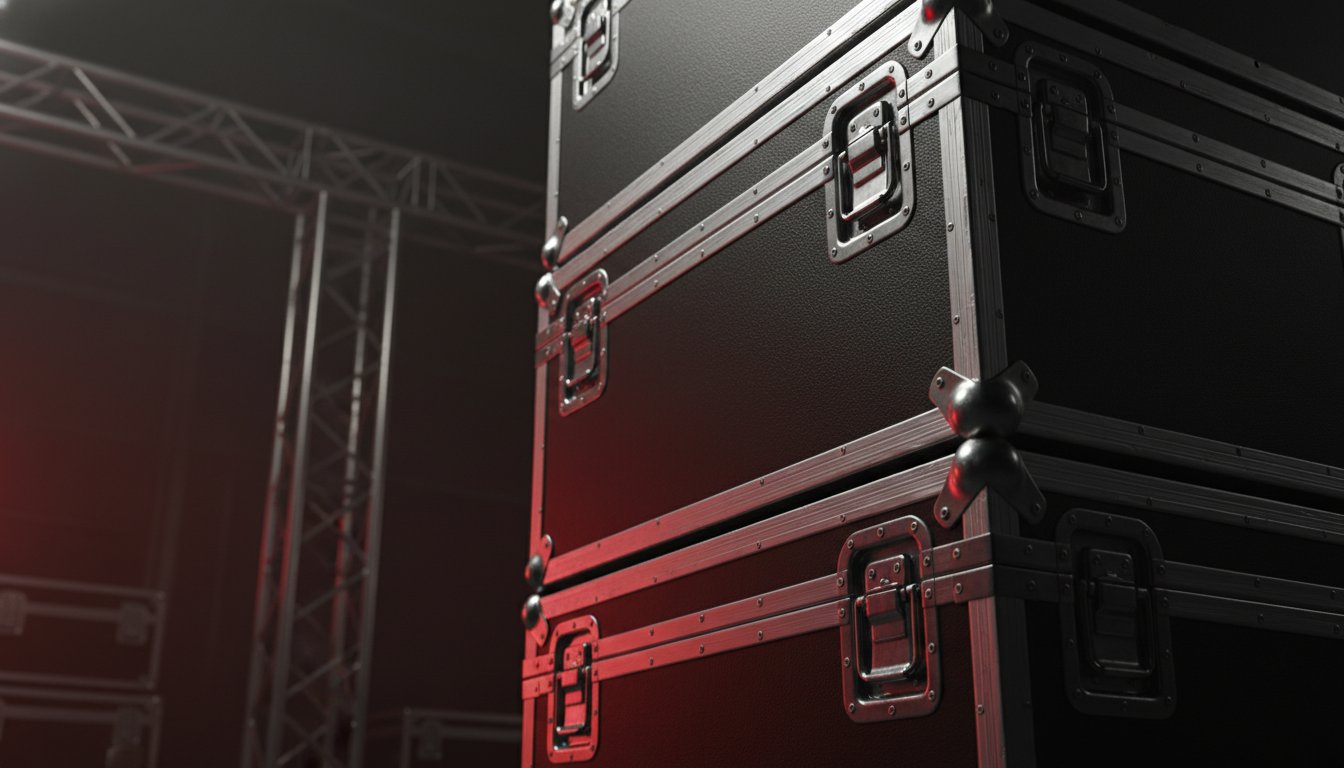
A single fractured lens on a high-output LED fixture like the Robe T3 represents a failure in logistical engineering that costs more than just the repair fee; it compromises the entire production timeline. You recognize that in high-frequency touring, the structural integrity of your transport solutions is the only barrier between a successful show and a catastrophic equipment loss. Protecting these high-value production assets requires more than a standard box. It demands a sophisticated understanding of material science and mechanical assembly. When you invest in professional Lighting Cases, you aren't just buying storage; you're implementing a specialized protection strategy designed to withstand the crushing pressures of a fully loaded trailer and the rigorous demands of global transit.
This comprehensive reference allows you to master the technical specifications and logistical requirements necessary for zero-damage transport and optimized load-in times. We'll analyze the critical role of the ATA-300 Revision 2020.1 specification and how it governs container durability. You'll also gain insights into the latest 2026 IATA Dangerous Goods Regulations regarding lithium-ion state-of-charge requirements for integrated battery fixtures. From the precise foam densities needed for kinetic lighting systems to the structural advantages of TruckPaX™ configurations, this guide provides the engineering data required to maintain a professional-grade fleet for the long term.
Key Takeaways
- Learn how professional Lighting Cases function as engineered enclosures to mitigate kinetic energy and environmental hazards during high-frequency touring.
- Compare structural rigidity between 3/8" and 1/2" plywood thickness to ensure your enclosures meet ATA-300 Category 1 standards for reusable shipping containers.
- Identify specific design requirements for protecting delicate optics in moving head fixtures and managing high-density storage for LED video wall panels.
- Optimize your fleet for "Truck Pack" efficiency using standardized dimensions and caster cups to ensure secure multi-level stacking and rapid deployment.
- Determine when to transition from standard storage to custom-engineered solutions utilizing CAD modeling and precision CNC cutting for bespoke lighting rigs.
Defining the Professional Lighting Case: More Than Just Storage
A professional lighting case functions as a specialized technical system designed to neutralize kinetic energy and environmental hazards during transport. Unlike generic utility boxes, high-performance Lighting Cases provide a controlled environment for sensitive electronics and precision optics. In professional production, the distinction between a soft-sided transport bag and a hard-shell touring case is fundamental. Soft-sided options are suitable for lightweight, static gear. However, heavy fixtures like the Robe T3 require the structural rigidity of a Road Case (Flight Case) to withstand the stacking pressures of a fully loaded trailer. These engineered enclosures ensure rapid equipment deployment while maintaining the integrity of high-value assets during global transit.
The Anatomy of a High-Performance Case
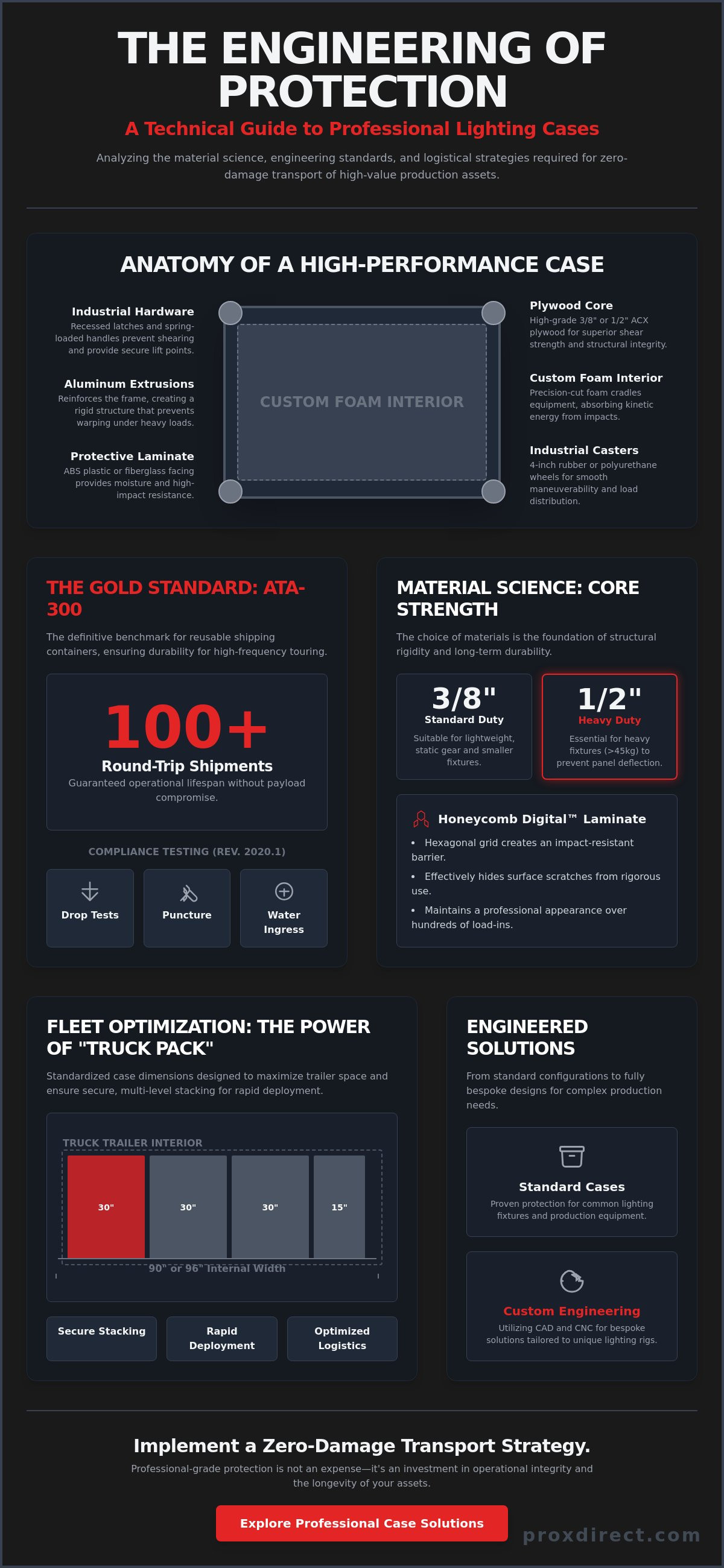
The efficacy of a case depends on the interaction between its structural components. Most professional touring cases utilize 3/8-inch or 1/2-inch ACX plywood panels laminated with an ABS plastic or fiberglass face for moisture and impact resistance. Aluminum extrusions reinforce these panels, creating a rigid frame that prevents warping under significant vertical load. Hardware must meet industrial standards to ensure long-term reliability. This includes recessed latches that won't shear off during transit and spring-loaded handles designed for ergonomic lift points. Industrial-grade casters, typically 4-inch blue rubber or polyurethane, are essential for maneuverability and load distribution. Inside,
Engineering Standards: ATA-300 Compliance and Material Integrity
Engineering standards dictate the operational lifespan of a production fleet. For professional Lighting Cases, the ATA-300 Category 1 specification remains the definitive benchmark for reusable shipping containers. This standard, last updated as Revision 2020.1, ensures that a container can withstand the rigors of at least 100 round-trip shipments without compromising the internal payload. Adherence to these mechanical benchmarks separates industrial-grade protection from consumer-level storage. Professional operators often select specialized case solutions that exceed these base engineering requirements to ensure zero-damage transport in high-stakes environments.
The Role of ATA-300 in Professional Touring
The ATA-300 certification involves a series of destructive tests designed to simulate the most extreme transit conditions. These include drop tests from varying heights, puncture resistance evaluations, and water ingress testing. Category 1 compliance is the industry requirement for any gear intended for frequent air or sea freight. Beyond air transport standards, many manufacturers also look to ESTA Technical Standards to align their builds with broader entertainment industry safety and logistical protocols. Evaluating a manufacturer based on these certifications provides a data-driven assurance of durability. It's the difference between a case that survives a single season and one that remains in service for a decade.
Material Selection for Maximum Durability
Material science is the foundation of structural rigidity. While composite materials are gaining interest for weight reduction, high-grade plywood remains the industry standard due to its superior shear strength and predictability. The choice between 3/8-inch and 1/2-inch plywood depends on the mass of the fixture. For high-output moving heads like the Robe T3, which weighs 45.6 kg, 1/2-inch plywood is essential to prevent panel deflection under stacking pressure.
Surface protection is equally critical. The ProX Honeycomb Digital™ laminate utilizes a hexagonal grid pattern that serves a dual purpose. It creates an impact-resistant barrier that hides surface scratches while providing a unique aesthetic that maintains a professional appearance over hundreds of load-ins. Structural integrity is further reinforced through the following hardware specifications:
- Steel Ball Corners: Heat-treated steel corners absorb and deflect impact energy away from the plywood joints.
- Aluminum Valances: Tongue-and-groove aluminum extrusions ensure a precise, dust-resistant seal when the lid is latched.
- Zinc-Plated Hardware: Steel latches and handles with zinc plating offer superior corrosion resistance compared to standard aluminum components.
Rigidity is key. A well-engineered case doesn't just hold gear; it maintains its geometric shape under the weight of an entire truck pack. This structural stability is what allows for the secure multi-level stacking required in modern logistics.
Specialized Case Configurations for Modern Lighting Fixtures
Modern lighting systems vary significantly in mechanical complexity and structural vulnerability. A static LED wash fixture requires basic impact protection, while an automated moving head demands precise internal stabilization to protect its drive motors and optical alignment. Professional Lighting Cases must be configured to these specific mechanical requirements to prevent component failure during high-frequency touring. Engineering a case for a 45.6 kg Robe T3 profile requires a different approach than a case designed for lightweight battery-operated uplights.
Moving Head and Intelligent Lighting Protection
Automated fixtures contain delicate gears and belt drives that are susceptible to damage from lateral forces during transit. High-performance enclosures, such as Santosom Cases, utilize custom-engineered foam inserts that lock the fixture yoke into a neutral position. This prevents the head from swinging, which eliminates mechanical strain on the pan and tilt motors. Dual and quad-head configurations are the industry standard for these fixtures. These designs allow for a higher density of equipment per truck foot while maintaining individual protection for each unit. For high-power hybrid fixtures like the Robe GigaPointe, these cases also provide dedicated compartments for specialized lenses and laser light source accessories.
LED Video Panel and Support Infrastructure
The logistical challenge of LED video walls involves balancing the fragility of individual pixels with the significant weight of the support frames. Standard utility bins don't provide the necessary isolation for these assets. Specialized enclosures for LED Video Panel Wall Support systems ensure that panels remain upright and separated by non-abrasive dividers. This configuration prevents compression damage to the surface-mounted diodes (SMDs) and ensures that the precision-milled locking mechanisms on the frames remain aligned. Long-haul transit requires that these panels are secured against micro-vibrations that can loosen internal ribbon cables or compromise the integrity of the LED modules.
Utility and Workstation Integration
A complete lighting rig includes more than just fixtures; it requires a centralized control infrastructure. Lighting consoles and processing hardware require integrated workstations that facilitate rapid deployment. Technicians often utilize AV Broadcasting Cases for complex control setups. These provide rack-mounted security for media servers and signal processing units. These touring workstations often feature:
- Integrated Drawer Units: Heavy-duty slides provide secure storage for tools, sensors, and spare parts.
- Cable Trunks: Specialized trunks with adjustable dividers keep heavy power looms and delicate data cables separated to prevent jacket damage.
- Technician Tool Chests: Built-in work surfaces allow for on-site repairs without requiring additional table space.
Organization is the foundation of efficiency. By utilizing specialized configurations for every component of the rig, production teams can reduce load-in times while extending the operational lifespan of their high-value lighting assets.
Logistics Management: Stacking, Maneuverability, and Truck Pack Optimization
Logistical efficiency in professional production is measured by the cubic foot. For high-performance Lighting Cases, protection is only one part of the engineering requirement. The other is spatial compatibility with standard transport infrastructure. Professional fleets must integrate seamlessly into a "Truck Pack" system, where case dimensions are calculated to divide perfectly into the internal width of a standard trailer. This mathematical approach to enclosure design eliminates dead space and prevents hazardous load shifting during long-haul transit.
Optimizing Truck Pack Density
A standardized footprint is the foundation of modern touring logistics. Most professional trailers utilize an internal width that accommodates multiples of 22.5 inches, 30 inches, or 45 inches. Utilizing TruckPaX™ Truck Pack Cases ensures that your load utilizes every available inch of floor space. When cases fit tightly against one another, the need for excessive strapping and dunnage is reduced. This precision has a direct financial impact on touring production budgets by reducing the total number of vehicles required to move a rig. It also accelerates load-out times, as the puzzle of the truck pack becomes a repeatable, logical sequence rather than a daily variable.
Safe Stacking and Warehouse Management
Vertical space utilization is essential for both warehouse storage and truck density. High-grade enclosures are engineered to support significant vertical pressure, often exceeding several hundred kilograms when stacked four or five units high. The primary safety feature for vertical management is the recessed caster cup. These steel dishes, integrated into the case lid, lock the wheels of the upper unit into place. This prevents lateral movement and ensures the center of gravity remains centered over the structural walls of the lower cases.
Maneuverability on site requires industrial-grade hardware. 4-inch blue rubber or polyurethane casters are the industry benchmark for navigating rough terrain, stage ramps, and cable crossovers. These wheels must be rated for the high-mass loads of moving heads and LED panels while providing enough shock absorption to protect internal optics. To streamline these logistics, you can browse professional truck pack solutions that prioritize both maneuverability and structural rigidity.
- Balanced Weight Distribution: Engineering internal compartments to keep the heaviest components over the casters prevents tipping.
- Labeling Systems: Recessed dish labels or silk-screened inventory numbers allow for rapid identification in low-light environments.
- Braking Mechanisms: High-quality casters include total-lock brakes that secure both the wheel rotation and the swivel for stable storage on inclined surfaces.
Load-in efficiency starts in the design phase. By selecting hardware and dimensions that align with global logistical standards, production companies ensure their gear is as mobile as it is protected.
Integration and Custom Engineering for Production Workflows
Standard Lighting Cases address the majority of production requirements. However, complex stage designs and non-standard fixtures often necessitate a transition to custom-engineered solutions. Bespoke engineering becomes vital when your inventory includes irregularly shaped kinetic elements or high-density rigging hardware that exceeds the dimensions of off-the-shelf models. Precision is the priority. CAD modeling facilitates the digital prototyping of internal layouts, ensuring that every millimeter of space is utilized while maintaining the structural integrity of the enclosure.
Bespoke Engineering for Unique Rigging
Custom engineering is essential for protecting non-standard fixtures and bespoke stage elements that don't fit standard foam profiles. Utilizing precision CNC cutting ensures that internal foam inserts match the exact contours of your specific assets. This prevents lateral movement and secures sensitive optical paths. High-density custom foam inserts can extend the life of legacy lighting gear by providing modern impact mitigation for older, more fragile mechanical components. Working with an established manufacturer like ProX provides access to technical design expertise that aligns your custom builds with global transport standards.
Coordinating with Structural Infrastructure
A comprehensive transport plan must account for the structural components used to support the rig. Integrating ProX Truss, base plates, and corner blocks into your case strategy ensures that all rigging hardware remains organized for rapid deployment. This coordination prevents logistical bottlenecks where fixtures arrive at the venue but the necessary support structures remain inaccessible in unorganized utility bins. Future-proofing your investment involves selecting enclosures that accommodate current fixtures while offering the flexibility to re-foam the interior for future equipment upgrades as LED technology continues to evolve.
Maintenance and Replacement Parts
The operational lifespan of an industrial case depends on regular inspection and the replacement of wear-intensive components. High-frequency touring places significant mechanical stress on hardware. Technicians should conduct quarterly audits of recessed latches, spring-loaded handles, and industrial casters to identify signs of fatigue, oxidation, or structural deformation. Selecting a manufacturer that maintains an inventory of precision-fit replacement parts ensures that a single damaged component doesn't compromise an entire enclosure. Maintaining your fleet with industrial-grade parts preserves the reliability of your protection strategy over hundreds of load-ins.
Explore the full range of ProX Lighting Cases to secure your next production.
Engineering Longevity into Your Production Fleet
Your transport strategy directly impacts the operational lifespan of your lighting inventory. By prioritizing ATA-300 compliant designs and standardized truck pack dimensions, you eliminate the mechanical risks associated with high-frequency touring. Professional Lighting Cases serve as the technical backbone of your production, ensuring that sensitive optics and automated yokes arrive at the venue in peak condition. Whether you're managing high-density LED video walls or complex moving head rigs, engineering precision remains the only reliable defense against the physical demands of global logistics.
ProX has been engineering high-performance gear since 1984. Our rugged designs are trusted by global production dealers for their structural integrity and logistical compatibility. Maintaining your assets with industrial-grade enclosures ensures that your gear is protected through every load-in and long-haul transit. You can Browse the Professional ProX Lighting Case Catalog to find the exact configuration for your next production. Secure your investment today with the industry standard in technical protection. We're committed to the integrity of your build.
Frequently Asked Questions
What is the difference between a standard utility case and a professional lighting case?
A professional lighting case is an engineered enclosure designed for precision optics and mechanical stabilization. Unlike a generic utility case, these specialized Lighting Cases utilize custom-cut foam inserts to secure the yokes and drive motors of automated fixtures. This prevents internal mechanical strain during high-vibration transit. Utility cases provide general protection, but they lack the specific impact mitigation required for high-value intelligent lighting assets.
Why is ATA-300 certification important for lighting equipment?
ATA-300 Category 1 certification is the definitive benchmark for reusable shipping containers in the production industry. It verifies that a case can survive a minimum of 100 round-trip shipments through rigorous testing for drop impacts and water ingress. For air transport and international touring, this certification provides data-driven assurance that your equipment remains protected. Adhering to this standard is essential for maintaining the integrity of high-output LED fixtures.
How do I choose the right caster size for my lighting cases?
Caster selection depends on the total mass of the loaded case and the terrain of the venue. 4-inch blue rubber or polyurethane casters are the professional standard for touring. These wheels provide the necessary shock absorption to protect internal optics while offering a high weight capacity for heavy moving heads. Smaller casters often fail on stage ramps or rough surfaces, which can lead to hazardous tipping or mechanical failure.
Can I stack different brands of lighting cases in a truck pack?
You can stack different brands if they utilize standardized "Truck Pack" dimensions, such as 22.5-inch or 45-inch widths. However, non-uniform caster cup placements can compromise the safety of a vertical stack. It's technically superior to maintain a fleet with consistent hardware specifications. This ensures that the wheels of the upper unit lock securely into the lid of the lower unit, which maintains a stable center of gravity during transit.
What is the best way to clean and maintain my touring cases?
Regular maintenance involves inspecting latches, hinges, and casters for mechanical fatigue or oxidation. Clean the external laminate with a non-abrasive detergent to remove road grime and adhesive residue. You should also check the internal foam for compression or degradation over time. Lubricating moving hardware components ensures smooth operation, while replacing damaged casters immediately prevents structural stress on the plywood panels during load-ins and load-outs.
How does foam density affect the protection of moving-head lights?
Foam density is critical for managing impact energy and vibration isolation. High-density polyethylene foam provides the structural rigidity needed to lock a fixture's base and yoke into a neutral position. This is often combined with softer foam layers that cushion the optical head without exerting excessive pressure on the lenses. This engineering approach prevents mechanical drift in the pan and tilt motors while protecting the delicate internal glass components.
Are there specific cases for LED video wall panels?
LED video wall panels require specialized enclosures designed with vertical dividers to prevent diode compression. These Lighting Cases ensure that the surface-mounted pixels don't make contact with other panels or the case walls. They also feature dedicated compartments for heavy rigging hardware and support frames. This separation is vital for preventing pixel damage and ensuring that the precision-milled locking mechanisms on the panel frames remain perfectly aligned.
What materials are best for long-term touring durability?
High-grade plywood, typically 3/8-inch or 1/2-inch thick, is the best material for long-term structural rigidity. It offers superior shear strength compared to plastic alternatives. This plywood should be protected by an impact-resistant laminate like ProX Honeycomb Digital™ to hide surface scratches. Reinforcement hardware, including heat-treated steel ball corners and aluminum tongue-and-groove valances, provides the necessary mechanical integrity to survive the rigors of high-frequency touring.
Disclaimer
Any trademarks, trade names or brand names appearing herein that do not belong to ProX are the property of their respective owners and/or companies, and such appearance doesn't and shall not constitute or imply endorsement, sponsorship or recommendation by ProX.


