

A touring wardrobe case must do more than hold costumes. A portable wardrobe case for theater tours can organize hanging garments alongside folded costumes, uniforms, and production gear, with a layout suited to the crew’s load and workflow. The key decisions are hanging capacity, compartment layout, access during quick changes, and how the case will move between venues.
Disorganized storage can slow load-ins, quick changes, and pack-outs. The challenge is choosing a case that keeps costumes accessible and separate from accessories or other equipment, while fitting the tour’s transport plan and backstage workflow.
This guide explains how hanging rails, shelves, and drawers serve different storage needs, and what to consider when selecting a case for theater, film, music, or live-event productions. It also covers transport planning and how a wardrobe case can fit into a broader production-storage setup.
Key Takeaways
- Separate hanging costumes, folded garments, uniforms, and accessories by storage zone to keep wardrobe items organized and accessible.
- Choose hanging rails, shelves, and drawers around garment types and backstage access needs.
- Plan case dimensions and handling around the production’s transport method and loading workflow.
- Match the case layout to the production, whether it supports theater, film, music, or live-event crews.
- Use complementary storage cases and accessories to keep wardrobe equipment integrated with the broader production load.
Costume, uniform, and gear storage
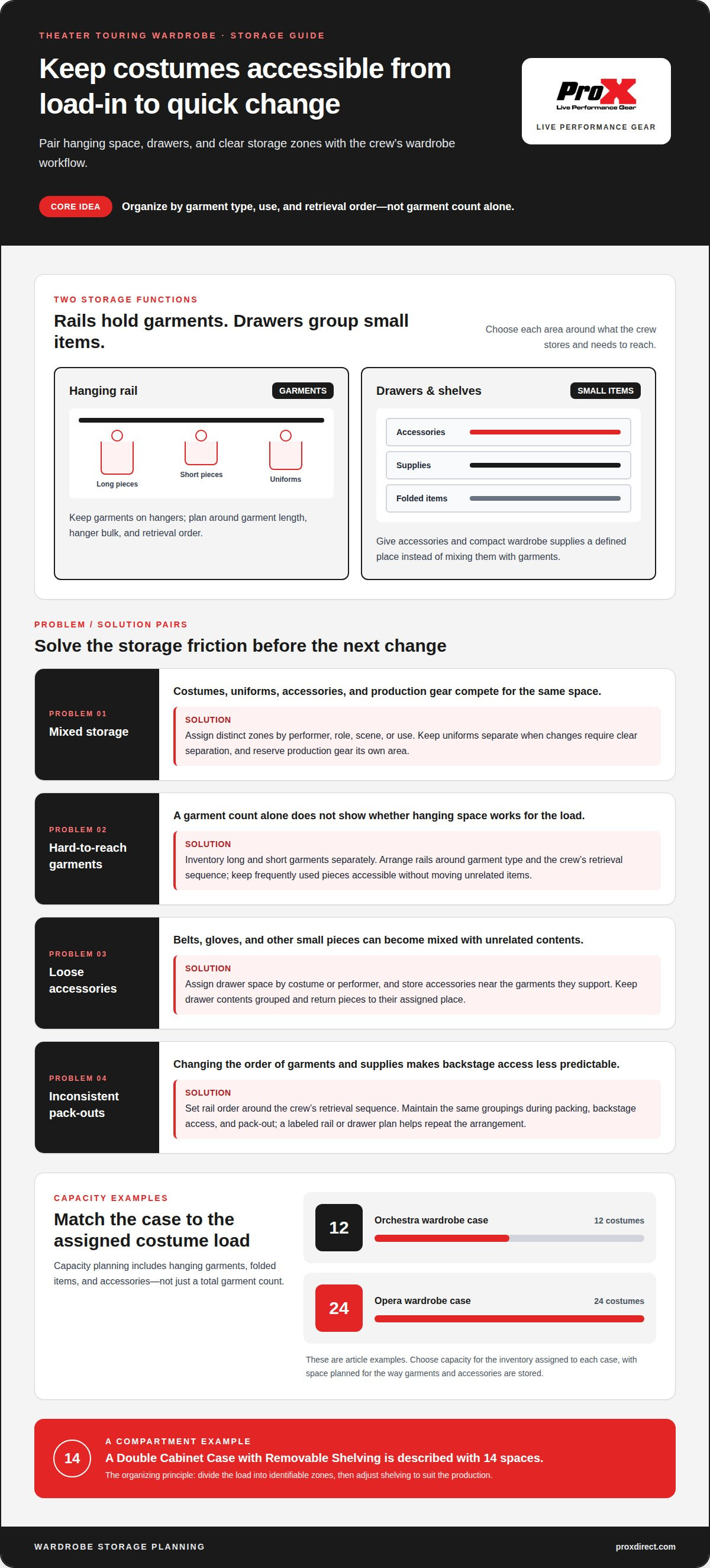
A wardrobe case should keep garments separate from accessories and production gear. Plan its layout around the costume load and the way the crew accesses each storage zone.
Costume and Gear Organization
Start by grouping items by use: performance costumes, uniforms, and supporting gear. Assign each group a distinct area, such as hanging space for jackets and shelves for folded garments. This prevents unrelated items from sharing a storage zone and helps the crew return each piece to its place after a change or pack-out.
Next, plan for small items. Belts, gloves, and costume accessories need a defined place near their corresponding garments. Give production gear its own storage area rather than using space needed for costumes. Shelves can separate categories, and removable shelves make it easier to adjust the layout between productions.
- Group garments by performer, role, or scene.
- Keep uniforms apart from costume pieces where changes require clear separation.
- Store accessories with the garments they support, not as loose mixed contents.
A Double Cabinet Case with Removable Shelving is described with 14 spaces. That configuration illustrates how compartments can divide a load into identifiable zones. Theater crews can use the same organizing principle when planning storage: separate costume categories, then reserve designated space for uniforms and gear. A case overview can help frame these decisions across professional case storage options.
Costume Capacity
Costume capacity means more than a total garment count. It depends on what the case must hold, how garments are stored, and whether accessories share the interior. An Orchestra wardrobe case is described for 12 costumes, while an Opera wardrobe case is described for 24. Those examples show why capacity should match the production’s actual wardrobe load.
Inventory the garments assigned to the case, separating hanging pieces from folded items. Full-length costumes may need more uninterrupted hanging space, while a uniform-heavy load may call for a different balance of hanging storage and compartments. Include accessories in the plan: even small items take up space.
- Match capacity to the costume inventory assigned to each case.
- Distinguish hanging garments from folded garments and accessories.
- Choose a divided layout when separate groups need separate storage.
For a larger wardrobe, a 24-costume case may suit the load better than a 12-costume configuration. The useful choice is the one that stores the assigned costumes without forcing unrelated gear into garment space. Theater, opera, and touring crews can use these capacity examples as planning references, then organize each case around the production’s costume categories.
Hanging rails and drawers
Rails and drawers serve different wardrobe tasks. Hanging space keeps garments on their hangers; drawers contain smaller items. A Touring Performance Wardrobe Road Case is described as having durable drawers and full hanging space, combining garment storage with enclosed compartments for accessories. Choose a layout based on what the crew needs to access between scenes and how each garment travels.
Begin with the garments. Long coats, dresses, and uniforms need clear vertical hanging space. Shorter jackets and shirts can share a rail arrangement if they remain easy to reach. Do not plan around a garment count alone: costume length, hanger bulk, and retrieval order also affect how the interior works. An inventory by garment type gives you a more practical layout.
Rail configuration affects sorting, too. The Double Classic wardrobe category has two rods and hinged double lids. The rods can separate groups, such as performers’ costumes and crew uniforms. Consider the opening direction in relation to where the case will sit backstage. Assign each rod a consistent category and keep that division through load-in and pack-out.
Drawers have a different role. Use them for items that should stay grouped and easy to retrieve, such as costume accessories or compact wardrobe supplies. They keep small pieces from shifting among larger garments. Decide what belongs together before assigning drawer space. For example, group accessories by costume or performer instead of mixing unrelated items.
Use this sequence to assess a rail-and-drawer layout:
- List garments that require hanging, including long and short pieces.
- Separate uniforms from performance costumes when crews handle them differently.
- Identify smaller items that need drawer storage.
- Set the rail order around the crew’s retrieval sequence.
- Keep the same groupings during packing and backstage access.
The Touring Performance Wardrobe Road Case is described as having durable drawers and full hanging space. This pairing illustrates the distinction: rails hold garments, while drawers organize smaller wardrobe components. Consider whether the crew needs both functions in one case. A hanging-only layout may suit a garment-focused load; drawers provide defined storage for accessories and supplies.
Access matters during a quick change. Place frequently used garments where wardrobe staff can reach them without moving unrelated items. Keep drawer contents assigned, and return each piece to its compartment after use. For a portable wardrobe case for theater tours, plan rail spacing and drawer placement around the costumes and backstage workflow, not an assumed standard layout.
Check the loaded layout against the case’s intended use. Hanging garments need room to remain on their hangers, and drawers should hold their assigned contents without blocking access. A labeled rail or drawer plan gives the crew a repeatable packing sequence and helps maintain the same organization at each venue.
Portability and transport protection
Wardrobe cases, rolling garment racks, and costume trunks serve different transport needs. A rack provides open garment access, while an enclosed case contains garments during movement. A costume trunk can combine garment storage with a defined transport footprint. Choose according to route, handling, and the protection required between venues.
On tour, portability starts with the route. Map how the case moves from storage to the loading area, vehicle, and backstage position. Check turns, thresholds, ramps, and staging space along the way. A narrow backstage corridor, for example, may limit where a large case can be positioned. Plan for both transport and access at the venue.
Case dimensions matter alongside contents. The Backstreet Boys Touring Costume Wardrobe Trunk is designed around a 90-inch truck-pack footprint. That gives touring crews a specific footprint reference when planning truck-pack space. It does not determine whether a case fits every vehicle or loading arrangement. Measure the intended space and account for the case’s complete exterior dimensions.
Rolling hardware is another practical consideration. The Custom Wardrobe Basket Tour Case has 4-by-2-inch casters. Caster dimensions are one detail in the movement system, not a substitute for planning the route. Identify the surfaces and transitions the crew will cross, then consider how staff will position and guide the loaded case. A clear route reduces unnecessary repositioning.
- Record the case footprint and compare it with allocated transport space.
- Map turns, doorways, ramps, and backstage placement points.
- Keep garment access and loading order in the transport plan.
- Assign a handling sequence for loading, unloading, and positioning.
Transport protection also depends on how the interior is packed. Keep garments on hangers where the case supports hanging storage, and secure loose accessories in assigned compartments. Separate items that could press against costumes in transit. Before loading, check that doors or lids close without catching garment edges. After unloading, preserve the same organization for easier access.
A rolling garment rack suits open access when garments travel short distances under crew supervision. An enclosed wardrobe case contains the load during transport, while a costume trunk can suit productions that organize garments within a defined footprint. Choose based on the route, storage method, and protection the garments need while moving between locations.
For a portable wardrobe case for theater tours, plan the transport sequence before finalizing the layout. Match the case footprint to available space, consider caster dimensions, and account for access at each stop. A case that fits the load but is difficult to position can slow handling. Treat dimensions, route, and garment access as connected planning factors.
Touring performance wardrobe case
A touring case needs to support both garment handling and production logistics. The Custom Touring Wardrobe Road Case is sized to fit through a Boeing 737 cargo door. That dimension makes transport access a specific design consideration. Case fit still depends on the complete load path, from vehicle loading through backstage placement.
Start with the case’s exterior dimensions and the route it must travel. Include cargo access, loading areas, venue doors, and the final storage position. Clearing an aircraft cargo door does not guarantee a workable route at every venue. Map the route before assigning the case a place in the touring plan.
The Custom Touring Wardrobe Road Case also includes a 2U rack section. This combines wardrobe storage with a defined space for rack-mounted equipment. Consider whether that integrated arrangement matches the production’s load plan. Keep garment access and equipment access distinct, so retrieving one category does not disrupt the other.
Separate compartments can clarify responsibilities during quick changes. For example, wardrobe staff can manage costumes while production staff access rack equipment. Agree on what belongs in each section before packing. Consistent assignments help crews return items to the same place after each performance and venue move.
- Map the case route through loading and backstage areas.
- Compare exterior dimensions with the intended cargo access.
- Assign garments and rack equipment to separate storage zones.
- Set an access order for wardrobe and production staff.
- Keep the same packing assignments between venues.
Material and construction affect a touring case’s role. The Backstreet Boys Touring Costume Wardrobe Trunk is built from ½-inch plywood. That figure describes this case’s panel thickness, not every wardrobe case. When comparing designs, distinguish documented construction details from assumptions about other cases.
Plan the interior around the production’s working sequence. Put frequently accessed garments where wardrobe staff can retrieve them without moving unrelated contents. Keep the rack section assigned to its intended equipment. During pack-out, return items to their designated zones before closing the case. This creates a repeatable process across venues.
A portable wardrobe case for theater tours should align with both garment handling and transport constraints. The Boeing 737 cargo-door dimension and 2U rack section show how a touring design can address specific access and equipment needs. Use those details as planning references, then assess the case’s route, internal zones, and crew workflow together.
Use by theater, film, music, and live-event teams
Theater, film, music, and live-event crews organize wardrobe in different ways. A theater production may sort garments by performer and scene. A film unit may arrange them by character and shooting sequence. A music tour may separate stage clothing from crew uniforms. Base the storage plan on who retrieves each item and when.
For theater and opera tours, wardrobes support repeated performances across venues. Align costume groups with the show’s running order. For example, a quick-change team can assign garments by performer and then order them by entrance. Theater and Opera wardrobes are recommended for tours. Production type is a useful starting point, but one layout will not suit every crew.
Film productions often follow a different sequence. Scenes may be shot out of order, so label costumes by character and scene. Wardrobe staff can keep duplicate looks separate from continuity-sensitive garments. A case layout should preserve those distinctions during moves between filming locations. The crew’s retrieval plan matters as much as the garment categories.
Music crews may coordinate wardrobe among performers, stage staff, and production personnel. Separate performance clothing from crew uniforms, then assign accessories to the relevant group. Plan for who handles pack-out after each show, and use consistent labels so different crew members can return items to their assigned positions.
Live-event teams may work with short setup windows and changing personnel. A practical storage plan makes garment groups easy to identify without relying on one person’s memory. Assign responsibility for each zone, such as performer clothing or uniforms. Keep labels and packing order consistent between locations to support a clear handoff from load-in through post-event packing.
- Set garment categories around the production’s actual workflow.
- Label groups by performer, character, scene, or crew role.
- Assign responsibility for each storage zone.
- Keep labels and packing order consistent between venues.
Across all four production types, access is the key decision. Theater staff may prioritize scene order, while film teams may prioritize continuity. Music crews may separate stage and crew clothing; live-event teams may focus on quick identification and handoffs. A portable wardrobe case for theater tours should support the specific production, not just store garments.
Before assigning a case, define garment groups, access sequence, and responsible crew roles. Then align storage with those decisions. For example, a touring opera team and a film wardrobe department may carry similar garments but need different sorting logic. Explore production case configurations when planning storage across departments.
For crews choosing a portable wardrobe case for theater tours, plan around the production’s handoffs. Clear roles, consistent labels, and storage arranged to match the working sequence help each department manage wardrobe across changing venues and personnel.
ProX: Racks & Case Accessories
ProX offers Racks & Case Accessories for production crews organizing equipment alongside wardrobe loads. When costumes travel with technical gear, separate cases can keep those categories distinct in the transport plan. Utility/Storage Cases, Santosom Cases, and TruckPaX™ Truck Pack Cases are additional options for production storage.
Consider these offerings for adjacent equipment storage, rather than letting technical gear dictate the wardrobe layout. Match each case category to the equipment it will hold and the crew’s handling workflow. Explore ProX case options for your production’s storage requirements.
Plan the next production load
Use the production’s equipment plan to determine how wardrobe storage fits the wider load. A portable wardrobe case for theater tours is one part of that plan, alongside cases for related production equipment. ProX offers Santosom Cases, TruckPaX™ Truck Pack Cases, and Utility/Storage Cases for production storage needs.
Consider these case categories when planning how supporting equipment travels with costumes. Match each category to the equipment it will hold and the crew’s handling workflow. For a portable wardrobe case for theater tours, coordinate the garment plan with adjacent equipment storage. Contact ProX about wardrobe cases to discuss options for your production.
Frequently Asked Questions
What types of portable wardrobe cases are used for theater tours?
Theater tours use enclosed trunks, cabinet-style cases, and hanging cases with shelves or drawers. A trunk can consolidate wardrobe items for transport, while a cabinet layout can divide garments and accessories. Choose the style by considering the production’s wardrobe inventory, backstage setup, and handling sequence. For a touring company with several departments, separate cases can keep wardrobe loads distinct from technical equipment.
What are the best wardrobe cases for touring theater costumes?
The right choice depends on the costume load and crew workflow. A portable wardrobe case for theater tours should accommodate its assigned garments and give staff practical backstage access. A production carrying elaborate costumes may prioritize hanging space, while a simpler load may benefit from shelves or compartments. Choose a configuration that supports the show’s handling process without mixing unrelated equipment.
What dimensions and capacity should a theater tour wardrobe case have?
Choose dimensions and capacity to suit both the garments and the route into each venue. A portable wardrobe case for theater tours must fit the available transport space and backstage position while holding its assigned wardrobe load. A listed example measures 620 × 680 × 1,220 mm, but that is one configuration, not a universal standard. Consider garment length, case access, and space for accessories together.
Which materials and construction hold up best to touring and freight handling?
Assess the construction details of the specific case and its intended handling conditions. One touring costume trunk is described as built from ½-inch plywood; that detail should not be generalized to all cases. Consider how the enclosure protects its contents and how the crew can pack garments to limit shifting. Prices, specifications, and images are subject to change without notice. ProX is not responsible for typographical or illustrative errors.
What airline, freight, and road-case size or weight limits apply to touring wardrobe cases?
Limits depend on the airline, freight service, vehicle, and shipment arrangement. Compare the case’s exterior dimensions and loaded weight with the requirements for the route. Include packaging and attached hardware when calculating the shipment footprint. A case designed around a particular cargo opening does not establish acceptance for every carrier or journey. Plan for each handoff from loading through venue delivery.
How much do portable theater wardrobe cases cost?
Pricing for a portable wardrobe case for theater tours varies significantly based on size, heavy-duty hardware, customized interior shelving, and the manufacturer. Standard production models generally start at several hundred dollars, while fully customized or heavy-duty ATA-rated options can exceed thousands of dollars. To get an accurate quote tailored to your specific touring requirements and hardware upgrades, contact ProX directly or consult authorized dealers for current pricing.
Disclaimer
Any trademarks, trade names or brand names appearing herein that do not belong to ProX are the property of their respective owners and/or companies, and such appearance doesn't and shall not constitute or imply endorsement, sponsorship or recommendation by ProX.


