
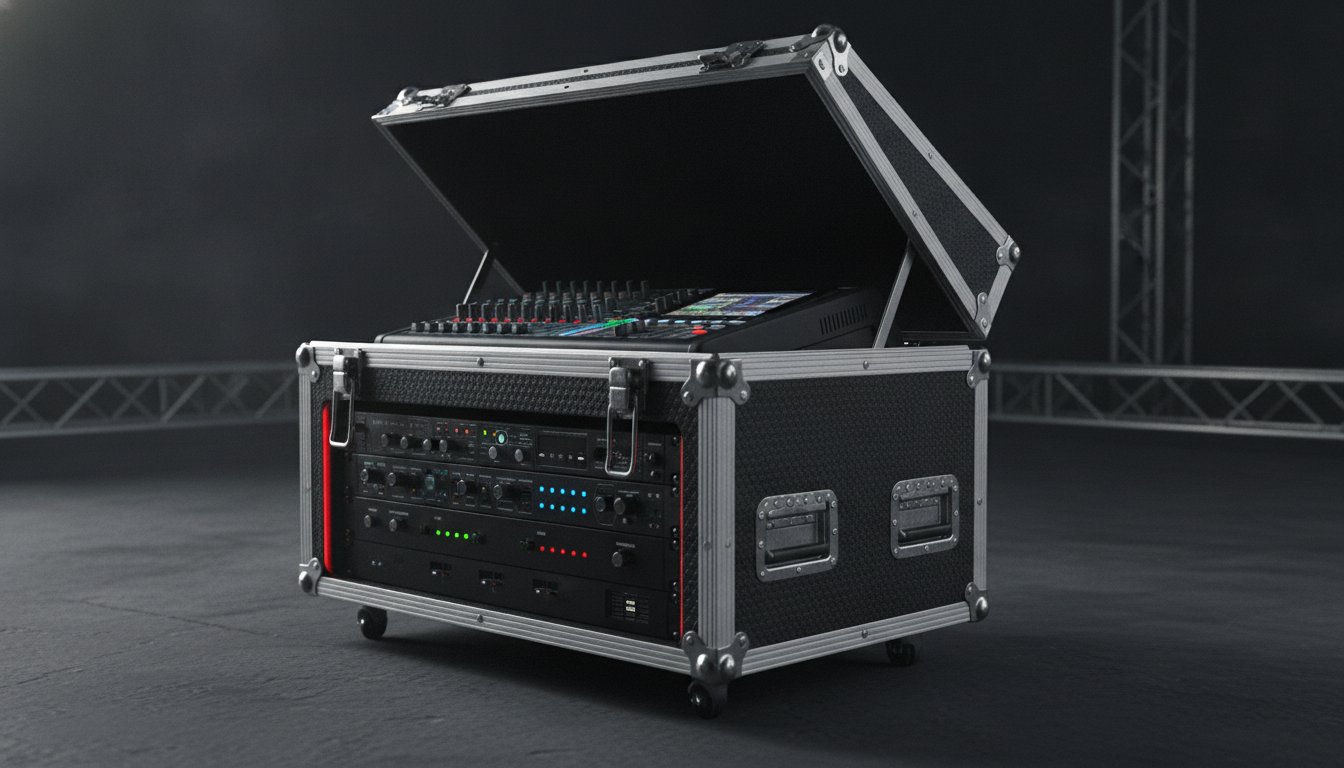
What if the enclosure designed to protect your signal chain is actually the primary catalyst for thermal failure and mechanical degradation? In high-stakes production environments, Mixer & Rack Combo Cases must function as more than just transport shells; they are precision-engineered mobile command centers. You understand that a single millimeter of misalignment can shear a fader or crush a potentiometer during transit. Professional operators cannot afford the downtime caused by substandard housing that fails to account for equipment density or heat dissipation.
You recognize that balancing hardware protection with the physical limitations of solo operation is a constant logistical challenge. This engineering guide provides the technical framework to master EIA-310 rack standards and ergonomic requirements for your 2026 equipment deployment. We will analyze the structural specifications for ATA 300 Category I compliance, thermal airflow protocols, and integrated cable routing systems. By the end of this analysis, you'll have the data necessary to select a consolidated workstation that meets industrial transport standards while maintaining the integrity of your sensitive faders and internal circuitry.
Key Takeaways
- Master the technical application of EIA-310 standards to ensure precise 19-inch rackmount alignment and vertical space management for all signal processing hardware.
- Evaluate the structural integrity of 3/8-inch plywood and moisture-resistant laminates to meet industrial-grade transport requirements without adding unnecessary weight.
- Optimize your mobile production workflow by selecting Mixer & Rack Combo Cases that feature integrated laptop surfaces and internal cable routing for rapid deployment.
- Learn to calculate equipment depth with precision, factoring in rear-mounted connectors and thermal safety protocols to prevent hardware failure in enclosed environments.
- Identify specialized engineering solutions that align with the specific chassis dimensions of flagship consoles from Pioneer DJ, Midas, and Yamaha for a secure fit.
What is a Mixer & Rack Combo Case?
Mixer & Rack Combo Cases represent a specialized category of protective enclosures designed for simultaneous operation and transport. Unlike standard utility trunks, these cases utilize a dual-axis internal frame. The architecture consists of a top-mounted, slanted mixer section positioned directly above a vertical rack space. This configuration creates a self-contained mobile workstation. It allows engineers to maintain permanent signal connections between the mixing console and outboard equipment such as power amplifiers, signal processors, and wireless receivers. By consolidating these components, the case functions as the central nervous system of a mobile production rig.
The structural foundation of these units is the 19-inch rack standard. This universal specification ensures that hardware from various manufacturers remains interchangeable and secure. In professional audio logistics, the ability to house multiple components within a single footprint is essential. It minimizes the physical space required at the front-of-house (FOH) position and significantly reduces setup time. By keeping cables patched internally, operators mitigate the risk of connector wear and signal degradation caused by frequent plugging and unplugging during touring cycles.
Primary applications for these combo units include:
- Mobile DJ Operations: Integrating a digital controller or mixer with wireless microphone receivers and power distribution.
- Live Sound FOH: Providing a compact station for small-to-medium format digital consoles and effects racks in clubs or theaters.
- House of Worship AV: Creating a secure, lockable enclosure for permanent or portable sanctuary audio systems that require simplified operation.
Anatomy of a Professional Combo Case
The internal layout is measured in Rack Units (U), where 1U equals 1.75 inches. The top-slant section is typically designed with 10U to 12U of space, angled toward the operator for ergonomic access to faders and knobs. Below this, the vertical rack provides additional U-space for heavy hardware. Professional Mixer & Rack Combo Cases feature a three-lid system. The top lid protects the console interface, while the front and rear lids provide access to the vertical rack rails and cable management ports. This design ensures that equipment remains protected while allowing for maximum airflow and connectivity.
Standard vs. Custom Configurations
Mechanical flexibility varies between models to accommodate different hardware profiles. Some units utilize fixed-angle rails for maximum structural rigidity, while others incorporate adjustable-tilt mechanisms. These ratcheting systems allow the user to set the mixer at the optimal viewing angle for specific lighting conditions or desk heights. For larger requirements, dual-rack configurations provide side-by-side vertical spaces. Modern workstations often integrate sliding laptop surfaces or articulated monitor arms. These additions transform a basic case into a comprehensive production hub capable of supporting digital software integration alongside analog hardware components.
Technical Specifications: Calculating Rack Units and Depth
Precision in engineering starts with standardized measurements. Calculating Rack Units (RU) requires an understanding of the EIA-310 specification, where 1U equals exactly 1.75 inches. For Mixer & Rack Combo Cases, this calculation must be performed across two distinct axes: the horizontal slant and the vertical stack. You've got to ensure that the cumulative height of your processors and amplifiers doesn't exceed the available vertical U-count, while simultaneously verifying the mixer's footprint fits the top rails.
Measuring mixer depth isn't just about the chassis dimensions. You must account for the "service loop" and connector protrusion. XLR connectors and IEC power cables typically require an additional 2.5 to 3 inches of clearance behind the rear panel. If you fail to account for this, you'll face cable strain or the inability to seat the mixer flush against the rails. For the vertical section, rail-to-rail depth is the critical metric. Deep-chassis amplifiers often extend 18 inches or more. You need to verify the case depth accommodates the hardware plus the rear rack rails if you're using a four-rail system for heavy support. For those building high-density rigs, reviewing the structural specifications of industrial Mixer & Rack Combo Cases ensures your hardware remains within safe operating tolerances.
Optimizing the Top-Mount Slant
Most professional 16-channel consoles require a 10U to 12U top-mount capacity. When calculating this space, don't just look at the rack footprint. Consider the height of motorized faders and high-profile gain knobs. If the mixer sits too high, the top lid won't clear the hardware. The angle of the slant is equally vital. A 15 to 20-degree incline typically provides the best ergonomic visibility for a seated operator while maintaining a low center of gravity for the case.
Thermal Management and Airflow
Combo cases present a unique thermal challenge. Heat generated by power amplifiers in the bottom section naturally rises, creating a "chimney effect" that can bake the mixer's sensitive internal circuitry. To mitigate this, don't pack the vertical rack to its maximum capacity without ventilation. Use 1U vented panels between high-heat components. Strategic placement is key. Placing heavy, high-draw amplifiers at the very bottom of the rack allows for better heat dissipation through the rear access panel and prevents heat soak into wireless receivers or processors mounted higher up.
Engineering for Durability: Materials and Hardware
The structural integrity of Mixer & Rack Combo Cases depends on the quality of their substrate and the precision of their mechanical assembly. Industry standards for touring equipment prioritize 3/8-inch (9mm) plywood. This thickness provides the necessary shear strength to support heavy vertical loads, such as high-current power amplifiers, while maintaining enough flexibility to absorb kinetic energy during transit. While 1/4-inch alternatives exist, they often fail under the stress of high-density rack configurations. The weight of 3/8-inch ply is a calculated trade-off; it ensures the chassis remains rigid and prevents the warping that leads to rail misalignment.
Surface protection is achieved through high-pressure laminates. Professional builds often utilize a hexagonal grid pattern, such as the Honeycomb Digital surface, which serves a dual purpose. It creates a scratch-resistant barrier against moisture and impact while providing a tactile grip for handlers. This laminate is bonded to the plywood using industrial-grade adhesives that resist delamination in extreme temperature fluctuations. To further reinforce the enclosure, Mixer & Rack Combo Cases utilize dual-anchor rivets and 6063 aluminum extrusions. These components lock the panels into a unified frame, ensuring that impact energy is distributed across the entire structure rather than localized at a single point of failure.
Professional-Grade Hardware Components
Hardware selection is a matter of mechanical reliability. Recessed butterfly latches are engineered to remain closed under intense vibration, utilizing a twist-action tensioning system that pulls the lids tight against the gaskets. Industrial ball corners are another critical feature. These steel caps dissipate impact energy away from the internal equipment. When a case is dropped on its corner, the ball shape prevents the force from crushing the plywood. Furthermore, spring-action handles are designed with rubber grips to improve ergonomics and prevent injury during heavy lifting maneuvers.
Casters and Mobility Engineering
Mobility is the final pillar of durability. High-density racks require 4-inch heavy-duty casters to navigate uneven surfaces and thresholds. Wheel diameter is vital; smaller wheels often catch on cable ramps or floor gaps, transferring the shock directly to the equipment. These casters should be plate-mounted to a reinforced dolly plate rather than bolted directly through the thin plywood floor. This reinforcement prevents the bolts from tearing through the wood under the weight of a fully loaded rig. Beyond structural rigidity, the physical interaction with the case requires attention to ergonomics and accessory integration to prevent operator fatigue and ensure long-term physical health during setup and strike.

Workflow Optimization: Ergonomics and Accessory Integration
Workflow optimization within Mixer & Rack Combo Cases transforms a protective shell into a high-efficiency production hub. Professional engineering focuses on reducing the transition time between transport and live operation. Integrated laptop surfaces are a primary example of this evolution. These surfaces provide a stable platform for digital audio workstations or lighting control software directly above the mixing interface. By maintaining the laptop in a fixed position, operators eliminate the need for external stands. Those external stands often compromise the footprint of the front-of-house position and create additional points of failure.
Effective cable management is the backbone of a reliable signal chain. High-quality combo cases incorporate rear access panels and dedicated interior routing paths. These features allow for permanent patching between the mixer's output stage and the rack-mounted processing hardware. You can pre-wire the entire internal system, leaving only the primary power and stage snake connections for field deployment. This "plug and play" capability significantly reduces setup time. Proper routing also prevents cable fatigue. It ensures that connectors aren't subjected to sharp bends or tension when you remove the lids during a strike. To find a chassis that supports your specific routing needs, you can browse professional Mixer & Rack Combo Cases designed for high-density configurations.
Ergonomics must account for varying operational heights. A standard rack base height of 30 to 36 inches is ideal for seated operation, while taller configurations are necessary for standing environments. You'll want to calculate the total height of the rack base and the angle of the top slant to ensure the faders remain within a comfortable reach. It's essential to maintain a neutral wrist position to prevent fatigue during long sets. If the mixer is positioned too high or at an improper angle, the operator's line of sight to the vertical rack components is obstructed.
The Role of Sliding Laptop Shelves
Sliding laptop shelves require precise mechanical engineering to maintain stability during a performance. The tracks must be rated for the weight of the hardware and include locking mechanisms to prevent accidental movement. Surface areas should be wide enough to accommodate not only a laptop but also small interface units or external hard drives. Friction surfaces and safety straps are essential. They prevent equipment migration when the shelf is tilted or subjected to heavy stage vibrations.
Accessory Racking and Storage
Accessory racking extends the utility of the vertical space. Rack drawers provide secure storage for microphones, adapters, and specialty cables that must stay with the rig. Integrating 1U rack lights improves visibility in low-light environments, allowing for precise adjustments to gain stages and EQ settings. Finally, mounting internal power strips with surge protection ensures clean electrical distribution. This eliminates the clutter of external power blocks and keeps the floor clear of tripping hazards.
Selecting the Right ProX Solution for Your Rig
ProX engineering standards have defined the industry since 1984. This heritage informs every mechanical specification and material choice used in the assembly of professional workstations. The brand's philosophy prioritizes functional excellence over aesthetic trends, ensuring that Mixer & Rack Combo Cases provide a dependable backbone for high-stakes production environments. By focusing on industrial-grade assembly techniques, these cases maintain structural integrity under the physical demands of frequent transport and heavy equipment loads. This long-term expertise allows for the creation of enclosures that act as precision instruments for equipment protection.
Matching your specific hardware to the correct chassis requires an analysis of chassis geometry and connector placement. Flagship consoles from Pioneer DJ, Midas, and Yamaha have distinct physical footprints that demand specific rail offsets and interior clearance. ProX engineers cases to accommodate these variations, providing a secure fit that prevents lateral movement during transit. For instance, the Midas M32R requires a different vertical depth than a standard 19-inch analog board. Utilizing the correct case ensures that faders and knobs remain clear of the lid gaskets while maintaining easy access to rear-mounted I/O panels.
The Honeycomb Digital™ surface design is a key differentiator in durability. This hexagonal laminate is bonded to the 3/8-inch plywood substrate to create a moisture-resistant barrier. It doesn't just provide a professional finish; it reinforces the panel against shear forces. The tactile pattern also minimizes the visibility of scuffs and impacts that are inevitable in logistical handling. This surface technology is a standard feature across the catalog, reinforcing the brand's commitment to industrial-grade protection. Procurement is streamlined through a global dealer network, allowing professionals to secure equipment housing on tight production schedules.
Standard ProX Combo Series Overview
The 10U Top / 8U Vertical configuration is the established standard for mobile DJ operations. It provides a balanced footprint that is manageable for solo operators while housing a mixer and essential wireless receivers. For large-scale live sound, the 13U Top / 16U Vertical model serves as a comprehensive FOH command center. This high-capacity unit supports full-sized digital consoles alongside extensive amplifier banks and signal processors. Operators in specialized fields can also find dedicated AV broadcasting cases tailored for video production and streaming hardware.
Next Steps: Custom Engineering and Support
Non-standard equipment configurations may require bespoke engineering. Custom builds from ZCASE in Poland offer solutions for unique ergonomic needs or non-EIA equipment dimensions. Maintaining your rig is vital for operational safety. Periodically inspect your 4-inch casters for debris and apply industrial-grade lubricants to the recessed butterfly latches to ensure smooth mechanical operation. These small maintenance steps prevent hardware failure during critical load-ins. You can browse the full ProX Mixer & Rack Combo Case catalog to identify the specific model that aligns with your 2026 equipment deployment and workflow requirements.
Optimizing Your Mobile Production Infrastructure
Mastering the technical balance between high-density equipment housing and thermal safety is essential for modern production. Successful deployment depends on precise EIA-310 standard compliance and the structural durability of 3/8-inch plywood. By integrating these engineering principles, you'll eliminate the risks of mechanical failure and signal degradation during transit. Mixer & Rack Combo Cases from ProX utilize ruggedized Honeycomb Digital™ surface technology to withstand the rigors of industrial logistics. It's a design philosophy that's supported the hardware of major brands like Pioneer DJ and QSC since 1984, providing a reliable foundation for professional audio and video rigs.
Your mobile workstation is the central hub of your signal chain. Selecting an enclosure that prioritizes mechanical precision and ergonomic access ensures your hardware remains secure and operational for every performance. You're now equipped to make an informed decision based on logistical standards and thermal requirements. Explore Professional Mixer & Rack Combo Cases at ProX. Build your next rig with the confidence of industrial-grade engineering.
Frequently Asked Questions
How do I know if my 19-inch mixer will fit in a standard combo case?
Check the Rack Unit (U) count of your mixer's rack-ear mounting hardware and its total chassis depth. A standard 19-inch mixer will fit if its depth from the front rails to the rear connectors is within the top-slant rail capacity, which is typically 10U to 12U. You must also verify that the height of gain knobs or motorized faders allows the top lid to close securely without making contact.
What is the difference between 1/4 inch and 3/8 inch plywood for rack cases?
Plywood thickness directly determines the structural shear strength and load-bearing capacity of the enclosure. 3/8-inch (9mm) plywood is the industry standard for touring because it prevents the chassis from warping under the weight of heavy power amplifiers. While 1/4-inch ply is lighter, it lacks the rigidity required for vertical rack stacks and is more susceptible to impact damage during logistical handling.
Can I leave my equipment plugged in during transport in a combo case?
You can maintain internal signal connections if you utilize proper cable management and internal routing paths. Mixer & Rack Combo Cases are specifically engineered for permanent patching between the console and outboard gear to reduce field setup time. It's essential to secure all cables with ties and ensure enough slack exists to prevent connector strain or signal degradation during high-vibration transport cycles.
How many rack units (U) do I need for a standard amplifier and power conditioner?
Most professional power amplifiers require 2U or 3U of vertical space, while standard power conditioners occupy exactly 1U. You should also account for a 1U vented panel between the amplifier and sensitive wireless receivers or processors. This configuration ensures that your total U-count calculation includes necessary spacing for thermal management and electrical distribution within the vertical rack section.
Are the laptop shelves in ProX cases removable for tighter spaces?
Most integrated laptop surfaces are designed with removable sliding tracks or quick-release pins to accommodate confined operational environments. This allows you to detach the shelf when working in cramped front-of-house positions where a lower profile is required. Removing the shelf also decreases the total weight of the case, which is a significant advantage for solo operators managing their own load-ins.
What should I do if my mixer is wider than the standard 19-inch rack rails?
Hardware wider than the 19-inch EIA-310 standard cannot be rail-mounted and requires a specialized console workstation or a bespoke enclosure. Standard combo cases are built to precise width specifications that cannot be adjusted. If your mixer exceeds this width, you should look for a custom build from ZCASE in Poland or a universal console case that utilizes high-density foam inserts rather than fixed rack rails.
How do I maintain the butterfly latches and casters on my case?
Mechanical maintenance involves regular cleaning and the application of dry silicone-based lubricants to all moving parts. Inspect butterfly latches for tension and lubricate the twist mechanism to prevent seizing in high-moisture environments. Casters require periodic cleaning to remove hair or debris from the bearings; this prevents flat spots and ensures the 4-inch wheels maintain smooth mobility across uneven stage thresholds and cable ramps.
Is thermal management a concern for amplifiers mounted in combo racks?
Thermal management is a primary engineering concern because heat generated by bottom-mounted amplifiers naturally rises toward the mixer. To prevent hardware failure, you must utilize vented panels and ensure the rear access door remains open during operation. Strategic placement of high-heat components at the bottom of Mixer & Rack Combo Cases allows for better airflow and prevents the chimney effect from damaging sensitive internal console circuitry.
Disclaimer
Any trademarks, trade names or brand names appearing herein that do not belong to ProX are the property of their respective owners and/or companies, and such appearance doesn't and shall not constitute or imply endorsement, sponsorship or recommendation by ProX.


