
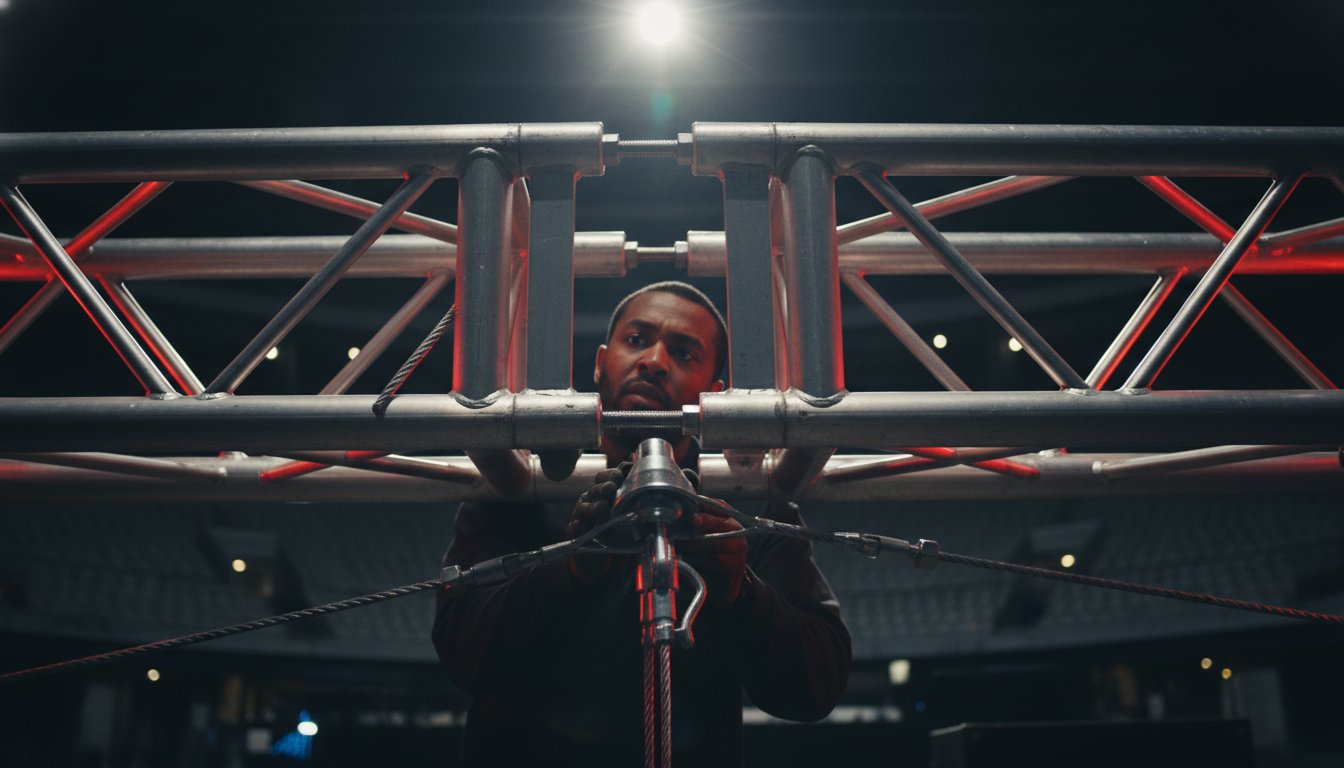
A stage truss is not merely a frame for lighting; it is a complex structural assembly where a single overlooked shear point can compromise the integrity of the entire rig. You understand that the high-stakes environment of live production leaves no margin for error, yet calculating multi-point load tables and managing material fatigue remains a persistent source of professional anxiety. It's difficult to maintain total confidence when industry standards evolve and equipment demands increase.
This guide provides the technical mastery required to implement rigorous stage truss safety protocols, ensuring every component meets current ANSI E1.2-2021 and ANSI E1.21-2024 standards. You'll gain a repeatable inspection workflow and the ability to interpret manufacturer load ratings with engineering precision. We will examine the physics of load distribution, material-specific guidance for 6061-T6 and 6082-T6 aluminum alloys, and the critical differences between static and dynamic safety margins. By the end of this analysis, you will have the expertise to manage structural risks and ensure your production remains compliant and secure.
Key Takeaways
- Understand the mechanical properties of 6082-T6 aluminum and how current ANSI E1.2-2021 standards dictate professional structural engineering.
- Learn to accurately interpret load tables by distinguishing between uniformly distributed loads and point loads to maintain a precise safety factor.
- Implement a standardized inspection workflow using the "Tap Test" and visual checks to ensure long-term stage truss safety for every production.
- Master the application of conical connection systems and independent safety cables to secure overhead hardware and prevent mechanical failure.
- Discover how standardized F34 and F32 dimensions provide global hardware compatibility and predictable structural performance across diverse venue environments.
The Fundamentals of Aluminum Stage Truss Engineering and TUV Standards
A stage truss serves as the critical structural framework for suspending lighting fixtures, audio arrays, and video panels in professional production environments. Understanding The Fundamentals of Truss Engineering is essential for any rigger or production manager responsible for stage truss safety. Unlike generic structural steel, professional-grade aluminum truss systems are engineered to provide a high strength-to-weight ratio. This allows technicians to support heavy payloads without adding excessive dead weight to the overhead rigging points.
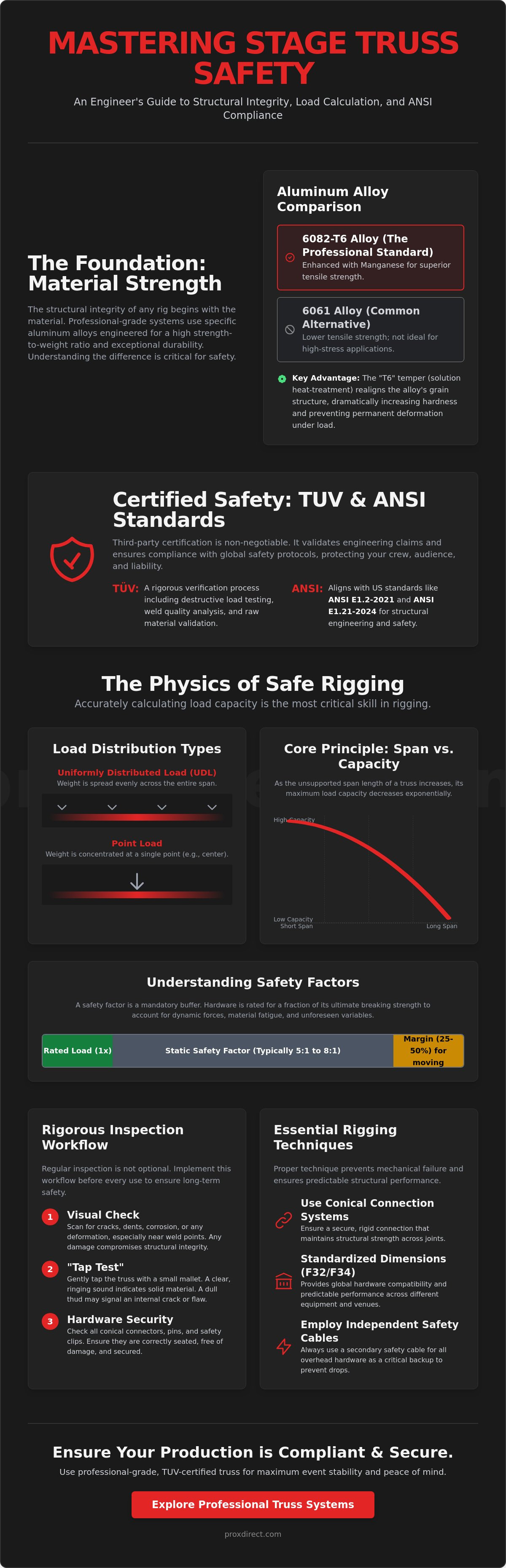
Material selection is a primary factor in structural integrity. Premium systems, including those in the ProX Truss range, utilize 6082-T6 aluminum alloy. This specific alloy contains higher levels of manganese and silicon compared to common 6061 variants, which enhances its overall tensile strength. Using inferior materials or uncertified generic alternatives introduces unpredictable failure points. These weaknesses often manifest in the heat-affected zones near the welds, leading to catastrophic structural collapse during a live event.
Why 6082-T6 Aluminum is the Industry Standard
The 6082-T6 alloy provides the optimal balance between lightweight portability and high load-bearing capacity. It's particularly valued for its natural corrosion resistance. This is vital for outdoor festival environments where equipment faces constant exposure to humidity and precipitation. The "T6" designation refers to the solution heat-treatment and artificial aging process. This metallurgical treatment aligns the internal grain structure of the aluminum, significantly increasing its hardness and yield strength. It ensures the truss maintains its shape under maximum permissible loads without permanent deformation or stress fractures.
Decoding TUV and ANSI Safety Certifications
TUV certification is a comprehensive third-party verification process that validates a manufacturer's engineering claims. It involves destructive load testing, meticulous weld quality analysis, and raw material verification. A TUV mark confirms that the truss meets international safety requirements, aligning with the ANSI E1.2-2021 standard for aluminum structures. This is a critical factor for securing production insurance and minimizing legal liability. Rigorous testing distinguishes between static load ratings, which represent stationary weight, and dynamic safety factors. Professional standards often require a safety factor of at least 5:1 or 8:1. This buffer accounts for the kinetic energy generated by moving fixtures or environmental factors. Adhering to these certifications ensures stage truss safety remains a predictable engineering discipline.
Calculating Load Capacities: Uniformly Distributed vs. Point Loads
Load tables are the definitive reference for stage truss safety. They serve as the engineering "Bible" for riggers, providing the maximum weight a specific span can support before reaching its elastic limit. These tables are not suggestions. They are calculated based on rigorous stress analysis and material testing. Ignoring these values risks permanent structural deformation or catastrophic failure during a live production. Every professional technician must understand that as the span length increases, the total weight capacity of the truss decreases exponentially due to the physics of beam deflection.
Standard engineering protocols typically utilize a 5:1 safety factor for static loads. This means the hardware is designed to withstand five times the rated load before mechanical failure occurs. However, you must account for dynamic forces. According to industry guidelines, a safety margin of 25-50% should be added to any rig containing moving lights or speakers to compensate for kinetic energy. For complex installations, consulting Proper Rigging Techniques published by ESTA ensures compliance with current technical standards. Proper planning also requires choosing between "dead hangs," which exert direct vertical force, and bridled points, which distribute weight but introduce horizontal tension into the truss structure.
Uniformly Distributed Load (UDL) Explained
Uniformly Distributed Load (UDL) refers to weight spread evenly across the entire horizontal span of a truss. A common scenario involves a line of identical LED par cans or wash fixtures spaced at equal intervals. Manufacturer UDL charts indicate the total capacity based on this even distribution. If a 30-foot span is rated for 1,000 lbs UDL, it assumes the weight is not concentrated in one area. If you are planning a high-density lighting plot, reviewing the specifications for ProX Truss systems allows you to match the correct truss series to your UDL requirements.
Center Point Load (CPL) and Third Point Loading
A Center Point Load (CPL) is a single, heavy fixture positioned at the exact midpoint between two support pillars. This is the most taxing configuration for any truss because the bending moment is highest at the center. Often, the CPL capacity is only 50% of the UDL rating for the same span. For heavier applications like LED video wall support, technicians use third-point or quarter-point loading. This method involves hanging columns of panels at designated intervals to distribute the weight more effectively than a single center hang. Never exceed the CPL rating even if the total weight is below the UDL limit. Doing so compromises stage truss safety by creating localized stress that the chords and webbing were not designed to handle.
Step-by-Step Structural Inspection: Identifying Wear and Damage
Systematic inspection is the primary defense against mechanical failure. A rigorous stage truss safety protocol requires both pre-show and post-show evaluations. These routines ensure that damage sustained during load-in or transport is identified before the system is suspended. Every production crew should maintain a standardized logbook. This documentation is vital for venue safety compliance and provides a clear audit trail for insurance purposes. When a truss "stick" reaches the end of its lifecycle due to cumulative material fatigue or structural damage, it must be permanently decommissioned and marked to prevent accidental reuse.
The "Tap Test" is a fundamental diagnostic tool for verifying internal structural integrity. By striking the main chords with a plastic mallet, a technician listens for a clear, resonant ring. A dull "thud" often indicates internal cracks, loose bracing, or a compromise in the metallurgical bond. While this test is not a substitute for x-ray or ultrasonic testing, it serves as an effective field method for identifying immediate concerns. Protecting these components during transport using ProX Cases reduces the frequency of transit-related damage that necessitates decommissioning.
Inspecting Main Chords and Diagonal Bracing
Technicians must examine main chords for any sign of "out-of-round" deformation. A dent exceeding 2mm in the main chord is an automatic failure. Such indentations concentrate stress and significantly reduce the load-bearing capacity of the entire span. Gouges or abrasions that remove more than 10% of the wall thickness are equally critical. You should also check for permanent set, which is a visible sag that remains after the truss is unloaded. If a span does not return to its original straightness, the aluminum has exceeded its elastic limit and the truss is no longer safe for professional use.
Evaluating Weld Integrity and Conical Connectors
Weld beads require close scrutiny for hairline cracks that might be obscured by dust or surface wear. Using a magnifying glass to inspect the heat-affected zones near the webbing joins can reveal early signs of stress fractures. Conical couplers must be checked for pitting, oxidation, or ovalization of the pin holes. A secure fit is essential; spigots and pins should slide into place with firm thumb pressure or a single light tap. If forced hammering is required to seat a pin, the connection system is likely deformed. Maintaining the precision of ProX Truss connection points is a non-negotiable requirement for maintaining structural stability across the entire rig.
Proper Rigging Techniques and Hardware Security
Hardware security is the final layer of stage truss safety. While the truss itself provides the structural capacity, the connection points and rigging hardware are the most frequent points of failure. Every bolt, pin, and shackle must meet specific load ratings. Using generic hardware store bolts instead of Grade 8 structural bolts is a common but dangerous error. Grade 8 hardware is engineered to handle significantly higher shear forces without fracturing. Similarly, safety cables are a non-negotiable redundancy. They must be attached to an independent point on the truss, not the fixture's primary clamp. This ensures they catch the load if the primary attachment fails.
When managing heavy screens, specialized LED Video Panel Wall Support systems are required. These provide the necessary lateral stability to prevent the high center of gravity from toppling the rig. Failure to use application-specific support hardware often leads to structural swaying or catastrophic tipping. It's vital to choose hardware that matches the specific weight and dimensions of the video panels being deployed.
The Mechanics of Conical Connectors and R-Springs
Modern Stage Truss utilizes conical connection systems because their tapered design creates a friction-locked joint. This eliminates the "play" or rattling common in older nut-and-bolt designs. Such movement can lead to metal fatigue or ovalization of the bolt holes over time. The R-spring, or safety clip, is a critical component that prevents the tapered pin from vibrating out due to low-frequency audio or fixture movement. Technicians should always insert pins from the outside of the truss toward the center. This ensures the R-clip is fully seated and visible for quick visual inspection during a walk-through.
Ground Support Stability and Base Plate Safety
Ground-supported structures rely entirely on the base plate for stability. A heavy steel base plate provides a low center of gravity. This is essential for stage truss safety in high-traffic areas or outdoor environments. You must calculate the footprint required based on the height of the vertical towers. While indoor environments might allow for smaller footprints, outdoor setups require outriggers and sandbags to counteract wind loads. Maintaining the integrity of these plates is crucial. If you are building a complex ground-supported rig, using professional Stage Truss and Base Plate Cases ensures your foundation hardware remains flat and free from the warping that occurs during loose transport.
Implementing ProX Truss Systems for Maximum Event Stability
Implementing a high-performance rig requires hardware that translates engineering theory into physical reliability. ProX engineering standards are built on decades of industry experience, prioritizing stage truss safety through rigorous material selection and structural testing. By adhering to the standardized F34 and F32 dimensions, these systems ensure global compatibility. This allows production companies to integrate segments seamlessly into existing inventories or cross-rental networks without compromising structural alignment. Interoperability is a cornerstone of professional production. It ensures that a rig assembled in one region performs identically to one built elsewhere. For complex builds or custom structural engineering projects, consulting with an authorized ProX dealer provides access to technical data necessary for safe implementation. They can provide specific CAD blocks and load calculations for specialized configurations.
To maintain the highest level of stage truss safety, all components must be protected from the mechanical stresses of logistics. Utilizing specialized Stage Truss and Base Plate Cases prevents the gouging and denting that often occurs during transit. These physical defects, as analyzed in previous sections, are the primary precursors to structural failure under load. Protecting the structural integrity of your hardware is as vital as the rigging process itself.
The ProX Advantage: Precision Manufacturing since 1984
ProX has focused on precision manufacturing since 1984. Every component is CNC-machined to ensure that tolerances remain within strict engineering limits. This precision is especially critical for conical connection points. Even a fraction of a millimeter of deviation can introduce unwanted vibration or stress concentrations. Uniform robotic welding across all truss segments ensures that the heat-affected zones are consistent. This provides predictable tensile strength throughout the entire span. Consistency is the enemy of failure. Maintaining system integrity also requires the use of genuine ProX replacement parts. Substituting non-certified pins or couplers can invalidate load ratings and compromise the safety of the entire rig. It's a risk that professional riggers don't take.
Protecting Your Investment with Professional Cases
Transport damage is the leading cause of truss decommissioning. Impact damage to the ends of a truss stick can deform the connection points. This makes it impossible to achieve a secure friction-lock with conical couplers. Professional ProX-Cases are engineered to isolate these sensitive components from impact and vibration. They provide a structured environment for heavy base plates and truss segments. By securing the truss in a dedicated storage environment, you preserve the structural integrity of the aluminum. This ensures that the equipment remains within manufacturer specifications for years of service. Protecting your hardware from the rigors of the road is a fundamental part of a long-term safety strategy.
Browse the ProX Truss Catalog for your next production.
Advancing Your Structural Safety Standards
Maintaining high-level stage truss safety requires a persistent commitment to engineering precision and material science. You've seen how the transition from basic load calculations to a comprehensive understanding of 6082-T6 alloy properties and TUV certification creates a more resilient production environment. By implementing standardized inspection workflows and utilizing application-specific support hardware, you mitigate the inherent risks of overhead rigging. Protecting these assets from mechanical fatigue during transport ensures that every connection remains friction-locked and every chord retains its structural temper.
ProX has been engineering performance gear since 1984, providing TUV Certified structural components that are fully compatible with industry-standard F34 systems. This technical consistency allows you to scale your inventory with total confidence in its structural performance. Explore ProX Professional Truss Systems to find the reliable backbone your next production demands. Your dedication to these rigorous standards ensures that every show is built on a foundation of professional-grade integrity.
Frequently Asked Questions
How often should I perform a safety inspection on my stage truss?
You must conduct a visual inspection before every load-in and immediately after every load-out. Pre-show inspections identify damage sustained during transit, while post-show checks catch structural stress or permanent sets caused by heavy payloads. A comprehensive annual inspection by a competent person is also required to maintain compliance with professional safety standards.
Can I mix different brands of truss if they have the same dimensions?
Mixing brands is not recommended and often voids manufacturer warranties and TUV certifications. Even if external dimensions match, differences in aluminum alloy composition, weld patterns, and conical connection tolerances can create unpredictable stress points. For consistent stage truss safety, you should only utilize components from a single manufacturer within a structural span.
What is the maximum load a standard 12-inch box truss can hold?
Maximum capacity depends entirely on the span length and the manufacturer's specific load table. A standard 290mm (12-inch) F34 truss may support significant weight on a 10-foot span, but that capacity drops exponentially as the span reaches 30 or 40 feet. Always consult the specific UDL and CPL charts provided by the manufacturer for your exact configuration.
How do I know if a dent in my truss makes it unsafe to use?
Any dent in a main chord that exceeds 2mm in depth is an automatic failure. Dents concentrate stress and compromise the tube's ability to handle compression and tension. If you identify gouges that remove more than 10% of the wall thickness or any deformation near a weld bead, you must decommission the segment immediately to prevent structural collapse.
Why are safety cables required even if the primary clamp is rated for the load?
Safety cables provide essential mechanical redundancy in the event of a primary fastener failure. While a rated clamp handles the static load, a secondary safety prevents a fixture from falling if the clamp vibrates loose or the bolt shears. These cables must be attached to an independent structural point to ensure total stage truss safety across the rig.
What is the difference between a ladder truss and a box truss in terms of safety?
Box truss provides superior lateral and torsional stability due to its four-chord design and multi-planar bracing. Ladder truss only has two chords, which makes it susceptible to twisting and bending under uneven loads. While ladder truss is suitable for lightweight decorative applications, box truss is the standard for supporting heavy lighting, audio, and video equipment.
Can I use a stage truss outdoors during high winds?
Outdoor use requires a calculated wind-load plan and sufficient ballast. According to ANSI E1.21-2024, temporary structures must have defined wind-speed thresholds for when loads must be lowered or the rig struck. You must use heavy steel base plates, outriggers, and sandbags to counteract the "sail effect" caused by fixtures and video panels in gusty conditions.
Do I need a structural engineer to sign off on my truss rig?
Professional engineer (PE) sign-off is often required for complex temporary structures, large-scale outdoor stages, or rigs exceeding specific weight thresholds. Local building codes and venue insurance policies frequently dictate these requirements. If your design deviates from standard manufacturer configurations, a structural analysis is necessary to verify the safety of the build.
Disclaimer
Any trademarks, trade names or brand names appearing herein that do not belong to ProX are the property of their respective owners and/or companies, and such appearance doesn't and shall not constitute or imply endorsement, sponsorship or recommendation by ProX.


