

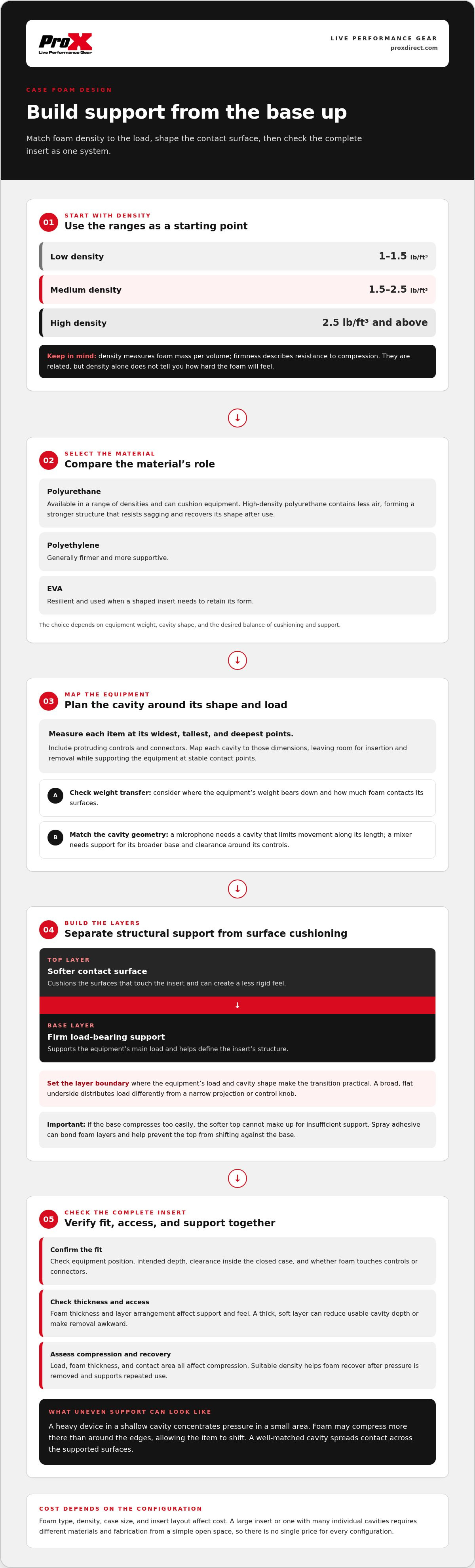
For choosing the right foam density for cases, use the density bands as a starting point: low-density foam is 1-1.5 pounds per cubic foot, medium-density foam is 1.5-2.5 pounds per cubic foot, and high-density foam is 2.5 pounds per cubic foot and above. High-density polyurethane foam is made with less air, creating a stronger structure that resists sagging and returns to its original shape after use. The best fit depends on the equipment load and whether the case needs firm support, a softer contact surface, or both.
Density is an important selection factor, but it is only one part of a case’s cushioning design. Foam thickness and the arrangement of firm and soft layers affect how equipment is supported and how the lining feels. This guide compares low, medium, and high densities, explains what density can indicate about durability and sag resistance, and shows how layered foam can balance support with a softer surface. Use these points to match foam construction to the demands placed on your case.
Key Takeaways
- Match foam density to the equipment’s load and the support the case needs, rather than selecting by feel alone.
- Compare low-, medium-, and high-density foam as practical ranges, then consider how each fits the case’s use.
- Separate density from firmness: they describe different properties and should both inform your selection.
- Use a firmer base with a softer contact layer when the design needs structural support alongside cushioning.
- Consider sag resistance and long-term support when assessing foam for equipment that will be stored and handled repeatedly.
Foam durability and sag resistance
Foam density indicates how much material is packed into a given volume. In a case insert, that structure affects how the foam responds to equipment weight and repeated compression.
Density and Foam Durability
Foam density is the material’s weight per unit of volume and can help indicate how it holds up under repeated use. High-density polyurethane foam contains less air, creating a stronger structure that resists sagging and recovers its shape after use. That matters when equipment rests in the same cavity between deployments. Density is a useful comparison, but it does not describe performance on its own: load, foam thickness, and contact area also affect compression.
Sag develops when foam compresses under a load and stops providing consistent support. For example, a heavy device in a shallow cavity concentrates pressure in a small area. The foam may compress more there than around the edges, allowing the item to shift. A well-matched cavity spreads contact across the supported surfaces, while suitable density helps the foam recover after pressure is removed.
Comparing Common Case Foam Types
Polyurethane, polyethylene, and EVA are distinct materials used in protective inserts, each with different structural characteristics. Polyurethane comes in a range of densities and can cushion equipment. Polyethylene is generally firmer and more supportive, while EVA is resilient and used when a shaped insert needs to retain its form. The right material depends on the equipment’s weight, cavity shape, and desired balance of cushioning and support.
Custom case foam cost varies with foam type, density, case size, and insert layout. When sourcing inserts from custom foam packaging manufacturers, a large insert or one with many individual cavities requires different materials and fabrication from a simple open space, so there is no single price for every configuration.
To design an insert, measure each item at its widest, tallest, and deepest points, including protruding controls and connectors. Map each cavity to those dimensions, leaving enough room for insertion and removal while supporting the equipment at stable contact points.
Assess the design by considering how the equipment sits, where its weight transfers, and how much foam contacts its surfaces. A microphone, for example, needs a cavity that limits movement along its length; a mixer needs support for its broader base and clearance around its controls. Cavity geometry matters as much as density when reducing movement and uneven compression.
For equipment with changing loads or delicate contact surfaces, compare the insert’s density and material against the item’s shape and storage position. Case formats for audio and production equipment can be reviewed alongside those requirements in the protective case range. The useful question is whether the foam maintains contact and support without forcing the equipment into the cavity.
Firm base and soft top foam layers
A layered insert combines foams with different properties to support equipment and shape the contact surface. A firm lower layer can carry the main load, while a softer upper layer cushions the surfaces that touch the insert. This design provides structural support and a less rigid interface without asking one layer to do both jobs.
Layering can also provide the desired cushion thickness while adjusting firmness and feel. For example, a mixer case may need a supportive base beneath softer foam at the contact points. The layers must work together: the top cushions, and the base limits excessive compression under the equipment. If the base compresses too easily, the softer top cannot make up for insufficient support.
Start by considering the equipment’s weight distribution and the surfaces that need support. A broad, flat underside distributes load differently from a narrow projection or control knob. The base layer should support the item where its weight bears down; the top layer can provide a more compliant surface around areas that need cushioning. Map these contact areas before deciding how the layers should meet.
Layer design also depends on cavity depth and access. A thick, soft layer may feel cushioned but reduce usable cavity depth or make removal awkward. A thinner top layer over a firmer base creates a different balance. Before finalizing the layout, check clearance inside the closed case, the equipment’s position, and whether foam touches controls or connectors.
- Firm base: supports the equipment’s main load and helps define the insert’s structure.
- Softer top: cushions contact surfaces and can create a less rigid feel.
- Layer boundary: place it where the equipment’s load and cavity shape make the transition practical.
Keep the layers aligned during use. Spray adhesive can bond foam layers and help prevent the top from shifting against the base. Apply the design to the actual cavity layout: a handheld device may need a shaped upper layer, while a broad component may need more continuous support beneath its base.
Review the complete stack as one insert, not as separate foam pieces. Confirm that the equipment sits at the intended depth, rests on the supportive layer, and meets the softer layer at appropriate surfaces. For case formats that can inform your layout planning, explore the protective case range alongside your equipment dimensions and layer arrangement.
Foam firmness versus density
Density measures the mass of foam within a given volume; firmness describes its resistance to compression. The properties are related, but density alone cannot tell you how hard an insert will feel against equipment. Distinguishing them helps prevent treating a density rating as a complete measure of cushioning performance.
Foam that is too soft can compress deeply beneath a heavy item, allowing movement or reducing support. Foam that is too firm may give too little at contact points, creating a poor fit around delicate surfaces. The right balance depends on the equipment’s weight, shape, and the pressure each area places on the insert. A case for a sensitive device, for example, must support its body without loading exposed controls.
Consider a mixer with a broad base and raised controls. A very soft insert may compress under the base without supporting the controls. A very firm insert may press against those controls instead of cushioning around them. When choosing the right foam density for cases, assess load-bearing surfaces and vulnerable areas rather than judging by how hard a sample feels.
Density helps compare how much foam material occupies a space, while firmness describes how the material responds to compression. Two foams with similar density can feel different because their formulations and cell structures differ. Use density to compare material structure, then assess firmness against the equipment’s contact requirements. Choosing the right foam density for cases means matching material properties to the actual equipment, not selecting a number in isolation.
Assess the intended fit with these factors:
- Equipment load: identify the broad surfaces that bear weight and the smaller points that concentrate pressure.
- Contact sensitivity: note controls, connectors, and finishes that should not carry the item’s load.
- Cavity depth: ensure the equipment sits securely without being forced into the insert.
- Removal: leave enough access to lift the item without pulling hard against the foam.
Start an assessment with the actual equipment, not a general label such as “firm.” Place the item in its planned cavity and examine where the foam makes contact. For a camera with a protruding lens, for example, the insert should support the body without concentrating pressure on the lens assembly.
Compare candidate foams by testing how they respond at relevant contact points. Press a sample with a representative load, then observe how far it compresses and whether it recovers when released. This does not replace checking the fit, but it can reveal differences that density figures alone do not show.
For a final design, consider firmness and density alongside cavity geometry and equipment placement. A broad, heavy component may need stronger support beneath its base, while a small, sensitive control surface needs clearance. One insert may need different foam behavior in different areas rather than a uniform feel throughout.
High-density foam longevity and support
High-density foam can last up to 10 years or more, while supporting equipment through repeated use. That span is not a fixed service life for every case. The load, contact area, compression, and storage conditions all influence how the foam performs. A mixer stored on the same narrow contact points, for example, puts different demands on its insert than a lighter handheld device.
In a case, support depends on how the insert carries the equipment’s weight and keeps it in position. High-density foam can be useful where a component needs stable cushioning beneath a consistent load. Consider an amplifier: its broad base needs support across the weight-bearing surfaces, while knobs and connectors need clearance. The insert’s shape and contact points matter as much as the material’s density.
Longevity also depends on whether the foam is compressed beyond its intended role. A cavity that presses tightly against a protruding control can concentrate force in one area. A cavity that is too open can let equipment shift and repeatedly load the same edges. For a rack component, inspect the support beneath its base and the fit around its corners.
Use the 10-year-or-more longevity figure as context, not as a guarantee for a particular insert. Check the foam’s condition as part of routine case inspections. Look for a cavity that no longer holds its shape, areas that remain compressed, or changes in how equipment sits. Those signs can indicate that support has changed, even when the outer case remains intact.
- Load pattern: identify where a keyboard, mixer, or rack unit transfers its weight to the insert.
- Fit: confirm the item stays positioned without pressure on controls or connectors.
- Condition: compare the foam’s current shape with the cavity profile designed for the equipment.
- Use: consider how frequently the equipment is inserted, removed, and stored in the same position.
High density alone cannot correct a poorly matched cavity. A dense insert may still leave unsupported space beneath a heavy component or press against a sensitive surface. Check equipment placement first, then assess whether the foam makes stable contact at the intended support points. A subwoofer component and a compact controller, for example, may need different cavity shapes even if both use high-density foam.
To assess lasting support, review the insert after regular use and compare the equipment’s position with its original fit. If the device starts sitting lower or moving inside its cavity, inspect where compression or clearance has changed. This shows how the foam performs under the actual equipment load, rather than relying on density as the only selection measure.
Low-, medium-, and high-density foam ranges
Foam density ranges provide a starting point for comparing case inserts. Low-density foam is 1-1.5 pounds per cubic foot. Medium-density foam is 1.5-2.5 pounds per cubic foot. High-density foam is 2.5 pounds per cubic foot and above. These bands describe material density, not a complete specification for an insert’s fit or firmness.
Choosing the right foam density for cases starts with treating density ranges as comparison points, not universal performance grades. Lower density may suit lighter loads, while higher density can provide a more substantial foam structure. Equipment shape, contact area, cavity depth, and firmness still affect support. A broad, light device and a compact, heavy component, for example, place different demands on their cavities.
The boundaries matter. The stated low and medium ranges meet at 1.5 pounds per cubic foot, while the medium and high ranges meet at 2.5 pounds per cubic foot. Compare the stated density with the foam type and intended use. A range label alone doesn’t show how the insert responds to compression or whether its cavity matches the equipment. A sound approach to choosing the right foam density for cases considers the whole insert design, not just its rating.
Item weight, fragility, and shipping conditions all influence foam selection. A heavier item puts more load on its supporting surfaces, while a fragile item needs a cavity that limits movement and cushions vulnerable areas. Repeated handling or rough transport can make stable positioning more important, but density alone cannot prevent damage.
- Low density, 1-1.5 pounds per cubic foot: assess whether the foam structure suits the item’s load and support needs.
- Medium density, 1.5-2.5 pounds per cubic foot: compare its fit and compression response against the equipment’s contact points.
- High density, 2.5 pounds per cubic foot and above: consider it where a stronger foam structure is needed, while checking firmness and cavity design.
For a fragile audio component, first map its weight-bearing surfaces and delicate controls. Then compare foam options for density and firmness. Make sure the cavity supports the body without pressing on controls. A heavier unit may need a different support arrangement, even when both items use foam from the same density range.
Use the ranges to shortlist materials, not to choose by number alone. Match density to the load, then evaluate fit, firmness, and expected handling conditions. If you’re assessing case formats for equipment, review the protective case options alongside the insert requirements.
ProX: Santosom Cases
ProX offers Santosom Cases for professionals choosing protective cases for equipment used in production environments. Once you have identified the item’s weight, contact points, and support needs, choosing a suitable case becomes a practical part of the overall protection plan.
Consider Santosom Cases when your equipment needs a dedicated format for storage and handling. ProX also offers TruckPaX™ Truck Pack Cases, Utility/Storage Cases, and Workstations for different equipment and workflow requirements. Match the case category to the equipment and how it is used, and treat foam density and insert design as separate considerations.
For case options suited to your equipment requirements, contact ProX or visit proxdirect.com.
Turn your foam requirements into a case plan
Turn your equipment’s protection requirements into a clear case brief. Record the operating context, the equipment that must fit, and any constraints affecting storage or handling. This gives your case selection a practical foundation and connects foam design to how the equipment is used.
Choosing the right foam density for cases is most useful when it informs the complete build, rather than remaining an isolated material choice. Set out your priorities before moving forward, including what the case must accommodate and which requirements matter most. Clear requirements make it easier to discuss the intended application and evaluate suitable case options.
For help with your next case decision, contact ProX about case foam. A well-defined brief is a solid starting point for moving your equipment protection plan forward.
Frequently Asked Questions
What does foam density mean for case foam?
Foam density describes the mass of foam material within a volume. It helps compare material structure, but does not show how well a particular cavity fits equipment. A compact audio interface and a larger power supply, for example, may need different cavity shapes even if their foam has the same density. Consider density alongside the item’s mass, contact surfaces, and how securely it must sit in its case.
What foam density is best for protecting camera equipment in a case?
No single density suits every camera setup. A camera body, detachable lens, and accessories have different shapes and contact points, so the insert should support each component without pressing on controls or exposed connections. For a camera kit, lay out each item in its stored position and assess how its weight transfers to the foam. Cavity depth and access also affect the fit.
What foam density should I choose for tools or heavy equipment?
For tools or heavy equipment, choose foam that supports the load without letting the item sink or shift. A tool with a narrow handle concentrates pressure differently from a broad instrument housing, so consider both weight and contact area. Position heavier items so their main body rests on supportive surfaces, not delicate attachments. Cavity shape and foam thickness also influence how the load is carried.
How do foam density and firmness differ, and which matters more for case protection?
Density describes mass per volume; firmness describes resistance to compression. Neither property alone determines case protection. A firm foam can still leave a connector unsupported if its cavity is poorly shaped, while dense foam may not provide the desired feel. Consider the equipment’s contact points, the insert’s fit, and the foam’s response together for a more useful assessment than prioritizing just one property.
What are typical foam density ratings and units used by U.S. case foam suppliers?
Foam density is commonly expressed in pounds per cubic foot, written as lb/ft³. The ranges used here are low density at 1-1.5 lb/ft³, medium density at 1.5-2.5 lb/ft³, and high density at 2.5 lb/ft³ and above. These categories help compare density values. Read the unit carefully, then evaluate the foam’s firmness and the insert’s fit for the equipment.
Does case foam density affect long-term durability, moisture resistance, or chemical compatibility?
Density can help indicate foam structure and durability, but it does not establish moisture resistance or chemical compatibility. Those properties depend on the foam material and its formulation. For example, an insert used near cleaning agents or in damp storage needs material suited to those conditions, not just a particular density rating. Similarly, in specialized fields like archival preservation and numismatics, companies such as Renniks emphasize chemically inert storage solutions to ensure items remain undamaged over decades. Consider exposure separately, alongside the equipment’s load and fit requirements.
How much does custom case foam cost by foam type, density, and case size?
Cost varies with foam type, density, case size, and insert layout. Larger inserts and designs with many individual cavities require different materials and fabrication from a simple open space.
Disclaimer
Any trademarks, trade names or brand names appearing herein that do not belong to ProX are the property of their respective owners and/or companies, and such appearance doesn't and shall not constitute or imply endorsement, sponsorship or recommendation by ProX.


