
A triangular truss isn’t automatically the right choice for a compact lighting rig. The box truss vs triangular truss for lighting decision depends on the equipment, layout, and intended load. Box truss is often preferred when added stability and multiple rigging points matter; triangular truss can suit tighter spaces and limited headroom. Compare the demands of the setup, not just the shape.
Both shapes provide a framework for suspending lighting, but their chord arrangement affects how they fit a production design. This guide explains what lighting truss is, how the two structures differ, and what to consider when choosing and configuring a setup. It also looks at where square truss can support a design combining lighting and sound equipment.
Key Takeaways
- Identify how chords and webbing form the truss structure, and how common configurations differ.
- Compare the support needs of your lighting rig with the geometry and rigging points each shape provides.
- Match the truss profile to the venue, headroom, equipment arrangement, and intended use.
- Consider modular connections and assembly requirements when planning a configuration.
- Explore square truss when the design needs to accommodate lighting and sound equipment together.
What is lighting truss?
Lighting truss is a structural framework for supporting luminaires and related event-production equipment. Aluminum systems use chords and webbing in configurations such as ladder, triangular, and box truss.
A truss’s profile, material, and connection system affect how it fits a venue and supports the intended arrangement.
Aluminum Construction and Durability
Aluminum truss combines structural tubes with smaller web members to form a framework for suspended equipment. Aluminum naturally resists corrosion, making it suitable for outdoor applications such as concerts and festivals. Compared with steel truss, its lower material mass can make sections easier to handle, while the specific structure and rated capacity determine how it can be used.
In the US, applicable safety standards and engineering requirements depend on the venue and jurisdiction. A suspended system’s design must account for its intended load, configuration, support points, and connection hardware.
Alloy and construction details matter. The BS4050 aluminum screw lighting truss uses 6061-T6 aluminum and 50 × 3.0 mm main tubes. Those details describe that system, not every aluminum truss; material grade and tube dimensions vary by design.
Truss Components and Configurations
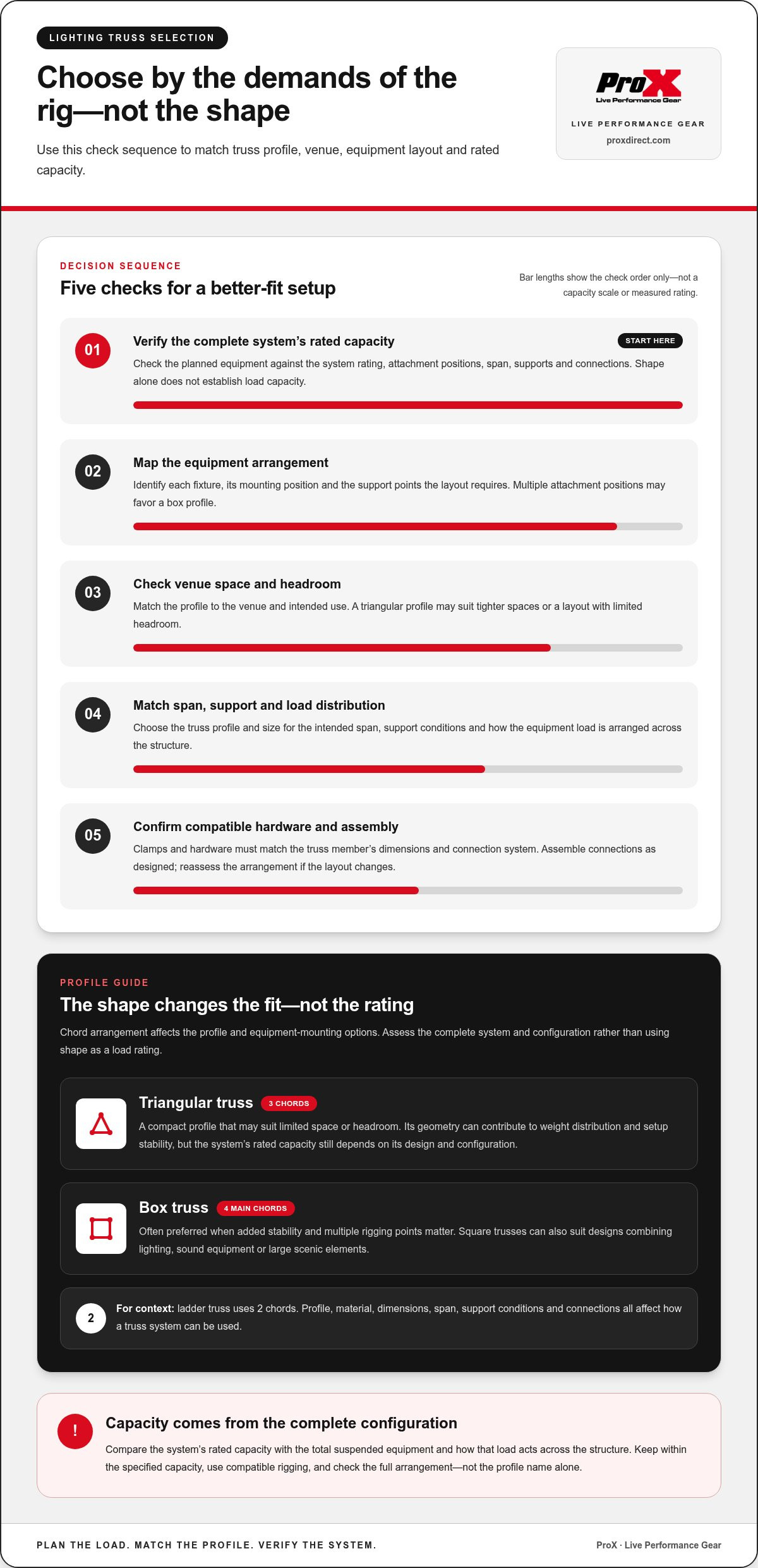
Chords form the primary members, while webbing braces the structure between them. A ladder truss uses 2 chords; triangular truss arranges 3 chords in a triangle, and box truss uses 4 main chords. These configurations create different profiles and equipment-mounting arrangements for event production.
Clamps and hardware must match the truss member’s dimensions and connection system. For box or triangular truss, choose hardware specified for that profile and application rather than assuming one clamp fits both.
Common aluminum truss sizes include 10 inches and 12 inches. Available lengths range from 500 mm to 3,000 mm and beyond, allowing sections to suit different spans and layouts. The truss design and its connection method determine how sections join into a continuous structure.
Tube dimensions also vary by system. The Aluminum Box Truss Cs20 has 30 × 2.0 mm main tubes and 20 × 2.0 mm braces. For a broader view of available profiles and configurations, the aluminum truss range provides a relevant reference point.
Choose a configuration based on the equipment arrangement, structural design, and venue constraints. Shape alone does not establish load capacity; the complete truss system and its specified connections determine whether it suits the planned setup.
3 Which shape of truss should I use?
Box truss has four sides and multiple rigging points; triangular truss has three chords arranged in a triangle. Choose based on equipment load, support arrangement, and available space, not shape alone.
Strength and Load Capacity by Shape
Truss shape affects how a structure distributes load and where equipment can be attached. Box truss is often preferred for lighting because its four-sided design adds stability and provides multiple rigging points. Square trusses also suit heavy lighting rigs, sound equipment, and large scenic elements.
That example isn’t a universal rating: actual capacity depends on the specific system, span, support conditions, connections, and load placement. Event planners should evaluate the complete configuration rather than treat a shape or nominal size as a load rating.
Triangular Truss Design and Stability
Triangular truss has three chords arranged in a triangular profile. Its geometry can distribute weight evenly and contribute to setup stability, making it suitable for lighting and sound equipment. The profile may also suit a layout where limited space or headroom rules out a wider structure.
Load capacity still depends on material, dimensions, span, rigging, and connection details. A triangular design does not establish a safe working load by itself. Compare the system’s rated capacity with the total suspended equipment and how that weight acts across the structure.
Selecting Truss Size and Shape
Start with the planned equipment arrangement: identify each fixture, its mounting position, and the required support points. Then match the truss profile and size to the intended span, available headroom, and load distribution. Box truss may suit a layout that needs several attachment positions; triangular truss can work when a compact profile is useful.
There’s no single typical US price for box versus triangular truss. Cost depends on the system’s dimensions, materials, connections, and configuration. Compare equivalent specifications rather than shape labels alone.
Overloading or improper assembly can compromise structural stability, damage connections, or lead to a collapse. Keep the total load within the truss system’s rated capacity, use compatible rigging, and assemble each connection as designed. For layouts combining several sections, compare truss configurations that align with the planned structure.
Before choosing a profile, understand the truss’s load capacity to plan a safe and effective setup. Check the rated capacity for the complete system against the planned equipment, attachment positions, span, supports, and connections. Shape can inform the choice, but it cannot replace an assessment of the actual configuration. If the layout changes, reassess the load and support arrangement instead of relying on the original selection.
A triangular truss’s three-sided structure can contribute to load distribution and setup stability, making it a practical option when its profile suits the space. Consider that benefit alongside the equipment layout and the system’s rated capacity, not as a guarantee of a particular load limit. Match either profile to the planned support and rigging arrangement without exceeding the specified capacity.
Choosing truss for intended use
Start with the production’s purpose, then match the truss profile to the venue and equipment arrangement. A theatre lighting bar, concert framework, and exhibition display place different demands on the structure. The right choice supports the intended layout while accommodating available headroom, rigging positions, and required capacity.
For stage and theatre productions, triangular truss can suit medium-sized lighting setups and equipment suspensions. Its profile may fit tighter spaces, including venues with limited headroom. This can make it useful when a lighting design needs support but the overhead area restricts a larger framework. Consider fixture placement and suspension arrangement together instead of choosing by shape alone.
Concert stages can use triangular truss for heavy audio and visual setups if the selected system suits the planned load. A concert production may combine lighting fixtures with sound or visual equipment, so the intended use affects placement and load distribution. Box truss is often chosen when a design benefits from multiple rigging points. Make sure the final layout matches the equipment positions, not just the event type.
At an exhibition, triangular truss can support dynamic lighting around a display. Its lightweight design can make it easier to handle, particularly when the setup uses modular sections and frequent configuration changes. For an outdoor event, triangular truss can provide a framework for equipment. In either case, account for the planned equipment, connection arrangement, and environmental setting in the structural design.
Decorative use calls for a different balance than a rig carrying heavy loads. A display framework may prioritize shape and fixture positions, while a production structure must also account for total suspended equipment and capacity. For example, a compact exhibition feature with accent lighting differs from a concert structure carrying lighting and sound equipment. Treat appearance as one design factor, not a substitute for load planning.
Use these application checks to narrow the choice:
- Stage or theatre: Consider triangular truss for medium-sized lighting and restricted headroom.
- Concert production: Match the structure and rigging points to lighting, audio, and visual equipment.
- Exhibition: Consider handling, modular arrangement, and the intended lighting effect.
- Outdoor event: Select a framework suited to the equipment layout and setting.
- Decorative installation: Separate visual goals from the structural capacity required by suspended equipment.
These applications can guide the initial selection, but the specific configuration still matters. A stage, concert, or exhibition label does not establish capacity. Assess the intended load, support arrangement, and available space before settling on a truss profile.
Installation and modular configurations
Modular truss sections let production teams configure structures for different venue layouts. Both triangular and square systems can be assembled and disassembled; the connection method and section arrangement shape the installation process.
Triangular truss works with a wide range of rigging systems, and modular components allow flexible configurations. For example, connected sections can position lighting around a theatre stage. Square truss also supports modular structures, including complex grids that organize lighting across a larger production area.
Both profiles can be assembled and dismantled, but setup time depends on the connection system, access, and layout. Square trusses facilitate quick assembly and disassembly. Triangular trusses are also described as easy to assemble and disassemble for stage and theatre productions. Swift assembly of triangular components can reduce labor costs, particularly when a production requires repeated configuration changes.
Weight and portability depend on individual sections, including their material, dimensions, and length. Triangular truss’s lightweight design can make sections easier to handle and move through tighter access routes. Shape alone does not establish the weight of a complete structure, so compare the specified components in the planned configuration rather than assuming every triangular system is lighter than every square system.
For trade shows, modular sections can support displays that need different visual arrangements across booths or exhibits. A triangular profile may suit a compact installation, while square sections can form grids for lighting and other production elements. In either case, coordinate the aesthetic with fixture positions and the structure’s intended use. Decorative goals should not replace suitable structural design.
Plan the configuration around the venue and assembly sequence. A stage installation may need straight runs and corners; an exhibition display may use a smaller framework to frame signage and accent lighting. Check how sections connect, how the finished structure fits the available space, and whether the chosen rigging system works with that profile.
Modular planning also affects handling between events. Sections that separate simplify disassembly and storage, while a consistent connection system helps crews repeat a familiar layout. For example, a production team moving between a theatre and a trade show can adapt the arrangement to each space without treating the installations as identical. Match the components to the structure’s visual, spatial, and practical requirements.
Square trusses for lighting and sound equipment
Square truss is a four-sided structure with four main chords. Its profile provides a practical framework for lighting and sound equipment, especially when a production needs multiple rigging points or a modular grid. Unlike a single-purpose lighting bar, a square truss system can organize different equipment positions within one structure.
That flexibility matters in event production. A concert setup, for example, may need lighting fixtures distributed around sound equipment, while a trade show display may use a grid to position lights across an exhibit. Square trusses can form complex structures and grids, supporting a coordinated visual layout. The structure must still suit the intended equipment and configuration.
Dimensions and construction vary by system. One listed 290 mm square spigot lighting truss uses 50 × 3 mm tubes. That specification describes that truss, not every square system. A separate round-corner lighting box truss, the PT34-C21-R, measures 0.5 m in length and weighs 4.4 kg. These examples show why component dimensions and weight matter when planning transport and handling.
For lighting and sound setups, assess the complete assembly instead of judging capacity from its square profile. Equipment placement, truss sections, connection points, and support arrangement all affect the configuration. Square trusses are described as suitable for heavy lighting rigs, sound equipment, and large scenic elements, but the intended load must match the specific system’s capacity. A grid carrying fixtures and audio equipment requires a different arrangement from a display supporting lighting alone.
Square truss systems are described as suitable for indoor and outdoor use, with durability in various conditions. The chosen components still need to match the venue and planned application. For example, a concert structure and an outdoor exhibition grid may both use square sections, but their equipment layouts and support requirements differ.
- For a combined rig: Map lighting and sound positions onto the intended grid before selecting sections.
- For transport: Account for each component’s dimensions and weight, including corners and connectors.
- For a trade show: Use the grid layout to coordinate equipment placement with the display’s visual design.
- For outdoor use: Match the system and its configuration to the venue and application.
The clear takeaway: square truss is useful when a production needs a modular framework for lighting and sound together. Compare the required layout with the actual component dimensions and system capacity. Explore square truss configurations for structures that need to coordinate multiple equipment positions.
ProX: Santosom Cases
ProX offers Santosom Cases to help production teams manage equipment between venues and setups. Once the truss configuration is selected, suitable cases and storage help organize the gear needed for the build.
For broader equipment and workflow needs, ProX also offers TruckPaX™ Truck Pack Cases, Utility/Storage Cases, and Workstations. These categories serve different practical purposes, from equipment storage to production work areas. Explore case options when planning how equipment will be stored and handled alongside a truss system.
Contact ProX to discuss the case or storage category that fits your production setup.
Plan the next build around the whole production
Turn the truss decision into a practical build plan by recording equipment positions, support points, venue constraints, and the intended configuration. This gives the team a shared reference as production requirements change. Use the box truss vs triangular truss for lighting comparison to guide planning, then document the chosen layout and its requirements.
The box truss vs triangular truss for lighting decision is most useful when it leads to a defined plan, not simply a preferred shape. Take the production’s requirements into the next planning discussion.
For questions about equipment and production needs, contact ProX about your truss needs. A well-planned build gives your team a strong starting point for the work ahead.
Frequently Asked Questions
Which truss is the safest?
No truss shape is inherently safest; safety depends on the complete structure and its planned use. The selected system must suit the total equipment load, span, support arrangement, connections, and rigging method. For example, a lighting bar with fixtures concentrated at one point needs a different load assessment from one with evenly distributed fixtures. Use the system’s capacity information and account for every suspended component, including hardware and cables.
Are triangular trusses suitable for outdoor events?
Yes, triangular trusses can be used for outdoor events, and aluminum naturally resists corrosion. That property supports outdoor suitability, but does not by itself establish that a structure suits every site condition. For a festival stage, consider equipment layout, supports, connections, and environmental forces as part of the full design. A corrosion-resistant truss still needs a configuration appropriate to its intended use.
Which truss shape has greater load capacity and stiffness for lighting fixtures?
Neither shape has a universal capacity advantage; the specific truss system determines its rated performance. Box truss provides four main chords and multiple rigging points, while triangular geometry can distribute weight evenly. Compare the system’s capacity for the intended span and load placement, then consider stiffness within its specified design. Fixture count alone isn’t enough: fixture positions and concentrated loads also affect the structure.
How do span length and point loads affect box and triangular truss capacity?
A longer span increases structural demand between supports, while a point load concentrates force where equipment attaches. For example, a heavy fixture mounted near the center of a span creates a different loading pattern from several lighter fixtures distributed along it. Evaluate the actual span, support positions, and each attachment location against the truss system’s capacity information. Shape alone cannot determine the allowable load.
What are typical weight limits and span tables for box and triangular lighting truss?
Weight limits and span tables vary by truss model, dimensions, material, connection type, support conditions, and load arrangement. Use documentation for the exact system and configuration rather than applying a generic limit to all box or triangular designs. A table for one truss profile may not apply to another, even when both have the same shape. Include fixtures, clamps, cables, and other suspended hardware in the planned load.
Which truss shape is best for concert stages, DJ rigs, and small venues?
The best profile depends on the equipment, space, and support layout for each setup. A concert structure carrying lighting and sound may benefit from box truss’s multiple rigging points. A DJ rig or small venue with restricted headroom may suit a more compact triangular profile. Before selecting, map fixture positions and available supports, then match the configuration to the system’s capacity and venue layout.
Disclaimer
Any trademarks, trade names or brand names appearing herein that do not belong to ProX are the property of their respective owners and/or companies, and such appearance doesn't and shall not constitute or imply endorsement, sponsorship or recommendation by ProX.


