

A case can match a mixer category and still be the wrong fit. An Allen & Heath SQ7 mixer case should suit the SQ7’s dimensions and control layout, with enough interior space for the intended carry setup. For a fitted dust cover, look for a shape that sits over the console without pressing on controls or leaving key surfaces exposed.
It’s easy to focus on outer dimensions, but interior clearance, cable storage and access to the mixer’s connections also affect whether a carry bag will fit. A dust cover has a different purpose: it protects the console in storage and should match its footprint and profile. This guide explains how to assess bag fit, choose a fitted dust cover and decide whether a purpose-built case better suits transport and storage. Compare these practical details to choose protection that works for your setup.
Key Takeaways
- Compare the mixer’s footprint and control layout with a bag’s interior, not just its exterior dimensions.
- Account for cable and accessory storage when assessing whether a carry bag suits your setup.
- A purpose-designed case for the SQ7 includes extra rear space for cables and small accessories.
- Choose a fitted dust cover that follows the console’s shape while keeping pressure off the controls.
- Match the protection to its job: a fitted cover for dust during storage, and a case when you need to carry the mixer.
Carry bag compatibility
An Allen & Heath SQ7 mixer case should match the console’s footprint, height, and control layout. A close fit limits unnecessary movement, while usable clearance prevents pressure on knobs, faders, and connectors. Compatibility also depends on what travels with the mixer. A setup carrying power leads and audio cables needs different interior capacity from a console carried alone.
Start with the mixer itself, not the bag’s exterior dimensions. Measure the SQ7’s width, depth, and height, including any protruding controls or connectors that remain attached during transport. Compare those measurements with the bag’s usable interior space. Exterior measurements describe the full case, not the cavity available to equipment. Padding and structural panels reduce internal clearance.
Account for the mixer’s orientation, too. It may fit lengthwise but press against the bag’s sides when rotated. Check the control surface and rear connections, then consider how the mixer enters and comes out of the opening. A narrow access panel can make handling difficult even when the interior dimensions seem suitable. Fit depends on access as well as enclosure.
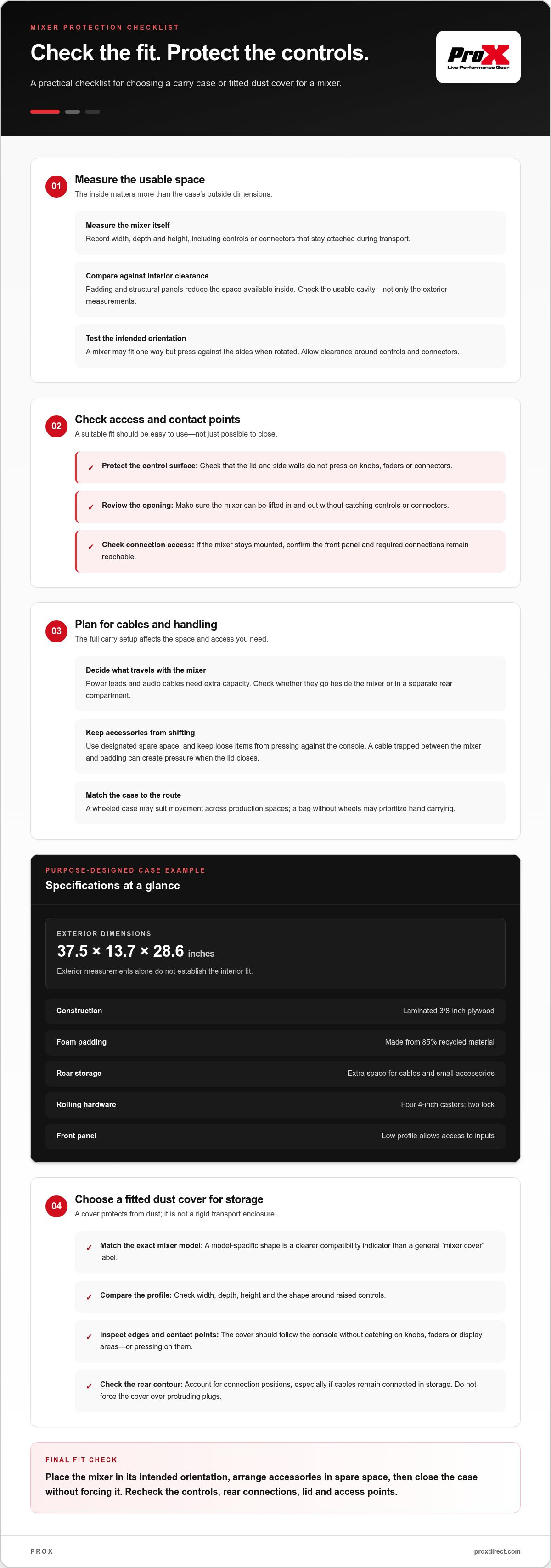
A purpose-designed SQ7 case provides a useful specification example. Its exterior measures 37.5 × 13.7 × 28.6 inches, but those figures alone don’t establish the internal fit. The case uses laminated 3/8-inch plywood and foam padding made from 85% recycled material. Its extra rear space accommodates cables and small accessories, separating storage capacity from the console’s own clearance.
- Compare usable space: Match the mixer’s measured dimensions to the interior, allowing for padding and the case’s structure.
- Check the control surface: Confirm that the lid or side walls don’t press against knobs, faders, or connectors.
- Assess cable storage: Identify whether cables travel beside the mixer or in a separate rear compartment.
- Review access: Check whether the opening lets you lift the console without catching controls or connectors.
The same example case has four 4-inch heavy-duty casters, including two locking casters. Those details describe the case’s rolling hardware, not its interior fit. A carry setup with casters may suit movement across production spaces, while a bag without wheels may prioritize hand carrying. Match the form to the route and handling method.
Review the front panel as well. The purpose-designed case has a low front panel that allows access to the mixer’s inputs. This matters when the console stays mounted during operation. If the case blocks connections, operators may need to reposition the mixer or remove it before connecting equipment. Make sure the access suits your setup.
Before packing, remove loose accessories from the console and test the empty case. Place the SQ7 inside in its intended orientation, then close the lid without forcing it. Check for contact points around the control surface and rear connections. Add cables only in designated spare space. A cable trapped between the mixer and padding can create pressure during closure.
For example, an operator carrying the SQ7 with power and audio leads should assess rear storage separately from mixer clearance. The extra rear space in the purpose-designed example accommodates small accessories, but it doesn’t replace a fit check. Keep heavy accessories from shifting against the console. Recheck the lid and access points after arranging the full load.
Distinguish a carry bag from a fitted dust cover. A bag or case needs room for insertion, padding and any accessories carried with the console. A dust cover follows the mixer’s profile and protects it in storage. Choose protection for the task, then assess dimensions, access and accessory placement before use.
The ProX XS-AHSQ7W case is custom-designed to fit the Allen & Heath SQ7 digital mixer. That makes it a relevant option to compare when the console is carried with its usual connections attached, but the intended fit should still be checked against the way the mixer is packed. Confirm that the front panel can remain accessible when required and that the console can be lifted clear without dragging its controls across the opening.
Before choosing a carry setup, decide whether accessories will share the space or travel separately. Position the console so its controls and connectors do not press against rigid sides, and leave enough clearance to remove it smoothly. If the mixer will remain connected inside the case, check whether you can reach the connections without shifting the unit. Choose a setup for the actual working arrangement, not just the mixer on its own.
Fitted dust covers for SQ mixers
A fitted dust cover protects an SQ7’s control surface during storage between sessions. Its job differs from a carry case: it covers the console without providing a rigid transport enclosure. Choose the cover by comparing its shape with the mixer’s footprint, control layout, and connection positions. A loose cover can expose edges, while a tight one may press against controls.
Start with the exact mixer model. The SQ7’s surface includes controls and connectors that affect how a cover sits. Measure the console’s width, depth, and highest point, then note where its controls extend. Compare those measurements with the cover’s stated fit, rather than judging by a general label such as “mixer cover.” Model-specific shaping is the clearest compatibility indicator.
Check the cover’s edges against the console’s perimeter. A fitted cover should lie across the control surface without catching on knobs, faders or display areas. Inspect the front and rear edges separately. The rear connections may require a different contour, especially if cables stay connected in storage. Don’t force a cover over protruding plugs.
Use this practical assessment before putting a cover into regular service:
- Match the model: Confirm that the cover is intended for the SQ7, not simply another SQ mixer.
- Compare the profile: Check width, depth, height, and the shape around raised controls.
- Inspect contact points: Look for pressure on faders, knobs, displays, and connected cables.
- Test removal: Lift the cover by its edges and watch for snags around controls or corners.
Fit matters at the corners as well as across the top. A cover that shifts during placement can leave one edge exposed. Position it evenly, then inspect all sides before leaving the SQ7 covered. For example, if the rear edge rides upward over connected cables, reposition the cables or remove them before covering. Don’t use tension to pull the fabric into place.
Consider how you store the console. A mixer kept on a workstation may need a cover that comes off quickly before operation. A console stored in a case may need a cover that fits under the lid without bunching. Test the full sequence: place the cover, close and reopen the case, then check whether folds press against the controls or shift the cover.
Material and construction affect handling, but appearance alone doesn’t establish suitability. Inspect the seams, edges, and areas that contact the SQ7. A smooth interior surface can reduce snagging during placement, while a stiff edge may hold its shape differently around the console. Choose based on how the cover sits and comes off, not on colour or styling.
A dust cover is not a substitute for a fitted transport case. It addresses surface exposure during storage, but it doesn’t provide the rigid structure or padding associated with a case. If the SQ7 must travel between venues, use a transport solution designed to contain and protect the mixer. Keep the cover’s role limited to dust protection when the console is stationary.
Finally, establish a repeatable storage routine. Disconnect cables if they obstruct the cover, clear loose items from the control surface, and lower the cover evenly over the SQ7. After removal, check that no control has caught on a seam or edge. That simple sequence helps maintain consistent fit without adding pressure to the console.
ProX: Santosom Cases
ProX is a practical next step when your SQ7 needs a case solution beyond a fitted dust cover. Santosom Cases are among the available case options; Utility/Storage Cases can also suit broader equipment storage needs. Choose according to the equipment you need to contain and how it will be used. A fitted dust cover protects the console surface during storage, while a case is the relevant category when you need an enclosure for handling and transport.
Review the ProX case range to see case options, or contact ProX to discuss your equipment needs.
Choose protection around your operating setup
Make the next decision around how the SQ7 moves through your production workflow. A console that stays installed between sessions has different protection needs from one that travels regularly between venues. Consider where it is stored, how it is handled, and whether accessories travel alongside it. Those details help you distinguish a fitted cover from a case solution without choosing by appearance alone.
Before selecting an Allen & Heath SQ7 mixer case, define the setup it needs to support. Note whether the mixer travels with connected cables, whether it remains on a workstation, and how often it is packed away. A clear use case makes it easier to assess suitable protection and avoid an enclosure that complicates routine setup.
ProX offers case options for different equipment and storage requirements. If you’re ready to discuss a suitable direction for your SQ7 setup, contact ProX about your SQ7 mixer case. A considered fit supports a more organized workflow from storage through setup.
Disclaimer
Any trademarks, trade names or brand names appearing herein that do not belong to ProX are the property of their respective owners and/or companies, and such appearance doesn't and shall not constitute or imply endorsement, sponsorship or recommendation by ProX.


