

The safest lift is often the one you don’t make by hand. Knowing how to properly lift heavy road cases starts with assessing the case, the route, and the space available to maneuver; if the load is too heavy or awkward, use suitable equipment or get help rather than forcing the lift.
Road cases protect equipment, but their size and shape can make them difficult to handle. A clear plan helps reduce strain and keep the case under control from pickup to placement.
This guide explains how to position your body, carry a case without twisting, and lower it without trapping your fingers or losing control. It also covers when to use a second person, dolly, hand truck, pallet jack, or hoist, and how to choose equipment for the load and route.
Key Takeaways
- Assess a case’s weight, shape, grip points, and route before lifting; use help or handling equipment when the load is awkward or difficult to control.
- Keep the case close, lift smoothly with your legs, and move your feet to change direction instead of twisting your waist.
- Set a case down with control by bending your knees, keeping your back in a natural position, and keeping fingers clear of pinch points.
- Choose a dolly, hand truck, pallet jack, or hoist to suit the case, the route, and the loading conditions.
- The Federal Motor Carrier Safety Administration requires drivers to inspect cargo and its securement devices within the first 50 miles of each trip.
What Should Be Included in Safe Lifting Training?
In the United States, OSHA has no specific ergonomic lifting standard. Employers must address serious, recognized workplace hazards under its General Duty Clause. Reduce the risk of back, hand, and foot injuries by assessing each load, moving with control, keeping fingers clear, and using properly fitting grip gloves when handholds are difficult.
-
Step 1: Practice Squatting With the Load Close
Stand close to the case with your feet shoulder-width apart and a stable stance. Bend at your hips and knees, then grasp secure handholds. Keep the case close to your body as you rise. A case held close is easier to control than one carried at arm’s length, which increases strain and can block your view.
-
Step 2: Bend at the Knees and Lift With the Legs
Bend your knees to lower your body instead of rounding your back. Maintain your back’s natural curves and brace your torso before lifting. Straighten your legs smoothly, without jerking the case upward. To turn, move your feet in the new direction rather than twisting at the waist while holding the load.
-
Step 3: Account for Load Distance, Height, and Frequency
Keep the case close and near waist height during the carry whenever the route allows. Lifting from the floor, reaching overhead, or holding a case away from your body makes it harder to control. For overhead handling, use a stable surface, avoid reaching and lifting at the same time, and lower the case under control. Plan breaks and task rotation for frequent lifts.
-
Step 4: Reduce Risk Through the Hierarchy of Controls
Before teaching a manual lift, look for ways to avoid it. Remove contents that can be carried separately, or use a dolly, hand truck, pallet jack, or hoist when appropriate. These controls reduce reliance on individual strength. Then plan the route, assign roles, and train workers to handle the case together. Gloves can improve grip when handholds are difficult, but they do not replace mechanical assistance or sound lifting technique. Match the control to the case, access conditions, and destination.
-
Step 5: Build Safe Routines Into Training
Use hands-on practice with realistic cases, not verbal instruction alone. Train workers to assess the case’s size, shape, grip points, and route before moving it. For road cases, choose handling arrangements suited to the equipment and access route, as reflected in these professional case configurations. Encourage workers to stop when a load becomes unstable and request help. On the transport side, the Federal Motor Carrier Safety Administration says federal rules require drivers to inspect cargo and its securement devices within the first 50 miles of each trip. The agency also requires rechecks after 3 hours of driving or 150 miles, whichever comes first, and at every change of duty status. Include those checks in the team’s cargo-handling routine.
What are the 6 steps to safely lift a heavy object?
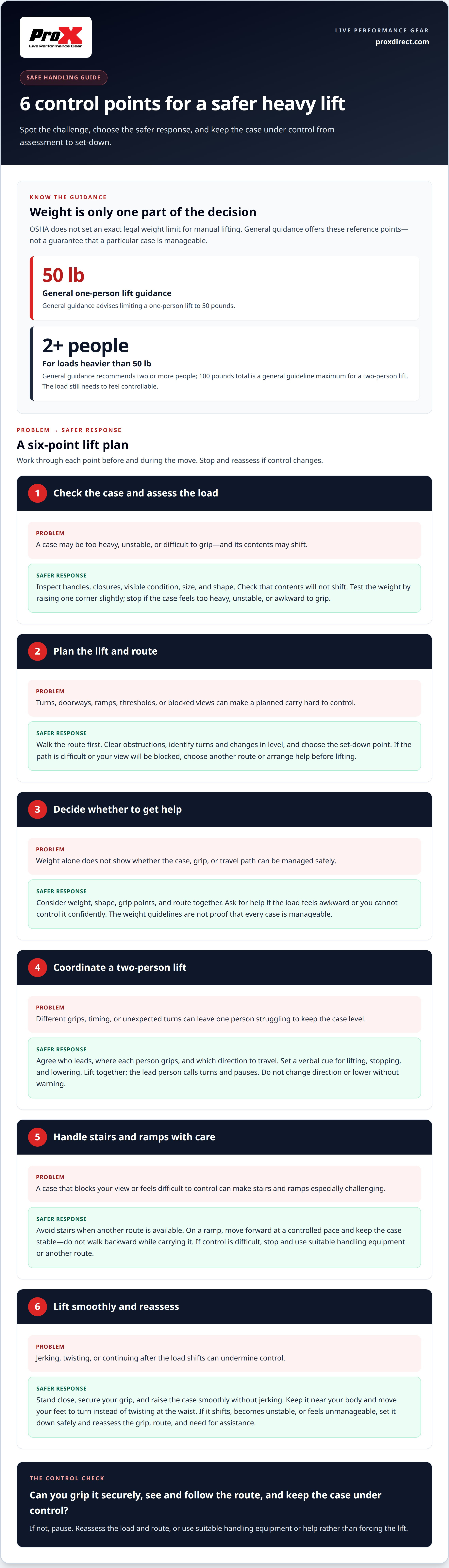
OSHA doesn’t set an exact legal weight limit for manual lifting. General guidance advises limiting a one-person lift to 50 pounds. Knowing how to properly lift heavy road cases starts with evaluating the load, the route, and your ability to keep control.
-
Check the Case and Assess the Load
Inspect the case before lifting. Check its handles, closures, and visible condition, then consider its size and shape. Make sure the contents will not shift during movement. Test the weight by raising one corner slightly. Stop if the case feels too heavy, unstable, or awkward to grip. This assessment is essential to learning how to properly lift heavy road cases without forcing a risky manual lift.
-
Plan the Lift and Route
Walk the route before moving the case. Clear obstructions and identify turns, doorways, ramps, and thresholds. Decide where the case will be set down and whether you can see the path while carrying it. If a sharp turn or blocked view makes the route difficult, choose another route or arrange help before lifting.
-
Decide Whether to Get Help
Consider the case’s weight, shape, grip points, and travel path together. General guidance recommends using two or more people for loads heavier than 50 pounds, with 100 pounds total as a general guideline maximum for a two-person lift. Those figures don’t establish that every case is manageable. Ask for help if the load feels awkward or you can’t control it confidently.
-
Coordinate a Two-Person Lift
Agree on who leads, where each person will grip, and which direction you will travel. Choose a verbal cue for lifting, stopping, and lowering. Lift together, keep the case level, and move at a pace both people can maintain. The lead person should call turns and pauses. No one should change direction or lower the case without warning.
- Choose a controlled approach for stairs or ramps. Avoid stairs when another route is available. On a ramp, move forward at a controlled pace and keep the case stable. Do not walk backward while carrying it. If the case blocks your view or either person struggles to maintain control, stop and use suitable handling equipment or choose another route.
- Lift smoothly and reassess if control changes. Stand close, secure your grip, and raise the case without jerking. Keep it near your body and move your feet to change direction. If the load shifts, becomes unstable, or feels unmanageable, set it down safely. Reassess your grip, the route, and the need for assistance before continuing.
Setting loads down safely
Choose the landing point before lowering the case. Maintain control through contact, release, and any repositioning.
- Approach the landing point squarely. Stop at a stable, level surface with enough room for the case’s full width. Clear cables, loose gear, and other obstructions from the floor. Face the destination so you can lower the case without twisting your torso. If the landing point is cramped or uneven, reposition before lowering rather than forcing the case into place.
- Set your stance before bending. Stand close to the case with your feet shoulder-width apart. Keep your balance and hold the case securely at its handholds. Bend your knees, maintain your back’s natural curves, and lower your body under control. Do not bend from the waist or let the case drift away, since distance increases the effort needed to manage its weight.
- Lower the case gradually. Keep both hands engaged as the case approaches the floor, platform, or vehicle deck. Set the corner or edge nearest you down first, then guide the rest of the case into place. This controlled sequence limits sudden shifts. Keep your fingers clear of the underside and pinch points, and do not release your grip until the case is stable.
- Keep your body aligned. Move your feet to adjust your position instead of twisting while holding the load. For a two-person set-down, agree on a verbal cue and lower the case together at the same pace. Keep the case level, and make sure neither person has to reach across it. If the load starts shifting, stop and regain control rather than trying to catch it.
- Use assistance when the carry becomes difficult. If the case feels too heavy, awkward, or unstable, stop at a safe location and set it down. Get help or use a suitable dolly rather than carrying beyond your control. A dolly supports the load during movement, but secure the case on it and keep both hands available to guide the equipment along the route.
- Keep clear of falling cargo. During unloading, stand outside the path of any case or other cargo that could fall. Never try to catch a falling load. If a case begins to tip, move clear and let it settle before approaching. Once it rests, assess its position and stability, then plan a controlled repositioning with assistance or handling equipment if needed.
Dollies, hand trucks, pallet jacks, and hoists
Choose handling equipment based on the case, travel path, and loading point. A hand truck or cart is recommended for heavy or bulky items.
- Use a dolly for stable, level movement. Position the case centrally so its weight stays balanced over the platform. Secure it against shifting before moving, and keep the load close to the dolly’s frame. Check that the wheels roll freely and the path has no cables or abrupt surface changes. A dolly reduces carrying, but workers still need to control the load at turns and thresholds.
- Choose a hand truck for upright transport. Seat the case fully on the toe plate, then stabilize it before tilting the truck back. Grip both handles firmly and maintain steady pressure as you move. Push the hand truck rather than pulling when possible. Walk forward, especially near stairs, ramps, and loading docks, so you can see the route ahead.
- Use a pallet jack for compatible palletized loads. Align the forks with the pallet openings and insert them fully before raising the load. Keep the case and pallet stable, then move at a controlled pace along a clear route. A pallet jack is suited to pallet movement, not loose cases. Do not use it if the case cannot be secured on a compatible pallet.
- Select a hoist for controlled vertical movement. A hoist can move a case where floor equipment cannot reach, but the lifting setup must suit the load and attachment points. Keep people clear of the suspended case, and raise it smoothly without swinging. Stop if the case tilts, shifts, or puts unexpected pressure on its lifting points. Never place your hands underneath a suspended load to guide it.
- Match the equipment to the full route. Check door clearances, floor transitions, ramps, and the final set-down area before moving. A hand truck may control a narrow upright case, while a pallet jack requires pallet access. Use a dolly when the case can sit securely on its platform. If the route includes a lift or obstruction, select equipment designed for that movement rather than improvising.
- Move with control, not speed. Keep both hands on the equipment, maintain a straight path where possible, and slow down before turning. Push rather than pull when practical, since pushing is easier to control. If the equipment begins to tip or the case shifts, stop in a safe position and reset the load. Do not continue while control is compromised.
Using proper equipment to unload heavy items
Load a truck or van using suitable handling equipment, a clear route, and controlled placement. Distribute cargo evenly, secure it against movement, and close and secure the vehicle doors before departure.
- Assess the unloading point before moving the case. Check the vehicle floor, dock, ramp, and landing area for obstructions or uneven transitions. If moving from a loading dock to a vehicle, chock the vehicle’s wheels first. Make sure the transition is smooth and the dock leveler can withstand the load’s weight.
- Select equipment for the route and load. Use a hand truck or cart for heavy or bulky cases that can sit securely on it. A pallet jack suits compatible palletized loads, while a hoist supports controlled vertical movement when floor equipment cannot reach. Match the equipment to the case, access, and destination rather than relying on lifting technique alone.
- Prepare the case for handling. Close and secure its panels, then check accessible handles and grip points. Remove loose items that could shift, and use properly fitting gloves when handholds are difficult to use. Gloves should provide adequate grip without obstructing control. Do not use a handle that appears damaged or cannot support a secure hold.
- Control the case as it leaves the vehicle. Keep the load stable on the platform or lifting equipment before moving it. Use a second worker when the case’s size, shape, or position makes one-person control difficult. Communicate before lifting, lowering, or changing direction. Keep people clear of a suspended or unstable load, and never place hands underneath it.
- Secure cargo for transport. Position cases to distribute weight evenly and avoid overloading the vehicle. Use tie-downs to prevent cargo from moving forward, backward, or sideways. Add edge protection where a tie-down could be cut or abraded against the case. Secure tie-downs so they cannot loosen or release during transit, then close and secure the cargo doors.
- Inspect the vehicle and cargo before continuing. Walk around the vehicle after parking and correct loose or damaged cargo before departure. If a case shifts behind a truck door, do not stand in its fall path or try to catch it. Close the door and get help. This procedure protects workers from uncontrolled movement and reduces pressure to handle awkward loads manually.
When lifting, stand close to the object, keep it near your body, bend at the hips and knees, and stand using your legs without twisting. Stay clear of falling cargo, and do not try to catch it.
Racks & Case Accessories
Racks & Case Accessories help production teams organize and handle equipment. If your setup makes cases difficult to grip, secure, or move along a loading route, review your handling process alongside your case and accessory choices.
For road transport, truck-pack cases are one option. Utility/Storage Cases and other cases support different equipment and storage needs. Choose based on the equipment being carried, how it will be handled, and the conditions it faces during loading and unloading.
For help choosing a suitable case or accessory for your equipment, contact your supplier.
Make Safe Case Handling Part of the Setup
Use your lifting plan as a starting point for reviewing how cases move through your production workflow. Choosing a suitable case can support more controlled handling from storage to vehicle, especially when equipment size, access, and loading methods vary between jobs. Knowing how to properly lift heavy road cases is one part of the process; choosing cases that fit your equipment and handling needs is another.
Protective equipment cases and utility or storage cases are available for different equipment and storage requirements. Consider which type suits the gear you handle and how it moves through your workspace, loading area, and vehicle.
Plan your case setup and identify an option suited to your equipment. A considered setup gives your team a practical foundation for safer handling on the next move.
Frequently Asked Questions
What injuries are caused by improper lifting?
Improper lifting can cause back and shoulder strains, sprains, and hand or foot injuries. A shifting case may pinch fingers or land on someone’s feet, while a poorly controlled carry can strain the back or shoulders. For example, reaching over a case to grip a far handle can make loading awkward. Stop and reassess if you experience pain, lose your grip, or notice instability.
What is the safe lifting zone (power zone)?
The power zone is close to the body, between mid-thigh and mid-chest height. A case held within this area is generally easier to control than one held far away or overhead. If a case sits beyond easy reach, adjust its starting position before lifting. Keep the route clear so you can maintain a stable position rather than stretching around obstacles.
Why Are Lifting Ergonomics Important?
Lifting ergonomics means matching the task, load, and handling method to the worker’s capabilities. This matters when repeated case moves, awkward grips, or extended reaches add strain over a shift. For example, stage cases near their next destination instead of carrying them repeatedly across a crowded work area. Review the setup whenever the case, route, or handling frequency changes.
What is the proper lifting technique for heavy road cases?
Inspect the case and its grip points, then clear the immediate path. Stand close, secure a firm grip, and raise the case smoothly while keeping it near your body. Move your feet to change direction. If the case has no usable handholds, do not improvise by gripping a lid or edge; use suitable handling equipment or get assistance.
How do you determine whether a road case is too heavy to lift manually?
Test the case by raising one corner slightly, then stop if it feels too heavy, unstable, or awkward to grip. General guidance advises limiting a one-person manual lift to 50 pounds and using two or more people for loads above that. Weight alone doesn’t determine manageability: case dimensions, grip, route, and the worker’s ability to control it also matter.
What lifting equipment is best for moving road cases: hand truck, dolly, or lift gate?
Choose equipment based on the case and route. A hand truck suits heavy or bulky cases that can be stabilized upright; a dolly supports cases that sit securely on its platform. A vehicle lift gate can help move cargo between vehicle height and ground level. Consider the entire transition, including door clearance and the final placement area, before selecting equipment.
Disclaimer
Any trademarks, trade names or brand names appearing herein that do not belong to ProX are the property of their respective owners and/or companies, and such appearance doesn't and shall not constitute or imply endorsement, sponsorship or recommendation by ProX.


