

The lowest-cost stage truss transport case isn’t automatically the right fit. Compare usable interior dimensions and capacity with your truss sections, then consider portability, storage space, and transport constraints. Price varies by case option and configuration, so weigh specifications alongside cost instead of choosing on price alone.
Transport planning must account for the complete load, not just the case. Component dimensions and weight affect whether everything fits in the available storage and vehicle space. Handling needs also determine whether a particular case setup is practical to move.
This guide explains how to compare case cost, dimensions, portability, storage, and transport suitability without assuming one size fits all. You’ll learn which criteria matter for different production needs, how to match a case to your truss inventory, and when a purpose-built option makes sense. The goal is a practical decision based on specifications that protects equipment and supports efficient handling.
Key Takeaways
- Compare case options by usable dimensions, portability, storage footprint and transport suitability, not price alone.
- Match internal space to the truss sections and accessories you need to move, accounting for how they’ll be arranged and handled.
- Assess transport constraints by considering the combined length, width, height and weight of the packed system.
- For rigging plans, use the exact truss manufacturer’s load and span tables and have planned loads reviewed by a qualified rigger or structural engineer.
- Use the material and construction details to judge whether a case suits your handling conditions and storage needs.
Aluminum truss portability and transport
How portable aluminum truss is depends on section dimensions and load weight, as well as how it is handled and stored. Plan around the packed load, not the material alone.
Truss Portability
Aluminum truss is modular equipment, so portability depends on each section’s length and the number of sections handled together. Shorter sections can be easier to position in confined loading areas, while longer sections need more clearance and coordinated handling. A case should accommodate the actual truss profile without forcing sections into an unsuitable orientation. For compatible options, explore stage truss and base plate cases.
Truss Transport
Transporting aluminum truss involves planning how sections move from storage into a vehicle and then to the venue. Highway or air transport may impose limits on component length, width, height, and weight, according to the U.S. Environmental Protection Agency. Measure the packed load against the space available, and plan handling access too: a tightly packed load may be difficult to position.
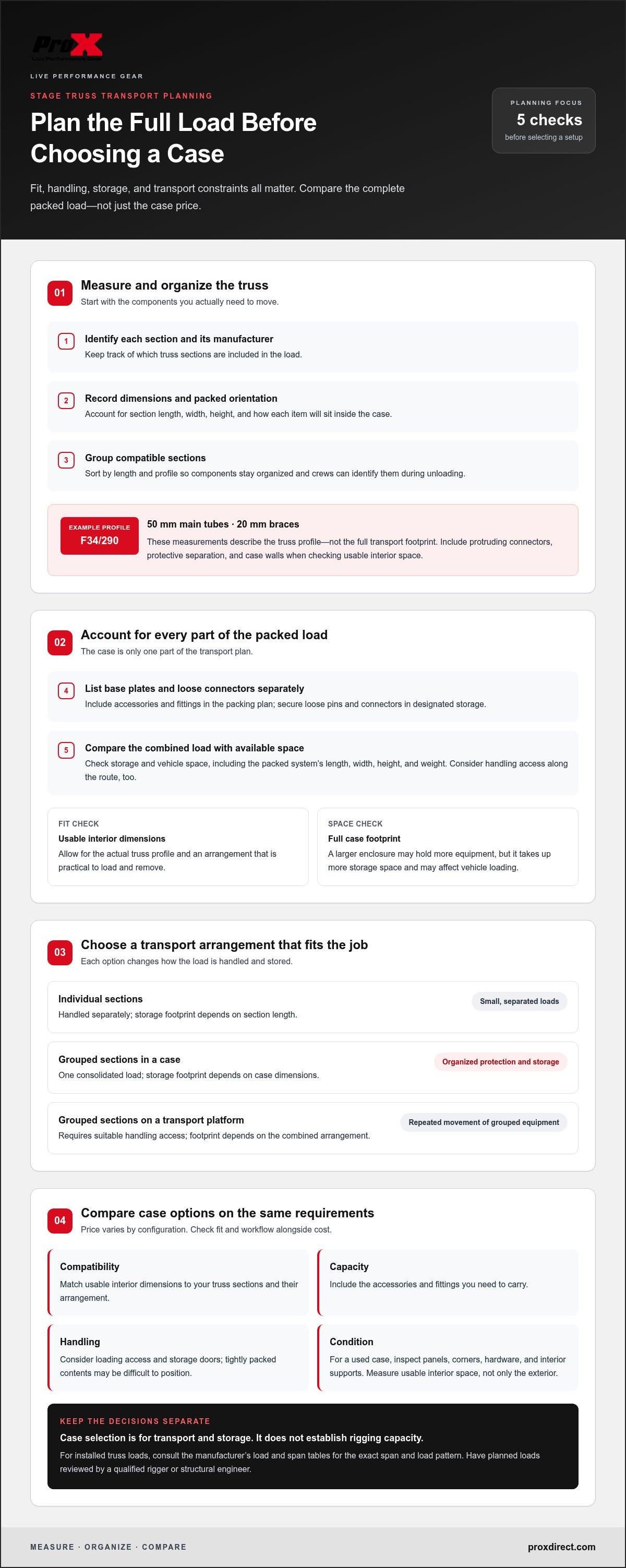
Use this sequence before selecting a transport configuration:
- Identify each truss section and its manufacturer.
- Record its dimensions and packed orientation.
- Group sections by length and compatible profile.
- Account for base plates and loose connectors separately.
- Compare the combined load with storage and vehicle space.
For example, F34/290 truss uses 50 mm main tubes and 20 mm braces. Those measurements describe the truss profile, not its complete transport footprint. Include protruding connectors, protective separation, and case walls when assessing usable internal space. Keep different truss profiles organized, so crews can identify compatible components during unloading.
| Transport option | Portability | Storage footprint | Best fit |
|---|---|---|---|
| Individual sections | Handled separately | Depends on section length | Small, separated loads |
| Grouped sections in a case | One consolidated load | Depends on case dimensions | Organized protection and storage |
| Grouped sections on a transport platform | Requires suitable handling access | Depends on combined arrangement | Repeated movement of grouped equipment |
Choose a case that fits the longest component and total load, and suits the handling route.
A transport setup does not establish rigging capacity. Consult the manufacturer’s load and span tables for the exact truss span and load pattern. Have a qualified rigger or structural engineer verify planned truss loads. These checks concern the installed structure; case selection concerns transport and storage. Keep the two decisions separate in production planning.
Choose a stage truss transport case that suits the sections you carry most often, with enough room to load and remove them easily. Before packing, separate components that could shift against one another. Secure loose pins and connectors in designated storage. Confirm that the packed load meets transport limits for the planned route and vehicle.
Product price
Case cost depends on the configuration needed for your truss inventory. Dimensions, internal layout, materials, closures, and handling features all affect the case. A compact enclosure for separated components has different requirements from one designed to hold several sections together. Compare specifications as well as price. Your stage truss transport case should fit the equipment and workflow, not just the budget.
Consider the case price separately from the wider cost of moving equipment. A larger enclosure takes up more storage space and may affect vehicle loading. A case with internal organization serves different needs from one with a basic open interior. Compare options against the same requirements, including usable space, capacity, and access to the contents.
Can you rent or buy a used case? Both are options in the wider equipment market. Renting may suit a short project; a used case may work for recurring jobs if its dimensions and condition match your truss.
Use a consistent checklist to compare purchase options. A lower price does not mean a better fit if the interior wastes space or makes components difficult to organize. A larger enclosure may hold more equipment, but its footprint can complicate storage. Compare compatibility, handling, storage, and expected frequency of use.
- Compatibility: Match usable interior dimensions to the truss sections.
- Capacity: Include accessories and fittings in the packing plan.
- Handling: Consider loading access and storage doors.
- Condition: Inspect panels, corners, hardware, and interior supports.
For a used case, inspect the entire enclosure before assessing its value. Look for separated panels, damaged corners, loose hardware, and interior supports that no longer hold components securely. Measure usable interior space, not just exterior dimensions. A case may look suitable from the outside but lack clearance for connectors or the truss profile.
Renting may suit a temporary need when the case fits the job and schedule. Buying may be more practical for repeated use, an established inventory, and predictable storage needs. Either way, list everything you need to carry, including base plates, loose connectors, and protective dividers, so the comparison reflects the actual packing arrangement.
Compare price after checking fit and handling. Record each option’s dimensions, condition, capacity, and included fittings. Compare equivalent configurations rather than unrelated case types. Choosing a stage truss transport case against these criteria supports a more practical purchasing decision.
Truss dimensions and model names
A model name identifies a truss family but does not provide every measurement needed to select a case. Compare the profile, section length, connector projection, and intended packing orientation. Each measurement affects the storage layout, so record them separately before comparing case dimensions.
F34/290 is a specific truss model designation. Its main tubes measure 50 mm, and its braces measure 20 mm. Those profile details help describe the cross-section, but they don’t give the section length or the full space required for packing. A case’s usable interior must accommodate the profile and the components’ actual arrangement.
Keep profile, section length, and interior clearance distinct. Profile means the truss cross-section; section length measures the component from end to end. Interior clearance is the usable case space after accounting for supports or dividers. Compare a stage truss transport case with the component’s full dimensions, rather than choosing by model name alone.
Use a consistent record for each model:
- Write down the exact manufacturer and model designation.
- Measure the profile across its widest points.
- Record section length, including projecting connectors.
- Note how the section must sit inside the case.
- Compare these measurements with usable interior dimensions.
Two models can have similar profiles but need different packing layouts. Connector geometry or section length can change how components sit together. Keep separate records for each model instead of grouping pieces by appearance alone. This also helps crews identify compatible components during packing and equipment returns.
Use the manufacturer’s documentation to identify the exact configuration. Similar model names do not always mean identical dimensions, and a suffix or connector configuration can affect fit. If the case interior is close to the measured profile, account for projections and leave enough room to place or remove the section without forcing it.
Account for the space dividers and supports use. A divider can organize separate components but also takes up room. Too much clearance may allow movement; too little can make loading difficult. Compare the intended packing arrangement with the usable interior of a stage truss transport case, including connector positions and any stored fittings.
Keep an inventory record with the manufacturer, model, profile, section length, connector projection, and packing orientation. List base plates separately because their shape changes the layout. Measure new equipment on its own and compare it with the existing case arrangement. This ties identification and storage decisions to the actual truss components.
Truss storage and transport
Plan storage around your truss inventory, loading route, and destination. Highway or air transport may impose limits on component length, width, height, and weight, according to the U.S. Environmental Protection Agency.
Brand, Model, and Dimension Fit
Select a case by matching the truss manufacturer, exact model, and measured dimensions. Check profile clearance, section length, connector projection, and packing orientation. A case that fits one model may not suit another with different connection geometry. Prioritize physical compatibility over the case label alone.
Keep an inventory record for each model. List base plates and loose fittings separately because they affect the packing layout.
Safety and Load Securing
U.S. safety requirements depend on the vehicle, shipment, and route. Secure truss and cases against movement during transport, and follow the requirements that apply to your shipment. Before loading, inspect restraints, closures, and contact points to ensure they are properly engaged.
Keep pins and connectors contained so they cannot shift inside the case. Secure the closed case in the vehicle; the case itself does not prevent movement during transit.
Materials and Roadworthy Features
Compare panel construction, corner protection, hardware attachment, and internal supports. Each feature addresses different handling stresses: panels protect broad surfaces, corners take edge contact, and supports help control movement inside the enclosure. Choose construction suited to your operation’s handling conditions and transport frequency.
Distinguish the cargo material from the enclosure material. Aluminum describes some truss components, not necessarily the case structure.
Freight weight limits depend on the vehicle, carrier, route, and other cargo. Consider the complete packed shipment, including the case, truss, base plates, and accessories. Length, width, height, and weight all affect transport space and freight handling. Use the combined shipment measurements when planning vehicle or air-freight arrangements.
Use this dispatch sequence:
- Group compatible sections by model.
- Contain fittings and base plates.
- Close and inspect each case.
- Restrain cases against movement in the vehicle.
- Record the packed dimensions and total weight.
For air freight, assess the complete packaged unit, including external packaging. For highway transport, account for vehicle capacity and loading access. A transport case helps organize storage, but the shipment plan must include every packed component. Keep model identification visible for crews handling equipment at pickup and delivery.
Treat the price as a separate line in the transport budget. Before selecting a cart, verify that its intended use suits the packed inventory. Keep that product choice separate from confirming that each truss section, fitting, and case is compatible and secured for the route.
Which materials and features make a truss case durable and roadworthy?
Durability depends on how a case is constructed and handled. Inspect the enclosure, edges, hardware, interior supports, and closure points, which face different contact during loading, storage, and unloading. Compare these features with your actual handling conditions, not appearance alone.
Keep truss material distinct from case material. Aluminum truss is the cargo; the enclosure must protect and contain it. A long section, for example, can press against interior supports during movement. Check that the case layout supports the section without concentrating pressure on a connector or edge.
Panel construction matters because broad surfaces can come into contact with other equipment during handling. Look for visible separation, cracks, or deformation. Check corners for impact damage and loose protective fittings. These signs can reveal wear hidden by a clean exterior. Compare the same areas on each case before choosing.
Inspect closures and hardware too. Open and close every latch, then examine its attachment points. Check that handles are secure and positioned for a firm grip. A case with sound panels but damaged closures may be harder to handle and keep shut in transit.
Interior supports should suit the truss profile and packing arrangement. A support that touches a connector can put pressure on a vulnerable point. Place each section in its intended position and inspect the contact areas. Dividers or padding can separate components if they fit the layout and stay in place.
- Panels: Look for separation, cracks, and visible deformation.
- Corners: Inspect edges and protective fittings for impact damage.
- Hardware: Test latches, handles, and their attachment points.
- Interior: Check that supports contact stable areas, not protruding connectors.
When inspecting a used case, follow the checks above, then place representative truss sections inside. Make sure the case closes without forcing components into position. Check that loose fittings have separate, secure storage. This fit test can reveal problems that exterior measurements alone will miss.
Transport durability also depends on loading. Arrange the contents to limit shifting, then secure the case in the vehicle. A well-built enclosure cannot make up for unstable packing or inadequate vehicle restraint. Treat construction, internal organization, and load securing as connected parts of the transport system.
Choose features according to the route and handling frequency. If the case is loaded repeatedly, pay close attention to corners, closures, and handles. For shared equipment storage, separation and internal organization may matter more. Match the case specifications to working conditions rather than relying on a general durability label.
Review stage truss and base plate cases against your handling and storage requirements.
ProX: Santosom Cases
ProX offers Santosom Cases for professionals comparing equipment protection and storage options. Consider them alongside TruckPaX™ Truck Pack Cases, Utility/Storage Cases, and Workstations when planning how truss and production gear fit into your operation. Each category addresses different storage needs, so base your shortlist on the equipment and handling workflow.
Use the dimensions, packing layout, and transport requirements in this guide to narrow your case selection. This provides a practical starting point for comparing suitable case categories without relying on a model name alone.
Visit proxdirect.com to explore ProX case options or contact ProX with your equipment requirements.
Put Your Case Decision Into Practice
Choosing a stage truss transport case is one part of a broader equipment workflow. Set a consistent packing standard for your crew, including how components are identified, positioned, and returned to storage. This makes preparation more repeatable across productions and helps keep inventory organized as equipment moves between venues.
Before choosing a case category, define what the equipment needs to do in your operation. ProX offers Santosom Cases, TruckPaX™ Truck Pack Cases, and Utility/Storage Cases for different storage and transport needs. Match the category to your equipment and handling process, then use that as the basis for your next decision.
Turn your requirements into a focused discussion. Ask ProX about truss cases and describe the equipment and workflow you need to accommodate. A clear starting point helps you move forward with confidence.
Frequently Asked Questions
What is a stage truss transport case?
A stage truss transport case is an enclosure for storing and moving truss components. It separates equipment from other production gear and keeps related parts organized during handling. For example, a crew can assign a case to a particular truss configuration and store connectors in a dedicated compartment. Choose a case that fits the actual components and packing arrangement, rather than relying on a general container.
What sizes and types of truss cases are available for stage trussing?
Truss cases vary in internal length, profile clearance, capacity, and layout. Some are configured for long individual sections; others organize multiple components or make room for base plates. Group inventory by truss model and section length, then compare each group with available case interiors. Account for connectors and separate fittings carried with the truss.
How many truss sections fit in a typical transport case?
There is no standard number of sections per case. Capacity depends on the length and profile of each section, along with the case’s interior layout and space for fittings. A case for longer sections may carry fewer pieces than one designed for shorter components. Use the stated capacity for the intended configuration, rather than estimating it from exterior dimensions.
How much does a stage truss transport case cost in the United States?
There is no single U.S. price for every case. Cost depends on dimensions, construction, internal organization, and whether the design is standard or tailored to specific equipment. For a useful comparison, assess stage truss transport case options against the same requirements: usable interior, intended truss configuration, and handling features. This avoids comparing cases with different sizes or equipment as though they were equivalent.
What are the best brands and models for truss cases?
No single brand or model suits every truss inventory. Choose a case designed around your equipment’s exact model and packing needs, then compare construction and internal layout. If your inventory includes multiple truss formats, a dedicated arrangement for each can simplify identification and packing. ProX offers Stage Truss and Base Plate Cases as a category to consider.
How do I pack and secure truss sections in a transport case?
Pack sections in a consistent order, grouping compatible components and securing connectors against shifting. Use internal supports or dividers to separate contact points, then close and inspect the case before loading. Secure the closed case in the vehicle so it cannot move during transit. Keep loose pins and fittings in a contained compartment, away from exposed truss surfaces.
Disclaimer
Any trademarks, trade names or brand names appearing herein that do not belong to ProX are the property of their respective owners and/or companies, and such appearance doesn't and shall not constitute or imply endorsement, sponsorship or recommendation by ProX.


