

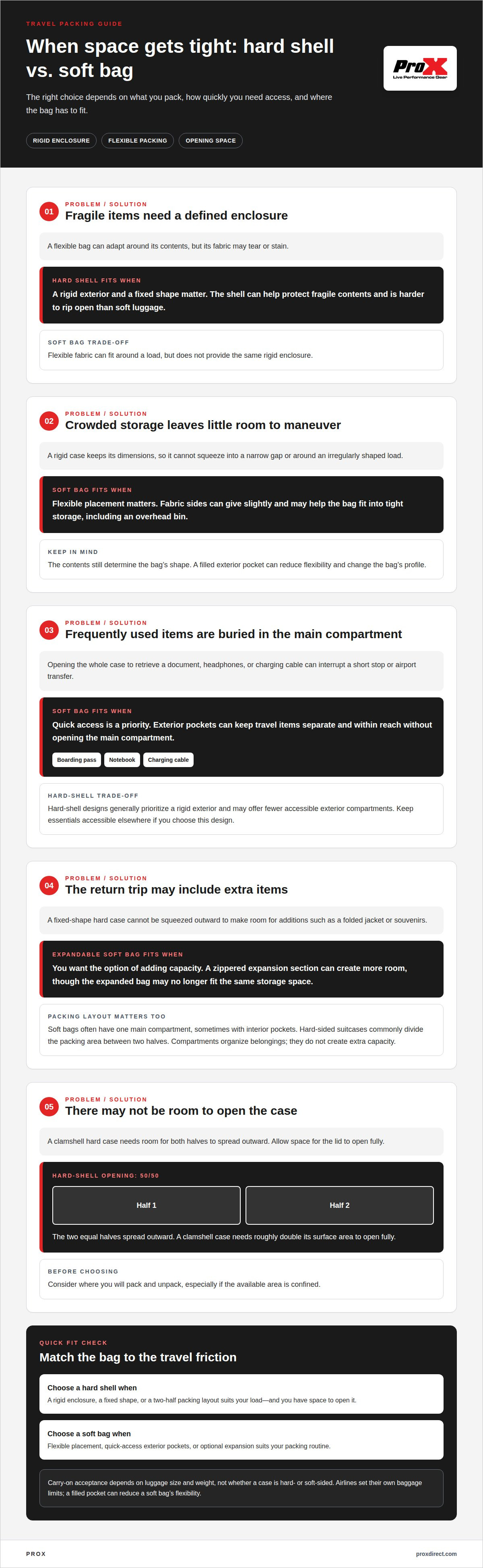
A hard case is not automatically the better travel choice. Choosing between a hard case and a soft bag depends on what you carry and how you travel: a hard case has a rigid shell for fragile contents, while a soft bag can flex into tight spaces and offer quick-access exterior pockets.
Both designs involve trade-offs. A hard case usually needs more room to open, and its rigid shape will not compress around extra items. A soft bag can be easier to fit into crowded storage, but its fabric may tear or stain. Choose the option that suits your equipment, packing habits, and travel conditions.
This comparison covers differences in durability, portability, access, packing capacity, and storage. It also explains how much room a hard case needs to open, so you can weigh its rigid structure against a soft bag’s flexibility and quick access.
Key Takeaways
- Match the case style to what you carry: a rigid shell can help protect fragile contents, while fabric construction offers more flexibility.
- Consider where you need access during travel. Exterior pockets can keep frequently used items within reach.
- Compare packing layout as well as outer size; expandable sections and flexible sides can affect how much you can fit.
- Account for opening space before choosing a hard-shell design, especially when you’ll pack or unpack in a confined area.
- Assess durability by material and construction, then compare the bag’s size and weight with your airline’s baggage restrictions.
Exterior pockets and carry-on access
Exterior pockets keep frequently used travel items separate from the main compartment. A boarding pass, notebook, or charging cable can stay within reach without opening the whole bag. Many soft-shell bags have these pockets, while hard-shell designs generally prioritize a rigid exterior. This can matter during airport transfers, security queues, and boarding, when quick access avoids unpacking.
For business travel, a front pocket can hold documents or a laptop for access between check-in and boarding. Pocket layouts vary, so consider what you carry and how often you need it. A shallow compartment suits papers; a larger pocket may fit a device. Keep heavy or fragile equipment in the main compartment, where surrounding contents can help limit movement.
Soft-shell luggage commonly uses flexible fabrics such as nylon, polyester, or ballistic fabric. These materials allow pockets on the outside without requiring a separate rigid shell. They also make the pocket area easier to compress in crowded storage. However, a filled exterior pocket changes the bag’s profile, so account for its contents when placing it in an overhead compartment.
Hard-shell luggage can have a smooth, wipeable exterior, but its rigid form may offer fewer accessible exterior compartments. This shifts organization inside the case. For example, a traveler carrying a passport, headphones, and a tablet may need to open the main case to retrieve them. If those items need to stay within reach, a soft-side design with suitable front pockets may be more practical.
Pockets help only when their placement suits your travel routine. Before packing, group items by how often you need them: documents and a pen in an outer pocket, spare clothing in the main compartment, and delicate equipment secured inside. Keep frequently handled items in a compartment you can reach while the bag is upright. This can save you from moving other belongings during a short stop.
Carry-on acceptance depends on luggage size and weight, not whether a case is hard- or soft-sided. Airlines set their own baggage limits, so check the specific carrier’s restrictions before travelling. A soft bag may compress into a crowded overhead compartment, but a full pocket can reduce that flexibility. A hard case keeps its shape, which can simplify placement but prevents you from squeezing it into a tighter gap.
When choosing between these designs, prioritize access over pocket count. Check that the exterior pockets fit your travel items, close securely, and remain usable when the bag is full. Choose a soft bag if frequent access and flexible placement matter most. Choose a hard case when a rigid shell is the priority and you can keep essential items accessible elsewhere.
Expandable capacity and packing
Soft-sided luggage flexes around its contents, while a hard shell keeps a fixed shape. This difference affects packing when a return trip adds a folded jacket or souvenirs. A soft bag with an expansion section can add room by opening its zippered panel. That extra capacity can help, but an expanded bag may no longer fit the same storage space.
Suitcases with similar exterior dimensions generally offer similar packing space before expansion. Soft-sided models can gain capacity through zippered sections; hard-sided luggage cannot be squeezed outward to fit extra items. For example, a traveler who packs a compact outfit for the outbound trip may have more room for purchases in an expandable soft case. A rigid shell calls for a different packing plan.
Flexible fabric sides also give slightly when a bag is full. This can help a soft-sided case fit into a tight storage area, including an overhead bin, although the contents still determine its shape. A hard case retains its dimensions, making its packing envelope more predictable. It cannot compress to fit a narrow gap or an irregularly shaped load.
Interior layout affects how efficiently you use the available space. Soft-sided suitcases usually open into one main compartment, sometimes with interior pockets or packing accessories. Some have multiple interior compartments to separate clothing from toiletries or keep a spare shirt apart from shoes. Compartments help organize contents, but they do not create extra capacity.
Hard-sided suitcases commonly divide the packing area between two halves. This layout can separate clean clothing from used items, though it may require you to organize belongings across both halves. A soft-sided bag with one main compartment may suit bulky items, such as a coat that does not stack neatly. Consider the shape of your usual load, not just its volume.
Material also affects how a bag handles its load. Aluminum and other rigid hard-shell materials maintain a firm exterior, so packing pressure does not make the case bulge outward. Soft-sided fabrics adapt around flexible items, but heavy contents still need to be packed securely. Place dense items near the base and distribute them across the interior to reduce shifting during travel.
Try a simple packing test before deciding: put your usual items in the main compartment, then note what remains outside. If the remaining items are occasional additions, an expansion section may provide useful flexibility. If the load is fixed and fragile, a rigid case offers a defined enclosure. Compare the packed shape with the storage space available for your trip, especially when overhead-bin capacity is limited.
Hard-shell storage and opening design
A hard-shell suitcase trades flexible access for a defined enclosure. Its rigid panels can help protect fragile contents and are harder to rip open than soft luggage. Most shell suitcases use a 50/50 opening, dividing packing space between two equal halves. That arrangement makes the opening design central to where and how you pack.
Allow room for the lid to open fully. A clamshell case needs roughly double its surface area because both halves spread outward. In a narrow hotel room, opening it beside a bed may leave little floor space to walk. On a broad luggage rack, the same layout can provide a stable area for sorting contents. Check the available surface before unpacking.
The split layout also affects how items sit inside. Place flat garments or documents across one half, then arrange bulkier items in the other. Each side must close without contents crossing the centre seam. A soft-sided bag can flex around a crowded load; a hard case cannot be squeezed to take extra items. Pack to the shell’s fixed shape.
Hard-shell luggage is easy to stack, which can simplify storage in a vehicle or shared room. Its rigid exterior keeps the case’s profile consistent when another bag rests on top. That structure also makes it less adaptable to an irregular gap. Soft luggage may compress into a crowded overhead compartment, while hard-shell luggage keeps its original dimensions.
Material affects a hard shell’s balance of weight and durability. Among the compared materials, ABS is the lightest, while polycarbonate is more durable than ABS. Aluminum is the most durable in that comparison, but also the heaviest. Choose based on your contents and handling needs rather than assuming every hard shell performs alike.
For surface care, you can wipe hard-shell luggage with a damp cloth. Most hard shells repel water better than fabric luggage, but they are not necessarily waterproof. This distinction matters if a case sits on a wet floor or encounters rain. Protect sensitive contents inside, and do not treat a rigid exterior as a sealed enclosure.
The practical takeaway is to match opening clearance and shell material to the trip. Choose a hard case when fragile contents, stacking, or a firm enclosure are priorities. Prefer soft luggage if overhead space is crowded or your load needs to compress. Before packing, measure the space where the case must open, then check whether both halves can lie flat.
A hard shell is harder to rip open than soft luggage and provides a firmer enclosure, offering more resistance to this kind of forced entry. This comparison does not establish how the designs differ in other theft protections.
Which is more durable, and how long does each typically last?
Neither construction has a fixed service life. Durability depends on material, build quality, handling, and exposure during travel. A hard-sided suitcase can crack after impact, while soft-sided luggage can tear or stain. Compare how each design responds to the kinds of damage its materials are most likely to face.
For a hard case, the shell material affects its resistance to impact and wear. Polycarbonate is more durable than ABS, while aluminum is the most durable of the hard-shell materials compared. Aluminum is also the heaviest. A hard shell can protect fragile contents, but a crack can compromise its protective structure.
Soft-sided luggage relies on its fabric and construction. High-density fabric can improve durability, and quality soft-sided luggage can use hard-wearing, tear-resistant material. Low-quality fabric may tear under stress. Abrasion can also wear the surface over time, while stains may remain more visible on fabric than on a hard shell.
Check the components that see repeated use. Reinforced stitching helps support seams, while resilient zippers reduce a common point of failure. Sturdy handles and strong extension handles matter when lifting a packed bag or pulling it through a terminal. A durable fabric panel is of little use if its handle attachment or zipper fails first.
Water exposure creates another difference. Soft-shell luggage is less water-resistant than hard-shell luggage, and fabric can absorb moisture or become stained. Hard-shell luggage often repels water better, but it is not necessarily waterproof. A damp exterior does not guarantee that water cannot reach the contents.
To assess likely service life, match the case to the trip’s demands. Frequent transfers and long journeys repeatedly stress handles, seams, zippers, wheels, and shell panels. A fragile load may benefit from a rigid enclosure; a bag that must flex around tight storage may suit durable fabric. Inspect these stress points before each trip and address visible damage before packing.
For a practical comparison, examine the shell or fabric, then test each closure and handle. Look for cracks in a hard case and fraying seams or damaged zippers in a soft bag. A hard case is not automatically longer-lasting, and a soft bag is not automatically less durable. Choose based on material quality and the handling conditions your travel routine involves.
What are the typical prices of hard cases and soft bags?
There is no single price range for every hard case or soft bag. The category alone does not determine value: material, dimensions, construction, and storage features all affect what a buyer pays. Compare specific models with similar capacity and intended use rather than treating every hard shell or fabric bag as equivalent.
Start with material. Hard-shell luggage can use ABS, polycarbonate, or aluminum, and these materials differ in weight and durability. Aluminum is the most durable of the materials compared here, but also the heaviest. Soft-sided luggage uses flexible fabrics, and construction quality affects how well a bag handles abrasion and repeated packing. Material names provide context, not a complete measure of value.
Next, compare capacity and layout. A soft-sided suitcase may include an expansion section, exterior pockets, or multiple interior compartments. These features can help a traveler who carries documents separately or brings back extra items. A hard-shell suitcase may have a divided interior and a fixed outer shape. Before comparing prices, assess whether those design differences meet a real packing need.
Construction details matter too. Inspect the stitching, zipper operation, handle attachment, and quality of moving parts. A bag with practical compartments may not suit frequent travel if its closure feels unreliable. A rigid case may provide a firm enclosure, but its material and components still affect its usefulness. Compare the complete construction, not just one headline feature.
Use the same checklist for each candidate:
- Capacity: Match interior room to the clothing or equipment you routinely carry.
- Materials: Compare shell composition or fabric construction against expected handling.
- Access: Consider whether exterior pockets or a divided opening support your packing routine.
- Components: Examine seams, closures, handles, and wheels for sound construction.
- Storage: Account for the space needed to open a case and store it between trips.
Tie cost to function. A business traveler who frequently retrieves a laptop may value exterior access, while someone carrying fragile contents may prioritize a hard shell. Neither preference establishes a universal price advantage. The key question is whether a model’s materials and features justify its cost for your actual travel needs.
For professional equipment, evaluate the case against the load it must protect and the handling conditions it will face. Explore case options to compare designs suited to different equipment and storage requirements.
Racks & Case Accessories
Racks and case accessories help organize and protect equipment during storage and transport. If you are choosing a case for professional gear rather than personal luggage, match its format to the equipment, handling conditions, and available storage space.
Equipment cases, truck pack cases, and utility/storage cases address different equipment and storage needs. A defined equipment load may call for a case built around its contents, while general-purpose storage may suit a utility case. Choose a format based on what you need to protect and how it will be handled.
Contact us to discuss which case category fits your equipment and storage requirements.
Choose protection that fits the load
Make your final decision based on what you carry, where it will be stored, and how it will be handled. Choosing between a hard case and a soft bag is a decision about personal travel luggage; professional production equipment may need a purpose-built case instead. Keeping those needs distinct prevents a suitcase comparison from substituting for equipment protection.
For production gear, the company offers cases for equipment transport and storage. Define the load, its handling environment, and the storage arrangement it needs. Note which items must stay together and how the equipment will be moved. These details provide a practical starting point for selecting a case, without assuming that personal luggage and professional equipment cases serve the same purpose.
Contact the company to discuss a case option for your equipment. With the load and its use conditions clearly defined, you can move forward with a protection choice suited to the job.
Frequently Asked Questions
Are hard or soft suitcases better?
The best way to choose between a hard case and a soft bag is to match the design to the trip’s main demands. For a commute with documents or a frequently used tablet, a soft-sided suitcase can make access easier. For fragile contents exposed to rough handling, a rigid shell provides a more protective barrier. Consider storage space and packing routine as well as protection. If priorities vary by trip, choose for the most demanding leg.
What are the disadvantages of hard side luggage?
Hard-side luggage has a fixed outer shape, so it cannot adapt to an awkward storage gap or expand around extra belongings. A rigid case can also crack after impact, compromising its protective shell. Opening it may require more floor or counter space than opening a soft bag. For a trip with tight storage or changing packing needs, these constraints may outweigh the benefit of a firm exterior.
Any difference with the handles, zippers, and wheels?
Component quality matters in both designs, so compare each handle attachment, zipper, and wheel assembly rather than assuming one case type is superior. Pull the extension handle through its range and check for stable movement. Open and close each zipper without forcing it. Almost all suitcases have spinner wheels that turn 360 degrees, but a smooth turn alone doesn’t assess every part of the wheel assembly.
How does it open?
Most hard-shell suitcases open like a clamshell, dividing the packing space between two sides. This works well on a broad surface, such as a hotel luggage bench, but can be awkward on a narrow bed. Soft-sided suitcases usually open into one main compartment. Before unpacking, find a surface that supports the case and leaves a clear path around it, especially in a compact room.
Is it easy to organize?
Both types support organized packing, but their layouts differ. A hard case’s two halves create separate zones, useful for keeping clean clothing apart from items worn during the trip. A soft-sided bag’s main compartment can suit irregular items that do not stack neatly. Use small pouches to group loose accessories, then keep each group together when moving between hotels or changing bags.
Which Is Better for Different Types of Travel?
For a road trip with irregular trunk space, a flexible soft-sided bag can fit around other luggage. For air travel with fragile contents, a hard case provides a more protective enclosure. Business travellers may value a soft bag’s accessible compartments for documents, while long journeys with several transfers may favour a durable shell. Match the design to the trip’s tightest storage point and the contents most at risk.
What are the pros and cons of a hard case versus a soft bag?
When choosing between a hard case and a soft bag, weigh the trade-offs against your usual itinerary. A hard case provides a rigid enclosure and stacks neatly, but cannot compress around extra items. A soft bag offers flexible storage and may have exterior pockets, but its fabric can tear or stain. Identify your main priorities, such as protecting delicate contents or fitting into crowded storage, then choose the design that serves them.
Which offers better protection from impacts, crushing, and weather?
A hard shell offers more protection for fragile belongings and resists crushing better than flexible fabric, but the shell itself can crack. Soft luggage can use hard-wearing, tear-resistant fabric, though low-quality fabric may tear. Hard shells generally repel water better, but neither design is necessarily waterproof. Both types can be water-resistant with an appropriate coating, so keep sensitive contents protected from direct exposure.
Disclaimer
Any trademarks, trade names or brand names appearing herein that do not belong to ProX are the property of their respective owners and/or companies, and such appearance doesn't and shall not constitute or imply endorsement, sponsorship or recommendation by ProX.


