

Protruding hardware creates avoidable contact points in tight work areas. The benefits of recessed hardware on cases include a lower-profile exterior and reduced collision hazards because handles sit within the case rather than jutting out. “Flush” describes how hardware sits relative to the surface; “recessed” describes its placement within the case.
That distinction matters when cases move through crowded production spaces, are handled repeatedly, or are packed close together. A handle that stays within the case profile is less likely to catch on nearby equipment or people, while still providing a grip for lifting or pulling.
This article explains how recessed and flush hardware differ, where the safety benefit comes from, and how handle design affects access and everyday use. You’ll also learn what to consider when choosing hardware for cases that undergo regular handling without unnecessary protrusions.
Key Takeaways
- Understand how flush mounting differs from placing a handle within the case surface, and why that distinction matters for access.
- Compare handle shapes and finishes to see how recessed hardware can reduce visual clutter while fitting the case design.
- Consider how folding bars and finger pulls affect grip, lifting, and access during regular handling.
- Learn why eliminating protruding parts can reduce collision hazards in crowded work areas and during close packing.
- See how recessed placement can help limit direct impacts on handles and latches, and what design factors influence that protection.
Aesthetic versatility and reduced visual clutter
Recessed hardware gives case designers more control over the exterior profile. Rectangular and circular pulls create different visual effects, while a custom backplate can match a case door’s paint or wood veneer. The handle remains functional but less visually prominent. A matte finish, brushed nickel, chrome, or stainless steel can also coordinate with other visible hardware.
Standard recessed pull handles typically have two parts: a backplate and a frame. Their shape, finish, and mounting position determine how they sit within the panel. A rectangular pull can follow a case’s straight panel edges, for example, while a circular pull can soften a compact access area. Screw placement and the visible interior profile also affect the design.
For shipping and air travel, recessed hardware offers a practical profile advantage over surface-mounted handles: fewer parts can catch on adjacent cargo or handling equipment, such as the automated palletising and packaging systems designed by Phoenix Handling Solutions Limited. That can make close packing easier, although the case’s overall construction and handling still matter. Recessed mounting alone does not determine how a case performs in transit.
Recessed hardware can add to case cost because its construction may involve a backplate, frame, mounting work, and panel preparation. The final effect depends on the hardware design and how the case is assembled. A simple pull and a more elaborate custom-finished assembly involve different components and labor, so there is no single cost increase that applies to every case.
Durability depends on the hardware material, fasteners, panel construction, and installation quality. Recessed placement can reduce direct contact with the handle, limiting some impact exposure. It cannot prevent every impact or compensate for loose screws or a weakened panel. Inspect mounting points periodically to spot movement or damage before access is affected.
For weight, interior space, and design, the result depends on the selected hardware and its mounting depth. The recessed assembly occupies part of the panel, so the case interior and nearby components need suitable clearance. A flush exterior can reduce protrusion without necessarily reducing the case’s overall weight. Case formats and hardware placement shape the final layout; protective case options illustrate the range of case configurations.
Dirt can collect in the handle recess, and screws may loosen with repeated handling. Clean recessed pulls with a soft cloth and mild detergent; harsh chemicals may damage the finish. Inspect the pull, frame, and fasteners for wear, then tighten loose screws or replace damaged hardware. These checks help preserve the finish and secure mounting.
Ergonomics and ease of access
Handle geometry affects how a person finds, grips, and moves a case. A recessed pull keeps the grip within the panel, so the hand reaches into the handle instead of catching on a projecting bar. On a mixer case beside another case, for instance, this can make the handle accessible without extra clearance around the exterior.
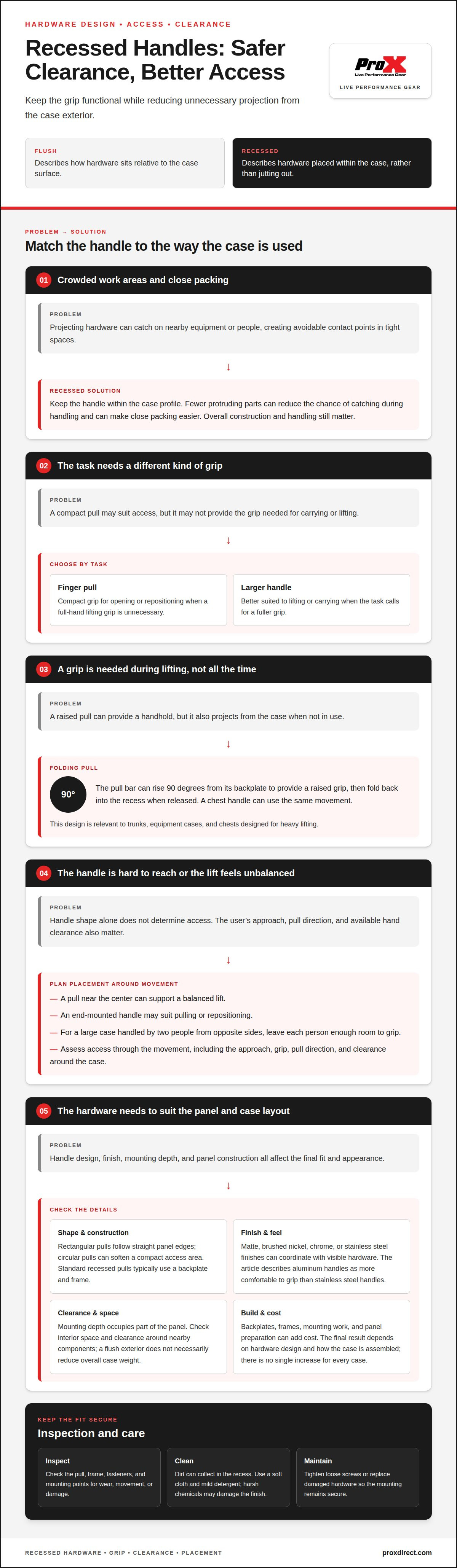
Finger pulls suit access points that need a compact grip. A recessed finger pull can be lifted from its backplate with one finger, which works for opening or repositioning a panel when a full-hand lifting grip is unnecessary. Choose according to the task: a small finger pull supports access, while a larger handle is better suited to lifting or carrying.
Folding pull handles offer a different grip profile. Their pull bars can rise 90 degrees from the backplate, giving the hand a raised surface to hold during a lift. Once released, the bar folds back into its recess. A chest handle can use the same 90-degree movement, making it relevant to trunks, equipment cases, and chests designed for heavy lifting.
Position affects comfort as much as shape. A pull near the case’s center can support a balanced lift, while an end-mounted handle may suit pulling or repositioning. On a large equipment case, two people may approach from opposite sides, so the layout needs to leave each person enough room to grip. The panel structure and handling method should guide placement.
Cabinet and kitchen hardware offer a useful comparison, but cases face different loads and movement. A cabinet pull usually opens a door from a fixed position. A case handle may need to support lifting, carrying, or frequent access, with surrounding equipment limiting hand clearance. A collection designed for cabinet appearance may not suit a case’s mechanical demands.
Assess access throughout the movement, not only when the case is closed. Consider the user’s approach, available grip, direction of pull, and clearance around the case. A recessed handle beside a narrow aisle avoids an outward bar, while a folding handle provides a grip when lifting is the main task. The right position and design improve access without unnecessary projection.
Material also affects how a handle feels in use. Aluminum door handles are described as providing a more comfortable grip than stainless steel handles. When choosing case hardware, consider grip feel alongside the hand’s approach and available clearance. Material should complement a handle that suits the task and supports the intended movement, not substitute for it.
Modern and minimalist appearance
A recessed pull keeps its grip within the panel instead of projecting outward, giving the case a more continuous surface. On a case door, the panel remains visually prominent while the handle still provides functional access. The hardware is visible and accessible; it simply occupies less visual space than a raised handle.
Flush mounting works well when a case has broad, uninterrupted panels. On an equipment case with a large front door and a separate access panel, recessed pulls can sit within both surfaces without adding raised shapes across the exterior. Consistent placement helps the panels read as parts of one design rather than separate areas crowded with fittings.
“Concealed” needs a precise meaning here. Recessed hardware is not necessarily hidden; its grip remains visible within its mounting area. The defining visual change is reduced projection. A recessed pull on a case side, for example, can remain easy to locate while sitting closer to the surrounding surface than a surface-mounted handle.
Minimalist design also depends on proportion and alignment. A pull near the edge of a panel creates a different visual balance from one centered on the door. Matching the positions of pulls on paired doors can create symmetry. On a single lid, aligning the handle with the panel’s centerline can make the layout look deliberate.
Case designers can coordinate hardware with the surrounding finish. A custom backplate may match the door’s paint or wood veneer, helping the pull blend into the panel. A contrasting finish can make the handle easier to identify. Choose according to whether the design calls for a quieter exterior or a clearly defined access point.
The mounting area must suit both the panel and the hardware. A recessed assembly sits within the case surface, so the opening and surrounding structure affect its appearance. Poor alignment can interrupt the panel’s visual line; accurate placement keeps the handle perimeter orderly. Visible screws and other fasteners also shape the final look, so position them to suit the hardware design.
Recessed hardware can create a clean exterior without making the case featureless. The handle remains available for access, while its lower profile reduces visual interruption. On a compact case with several panels, consistent placement, coordinated finishes, and flush mounting create a controlled appearance. Each choice connects the case’s function with its design.
Safety benefits of handles without protruding parts
In a crowded work area, a projecting handle can catch clothing, strike nearby objects, or obstruct a walking route. Recessed handles sit within the case surface, reducing exposed points that people or equipment can contact. This lower profile can reduce collision hazards in compact spaces, such as a production room where cases stand beside worktables.
Recessed hardware is especially useful when cases move through narrow aisles, stand close together, or need frequent handling. Trunks, equipment cases, and chests can also benefit from recessed chest handles, particularly when they are regularly lifted. The handle remains available to grip without projecting outward when not in use.
Consider a case beside furniture in a temporary work area. A surface-mounted handle can extend into the gap and brush against someone passing by. A recessed design reduces that contact point. The same principle applies when cases are staged side by side, although safe handling still depends on how they are lifted and positioned.
The safety benefit comes from the hardware’s geometry, not a promise that incidents cannot happen. A recessed pull can reduce snag points, but case edges, open lids, loose equipment, and poor placement can still create hazards. Near a doorway, handles within the panel leave more of the passage clear than projecting grips.
During a case assessment, consider these contact points:
- Walking paths: A recessed handle reduces the chance of catching clothing when a case sits beside an aisle.
- Adjacent equipment: A lower-profile handle presents fewer parts to contact another case during close placement.
- Lifting access: A chest handle supports a firm grip for trunks and equipment cases used in heavy lifting.
- Panel layout: Position the handle so the hand can reach it without placing fingers against nearby hardware.
Recessed construction does not remove the need for careful layout. Check that the handle remains accessible and does not interfere with a lid, latch, or the user’s grip. A handle placed too close to another fitting can be awkward to use, even when it sits below the exterior surface.
Furniture handles offer a useful comparison: a projecting pull can catch a passerby in a tight room. The same risk applies to cases around workstations, staging areas, and storage lanes. Recessed hardware can reduce protrusions while preserving access. Its value is greatest where people and equipment share limited space.
How does recessed hardware protect latches, handles, and hinges from impact damage?
Because recessed hardware sits below the surrounding panel, nearby surfaces are more likely to contact the case before the handle. If a case slides beside another case, for example, a projecting pull may take the first impact. A recessed pull reduces that exposure by keeping its grip within the panel’s outer profile.
The same principle applies to recessed latches. A latch set within a protective cup is less exposed to direct contact with adjacent equipment or a wall, which can reduce impacts on the latch body and operating parts. The recess must still allow clear access; a blocked or hard-to-reach latch can make opening difficult.
Hinges need a separate assessment. A recessed handle does not automatically protect a hinge mounted along the case edge. Protection depends on hinge position, case construction, and which surfaces contact nearby objects during handling. If a case is set down on its side, check whether the hinge projects beyond the panel or sits within its profile.
Impact protection also depends on how the case moves. A projecting handle may snag during close packing and take force as the case shifts. Recessed placement removes that exposed lever point, but does not prevent damage from a direct blow to the panel, a fall, or force transferred through the case structure.
Hardware design should suit the surrounding panel and mounting method. A recessed cup needs a properly sized opening, secure fasteners, and enough material around its perimeter. Loose screws can stress the mounting points even when the handle remains below the surface. Inspect the handle, latch, hinge, and nearby panel for movement or visible damage.
Consider a mixer case stored beside other equipment. Recessed pulls and latches reduce the parts that can contact neighboring cases during placement. A hinge at the edge still needs adequate clearance and a position suited to the case’s opening direction. Assess each fitting separately rather than assuming one recessed component protects them all.
Recessed hardware helps most when impact risk comes from contact with nearby objects, rather than severe force against the case itself. Select the recess depth and location around the case’s handling path, then check that fasteners remain secure. To compare case configurations for equipment access and hardware placement, review the available case designs.
Recessed cabinet pulls sit flush with cabinetry instead of protruding from the surface. Recessed pull handles can save space and allow items fitted with them to be stacked side by side.
ProX: Santosom Cases
ProX offers Santosom Cases for professionals choosing cases for production equipment. The right format depends on the equipment, access needs, and how the case will be handled. Recessed hardware is one design consideration: its position can reduce exposed projections while preserving a usable grip or latch point. Evaluate each fitting alongside the case layout, including how users open, lift, and store the case.
For different equipment and storage needs, ProX also offers TruckPaX™ Truck Pack Cases, Utility/Storage Cases, and Workstations. Start with the equipment being protected and the access required during use, since these categories serve distinct case and workspace needs. Visit proxdirect.com to explore ProX’s case options.
Choose hardware around the way your case works
When specifying your next case, connect hardware placement with the actual handling route. Note where users lift, open, store, and access equipment, then factor those points into the design decision. This makes the benefits of recessed hardware on cases a practical criterion, not just a preference for a cleaner exterior.
ProX offers Santosom Cases, TruckPaX™ Truck Pack Cases, and Utility/Storage Cases for different equipment and storage needs. Compare the case type with your setup’s access and protection requirements before choosing.
For a closer look at available options, visit ProX online. A deliberate hardware choice helps you specify a case that fits its working environment.
Frequently Asked Questions
Flush or Recessed: What is the difference?
Flush describes hardware that sits level with the surrounding surface; recessed describes hardware set into the panel. A fitting can be recessed and flush when its outer face aligns with the case surface. For example, a pull inside a shallow cup may sit level with the panel, while a raised rim may sit slightly above it. Check both the installation depth and finished profile.
What is a Recessed Pull Handle?
A recessed pull handle is mounted within an inset panel area. The user reaches into the opening to grasp and operate it, rather than holding a bar that extends beyond the case surface. For a case stored in a fitted rack, this can help keep the handle within the available clearance. Handle shape and recess depth affect how easily fingers reach the grip.
What is recessed hardware on a case?
Recessed hardware is a fitting installed partly or fully within a case panel rather than standing proud of it. The term can describe pull handles, latches, or other fittings designed for inset mounting. A recessed latch, for example, lets the user operate the closure from a protective pocket. The panel opening must match the fitting and leave enough room to operate it.
What are the main benefits of recessed hardware on cases?
The benefits of recessed hardware on cases include a lower-profile exterior, fewer exposed contact points, and an accessible grip or latch. This can help when cases are stored close together or moved through a narrow work area. The practical result depends on placement: a handle near a panel edge may be easier to reach in one setup, while a centered pull may suit another.
Does recessed case hardware reduce snagging during transport and storage?
Yes, recessed hardware can reduce snagging by leaving fewer projecting parts to catch on nearby objects. A case sliding into a storage bay, for example, is less likely to meet an outward handle if its fitting has a lower profile. Recessing hardware does not eliminate every snag risk; open lids, loose straps, and nearby fittings can still catch. Consider the case’s storage path and surrounding equipment.
Are recessed handles and latches easier or harder to use than surface-mounted hardware?
Usability depends on the grip opening, hand access, and task. A recessed finger pull can suit a light access panel, while a larger grip may be more practical for lifting. Surface-mounted hardware can be easier to grasp immediately, but needs exterior clearance. For a case beneath a work surface, check whether fingers can reach the recess comfortably without obstruction.
Disclaimer
Any trademarks, trade names or brand names appearing herein that do not belong to ProX are the property of their respective owners and/or companies, and such appearance doesn't and shall not constitute or imply endorsement, sponsorship or recommendation by ProX.


